






Connecticut, USA Locality Guide: dense historic localities yield prehnite, datolite, calcite, barite, and pegmatite minerals; prized for legacy and diversity.
Key facts
Connecticut is a small state with an outsized mineralogical personality. For collectors, its importance is not a single mine or one famous species but a compact sequence of very different collecting provinces: Mesozoic basalt quarries with vesicles full of prehnite, datolite, calcite, apophyllite-group minerals, quartz and pumpellyite-group species; Triassic red-bed fault veins that once made Cheshire one of early America’s great barite districts; Paleozoic and Permian granitic pegmatites that produced rare lithium, beryllium, niobium, tantalum, uranium and rare-earth minerals; and old hydrothermal metal mines at Trumbull and Roxbury whose specimens tie Connecticut directly to the early history of American mineralogy.
The look of the best Connecticut specimens is instantly recognizable once one has handled a few. O&G Southbury prehnite is sculptural and cellular: pea-green to blue-green botryoids, hollow “heart” floaters, yellow examples, rare iron-poor white pieces, and crystal-lined vesicle plates with calcite, apophyllite, datolite, pumpellyite or babingtonite. Cheshire barite is antique, heavy, lustrous and often stained by red arkosic matrix or pocket clay. Strickland and other Middletown-district pegmatites give smoky quartz, cleavelandite, beryl, tourmaline, columbite and old-time rare-species labels; Branchville remains one of the classic phosphate pegmatites of North America; and Trumbull’s Old Mine Park is inseparable from scheelite, ferberite-after-scheelite pseudomorphs, topaz and tungstite.
Regional View
Country View
What makes Connecticut especially rewarding for serious collectors is the density of historically named localities. Portland, Haddam, Middletown, East Hampton, Glastonbury, Branchville, Cheshire, Trumbull, Roxbury, East Granby, Woodbury and Southbury recur on old labels because the state’s mineral deposits were being explored at the same time American mineralogy was becoming a professional science. Yale, Wesleyan, the U.S. National Museum, early American Journal of Science papers, and later Geological Survey investigations all left a paper trail that makes good Connecticut labels unusually meaningful.

Photo: Wikimedia Commons

Photo: Wikimedia Commons
Search for specimens: View all specimens from Connecticut, USA
Connecticut’s specimen localities fall into several practical deposit families. The central lowland basins, especially the Hartford and Pomperaug basins, contain Mesozoic basalt, diabase and red-bed sedimentary rocks. The basalt flows and associated traprock quarries are the source of the state’s best prehnite specimens, together with datolite, calcite, quartz, apophyllite-group minerals, zeolites, pumpellyite-group minerals, babingtonite, pyrite and related low-temperature hydrothermal species. The most famous modern collecting name in this group is the O&G Southbury Quarry, also known historically as the Silliman Quarry or O&G No. 2, in the Orenaug Hills on the Woodbury/Southbury line. It is a large aggregate quarry in Jurassic Orenaug Basalt, a unit correlated with the Holyoke Basalt of the Hartford Basin. Its prehnite formed in gas vesicles and fractures, and the celebrated “heart” floaters developed through replacement and dissolution involving chalcedony, datolite and later prehnite growth.
The same broad Mesozoic setting also includes the Cheshire barite veins, particularly the Jinny Hill Mine. There the mineralization is not a basalt-vesicle assemblage but barite-quartz-calcite-copper mineralization in fault-brecciated Triassic New Haven arkose. The Jinny Hill system consists of roughly east-west veins, with the central vein historically the richest and most productive. Mining began in the late 1830s, and the Cheshire district became an important early American barite source for paint manufacture. The underground workings were extensive, deep and commercially significant, but today the old workings lie beneath residential private property and are not a collecting site.
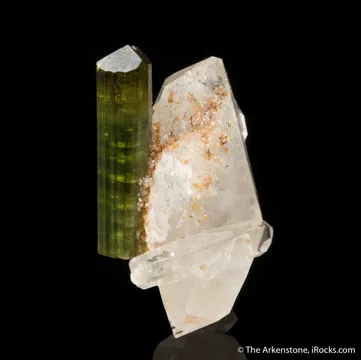
The eastern and central crystalline highlands carry Connecticut’s great pegmatite story. The Middletown pegmatite district, extending through Portland, Middletown, East Hampton, Haddam, Haddam Neck and Glastonbury, contains hundreds of pegmatite exposures and many historic feldspar, mica and gem-mineral quarries. The Strickland Quarry on Collins Hill in Portland is the classic name: a zoned pegmatite worked for high-grade feldspar, famous for smoky quartz, beryl, elbaite and other tourmalines, cleavelandite, spodumene, lepidolite, apatite, columbite, uraninite and many rarer species. F. E. Strickland’s habit of saving unusual crystals helped preserve the quarry’s mineralogical record, and specimens from the site entered important old institutional and private collections.
The Spinelli prospect in Glastonbury is far smaller than Strickland but scientifically exceptional. It is a small pegmatite exposure developed in the early twentieth century, probably for feldspar and mica, yet it became notable because of samarskite and associated columbite-(Fe). The samarskite-bearing zone lies toward the west end of the pegmatite in a microcline-perthite, albite, quartz and muscovite assemblage. Spinelli samarskite later played a role in early radioisotopic age work on Connecticut pegmatites, and modern study has confirmed samarskite and columbite-(Fe) from the prospect by analytical methods.
Branchville, at the Fillow Quarry in Redding, belongs to the western pegmatite story and is one of Connecticut’s great type-locality names. Opened in the 1870s in search of mica, the albite-quartz-muscovite pegmatite proved remarkably rich in manganese phosphates. Yale mineralogists George J. Brush and Edward S. Dana recognized a suite of new species there, making Branchville a touchstone locality for lithiophilite, eosphorite, dickinsonite, fairfieldite, fillowite, natrophilite, reddingite, triploidite and eucryptite.
Trumbull’s Old Mine Park, historically the Old Tungsten Mine at Long Hill or Saganawamps, is a separate and highly distinctive hydrothermal tungsten-topaz locality. Mineralization is associated with marble, amphibolite schist, quartz veins, topaz-bearing veins, fluorite and mica-rich alteration. The site preserves the first topaz locality identified in the United States and the type locality for tungstite, and it is famous among collectors for scheelite and ferberite or wolframite pseudomorphs after scheelite. The park is town-owned and is a walking and geoheritage site, not a specimen quarry for modern collecting.
Roxbury’s Mine Hill is another classic old mine, but its identity is siderite and ironmaking rather than pegmatite minerals. The Roxbury Iron Mine follows a large siderite-quartz hydrothermal vein along a fault, with pyrite, arsenopyrite, sphalerite, galena and other associated sulfides. The site is now within the Roxbury Land Trust’s Mine Hill Preserve, where trails and interpretive signs present the nineteenth-century ironworks, roasting ovens, blast furnace, mine tunnels and quarry landscape. Fine pyrite and siderite specimens survive chiefly as old-time pieces or material collected legally before modern restrictions.
Collecting access in Connecticut must be treated conservatively. State parks and state forests do not allow casual rock and mineral collecting, and hammering, digging or removing earth and rock on state land is treated as damage to protected public property. Educational collecting sponsored by recognized clubs, museums, nature centers or schools can be arranged through formal permission from the Connecticut Geological Survey. Many of the famous commercial quarries are active industrial sites where collecting is prohibited except by rare, organized permission. Historic mine parks and preserves are valuable places to learn the geology, but they should not be treated as open collecting ground. The strongest modern Connecticut collections are therefore built from old collections, club field-trip material with documented permission, estate pieces, and specimens carrying precise locality labels.
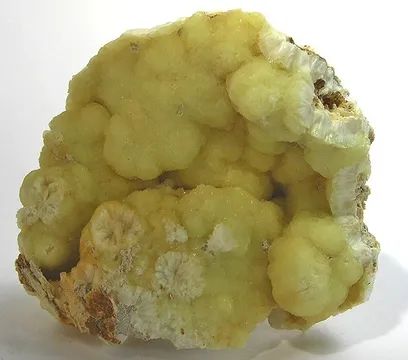
Connecticut prehnite is dominated by the basalt-vesicle material from the O&G Southbury Quarry and related traprock quarries at Woodbury, Southbury, East Granby, Newington and elsewhere; the best O&G pieces are botryoidal to spherical aggregates of tabular crystals in pale apple green, blue-green, yellow and rare nearly iron-free white, commonly associated with calcite, fluorapophyllite-(K), datolite, quartz, pumpellyite-group minerals, sphalerite, babingtonite, laumontite and pyrite. The locality’s most distinctive specimens are the hollow or free-floating “heart” forms produced after datolite replacement and dissolution, some exceeding 15 cm, with large prehnite crystals on interior surfaces and later prehnite overgrowth outside. Ordinary Connecticut prehnite is a massive or crusty green vesicle lining; better pieces show clean rounded architecture, translucency, undamaged luster, contrasting accessory minerals and a complete three-dimensional form rather than a sawn or battered basalt fragment.
Connecticut quartz ranges from industrial-scale milky quartz lodes such as Lantern Hill in North Stonington to fine pegmatite-pocket smoky quartz from Strickland and other Middletown-district quarries, plus chalcedony, agate and occasional amethyst in the basalt quarries. Strickland produced large clear to smoky, distorted prismatic crystals from the quartz-cleavelandite intermediate zone, with examples reported up to at least a foot long and nearly as broad, often as healed overgrowths on earlier broken quartz and associated with albite, cleavelandite, microcline, muscovite, cookeite, fluorapatite and rare pocket species. For collectors, Connecticut quartz is strongest when the label is specific: a dark, lustrous Strickland smoky with cleavelandite or beryl association, a delicate traprock quartz on prehnite or datolite, a true Lantern Hill silica-lode crystal, or a Trumbull quartz-topaz vein specimen carries far more interest than undifferentiated New England milky quartz.
Connecticut barite is most important from the Cheshire district, especially the Jinny Hill Mine, where barite filled fault-brecciated veins in red Triassic arkose with quartz, calcite and minor copper minerals. Most ore was massive to subhedral, but good euhedral crystals reached about 1 dm and subparallel clusters could be much larger; the finest old specimens show lustrous translucent to opaque blades or blocky tabular forms, often with red staining, drusy quartz, pinkish-red arkosic sandstone or conglomeratic matrix, and occasional malachite or copper-sulfide accents. Because the mines closed in the nineteenth century and the workings are now beneath private residential ground, quality Cheshire barite is fundamentally an antique-specimen market, where intact crystal edges, old labels, natural clay or iron staining, and clear distinction from more common foreign barites matter greatly.
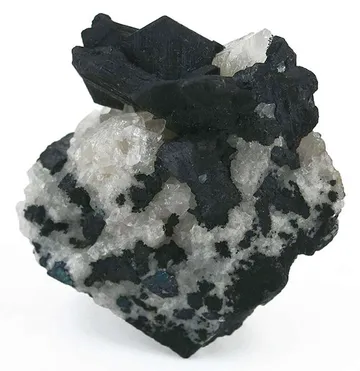
Connecticut columbite is chiefly a pegmatite mineral from the Middletown district, with Strickland Quarry and the Spinelli prospect the two collector names to know. Strickland columbite-(Fe) occurs as black tabular to elongated crystals and larger subhedral masses in the intermediate plagioclase-quartz mineralized zone, sometimes showing yellow, blue or purple iridescence and associated with cleavelandite, smoky quartz, pyrite, K-feldspar and other pegmatite species. Spinelli columbite-(Fe), in contrast, is closely associated with samarskite in a medium-grained microcline perthite-albite-quartz-muscovite zone and occurs mostly as subhedral crystals to massive aggregates up to roughly 8 cm, with small euhedral crystals uncommon; the best Connecticut columbites have crystal form, a reliable mine label, and visible pegmatite context rather than being anonymous black niobate lumps.
Connecticut samarskite is a Spinelli prospect specialty, occurring as black, lustrous to resinous euhedral and subhedral crystals, crystal clusters and massive aggregates in the Glastonbury pegmatite, commonly with columbite-(Fe), quartz, albite, microcline-perthite and muscovite. Modern work documented samarskite-rich pods and dump material at the small open cut, with specimens reaching about 10 cm and showing red to brick-colored alteration stains in the enclosing pegmatite; habits include blocky crystals, bowtie-like clusters, funnel forms and radial fans. The species is radioactive and commonly metamict, so top pieces are judged less by perfection than by confirmed Spinelli provenance, recognizable crystal faces, strong luster, matrix association, and freedom from excessive crumbling or heavy alteration rind.
Connecticut topaz is historically centered on Trumbull’s Old Mine Park area, where topaz-bearing quartz-mica hydrothermal veins cut the marble-amphibolite-schist assemblage at Saganawamps Hill; the locality is important because it was the first topaz locality identified in the United States, not because it produced the clean gem crystals familiar from Brazil or Utah. The old descriptions emphasize coarse greasy gray to yellowish massive topaz, locally with rough crystal planes where bounded by mica, associated with vitreous quartz, margarodite, margarite, fluorite in purple to pinkish and amber tones, sphalerite, scapolite, epidote, hornblende and tungsten minerals. The best Connecticut topaz specimens are locality pieces showing unmistakable quartz-topaz-mica vein texture or rough crystal form; small isolated pale fragments without matrix are easy to overrate or misidentify.
Scheelite from Connecticut is inseparable from the Old Tungsten Mine at Trumbull, where tungsten mineralization occurred near the lower contact of coarsely crystalline white marble interbedded with deep green amphibolite schist, with quartz veins, topaz-bearing veins, mica alteration, fluorite, sulfides and calc-silicate minerals. The locality was long famous for large pseudomorphs of ferberite or wolframite after scheelite, preserving the scheelite crystal habit after replacement; true scheelite from the site is scarce in modern circulation, and much of the historically admired material had already become unobtainable by the time early twentieth-century mineralogists revisited the mine. Collector-quality Trumbull scheelite or scheelite pseudomorphs are valued for old labels, recognizable tetragonal form, association with marble or quartz-topaz vein minerals, and response to ultraviolet light where original scheelite is present.
Connecticut pyrite occurs in several settings, but the classic collector source is the Roxbury Iron Mine at Mine Hill, where excellent crystals occur with siderite, quartz, arsenopyrite and other sulfides in a large siderite-quartz vein system. The most attractive Roxbury pieces show brassy to partly hematite-coated cubes, pyritohedra or curved, striated composite forms on dark brown rhombohedral siderite, sometimes with quartz or sphalerite; Strickland also produced small pyrite crystals in cleavelandite cavities, and O&G Southbury yielded millimeter-scale pyrite on prehnite or associated traprock minerals. Good Connecticut pyrite is not abundant on the market, and condition is crucial: bright faces, complete crystals, stable matrix and a precise label separate cabinet-worthy Roxbury or O&G pieces from ordinary oxidized sulfide fragments.
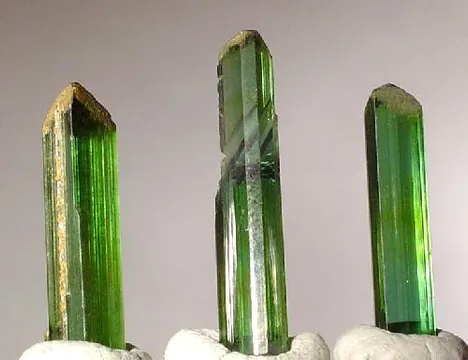
Other Connecticut minerals give the state its deepest collector pedigree. Branchville’s Fillow Quarry is the type locality for dickinsonite, eosphorite, eucryptite, fairfieldite, fillowite, lithiophilite, natrophilite, reddingite and triploidite, and it remains one of the classic North American sources of altered lithium-manganese phosphate assemblages with albite, cleavelandite, spodumene, muscovite and quartz. Danburite was named for Danbury, Connecticut. Trumbull’s Old Mine Park is the type locality for tungstite. Strickland and neighboring Middletown-district pegmatites add aquamarine, heliodor, morganite, elbaite, schorl, lepidolite, spodumene, uraninite, autunite, microlite, fluorapatite and cleavelandite, while the traprock quarries contribute datolite, babingtonite, apophyllite-group species, chabazite, stilbite, heulandite and pumpellyite-group minerals.
The principal authenticity issue with Connecticut specimens is not modern fakery so much as locality drift. Old labels may say only “Connecticut,” “Cheshire,” “Portland,” “Branchville,” “Trumbull,” or “Lane’s Mine,” and those words matter. Cheshire barite should ideally be tied to Jinny Hill, Peck Lane, Reinhard Road or another named Cheshire working. O&G Southbury specimens are often confusingly labeled Southbury, Woodbury, Silliman Quarry, O&G No. 2 or Orenaug Hills; all can be historically meaningful, but the exact wording should be preserved rather than “corrected” casually. Tungsten and topaz specimens labeled Lane’s Mine, Monroe require care, because later locality work has shown that some historic “Lane” tungsten material matches the mineralogy of Trumbull rather than Monroe. Strickland and Schoonmaker/Cramer labels can also be confused because the workings are close and related to the same pegmatite system, yet not identical operations.
Condition is species-specific. Prehnite botryoids bruise and polish on high points; calcite, apophyllite, datolite and zeolite accessories are easily chipped; and laumontite-bearing basalt pieces should be kept stable and dry because laumontite can dehydrate and deteriorate. Cheshire barite has perfect cleavage and many nineteenth-century survivors have edge wear, reddish coatings or attached pocket clay; cleaning too aggressively can destroy the antique surface that gives these pieces much of their character. Trumbull marcasite and pyrite-bearing material can oxidize, and any sulfide specimen from damp old mine workings should be kept in a dry, ventilated cabinet and checked periodically. Samarskite is radioactive and commonly metamict; store it boxed, avoid creating dust, wash hands after handling, and keep labels with the specimen because analytical identity and locality are central to its value.
Fluorescence and phosphorescence add interest to Connecticut suites. Trumbull scheelite, where preserved, is an ultraviolet-responsive tungsten mineral, and Old Mine Park fluorite has been noted for fluorescence, phosphorescence and even thermoluminescence in some reddish-brown material. Strickland spodumene has been reported to show orange phosphorescence. These responses are useful collector observations but should never be used alone to assign locality.
Market availability is uneven. O&G prehnite appears regularly because enough was collected before access narrowed, but first-rate “heart” floaters, yellow examples, white examples and pieces with undamaged accessory minerals are much scarcer than ordinary green botryoidal fragments. Cheshire barite, Branchville phosphates, Strickland columbite or smoky quartz, Spinelli samarskite, Trumbull tungsten/topaz material and Roxbury pyrite are best pursued through older collections, regional dealers, estate material and New England club networks. A modest Connecticut specimen with a strong old label may be more desirable than a flashier unlabeled piece.
At Branchville, the story begins almost like a nineteenth-century mineralogical fable: a mica working opened by Abijah N. Fillow became one of the richest phosphate localities in America because someone looked closely at the unusual material coming out of the pegmatite. George J. Brush and Edward S. Dana, working from Yale, recognized that the Branchville material was not merely another feldspar-mica-quartz assemblage but a suite of manganese phosphates new to science. In their fifth paper they remembered that the minerals Fillow had brought to light were “sagaciously selected and preserved,” a telling phrase: without that eye for odd, colored, altered masses, much of Branchville’s scientific importance might have been carted off as waste. From that small quarry came names that still animate phosphate collections: lithiophilite in salmon to brown masses, rose eosphorite, green foliated dickinsonite, reddingite, fairfieldite, fillowite, natrophilite, triploidite and eucryptite.
Strickland Quarry offers a different kind of Connecticut story, one centered on a knowledgeable quarry owner. F. E. Strickland was not simply extracting feldspar; early accounts describe him as an expert on his quarry’s minerals who saved unusual crystals. That habit matters enormously. Pegmatite pockets are often brief events in the life of a quarry: a blast opens them, the crystals appear, the commercial work moves on, and by afternoon the evidence may be gone. At Strickland, smoky quartz, beryl, elbaite, lepidolite, cleavelandite, columbite, apatite and rare minerals survived into old collections because someone at the quarry recognized that the strange pocket debris was worth keeping.
Spinelli’s drama is the opposite of Strickland’s productivity. The prospect is small, shallow, wooded and easy to miss. Yet in 1933 this modest Glastonbury pegmatite became scientifically important because its samarskite could be used in the developing field of radioisotopic dating. Wilbur G. Foye of Wesleyan helped make Spinelli samarskite available to scientists beyond Connecticut, sending the material into the network that included Harvard, the U.S. Geological Survey and the National Research Council’s Committee on the Measurement of Geologic Time. Modern investigators later returned to a site that looked nearly forgotten and mapped samarskite-bearing pods and dumps. One documented pod measured about 0.9 by 3.7 meters, and radiation measurements reached up to 45 times background where samarskite was present. The prospect still held the mystery of its own working method: researchers noted an apparent lack of drill holes, even on larger boulders and cut walls, leaving open the question of how such tough pegmatite was quarried.
Trumbull’s Old Tungsten Mine drew early collectors with the promise of tungsten minerals, topaz and strange alteration products. Earl V. Shannon’s 1921 account reads like a period field trip: take the train from Bridgeport, get off at Long Hill, walk north along the railroad for about 1.5 kilometers, and look for the mine openings and burned mill site visible from the tracks. He warned that, contrary to some published statements, he could find no trolley conveniently near the mine. The mineralogy was already partly historical even then: the famous pseudomorphs of wolframite after scheelite were “no longer obtainable,” but the place still offered marble with hornblende, coccolite pyroxene, garnet lenses, marcasite crusts, black sphalerite, quartz veins, massive greasy topaz, margarodite, margarite, fluorite and scapolite. One trench near the lime kiln especially seized his attention; what first looked like quartz-mica-feldspar pegmatite proved, on closer inspection, to be largely coarse gray to yellowish topaz with silvery mica alteration.
At Cheshire, the barite mines made a quiet agricultural town into a nineteenth-century mining center. The Jinny Hill and related workings employed hundreds of men at their height, including miners from Cornwall underground and Irish laborers above ground. The ore was not a gem mineral but a heavy white sulfate needed for paint, shipped and milled for industrial markets in New Haven, Stamford, Hamden and New York. Over roughly four decades, the Cheshire district produced on the order of 160,000 tons of barite. The underground scale was enormous for Connecticut: miles of tunnels, deep shafts, and veins followed through red arkosic rock. The mines later became a hidden landscape beneath houses and roads, making Cheshire barite specimens doubly historical: they are both mineral specimens and surviving fragments of an industry now largely invisible at the surface.
Mine Hill in Roxbury is the state’s most evocative iron-mining landscape. The siderite vein was not the easy bog iron that fed many old Connecticut furnaces; it was a large carbonate-iron body in hard rock, reached by tunnels, shafts and rail grades on a steep wooded hill. In the 1860s the Shepaug Spathic Iron and Steel Company built an industrial complex with roasting ovens, a blast furnace, a puddling furnace, a rolling mill, rails and a worker settlement called Chalybes. The operation was ambitious and troubled. At the first firing, the furnace formed a “salamander,” a mass of solidified iron and slag that forced expensive rebuilding. Later attempts to make steel failed, and the steel-making equipment was moved to Bridgeport. Today the forest has reclaimed much of the site, but the trail still climbs the old Donkey Trail past gated mine openings and air shafts that now serve as bat hibernacula. For a mineral collector, Roxbury pyrite on siderite is more than a pretty sulfide; it is a cabinet-sized memory of a brief, overbuilt, and intensely local attempt to turn a Connecticut hillside into an iron and steel center.

-75446.jpg)