A collector's guide to Haddam, USA: its geology, mining history and notable minerals, illustrated with the 33 specimens documented from this locality on EarthWonders.
Key facts
Haddam, in Middlesex County, Connecticut, is one of the classic names of American pegmatite mineralogy. For collectors the name usually points first to the lithium-bearing granite pegmatites around Haddam Neck—above all the Gillette Quarry, also known historically as the Haddam Neck Quarry and later the J-J Mine—where gem tourmaline, beryl, smoky quartz, fluorapatite, cleavelandite, lepidolite, muscovite, microlite-group minerals and columbite-(Fe) made a compact New England quarry into a museum locality. The setting is the rugged lower Connecticut River valley, where coarse pegmatite bodies cut high-grade metamorphic rocks of the Haddam and Middle Haddam quadrangles: gneisses, mica schists, calc-silicate rocks, amphibolite-rich units and marble lenses folded around the Killingworth dome and Monson anticline. These pegmatites are not mere feldspar veins; the best of them are zoned, pocket-bearing bodies with lithium enrichment and a long record of attractive crystallization.
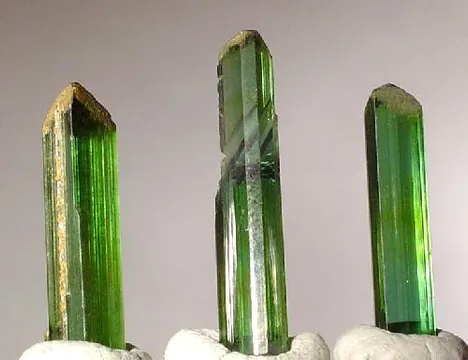
The collector’s image of Haddam is a ribbed, pencil-like elbaite: usually green, sometimes blue-green, with abrupt terminal zones of pink, yellow, pale green, colorless or blue. The finest crystals are slender, lustrous, and sharply terminated, sometimes doubly terminated, and occasionally set through smoky quartz or perched on crystallized quartz and albite. Matrix pieces are far scarcer than loose crystal sections, because quarry blasting and pocket collapse broke many of the crystals before they could be removed intact. Beside the tourmalines stand the other signatures of the district: smoky quartz carrying cookeite and fibrous mica, rose to pale-green beryl and morganite, bright-fluorescent fluorapatite, and the curious pink fibrous muscovite variety schernikite, first made famous from Gillette material.
Regional View
Country View
Haddam also carries an older historical charge than its pegmatite specimens alone would suggest. The town name is tied to the long and complicated story of columbite in North America: early Connecticut columbite, associated in the literature with the Winthrop collection and later with John Torrey’s Haddam work, stands near the beginning of the scientific history of niobium, originally named columbium by Charles Hatchett. The precise original source of Hatchett’s old specimen has been debated, but Haddam’s in-situ columbite and chrysoberyl occurrences made the town a reference point in early American mineralogy.

Photo: Wikimedia Commons
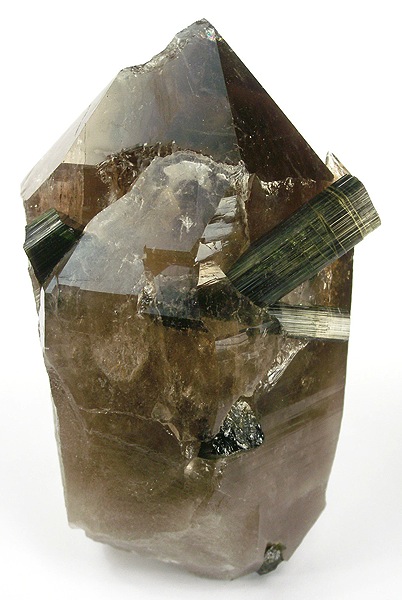
Photo: Wikimedia Commons
Search for specimens: View all specimens from Haddam, USA
The collectible mineralization at Haddam belongs chiefly to granitic pegmatites of the Middletown pegmatite district, developed in and around the metamorphic rocks of central Connecticut. In the Haddam quadrangle, the country rock includes Monson Gneiss and Middletown Formation rocks, with overlying high-grade mica schists, calc-silicate granofels, meta-cherts or coticules, and related units of the Collins Hill Formation. Coarse quartz-microcline-plagioclase pegmatites are widespread, but the youngest, discordant bodies are the important specimen producers. Gillette Quarry is the best known of these: a lithium-bearing, internally zoned pegmatite, exposed in an irregular open cut with crosscuts, developed along steeply dipping interconnecting lenses. Published descriptions give the Gillette pegmatite an exposed strike length of about 100 meters, thickness varying roughly from 5 to 25 meters, and workings including an irregular open cut about 108 meters long.
The pegmatite is complexly zoned. In its western part, described from wall inward, it includes a fine-grained border zone of quartz, albite-rich plagioclase, muscovite, garnet and black tourmaline; a sheet-mica-bearing wall zone with quartz, plagioclase, subordinate perthite and muscovite, plus green apatite and black tourmaline; and a broad perthite-quartz zone with white to salmon-pink perthite, pale green milky quartz, graphic granite, plagioclase, green muscovite and accessory black tourmaline, green and rose beryl, red fluorite, apatite and lepidolite. The eastern part is still more varied, with quartz-plagioclase-perthite wall and intermediate zones, sheet-mica-bearing zones, a perthite-quartz intermediate zone, and a quartz-perthite core. The pocket minerals beloved by collectors were concentrated especially in the more evolved, miarolitic portions of the pegmatite, with the western cut often singled out for abundant cavities.
Those pockets were not large caverns in the western American sense, but they were numerous and productive. Historical descriptions give cavity sizes from egg-sized openings to cavities as large as a barrel or more, commonly lined with quartz crystals and partly filled with wet, decomposed pegmatite material. In the richest pockets, tourmaline crystals stood loose or only weakly attached, sometimes by the hundreds. Sterling Gillette described pockets yielding as many as 600 tourmaline crystals, ranging from needle-like crystals to pencil-sized and larger pieces. The pocket assemblage centered on quartz and albite or cleavelandite, with elbaite, smoky quartz, cookeite, muscovite, schernikite, lepidolite, beryl and fluorapatite; darker accessory minerals such as microlite-group crystals and columbite-(Fe) add the rare-element character of the deposit.
Gillette Quarry was opened in the fall of 1895 by Merit P. Gillette. The first elbaite crystals were reportedly found on December 1 of that year, and by 1896 a significant series of specimens had already reached the Oxford Museum through Ernest Schernikow of New York. The quarry was worked for gem tourmaline and specimens before it also became a feldspar operation. Beginning in the early 1900s, the quarry was leased and worked commercially; period accounts and later summaries record production for feldspar as well as gem and specimen material. The Eureka Mining and Operating Company of Trenton, New Jersey, leased the property beginning in 1904 and is reported to have produced as much as 65 tons of feldspar per day for about twelve years. By the World War II era it was worked again as the J-J Mine by B. E. Johnson of Haddam and E. H. Johnson of Middletown, with the last operations running from November 1942 to November 1944.
Operators and collectors associated with Gillette gave the locality its early reputation. Ernest Schernikow mined the tourmaline-bearing pockets systematically from about 1898 to at least 1901 and was known for allowing other collectors access. Horace Williams worked there and later sold many crystals to George English. George F. Kunz, acting both as a gem authority and as purchasing agent for Tiffany & Co., acquired gem material. John Pierpont Morgan obtained a large suite that later entered the American Museum of Natural History. M. P. Gillette reportedly gave a collection of roughly 300 crystals to Wesleyan University, and Yale also obtained significant material. By the first years of the twentieth century, Haddam Neck elbaite had moved beyond local curiosity and into major institutional cabinets.
Gillette is not the only Haddam mineral locality collectors should recognize. Haddam Neck includes additional pegmatite and quarry sites such as Rock Landing, Tidewater and Quarry Hill/Brainerd areas, while the broader town includes the Hewitt Gem Quarry, the Civilian Conservation Corps prospect in Cockaponset State Forest, historic chrysoberyl-columbite occurrences, gneiss quarries, amphibolite and calc-silicate occurrences, and Route 9 rock cuts. These localities produced or documented beryl, columbite-(Fe), chrysoberyl, smoky quartz, schorl, elbaite, muscovite, fluorite, uraninite alteration products and a variety of metamorphic minerals. Their labels are often old and imprecise, so “Haddam,” “Haddam Neck,” and “Gillette Quarry” should not be treated as interchangeable without supporting provenance.
Collecting access today is limited. Gillette Quarry is on private residential property and is not open to collecting. Some older descriptions and dealer captions have repeated the idea that the site was lost to development, but modern locality documentation indicates that it remains on private property and has simply been closed to collecting. Connecticut state lands are also not open to casual rock and mineral collecting; a few state-owned sites, including the CCC Quarry in Cockaponset State Forest, are available only during scheduled educational field days sponsored under state permit by clubs, museums, schools or similar groups. For serious collectors, most Haddam specimens now come from old collections, dispersed museum duplicates, estate material and long-held New England collections rather than from fresh field recovery.
“Haddam tourmaline” on old labels most often means the Gillette Quarry suite of elbaite and schorl-bearing pegmatite material, and the best pieces are instantly recognizable: elongated, striated trigonal prisms with glassy to silky luster, usually green to blue-green, sometimes carrying pink, yellow, blue, pale-green or colorless terminal zones. Larger pocket crystals reached exceptional size for Connecticut, with historical examples described up to about 10 inches long and others nearly 2 inches in diameter, but most collectible crystals are far smaller—needle-sized to a few centimeters—and commonly broken or repaired because blasting shattered many pockets. Good pieces are those with strong color zoning, sharp terminations, transparency, and credible old provenance; matrix examples on smoky quartz, albite or cleavelandite are much scarcer than loose sections, while tourmaline with lepidolite, muscovite, fluorapatite, beryl, cookeite or smoky quartz captures the true Gillette paragenesis.
Elbaite is the mineral that made Haddam Neck famous beyond Connecticut: in the miarolitic pockets of the Gillette pegmatite it occurred as slender crystals, generally striated and elongated, with green and blue-green prisms and terminal color combinations in green, yellow, pink, blue and colorless zones. Davis’s early account emphasized the variety of color, including crystals with sharply divided longitudinal color bands and some showing as many as five colors; later descriptions note that concentric “watermelon” zoning is not common here, while longitudinal and terminal zoning is characteristic. The finest Haddam elbaites are transparent or gemmy, strongly colored, complete or nearly complete, and preferably doubly terminated; crystals piercing smoky quartz or set with cleavelandite, cookeite, muscovite and fluorapatite are especially desirable because they show the pocket context that loose repaired pencil sections often lack.
Other documented Haddam minerals give the locality much of its depth. Gillette Quarry is a type locality for schernikite, the pink to tan fibrous variety of muscovite named for Ernest Schernikow, occurring as rhombic fibers in parallel or twin-position, as overgrowths on lepidolite or muscovite, and as inclusions or coatings on pocket quartz. Fluorapatite occurs as pale gray-green to rose-pink or purple crystals, with bright yellow fluorescence reported for some material. Beryl is present as pale green, colorless, aquamarine and rose to morganite material; some crystals show pale-green cores with colorless or pinkish overgrowths. Smoky quartz can be sharp and attractive, sometimes with schernikite fibers, elbaite inclusions or cookeite blebs. Microlite-group crystals from Gillette are brown to black modified octahedra, locally resinous and radioactive, while columbite-(Fe), cassiterite, topaz, lepidolite, amazonite, fluorite, hematite, magnetite, almandine, graphite and uraninite or its alteration products round out the rare-element and accessory suite. Beyond Gillette, Haddam’s historic chrysoberyl-columbite localities and the CCC columbite prospect keep the town important in the older literature of American mineralogy.
The first authenticity issue with Haddam specimens is locality precision. Old labels may read simply “Haddam,” “Haddam Neck,” “Haddam, Conn.,” “Gillette Quarry,” “Haddam Neck Quarry,” or “J-J Mine.” These are not always equivalent. Gillette elbaite has a distinct look, but nearby Haddam Neck and broader Middlesex County pegmatites also produced tourmaline, beryl and quartz; a specimen described only as “Haddam” should be valued below one with a reliable Gillette or specific quarry pedigree unless the mineral association and label history are persuasive.
Repairs are common and should not automatically disqualify a specimen. The historical record repeatedly notes blasting damage, and many good crystals were restored early in their collecting life. Repairs through a tourmaline prism, reattached terminations, composite lock-fit quartz repairs, and small stabilized matrix breaks are all encountered. They should be disclosed clearly. The problem pieces are those with concealed glue lines, mismatched color zones, overly “perfect” reassembled crystals, or matrix/tourmaline contacts that do not make geological sense. A loupe inspection along color breaks and a strong side light through transparent green or blue-green tourmaline are useful.
There is no well-documented epidemic of manufactured Haddam fakes comparable to the notorious faking histories of some larger gem-pegmatite districts, but misrepresentation is easy because classic Connecticut tourmalines command a premium. Maine, California, Brazil, Afghanistan and Pakistan elbaites can be mislabeled or wishfully attributed to Haddam if provenance is lost. Genuine Gillette crystals tend to be slender, often longitudinally zoned, commonly green to blue-green with terminal color changes, and frequently show the scars of old quarry recovery. Matrix pieces should be examined especially carefully, because true elbaite-on-quartz or elbaite-on-cleavelandite examples from Gillette are much scarcer than loose sections.
Condition standards should be locality-sensitive. Minor bruising, missing terminations, repairs and internal fracturing are common in Gillette tourmaline and smoky quartz; completely undamaged, richly colored, transparent, terminated crystals with old labels are legitimately scarce. Cookeite blebs and schernikite fibers on quartz can look like dirt or alteration to non-specialists, but they may be part of the locality’s character. Fluorapatite and some feldspar/beryl material may show notable fluorescence, and uranium-bearing accessory minerals or dark-halo microlite-group crystals should be stored and handled with ordinary radioactive-mineral precautions: label them, keep dust contained, avoid abrasion, and do not store radioactive specimens tightly against light-sensitive or fragile material without thought.
Market availability is episodic. Fresh production from the key private sites is essentially absent, so quality specimens surface when old New England, institutional-adjacent or dealer collections are dispersed. Loose elbaite sections appear more often than matrix pieces; good doubly terminated crystals, strong blue or indicolite zones, crisp multicolor examples, morganite-elbaite combinations, and well-documented old labels command strong premiums. The most desirable Haddam specimens are not just colorful—they carry the early American pegmatite story with them.
In the summer of 1896, Oxford received about eighty specimens from a newly opened quarry at Haddam Neck, a sudden transatlantic arrival from a small Connecticut riverside village. The donor was Ernest Schernikow of New York, and the suite must have been astonishing for the period: green and pink tourmaline, albite, microcline, green and pink apatite, brown fluorite, beryl, quartz, cookeite, lilac lepidolite, greenish-white muscovite, and the strange pink fibrous mica later tied to Schernikow’s name. The locality was described almost like directions in a travel letter: Haddam Neck, opposite Haddam, on the east bank of the Connecticut River, where the river is about half a mile wide. For a quarry only just opened, it entered the great cabinets very quickly.
James W. Davis’s 1901 description preserves the wonder of the early pockets better than any polished modern summary. The cavities were lined with quartz and albite, and the tourmalines stood on them in colors Davis could only describe by invoking “the range of the spectrum.” Green came first, then pink, then yellow, white and blue. One pale-green crystal was about ten inches long, an inch thick at the base, tapering to three-quarters of an inch; another was green, eight inches long, doubly terminated, and yellow at one end; another was three inches long and an inch thick, half green and ending in deep pink. Davis mentioned a seven-inch crystal less than one-eighth inch thick, like a darning needle, clear light green from end to end. Most memorable is the five-color crystal: white, pink, yellow, green and blue in a single piece.
The pockets were wet. They were not neat display cases underground, but muddy, decomposed cavities in a feldspar quarry, and the crystals were often standing loose, unattached to matrix. Sterling Gillette later described cavities from “that of an egg or less up to a barrel or larger,” with quartz crystal linings and the bottom half full of softened pegmatite. In some pockets, he said, as many as 600 tourmalines were present, from needle-sized pieces to pencil-sized crystals and larger. It is easy to imagine the exhilaration of opening such a pocket—and the heartbreak of blasting too hard and hearing the sound of gem tourmaline reduced to fragments.
One of the best old collector tales turns on a final blast. In a 1917-style collecting account of the Middletown area, the Gillette quarry was described as abandoned because it had been worked so deep that water could not be kept out. Yet the same account relates that the last blast made by Mr. Gillette exposed a gem pocket whose tourmalines were sold to a New York museum for $700, a remarkable sum for a small New England quarry pocket at the time. The same writer warns would-be collectors to note the “Neck,” because the Connecticut River country had too many Haddams to navigate casually: Little Haddam, East Haddam, Middle Haddam and Haddam Neck could all confuse a stranger hunting tourmalines.
The same collecting narrative is delightfully human. The travelers spent the afternoon “traveling up and down hills, wasting gasoline” while trying to find the famous Gillette quarry, said to be near Rock Landing on the east bank of the Connecticut River. Eventually they found it, and although it was not being worked, they still obtained good specimens of tourmaline, distorted quartz crystals and apatite. Then the roads on the east side of the river below Haddam being bad, they crossed back to the west bank and made Saybrook in time for what the writer called a much-appreciated dinner. The episode captures the old New England collecting life perfectly: vague directions, river crossings, rough roads, abandoned quarries, and enough tourmaline on the dump to make the day worthwhile.
The schernikite story is quieter but just as distinctive. Bowman studied the odd fibrous mica from Gillette in detail, noting its rhombic cross sections and the way the fibers fitted together in parallel masses like a tessellated fabric. Later collectors described pieces that looked almost woody when iron-stained, with fibrous pink muscovite arranged around lepidolite or muscovite cores. Under the microscope, cleaved plates revealed tiny rhombic units, a mineralogical texture unlike the usual book mica of a pegmatite. It was named for Schernikow, the same operator whose 1896 specimens carried the quarry’s reputation overseas, and for many years Gillette was treated as the defining occurrence of the material.
Bowman, H. L. (1902), “On an occurrence of Minerals at Haddam Neck, Connecticut, U.S.A.,” Mineralogical Magazine, 13(60), 97–121 — The classic early scientific paper on the Haddam Neck occurrence, based on about eighty specimens presented to Oxford by Ernest Schernikow; essential for the pocket assemblage and the fibrous mica later known as schernikite.
Davis, James W. (1901), “The Minerals of Haddam, Conn.,” The Mineral Collector, vol. 8, nos. 4–5, pp. 50–54 and 65–70 — Early collector-oriented account of Haddam minerals, including vivid descriptions of the Gillette elbaite crystals and their color zoning.
Cameron, E. N., Larrabee, D. M., McNair, A. H., Page, J. J., Stewart, G. W., and Shainin, V. E. (1954), Pegmatite Investigations, 1942–45, New England, U.S. Geological Survey Professional Paper 255 — The major U.S. Geological Survey pegmatite study covering New England, with the geologic and mining context for the J-J/Gillette pegmatite and the Middletown district.
Burnett, G. B., Callihan, J. T., Shainin, V. E., and Cameron, E. N. (1943), J-J Mine (Gillette Quarry), Haddam Neck, Connecticut, U.S. Geological Survey Open-File Report 43-56 — Wartime mapping reference for the J-J Mine/Gillette Quarry, listed as two maps and superseded by the later Professional Paper 255 treatment.
Ingerson, Earl (1938), “Uraninite and Associated Minerals from Haddam Neck, Connecticut,” American Mineralogist, 23(4), 269–276 — Important treatment of the uranium-bearing mineral suite and associated minerals from Haddam Neck.
Scovil, Jeffrey A. (1992), “Famous Mineral Localities: The Gillette Quarry, Haddam Neck, Connecticut,” The Mineralogical Record, 23(1), 19–28, 80 — The modern classic collector-locality article on Gillette Quarry, with maps, historical synthesis and specimen photographs.
Mineralogical Record Vol. 23, No. 1, 1992 issue page — Publisher listing for the issue containing Scovil’s Gillette Quarry article.
Rodgers, John (1985), The Bedrock Geology of the Haddam Quadrangle, Connecticut Geological and Natural History Survey Quadrangle Report 37 — Bedrock framework for Haddam, including the metamorphic setting, pegmatites, diabase and structural evolution.
Torrey, John (1824), “An Account of the Columbite of Haddam, (Connecticut,) with Notices of several other North American Minerals,” Annals of the Lyceum of Natural History of New-York — Foundational early paper on Haddam columbite and related North American minerals.
Weber, Marcelle H., and Sullivan, Earle C. (1995), “Connecticut Mineral Locality Index,” Rocks & Minerals, 70(6), 396–409 — Widely cited locality-index reference for Connecticut mineral occurrences, including Haddam-area sites.
Haddam, Middlesex County, Connecticut, USA — mindat.org — Broad locality page for the town, useful for separating Haddam proper, Haddam Neck, Higganum and individual quarry occurrences.
Gillette Quarry (J-J Mine; Haddam Neck Quarry), Haddam Neck — mindat.org — Core locality page for the classic elbaite and specimen pegmatite, with history, geology and mineral list.
Haddam Neck, Haddam, Middlesex County, Connecticut — mindat.org — Regional locality page for the east-bank village area that hosts Gillette, Rock Landing, Quarry Hill and related sites.
Elbaite from Gillette Quarry — mindat.org occurrence page — Occurrence page focused on Gillette elbaite, with photo galleries and associated-mineral data.
Tourmaline from Haddam Neck — mindat.org occurrence page — Helpful page for the broader Haddam Neck tourmaline context and associated minerals.
Schernikite — New Localities Identified in Maine Pegmatites — Detailed article on schernikite, including the Gillette type material, habits and Raman comparison with Maine specimens.
Category:Gillette Quarry — Wikimedia Commons — Open image gallery of Gillette Quarry specimens, including tourmaline, elbaite, beryl, topaz, lepidolite, muscovite and quartz.
Connecticut Mineral Pilgrimage — Mineralogical Society of America Collectors Corner archive — Period collecting narrative with practical and historical notes on locating Gillette Quarry and collecting old Haddam Neck material.
Middletown, Connecticut — Mineralogical Society of America Collectors Corner archive — Regional collector account covering the Middletown-Haddam-Portland pegmatite belt and Gillette’s historical tourmaline production.
Pegmatite investigations, 1942–45, New England — U.S. Geological Survey — Authoritative federal publication for New England pegmatite geology and wartime mining.
J-J Mine (Gillette Quarry), Haddam Neck, Connecticut — U.S. Geological Survey — USGS publication page for the 1943 open-file mapping of the Gillette/J-J mine.
Mineral Collecting — Connecticut Department of Energy and Environmental Protection — Current collecting-access guidance for Connecticut state lands and permitted educational field days.
History of Haddam — Haddam Historical Society — Local historical background for Haddam, Haddam Neck and the Connecticut River setting.
History of Haddam Neck — Haddam Historical Society — Village history useful for understanding the east-bank setting of the Gillette and related Haddam Neck quarries.
Civilian Conservation Corps prospect, Haddam — mindat.org — Important Haddam columbite locality page, especially relevant to the town’s early columbite history and access limitations.
Chrysoberyl locality, Haddam — mindat.org — Historic in-situ chrysoberyl and columbite locality page with context for early American mineralogy.
File:Tourmaline-146181.jpg — Wikimedia Commons — Image page for a historic, repaired but important Gillette indicolite tourmaline crystal.
File:Elbaite-Quartz-251209.jpg — Wikimedia Commons — Image page for a rare Gillette elbaite-on-smoky-quartz specimen.