Gillette Quarry, USA - classic Haddam Neck pegmatite in Connecticut; early elbaite source with slender green-blue tourmalines and notable pocket associations.
Key facts
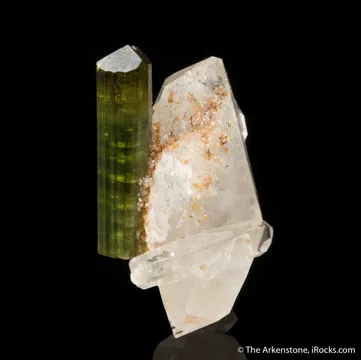
Gillette Quarry is the classic Haddam Neck pegmatite locality: a lithium-bearing, complexly zoned granitic pegmatite on the east side of the Connecticut River in Middlesex County, Connecticut. To collectors, its importance rests on two linked reputations. First, it was one of the earliest eastern American localities to yield abundant pocket elbaite in colors good enough for both gems and cabinet specimens. Second, it supplied a distinctive Gillette “look”: slender striated tourmalines, commonly green to blue-green with sharply demarcated pink, yellow, pale-green, colorless, or blue terminations, found with smoky quartz, albite-cleavelandite, cookeite, lepidolite, fluorapatite, beryl, and the locality’s celebrated fibrous muscovite variety schernikite.
Regional View
Country View
The finest Gillette specimens are unmistakably old New England classics. Many are not big by modern Brazilian or Californian standards, but they have a taut, elegant habit: bright, slender, often doubly terminated or partly matrix-attached prisms; transparent to translucent green bodies; dark indigo or blue caps on some crystals; and occasional pink or multicolored zones. Matrix pieces can be especially desirable when the tourmaline is visibly set into a real pocket association—smoky quartz penetrated by elbaite, white albite plates, purple lepidolite, pink fibrous schernikite, and cookeite blebs rather than a loose single crystal with no context.
Historically, Gillette mattered almost immediately after it was opened. Its crystals were being described in the mineralogical literature by 1901–1902, and material entered major collections in the United States and Europe. Ernest Schernikow of New York supplied an important early suite to Oxford, George F. Kunz acquired gem material, Yale and Wesleyan obtained significant holdings, and J. P. Morgan’s Gillette material ultimately became part of the American Museum of Natural History collection. For collectors of American pegmatites, Gillette sits with Strickland, Mount Mica, Dunton, and the San Diego County mines as a name that carries both mineralogical and cultural weight.
Search for specimens: View all specimens from Gillette Quarry, USA
Gillette Quarry, also known in the literature as the J-J Mine and Haddam Neck Quarry, is at Haddam Neck, Haddam, Middlesex County, Connecticut, near the east bank of the Connecticut River. The locality is a quarry in the Middletown pegmatite district, a compact but exceptionally mineralized belt of pegmatites in central Connecticut. The important mineral localities of the district are concentrated in and near metamorphic rocks around the Glastonbury gneiss and adjacent schists and gneisses; older writers emphasized that the gem-bearing pegmatites were not scattered randomly through the gneissic uplands, but clustered in a narrow, structurally favorable belt.
The Gillette pegmatite is complex and lithium-bearing. The workings exposed steeply dipping, interconnecting pegmatite lenses with a northwest strike, developed in an irregular open cut more than 100 meters long. Published descriptions separate the body into wall, intermediate, and core zones, including a sheet-mica-bearing intermediate zone, quartz-plagioclase-perthite units, a perthite-quartz zone, and a quartz-perthite core. The perthite-quartz zone is especially important for understanding the specimen suite: it contained white to salmon-pink perthite, pale greenish milky quartz, graphic granite, plagioclase, green muscovite, black tourmaline, beryl, red fluorite, apatite, lepidolite, and other accessory minerals. Miarolitic pockets were particularly associated with the western cut.
The pockets were the quarry’s glory. Early accounts describe cavities lined by quartz and albite, with tourmalines standing free or perched on pocket minerals. Sterling Gillette later described pocket sizes ranging from egg-sized openings to cavities “up to a barrel or larger,” commonly wet and partly filled with decomposed pocket material. Some pockets reportedly contained hundreds of tourmaline crystals, ranging from hairlike needles to pencil-sized crystals and larger. The elbaite was commonly slender and striated, but its color range was exceptional for an eastern U.S. locality: green predominated, followed by pink, with yellow, blue, colorless, and complex combinations.
The quarry was opened by Merit P. Gillette in the fall of 1895, and the first elbaite crystals were reportedly found on December 1 of that year. It was worked for gem tourmaline, specimen minerals, feldspar, and mica. From about 1898 to at least 1901, Ernest Schernikow of New York systematically mined specimens there and was generous enough, by early accounts, to allow other collectors on the property. Beginning in 1904, the quarry was leased to the Eureka Mining and Operating Company of Trenton, New Jersey, and for roughly a dozen years it produced commercial feldspar on a substantial scale, with one contemporary account giving output as high as 65 tons per day.
By the early twentieth century the old Haddam Neck quarry had become a mineralogical destination. W. G. Foye wrote in 1922 that “the Haddam Neck locality,” meaning Gillette, was one of the best-known mineral localities in the United States, but he also noted that it had already been abandoned for a period because water made deeper quarrying difficult. Other short periods of work followed. The quarry was reopened in the early 1930s under Sterling Gillette, with feldspar sent to Bon Ami in Manchester, Connecticut. The final wartime operations were by B. E. Johnson of Haddam and E. H. Johnson of Middletown under the J-J Mine name from November 1942 to November 1944. It has been idle since.
Collecting access today should be treated as closed. The site remains on private residential property and is not open for casual collecting. Older collectors did obtain material from the dumps on organized or permitted visits decades ago, and a 1983 club trip is documented by collector recollections, but modern buyers should regard Gillette material as old-collection material unless there is unusually strong provenance explaining a later legal recovery. Claims that the quarry has disappeared under development are also too simplistic; the more important point for collectors is that it is private, inactive, and not a realistic field-collecting destination.
The notable finds are now best understood through specimens rather than active pockets. The classic pockets produced multicolored elbaite, smoky quartz pierced by tourmaline, beryl including aquamarine, goshenite, and morganite, fluorapatite, fluorite including chlorophane, lepidolite, cookeite, microlite-group minerals, columbite-(Fe), cassiterite, and topaz. The most coveted pieces preserve the original pocket paragenesis: elbaite with albite and smoky quartz, beryl with tourmaline or mica, or schernikite-rich associations that point unmistakably to Haddam Neck rather than to a generic “Connecticut tourmaline” label.
Elbaite is the signature Gillette mineral and the reason the quarry became famous so quickly after its 1895 opening. Gillette elbaites are typically elongated, striated trigonal prisms, from hairlike needles and small thumbnail crystals to exceptional crystals approaching 30 cm; most collectible examples are only a few centimeters long, and flawless crystals are much scarcer than broken or repaired ones. The typical color is green to blue-green, but the locality is prized for sharp longitudinal and terminal zoning in green, pink, golden yellow, blue, colorless, and pale aqua, with some crystals showing several colors in a single prism; true concentric “watermelon” zoning is less common here than many casual labels imply. The best pieces are transparent, lustrous, well terminated, and retain either a strong Gillette color combination or a convincing pocket association with smoky quartz, cleavelandite, cookeite, lepidolite, schernikite, fluorapatite, beryl, fluorite, microlite, or columbite.
“Tourmaline” from Gillette is both a historical label and a mineralogical umbrella: old labels often predate modern species naming, while the locality includes fine elbaite as well as schorl and darker tourmaline material. Collectors should expect slender to thick striated prisms, commonly capped by pinacoids or rhombohedral terminations, with black, dark green, green, blue-green, pinkish, colorless, yellow-ended, or blue-capped combinations. Good Gillette tourmaline is judged by color separation, transparency, termination quality, and provenance; a small, undamaged, well-colored, old-label crystal can be more desirable than a larger dull or incomplete one. Matrix association is a premium when it is natural and coherent—especially tourmaline with lepidolite, albite, smoky quartz, beryl, or schernikite—because the best Gillette pieces are not just tourmaline crystals but records of a classic Connecticut pocket.
Other documented Gillette minerals make the locality far richer than a simple tourmaline occurrence. Schernikite, the pink fibrous muscovite variety first described from Gillette, is one of the quarry’s most distinctive mineralogical contributions; it occurs as rhombic fibers, parallel bundles, overgrowths on muscovite and lepidolite, and inclusions in quartz. Beryl occurs as aquamarine, goshenite, and morganite, including noted morganite overgrowths on pale green beryl cores. Microcline and perthite are major pegmatite minerals, with microcline and amazonite represented in old collections. Smoky quartz can form fine crystals and may be penetrated by elbaite or include schernikite fibers. Fluorapatite, fluorite including chlorophane, lepidolite, cookeite, microlite-group minerals, columbite-(Fe), cassiterite, topaz, magnetite, hematite, graphite, pyrite, almandine, annite, uraninite, and uranophane round out the classic and rare assemblage, though several historical reports for the district require caution because “Haddam,” “Haddam Neck,” and neighboring quarries were not always labeled with modern precision.
Gillette specimens require close attention to provenance, condition, and locality specificity. The quarry has been inactive since 1944 and is not open to collecting, so high-quality material reaching the market today should normally have an old collection history, an institutional deaccession trail, an old dealer label, or at least a plausible chain of ownership. Labels reading only “Haddam,” “Haddam Neck,” or “Connecticut” should be treated carefully. The wider area includes Gillette, Brainerd/Quarry Hill, Rock Landing, Strickland, Hewitt, and other pegmatites, many of which produced tourmaline, beryl, mica, or quartz. A precise Gillette attribution is strongest when the specimen style and label agree.
The most common condition issue is breakage. Early writers already observed that many Gillette tourmalines were damaged by blasting and later restored. Slender prisms are prone to mid-crystal breaks, termination chips, side bruises, and repairs; some otherwise important crystals are accepted with a single clean repair because undamaged large Gillette elbaite is rare. Repaired specimens are not automatically undesirable, but the repair should be disclosed, stable, and reflected in price. Watch also for trimmed bases, glued matrix, excessive oiling or polishing of broken faces, and “watermelon” descriptions applied loosely to any pink-and-green zoning.
No famous class of Gillette fakes is well documented, but misdescription is a real market problem. Dark green or black-capped tourmalines may be sold as “indicolite” or “watermelon” when the color zoning is better described as green elbaite with a blue or dark cap. Old labels may use “tourmaline” without specifying elbaite, and that is normal for historical material; modern sellers should not over-upgrade such pieces without analytical or visual support. Conversely, schorl, elbaite, and generic tourmaline can sit together in old assemblages, so the safest descriptions acknowledge historical labeling and visible characteristics.
Fluorescence is not the main reason to buy Gillette material, though microcline is reported with bluish-white fluorescence and chlorophane fluorite may show interesting behavior. Uraninite and uranophane are documented from the locality, and microlite-group specimens can be weakly radioactive; small pegmatite accessory specimens should be stored and handled sensibly, especially if they show dark radioactive halos around brown to black resinous crystals. Schernikite and cookeite-bearing specimens are mechanically delicate, and fibrous mica surfaces can abrade or shed if handled roughly.
Market availability is thin but not nonexistent. Small Gillette tourmalines, repaired old crystals, and matrix fragments appear periodically from dispersed American collections. Fine, transparent, multicolored elbaite with strong termination and old provenance is much rarer and competes with broader demand for classic U.S. tourmalines. Museum-quality pieces—large, well-colored, doubly terminated, or accompanied by important historical labels—belong in the upper tier of American pegmatite specimens and should be evaluated less by size alone than by completeness, color, associations, and documentary credibility.
The first great Gillette story begins almost like a collector’s folktale, with a date: December 1, 1895. Merit P. Gillette had opened the quarry only that fall, and the first elbaite crystals appeared before the year was out. Within a few seasons the place was no longer just another feldspar opening on the Connecticut River. It was a gem pocket quarry whose crystals were moving through the hands of New York dealers, museum curators, and the early American mineral trade.
In the summer of 1896, the Oxford Museum received about eighty specimens from the newly opened quarry, presented by Ernest Schernikow of New York. The suite was already remarkably complete: green and pink tourmaline, albite, microcline, apatite, fluorite, beryl, quartz, cookeite, lilac lepidolite, greenish-white muscovite, and the odd pink fibrous muscovite that would later be known as schernikite. That shipment is one reason Gillette entered the scientific record so quickly. The quarry’s fame was not built decades after the fact; it was recognized while the pockets were fresh.
The early pocket descriptions read like a catalog of improbable color. Green dominated, but crystals could pass into pink, yellow, blue, white, or colorless zones, sometimes in crisp bands and sometimes in subtle gradations. One reported crystal was pale green, roughly ten inches long and about an inch thick at the base. Another was eight inches long, green, doubly terminated, and yellow at one end. Still another was green for half its length and deep pink at a termination. A seven-inch light-green crystal was said to be less than an eighth of an inch thick, almost needle-like. The detail collectors still repeat is the five-color crystal: white, pink, yellow, green, and blue in one tourmaline.
Gillette also produced one of those tantalizing “last blast” tales that cling to old quarries. W. G. Foye recorded that the final blast made by Mr. Gillette opened a gem pocket whose tourmalines were sold to a New York museum for $700, a striking sum in the early twentieth-century mineral world. Foye also wrote that the quarry was eventually abandoned because it had been worked so deep that water could not be kept out. The image is vivid: a water-troubled Connecticut pegmatite, already famous, giving up one more costly pocket before falling quiet.
The quarry could be hard to find even when it was famous. In 1917 Charles W. Hoadley wrote of spending an afternoon “wasting gasoline” while trying to locate it near Rock Landing. His practical advice still has a collector’s ring: “Be sure to note the Neck.” Haddam, East Haddam, Middle Haddam, Little Haddam—the old place names could mislead a visitor before he ever reached a dump. Hoadley finally found the inactive quarry and still managed to obtain tourmaline, distorted quartz crystals, and apatite before continuing down the river roads toward Saybrook.
A later, quieter story belongs to the collector era. Decades after mining ended, organized collectors still visited under permission, and one documented recollection records fluorapatite collected on the dumps during a Stamford Mineralogical Society field trip on September 25, 1983. Such finds were no longer the great elbaite pockets of the 1890s, but they show how long Gillette remained alive in the collecting community: not as a commercial mine, but as a classic locality whose dumps still held fragments of the old assemblage.
The strangest modern Gillette episode took place not at the quarry but inside a museum collection. On January 22, 2016, an historic elbaite from Gillette went missing from the American Museum of Natural History. It was a single crystal, 5.6 x 1.1 x 0.9 cm, with a green body and red-pink termination, stored with a group of twenty-seven others. A paper label with catalog number 98718 was glued to the crystal. The reported theft was a reminder that Gillette tourmalines are not merely pretty old specimens; they are cultural objects with documented histories, and once one disappears from a museum tray, part of the locality’s record disappears with it.