A collector's guide to Cole Mine, USA: its geology, mining history and notable minerals, illustrated with the 48 specimens documented from this locality on EarthWonders.
Key facts
Cole Mine is one of the great specific labels within the Bisbee universe: not merely “Bisbee, Arizona,” but the Cole shaft, Cole No. 3, on the Calumet & Arizona side of the Warren District in the Mule Mountains of Cochise County. For collectors, that precision matters. The mine worked copper-silver-bismuth mineralization in irregular carbonate-replacement ore bodies hosted chiefly by relatively unaltered Cambrian Abrigo and Devonian Martin limestones along the Dallas fault zone and adjacent fracture systems. In the broader Bisbee district those limestone replacements sit in the shadow of the Sacramento intrusive complex, with pyrite-rich hypogene mineralization, oxidized copper ore, and open-space supergene pockets all contributing to the extraordinary suite for which Bisbee became famous.
The Cole label is especially desirable for velvety malachite, lustrous blue azurite, native copper with calcite, fluorescent calcite, pyrite from the deeper levels, and a long roster of rare secondary species. Its best cabinet pieces have the unmistakable Bisbee look: iron-rich, dark red-brown gossan or hematitic ore; saturated greens and blues in cavities; white to colorless calcite perched over copper carbonates; and, on rare old pieces, crystallized native copper with malachite and cuprite patina. It is also a locality of scientific consequence: graemite, CuTeO3·H2O, was first described from material collected in the Cole shaft, making the mine the type locality for a valid mineral species.
Regional View
Country View
Cole Mine specimens reward close locality study because several very different mineralizing environments are represented under the same mine name. Some pieces are classic oxidized copper-ore specimens: malachite, azurite, cuprite, native copper, calcite, and goethite in cavities and replacement masses. Others are deeper-level or post-mining products: pyrite in pale sericitic material, unusual sulfates, uranium minerals, and obscure tellurates or tellurites that would never be recognized without careful analysis. The best labels often carry level and stope information, and those old notations—1200 level, 1300 level, 1400 level, 202 stope, 26-K stope—can change a specimen from “nice Bisbee” into a documented piece of the mine’s mineralogical record.

Photo: Wikimedia Commons

Photo: Wikimedia Commons
Search for specimens: View all specimens from Cole Mine, USA
Cole Mine is in the Bisbee portion of the Warren Mining District, roughly west-northwest of Warren and southeast of old Bisbee proper, at about 31.41806, -109.90667. The mine is also encountered on labels as the Cole shaft, Cole No. 3, or Cole Shaft, and older literature connects it with the Triangle and John P. Jr. claims. It was a major Calumet & Arizona Company mine and was, at various times or in part, associated with the Lake Superior & Pittsburg Development Company, the Lake Superior & Pittsburg Mining Company, the Superior & Pittsburg Copper Company, Calumet & Arizona, and finally Phelps Dodge through the consolidation of Bisbee mining interests.
The ore is best understood as part of Bisbee’s carbonate-replacement system rather than as a simple vein mine. At Cole, the recorded mineralization is partially oxidized copper ore in irregular replacement bodies in Cambrian Abrigo Limestone and Devonian Martin Limestone, controlled by the Dallas fault zone and nearby fractures. District-wide, Bisbee’s replacement deposits formed around and outward from the Sacramento stock complex and related intrusive bodies. Large masses of pyrite and siliceous sulfide rock were followed by copper-rich replacement ore in favorable limestones, then by oxidation and supergene enrichment that produced the blue and green mineral assemblages prized by collectors. The Cole mine’s most collectable material generally came from oxidized zones, cavities, and stope material rather than from massive uninteresting sulfide ore.
Early published mining reports show the Cole shaft as an important developing property by the first decade of the twentieth century. In 1902 it was already about 1000 feet deep under Lake Superior & Pittsburgh ownership, though not yet a major producer. By 1906 the shaft was reported at 1200 feet and yielding high-grade copper ore from stopes above the 1000-foot level, with ore carrying 15 to 35 percent copper. Development of new bodies tributary to the Cole shaft was noted as active and important at that time, and the nearby Lake Superior & Pittsburg No. 3 shaft was tied to Cole by underground workings and used for men, supplies, ventilation, and haulage during Cole shaft improvements.
The broader Calumet & Arizona ground was a complicated network of shafts and underground levels rather than isolated holes in the ground. Cole was part of the more westerly mineralized zone that included the Irish Mag, Oliver, P. and D., and Cole mines. A later study of mine water described these western workings as no longer operated after 1919, but Cole remained physically important because water, air, and access through connected workings continued to matter in the district. The shaft and its neighborhood were still part of the working and explored underground environment into the Phelps Dodge years; Cole workings were accessible during the 1960s and 1970s, and local mining reminiscence places Cole equipment and personnel into the district’s final underground era before Bisbee mining ended in 1975.
For specimen collectors, the named levels and stopes are more than romantic detail. Graemite was collected from the 1200-foot level, 202 stope, as a blue-green tellurium mineral replacing teineite embedded in malachite, with cuprite also present. Calcite and malachite are documented from the 1200- to 1300-level range. Copper with fluorescent calcite is known from the 26-K stope on the 1300 level. Pyrite specimens are recorded from the 1400 level as individual pyritohedrons in chalky sericite. Other level-specific records include chlorargyrite with malachite and minor sengierite from the 1100 level, native gold on bornite and quartz from the 39A stope on the 1300 level, and a documented azurite-malachite specimen from the 700-foot level, 110 stope.
Collecting access today should be regarded as historical and market-based, not a field-collecting opportunity. The Cole Mine locality is on private land, and the old Bisbee mine workings, dumps, shafts, and pit areas are dangerous, unstable, restricted, or reclaimed unless explicit permission and safe legal access have been arranged. Serious collectors should expect Cole Mine specimens to come from old collections, estate material, show stock, dealer inventories, and museum-quality legacy material, not from casual modern digging.
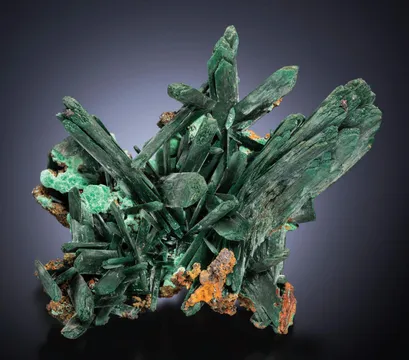
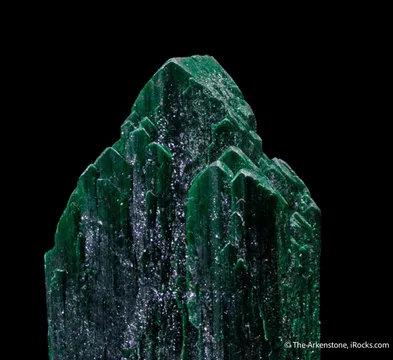
Cole Mine malachite is a classic Bisbee collector species, most often admired as vivid green velvet, fibrous crusts, acicular carpets, pocket linings, and pseudomorphous masses after azurite. Documented examples include large hematitic ore pieces with shallow cavities lined by shimmering acicular malachite, including a specimen more than 15 cm across with a roughly 7.5 cm pocket, as well as old collection pieces described as coarse, lustrous, felty malachite probably replacing azurite. Fine Cole malachite should have fresh saturated green color, intact silky fiber, obvious open-space growth, and attractive contrast against dark iron-rich ore or copper-bearing matrix; ordinary pieces tend to be patchy green coatings on gossan without the velvety texture, pocket form, or pseudomorph structure that gives the best Cole specimens their Bisbee authority.
Cole Mine calcite ranges from colorless to white platy and rhombohedral crystals to supergene coatings on goethite, hematite, malachite, azurite, and native copper. The most attractive specimens are association pieces: translucent platy calcite grown over brushy malachite on limonitic matrix, or calcite with native copper from the 1300 level, where the calcite may fluoresce a strong red to red-orange under shortwave ultraviolet light. Good Cole calcite is judged less by sheer crystal size than by context—sharp, undamaged plates on colorful copper minerals, visible paragenetic layering, clean contrast on dark matrix, and documented mine-level provenance; loose white calcite without malachite, copper, azurite, or fluorescence is far less compelling from this locality.
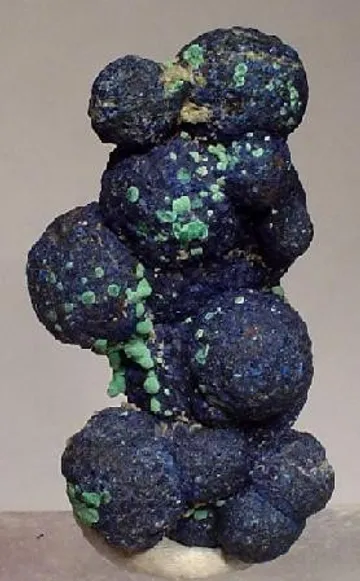
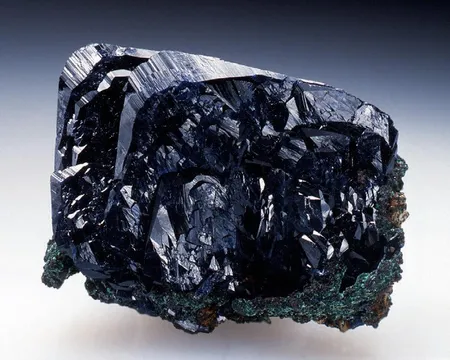
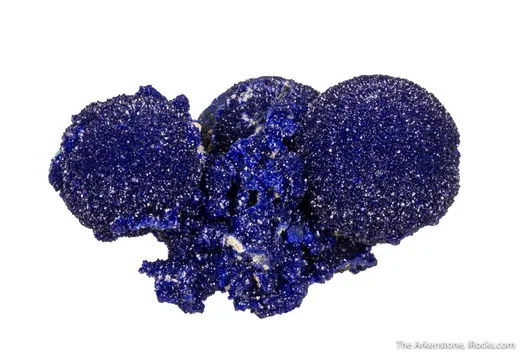
Cole Mine azurite belongs to the old Bisbee tradition of lustrous, deep blue rosettes, bladed aggregates, flattened crystals, and azurite partly or wholly altered to malachite. The best small pieces can be complete, rich blue rosettes only a few centimeters across, while larger combination specimens show navy-blue crystal remnants, malachite replacement, scattered calcite rhombs, cuprite, gypsum, paratacamite, or dark manganese oxide coatings. Particularly desirable examples retain glossy, unaltered azurite faces beside velvety green malachite, proving the replacement history in a single hand specimen; lesser Cole azurites are dull, bruised, powdery, or so completely altered that only the malachite pseudomorph habit hints at the original blue carbonate.
Native copper from Cole Mine is much scarcer as an aesthetic specimen than the abundance of copper in the ore might suggest. Fine pieces are crystallized, arborescent, skeletal, or spinel-twinned copper, commonly associated with calcite, cuprite, and malachite; a major old specimen from the Cole shaft measures about 24.5 cm and carries copper crystals to about 3.5 cm, patinated by malachite and cuprite, while 26-K stope material from the 1300 level is noted for fine copper crystals with red-orange fluorescent calcite. Collectors should look for crystallization rather than massive metal, old undisturbed patina rather than harsh cleaning, and intact calcite-copper relationships; ordinary ore pieces or acid-brightened copper lack the historical and paragenetic quality that makes Cole copper worth pursuing.
Cole Mine pyrite is significant because it records the deeper sulfide story behind Bisbee’s celebrated blue and green oxidized minerals. The best documented collector style consists of individual pyritohedrons from the 1400 level, found in chalky sericitic material and preserved as loose crystals, some with a darker metallic appearance that can recall galena at first glance. In the larger deposit, pyrite was a dominant hypogene mineral and a driver of later oxidation chemistry; as a specimen species from Cole, however, the appeal lies in sharp isolated crystals, clean form, and level-specific provenance rather than bright brassy flash or large showy clusters.
Beyond the five collector staples above, Cole Mine has an unusually rich documented suite for a single Bisbee shaft. Graemite is the headline rarity: a blue-green copper tellurium mineral, CuTeO3·H2O, first described from Cole material collected on the 1200-foot level, 202 stope, where it occurs replacing teineite in malachite with cuprite. Other documented or notable species include cuprite, brochantite, paratacamite, buttgenbachite, claringbullite, connellite, aurichalcite, hemimorphite, chalcophanite, goethite, chalcosiderite, variscite, turquoise, mimetite, wulfenite, scheelite, native silver, native gold including electrum, bromargyrite or chlorargyrite, sengierite, teineite, tyuyamunite, uranopilite, zippeite, bayleyite, ransomite, redondite, römerite, and voltaite. Many of these are micro, rare, post-mining, or analytical species rather than cabinet-display minerals, but they make Cole one of the more intellectually rewarding Bisbee labels.
The first authenticity issue with Cole Mine specimens is locality precision. “Bisbee” is a broad and prestigious label that may cover Copper Queen, Czar, Holbrook, Shattuck, Southwest, Campbell, Junction, Lavender Pit, Cole, and other mines; a specimen sold as “Cole Mine” should ideally have an old label, collection pedigree, mine-level notation, or a visual style that fits documented Cole material. Conversely, many genuinely old pieces were labeled only “Bisbee,” so a Cole attribution without evidence should be treated cautiously unless it comes from a reliable collection history.
No widely documented manufactured fake category is specifically associated with Cole Mine malachite, azurite, calcite, copper, or pyrite, but mislabeling is a real concern. Bisbee azurite and malachite pseudomorphs are commonly traded under general district names, and visually similar material from other Arizona, New Mexico, Mexican, or African copper deposits can be passed into the market as “Bisbee” if labels are lost. For Cole copper, beware of unnaturally bright surfaces, aggressive acid cleaning, artificial polishing, or lacquer that masks the old malachite-cuprite patina. For malachite-after-azurite, look for natural fiber direction, coherent pseudomorph shape, and integration with the matrix; glued composites, dyed green coatings, or polished lapidary malachite have a very different surface.
Condition matters strongly. Cole malachite velvet is easily rubbed; the best surfaces should sparkle or shimmer under low-angle light rather than look matted. Azurite crystals chip along edges and may show dull bruised faces if handled roughly. Calcite is soft, acid-sensitive, and often sits on iron-rich matrix where careless cleaning can etch, frost, or loosen crystals. Native copper can be mechanically bent or chemically stripped, and old Bisbee copper specimens should not be made “penny bright” unless the goal is to destroy collector value. Pyrite from Cole is generally more stable than the notorious marcasite-rich decay material from some localities, but any pyrite kept in humid conditions should be monitored for oxidation.
Fluorescence is a legitimate bonus at Cole, especially for calcite associated with native copper. Shortwave ultraviolet response can be red to red-orange in copper-calcite assemblages, while some hemimorphite and uranium-bearing minerals from the mine or district may also respond. Fluorescent testing should be gentle and informed: uranium minerals such as uranopilite, zippeite, tyuyamunite, and bayleyite, where present, call for sensible handling, dust avoidance, labeling, and storage away from children or food-preparation areas. Many rare sulfates and post-mining minerals are fragile or water-sensitive, so avoid washing obscure yellow, green, white, or crusty secondary material from old Cole pieces unless the species is already known.
On the market, Cole specimens are available but not common in high quality. Small azurite rosettes, malachite pockets, calcite-malachite associations, and copper-calcite pieces appear through old Bisbee collections and specialist dealers. Graemite from the Cole type locality is essentially a scientific rarity rather than a realistic buying target for most collectors. A precise Cole label, especially with level or stope data, should command a premium over a generic Bisbee label when the specimen quality supports it.
The most memorable Cole Mine story begins not with a formal collecting permit or a museum expedition, but with a young Bisbee collector slipping into the underground during a summer maintenance shutdown. In July 1959, Richard Graeme went into the Cole Mine because he had heard that unusual minerals occurred in 202 stope on the 1200 level. The mine was remote enough that unauthorized late-afternoon access was possible. The descent—1,200 feet down the manway—was quick; the return, as he later recalled, was another matter.
Graeme had been in the Cole once before as a boy, about six years earlier, only to be found by a miner and escorted out to the chief watchman. In 1959 he was more careful. He reached 202 stope, only to find the broken muck had been thoroughly cleaned out before the shutdown. The stope itself offered nothing. Nearby, however, stood three loaded mine cars containing oxide ore from the same stope. Digging through the tops of the cars, he found a few mud-covered pieces that looked promising, wrapped them in newspaper, and then faced the long climb back out and the walk home in the dark.
The next day, after washing the specimens, one rock stood apart. It was a spongy mass of malachite with 2 to 4 mm cuprite crystals and a prominent 2 cm blue-green crystal on one side, with smaller sharp electric-blue crystals nearby. For about a decade collectors and geologists thought the unusual species might be chalcophyllite and connellite, but Graeme remained uneasy about the identification. In 1973, while working with Phelps Dodge mineralogist Phil Matter on alteration sampling, he showed the specimen to Matter, who took it to the Douglas laboratory and placed it before Sidney A. Williams. The electric-blue crystals proved to be teineite; the blue-green material did not match any known mineral. Williams and Matter completed the description, and the new species was named graemite in Graeme’s honor.
That little mud-covered piece from a loaded mine car became the holotype specimen of a new mineral species. The type piece is described as graemite replacing teineite, with cuprite and teineite on malachite, from the 202 stope, 1200 level of Cole Mine. Later accounts emphasize just how rare the species remains in Bisbee: only three Bisbee graemite specimens were known, and only one from the Cole type locality.
Cole also played an unexpected role in a natural chemistry experiment underground. Mine water from outlying areas of the P. and D. workings passed through lower Cole levels heavily mineralized with iron and copper sulfides. As the opened sulfide zone slowly oxidized, the water changed character: from originally pure potable water into a sulfate-rich solution carrying copper, calcium, magnesium, iron, and aluminum. From the 1400-foot bottom level at the southern end of Cole, water was carried through a long drift across an undeveloped block of ground to the 1300-foot level of the Briggs Mine. There, mixing and changing conditions led to active copper carbonate deposition—a modern, observable analogue for processes often invoked to explain ore formation but rarely seen so plainly while a mining system is still accessible.
The practical mining history around Cole had its own rough texture. During work on the neighboring Lake Superior & Pittsburg No. 3 shaft, a 2300-foot drift connected it to Cole on the 1000 level for ventilation, and when the Cole shaft was being enlarged, men and materials for Cole were handled through the No. 3 shaft. On October 8, 1904, mules were brought underground to haul cars from Cole to the L.S. & P. No. 3 shaft because the haulage distance was too long for hand-pushing cars. The mine-mule world had its own lore: when the Cole shaft was shut down the following year after a mule-handling wager elsewhere in the district, its mules were brought to surface, including one that had been underground for six years and was reported to be pleased to see daylight again.
A darker story attached to the Cole name belongs to John Campbell Greenway, later famous as a mining man, soldier, and Arizona figure. While drilling after blasting in the Cole Mine, Greenway struck an unexploded stick of dynamite left from the previous night’s work. It detonated. Workmen who pulled him from the debris reportedly wagered that he would not survive the trip to the hospital. He did survive, but lost his right eye and a kneecap, and spent years recovering in Bisbee, El Paso, and Johns Hopkins while doctors removed fragments of rock and wood from his body. The story became part of Greenway legend: even the Cole Mine explosion did not end his appetite for action.