A collector's guide to Campbell Mine, USA: its geology, mining history and notable minerals, illustrated with the 55 specimens documented from this locality on EarthWonders.
Key facts
Campbell Mine is the deep eastern Bisbee locality that serious collectors tend to approach with two quite different expectations. One is the classic Bisbee look: oxidized copper minerals from limestone replacement ore—azurite, malachite, cuprite, calcite, cerussite, smithsonite and iron oxides—formed in cavities, fractures and altered ore along the Campbell fault system. The other is the far more specialized Campbell story: a rich, pipe-like sulfide orebody whose microscopic tellurides and tin-tungsten sulfides made the mine a reference locality for modern ore mineralogy. Few American copper districts combine cabinet-grade oxidized specimens and reflected-light microscope rarities so completely.
Geologically, Campbell belongs to the Warren mining district at Bisbee in the Mule Mountains of southeastern Arizona. The ore is tied to the district’s porphyry-related carbonate-replacement system, where mineralizing fluids invaded Cambrian Abrigo, Devonian Martin and Mississippian Escabrosa limestones near porphyry dikes, breccias, and steep faults. The Campbell orebody itself was one of the great deep discoveries of the district: a large sulfide mass centered on the Campbell structural zone, with pyrite-rich breccia, chalcopyrite, bornite and chalcocite, later overprinted by precious-metal telluride mineralization and locally oxidized high in the system.
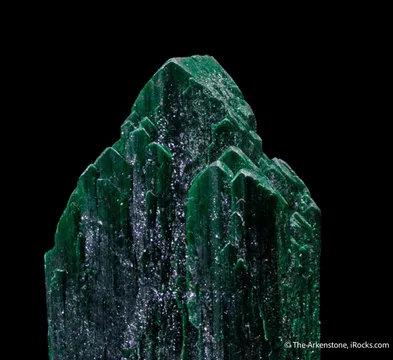
For collectors, the mine’s most recognizable specimens are the dark, tough, angular Campbell pieces: malachite pseudomorphs after azurite with blocky or bladed forms still sharp under a matte to velvety green skin; deep blue to nearly black azurite crystals on siliceous or iron-rich matrix; native copper with cuprite and calcite in dense “campbellite” ore; and fluorescent hydrothermal calcite from the deep levels. The best Campbell material rarely has the sunny openness of early Copper Queen cave specimens. Its appeal is more muscular—heavy matrix, strong color, compact pockets, and the unmistakable feel of a deep Bisbee mine.
Regional View
Country View
The Campbell Shaft also sits in an important historical position. It was developed by Calumet & Arizona as an east-side deep shaft and ventilation opening, later passed into the Phelps Dodge system after the 1931 merger, and ultimately became the shaft from which Bisbee’s last underground ore was extracted in 1975. That final role gives Campbell a resonance beyond mineral specimens: it was one of the last working connections to a district that had produced billions of pounds of copper and a world-class mineral legacy.


Search for specimens: View all specimens from Campbell Mine, USA
Campbell Mine, also called the Campbell Shaft, is in the Bisbee area of the Warren mining district, Cochise County, Arizona, near Warren and Lowell on the east side of the historic Bisbee camp. The locality is on private mining land and is part of the old interconnected underground system of the district; it is not a public collecting site. The shaft and workings are no longer available to collectors, and the deep mine was allowed to flood after pumping ceased in the mid-1980s.
The deposit is best described as a porphyry-related, limestone-hosted replacement system. At district scale, Bisbee’s older rocks consist of Precambrian Pinal schist overlain by thick Paleozoic carbonate and clastic units, intruded by Jurassic porphyry bodies and associated breccias. In the Campbell area, mineralization occupies irregular replacement orebodies in Abrigo, Martin and Escabrosa limestones close to porphyry dikes and sills. Structural control is essential: the Campbell fault is one of the important north-northeast fault zones that helped localize ore in the eastern part of the district.
The Campbell orebody was an unusually large Bisbee sulfide mass. It has been described as pipe-like to cigar-shaped, with pyrite, silica and silicified limestone fragments in the core and important copper sulfides—chalcopyrite, bornite and chalcocite—along with lesser lead-zinc mineralization and precious-metal values. Compared with the older oxidized cave deposits that made the Copper Queen, Czar and Holbrook mines famous, Campbell is a deeper, more sulfide-rich story, but the upper and structurally open parts of the Campbell system still produced notable oxidized copper specimens.
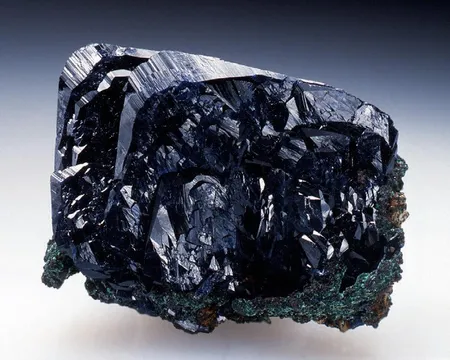
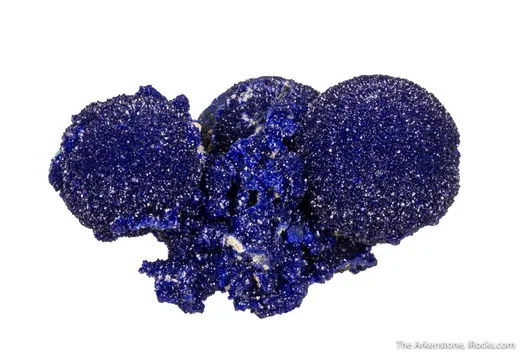
The oxidized collector material came especially from the north end and upper portions of the Campbell orebody, including zones from roughly the 1600 to 2000 levels along the Campbell fault. These workings yielded azurite, malachite, malachite after azurite, cerussite, smithsonite, hematite and limonitic matrix. The azurite was reported as sharp singles and groups, with individual crystals in the best pockets reaching several inches, usually very dark blue to nearly black and commonly seated on angular siliceous fragments. This is a key diagnostic point for Campbell azurite: the specimens tend to be dense, dark and somewhat “hard-rock” in feeling, unlike the airy, open oxidation-cave masses from some earlier Bisbee mines.
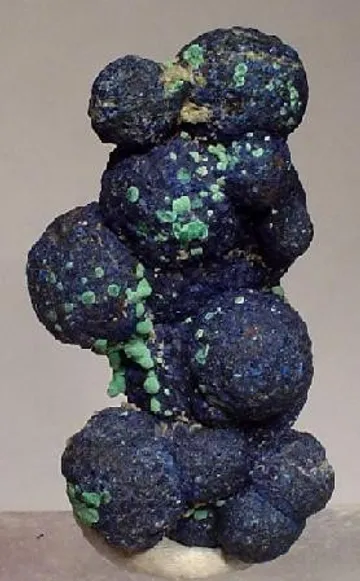
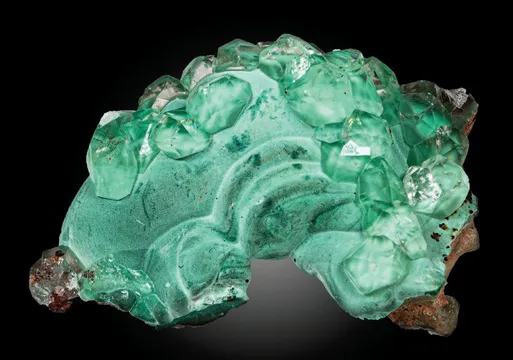
Malachite pseudomorphs after azurite are among the mine’s most collectible oxidized pieces. A documented 105 Stope, 1900 level specimen in the trade is an 8.8 x 10.0 x 4.7 cm small cabinet piece of forest-green, velvety malachite replacing azurite, with an old Scott J. Williams label dating from about 1955–1961. Wikimedia and mindat-linked examples also show Campbell malachite preserving blocky azurite forms, including a 7.0 x 4.6 x 3.1 cm small cabinet specimen whose largest replaced crystal exceeds 1.5 cm. These are not abundant decorative curiosities; sharp, undamaged Campbell pseudos are a recognized Bisbee specialty.
Native copper occurs in several Campbell contexts and requires careful interpretation. Older ore specimens show copper with cuprite, calcite, quartz and other gangue minerals in dense campbellite-type material. There are also documented post-mining copper occurrences formed in the workings after mining introduced acidic, copper-bearing waters to steel, timber, rails and mine debris. Some copper masses from Campbell and Junction formed by replacement of iron or direct precipitation from copper-rich mine water; they can be fascinating historical mine products, but they should not be confused with primary or supergene native copper from untouched ore cavities.
Calcite from Campbell is a quiet but important collector subcategory. The most distinctive material comes from the 2566 level and nearby deep workings, where hydrothermal calcite formed colorless to white or pale yellow rhombs, pseudohexagonal crystals and complex aggregates, commonly with goethite coatings or phantoms. Some of this Campbell calcite is highly fluorescent, with later calcite generations giving a bright red shortwave ultraviolet response and a weaker longwave response. Hundreds were reportedly recovered during late-1940s lead-zinc mining, but many were damaged during removal or dismissed at the time as ordinary calcite.
Mining history at Campbell begins with Calumet & Arizona’s effort to develop deeper and better-ventilated eastern workings. The shaft was tied into the Junction system during the World War I era and became increasingly important as ore was found nearby. The great Campbell sulfide orebody was discovered or recognized in the late 1920s, and descriptions of the district’s history identify it as the largest and richest sulfide orebody found at Bisbee, containing more than one million tons of ore and extending down to the 2566 level and below. It was mined for decades and was crucial to Bisbee’s survival during the Depression years, when its copper, gold and silver values mattered greatly.
After Calumet & Arizona merged with Phelps Dodge in 1931, Campbell became part of the Phelps Dodge Copper Queen Branch system. The district continued shifting between underground stoping, open-pit mining, deep exploration, lead-zinc production and later precious-metal evaluation. Commercial underground mining at Bisbee ended in 1975, with the last ore extracted from the Campbell Shaft. Subsequent leaching and maintenance work continued in parts of the Warren district, but the deep Campbell workings were no longer a source of fresh collector access.
Today, Campbell Mine specimens reach collectors almost entirely through old collections, dealer inventories, museum deaccessions, and Bisbee specialists. The mine is private, deep, partly flooded and historically hazardous; collecting underground is not a realistic or lawful option. Provenance is therefore central. A piece labeled simply “Bisbee” may be correct but less useful than one tied to “Campbell Shaft,” “Campbell Mine,” or better still to a specific level or stope such as the 1900, 2200 or 2566 level.
Malachite from Campbell Mine is most prized when it preserves the form of earlier azurite, producing dark to forest-green pseudomorphs with blocky, bladed or tabular outlines still readable beneath a matte, velvety or finely crystalline surface. Documented specimens include small cabinet pieces from the 105 Stope on the 1900 level and sharp matrix-bound pseudos from the Campbell Shaft, generally in the miniature to small-cabinet range, with individual replaced azurite crystals from centimeter scale upward on the better pieces. Associations include azurite remnants, goethite or hematite, cerussite, smithsonite and siliceous breccia matrix. The best Campbell malachites are distinguished by crisp original azurite geometry, saturated color, minimal abrasion on crystal edges, and an old Bisbee/Campbell provenance; ordinary pieces tend to be massive green carbonate, bruised pseudomorphs, or attractive but locality-indistinct Bisbee material.
Azurite from Campbell is the deep, dark end of Bisbee’s azurite spectrum: lustrous to sublustrous crystals, singles and clusters, commonly very dark blue to nearly black, from oxidized portions of the Campbell orebody along the Campbell fault between the 1600 and 2000 levels. Historical accounts describe thousands of sharp single crystals and groups from this zone, with individual crystals reaching several inches, typically on or including angular siliceous fragments rather than the more open limestone-cave matrices of western Bisbee. Associated minerals include malachite, cerussite, smithsonite and hematite. Fine Campbell azurite is judged by crystal sharpness, depth of color without dead blackness, surviving luster, lack of alteration damage, and a matrix that confirms the Campbell look; lesser specimens are merely dark, rubbed, or partly converted to malachite without attractive pseudomorph form.
Copper from Campbell occurs both in older ore-specimen material and in post-mining mine-environment formations, so provenance and context matter greatly. Collectible ore examples include dense native copper with blood-red cuprite and white calcite in campbellite-type material, as well as reported spinel-twinned or arborescent pieces from deep levels such as the 2200 level. Campbell also produced copper that formed after mining from acidic copper-bearing solutions interacting with iron mine materials; rail- or steel-replacement copper from the 2200 level is historically fascinating, but it is best collected and labeled as a mine-formed replacement product rather than as a simple natural native copper specimen. The best Campbell copper pieces show clear metallic copper, contrasting cuprite or calcite, old labels, and honest description of whether the specimen is ore-related or post-mining; mediocre or misleading pieces are massive, oxidized lumps sold only on the strength of the Bisbee name.
Calcite from Campbell Mine is most notable from the deep 2566 level and related workings, where colorless to white, pale yellow or goethite-coated crystals occur as rhombohedra, pseudohexagonal crystals, complex aggregates and scalenohedral groups on iron-stained or sulfide-rich matrix. Some crystals are only about 1–1.5 cm, but specimens can be cabinet sized, and documented pieces include 10–22 cm views of Campbell calcite in the Graeme collection and market examples with sharp rhombs to about 1.3 cm. The best pieces may show internal phantoms, second-generation calcite overgrowths, and strong shortwave red fluorescence, sometimes muted by goethite coatings. Condition is decisive because many were collected from hard matrix and historically handled as “just calcite”; sharp terminations, intact crystal coatings, strong UV response and a precise Campbell level make a specimen stand out.
Beyond the four headline species, Campbell is one of Bisbee’s great microscopic ore-mineral localities. Henryite, (Cu,Ag)3+xTe2, is a type-locality mineral from the Campbell orebody and was found as only a few microscopic grains in telluride-rich sulfide ore. Kiddcreekite, Cu6SnWS8, is also tied to Campbell as a type or co-type occurrence, occurring as minute grains in pyrite with colusite and other sulfides. The Campbell suite includes numerous rare tellurides and complex sulfides reported from the orebody, among them hessite, petzite, sylvanite, altaite, rickardite, stützite, kostovite, calaverite, canfieldite, kësterite, famatinite, goldfieldite, colusite and related phases. For macro collectors, these are not show minerals; for ore microscopists, they are the reason Campbell belongs in the scientific mineral record, not merely the Bisbee specimen trade.
Campbell specimens should be bought with more attention to labeling than most Bisbee material. Many older labels read simply “Bisbee,” “Copper Queen,” or “Campbell Shaft,” and district-wide names can be imprecise because the mines were interconnected and company usage changed through time. A Campbell attribution is strongest when supported by an old label, a level or stope, or a specimen style that fits known Campbell occurrences: dark azurite on angular siliceous matrix, malachite after azurite from the 1900-level oxidized zone, deep-level calcite with goethite and fluorescence, or campbellite-type copper-cuprite-calcite ore.
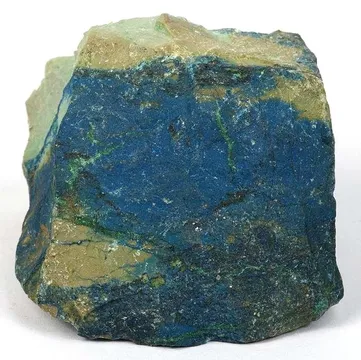
The most important naming trap is “campbellite.” It is not a valid mineral species; it is a lapidary and collector name for mixed Campbell Mine material, commonly involving native copper, cuprite, azurite, malachite, calcite, chrysocolla, quartz, tenorite and other constituents. Attractive campbellite specimens and cabochons are legitimate if sold as a rock or mixed ore material, but a label presenting campbellite as a single mineral species is incorrect.
Condition issues are predictable for the mine. Malachite pseudomorphs after azurite commonly lose sharp corners and edges because the replaced crystals can be velvety or somewhat granular at the surface. Dark azurite may show alteration, bruising, or dull areas that are easy to miss in low light. Calcite from the deep levels can have chipped terminations, goethite coatings that mask damage, and repairs to fragile crystal groups. Campbellite ore is dense and tough but can include crumbly sulfide or oxide seams, so freshly broken edges and glued fractures deserve close inspection.
One Campbell-specific authenticity concern is post-mining copper. Some copper masses formed after mining by replacement of iron rail, steel or other mine materials in acidic copper-bearing waters, while other copper-bearing specimens are genuine ore specimens. Both can be collectible, but they are different things. A post-mining copper-on-iron replacement specimen should be labeled as such; represented vaguely as “native copper from Campbell Mine,” it can mislead buyers about its origin.
Fluorescence can add real value to Campbell calcite, especially the shortwave red to pink-orange response of 2566-level hydrothermal calcite. Test under both shortwave and longwave UV when possible, but do not rely on fluorescence alone for identification or locality. Goethite coatings can mute or obscure the response, and exposed fresh calcite areas may fluoresce more clearly than coated crystal faces.
Fresh Campbell Mine material is not entering the market from collecting. Availability comes from old Bisbee collections, estate dispersals, specialist dealers and occasional museum-quality holdings. Good malachite-after-azurite and sharp azurite are scarce and often expensive when well provenanced. Campbell calcite remains undervalued relative to its locality interest, especially fluorescent examples with old labels. Microscopic type-locality minerals such as henryite and kiddcreekite are essentially scientific reference material, not normal specimen-market items.
The Campbell Shaft began as a practical solution to a Bisbee problem: heat and air. Calumet & Arizona needed ventilation for the deep ground east of the Junction Mine, so the shaft was developed as a new opening tied into the older workings. Contemporary historical accounts describe work progressing from the surface and by raising upward from the Junction’s 1300 level, with the connection completed in late 1919. The name honored Gordon R. Campbell, then secretary of Calumet & Arizona. What began as ventilation soon became much more consequential. Ore was found nearby, exploration continued, and the mine pushed the known productive ground of Bisbee farther east than earlier operators had expected.
The discovery of the Campbell orebody changed the late life of the district. In district histories, it is described as the largest and richest sulfide orebody ever found at Bisbee, containing more than one million tons of ore and extending from high in the mine down toward and below the 2566 level. For a camp already decades old, that was not a minor addition; it was a reprieve. During the Depression years, when the economics of copper mining were hard and precious-metal prices mattered, Campbell’s gold and silver values helped keep Bisbee alive. The mine had become, in effect, one of the district’s deep reserves of time.
One of Campbell’s most appealing mineral stories is also a story of neglect. During lead-zinc mining in the late 1940s, miners recovered hundreds of specimens of hydrothermal calcite from the 2566 level and nearby areas. The crystals were not all spectacular under daylight: many were coated by goethite, and calcite did not carry the glamour of azurite or malachite in old Bisbee collecting culture. Much of the material was handled roughly in hard matrix, and many specimens were damaged before anyone cared enough to preserve them. Under shortwave ultraviolet light, however, the later calcite overgrowths can flare red, salmon or pink-orange. The irony is sharp: some of Campbell’s most distinctive mineral specimens survived in reduced numbers because, at the moment they were found, they were dismissed as only calcite.
The orebody also produced one of Bisbee’s most microscopic dramas. In the late 1970s, after precious-metal prices rose, Phelps Dodge began looking carefully at remaining gold and silver possibilities in the massive sulfide shell around the exhausted Campbell orebody. Drill core and bulk samples went to the company’s laboratory in Douglas, and selected material reached ore-mineral specialists Alan Criddle and Chris Stanley at the British Museum. Several hundred samples were studied to unravel the tiny, complex intergrowths of gold, silver, tellurium, bismuth, tin, tungsten, vanadium and other elements. In one polished section of drill core, the mineral later named henryite appeared as just three grains. The largest was only about 0.5 mm across; another was roughly 0.8 mm long but only 0.1 mm across; the smallest was about 0.1 mm. Those three grains were enough to establish a new copper-silver telluride species and to make Campbell a type locality.
Kiddcreekite tells a related but slightly different story. Its descriptive work involved material from Kidd Creek in Ontario and the Campbell orebody at Bisbee. At Campbell it occurred as minute grains in pyrite, commonly less than 50 microns across, in a late-stage assemblage with colusite, tungsten-bearing colusite, stützite, altaite and other phases. A cabinet collector would never see it unaided. Yet those grains record the same extraordinary chemical complexity that made the Campbell orebody more than a copper mine: it was a miniature archive of late hydrothermal metal transport.
The mine’s final decades were not quiet. In November 1974, a suspected underground fire in the Junction-Campbell area was detected when smoke odor and carbon monoxide were found in the ventilation drift. Bulkheads and seals were built, mine rescue crews monitored carbon monoxide, and the fire was not finally judged out until May 1975—six months later, just as Bisbee underground mining was approaching its end. Other Campbell incidents from the same period read like the rough logbook of a deep working mine: boulders jumping a chute door, a blowpipe kicked by falling rock, miners hurt in stopes on the 2566, 2700, 2966, 3100 and 3233 levels. Campbell specimens came out of a living industrial workplace, not a tidy collecting chamber.
The last great Campbell scene is water. The deep Bisbee mines required constant pumping long after ore production declined. After precious-metal work and salvage ended in the mid-1980s, the pumps on the deep Campbell and Junction levels were shut down. Water rose fast—reported at about four feet a day at first across the immense connected workings, then about two feet a day as it reached higher levels. On May 7, 1986, power to the 2200-level station was turned off in preparation. A few days later, at 3:00 a.m. on May 11—Mother’s Day—the water entered the station. With that, the deep Campbell workings passed from mine to flooded memory.