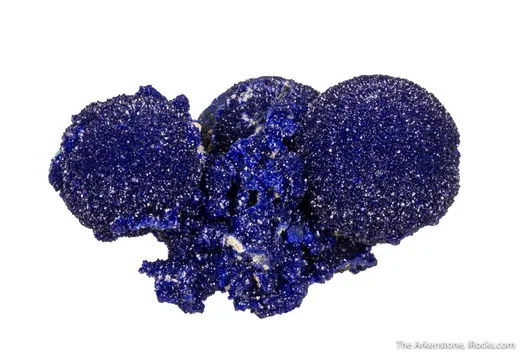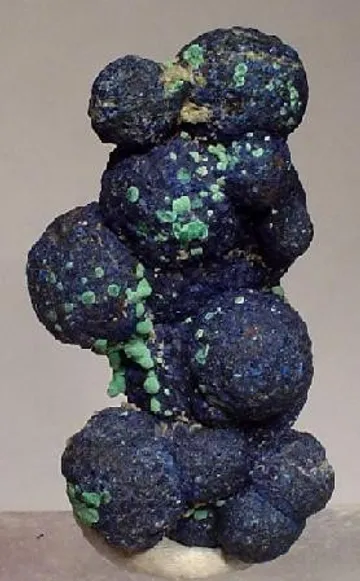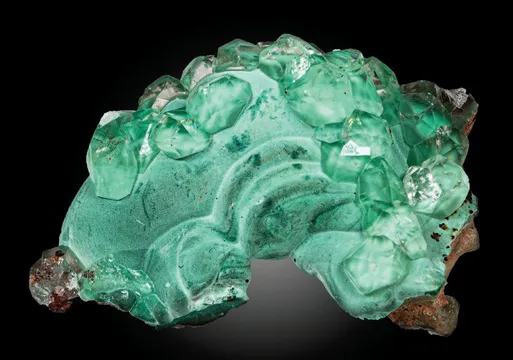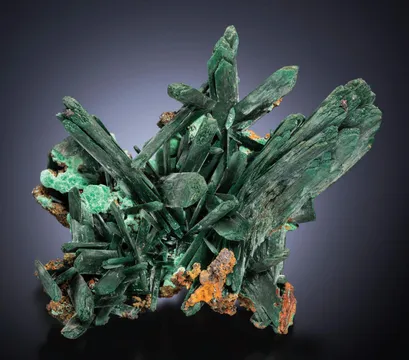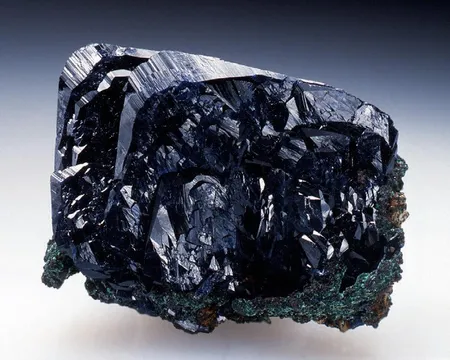
Shattuckite from the Shattuck Mine, Bisbee, Arizona — pale blue, porous copper silicate replacing malachite; prized for locality identity and historic labels.
Key facts
Shattuckite from the Shattuck Mine is not merely an Arizona copper silicate; it is the name-bearing material of the species. The mineral was recognized from the Shattuck workings at Bisbee in 1915, in the heart of the Warren mining district, where oxidized copper ores, limestone replacement bodies, silica breccias, caves, and a bewildering suite of secondary copper minerals made Bisbee one of the great American mineral localities.
The classic Bisbee look is subtler than the glassy blue sprays from Namibia or the hard, lapidary-grade dark blue material from Ajo. True Shattuck Mine shattuckite is commonly pale blue to gray-blue, porous, earthy to silky, and very often a replacement of earlier malachite. The most desirable pieces show the evidence of that replacement clearly: retained malachite texture, small spherical or radiating sprays of darker blue acicular crystals, and intimate associations with malachite, chrysocolla, quartz, hematite, and the historically important copper silicate material long known as bisbeeite.
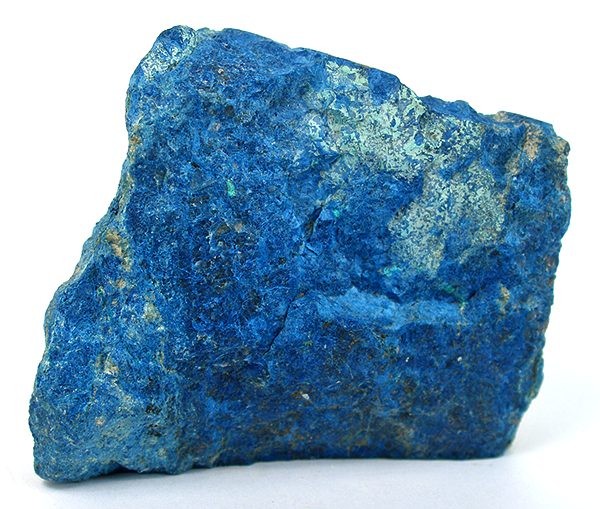
Photo: Rob Lavinsky, iRocks.com / Wikimedia Commons
For collectors, the appeal is partly visual and partly documentary. A fine specimen should read as Bisbee: blue shattuckite in porous or brecciated oxidized matrix, not a generic velvety blue copper silicate. The best pieces carry old labels, precise Shattuck Mine attribution, and, ideally, notes tying them to the 200 or 300 levels, the 69 prospect, early Shattuck collections, or later Phelps Dodge-era exploration. Because much more attractive shattuckite from Ajo has circulated under “Bisbee” labels, the locality identity is often more important than size or brightness.

Photo: Rob Lavinsky, iRocks.com / Wikimedia Commons
The Shattuck specimens that advanced mineralogy were not spectacular in the modern showcase sense. Their importance lies in the way they preserve a chemical and geological transition: malachite textures overtaken by a blue copper silicate in the oxidized zone of a major replacement deposit. In a serious type-locality suite, a well-documented Shattuck Mine shattuckite is a keystone specimen.
Search for specimens: View all shattuckite specimens from Shattuck Mine, Bisbee, Arizona, USA
The Shattuck Mine is in the Warren mining district at Bisbee, in the Mule Mountains of Cochise County, southeastern Arizona. The mine has also been known as the Shattuck-Denn Mine, Shattuck-Arizona Mine, and Denn Mine in historical and mineralogical literature. It is part of the same intensely mineralized district that produced the Copper Queen, Czar, Holbrook, Higgins, Southwest, Cole, and other classic Bisbee mines.
Geologically, the Shattuck ore belongs to Bisbee’s limestone-hosted replacement system. The district’s mineralization was controlled by intrusive activity, major structures, silica breccias, and replacement of Paleozoic carbonate rocks. Bisbee ores include copper, lead, zinc, silver, gold, manganese, and vanadium minerals, with many of the underground deposits developed as oxidized and enriched replacement bodies in limestone. At the Shattuck Mine specifically, records describe a replacement deposit of mostly oxidized and enriched copper carbonates, oxides, and sulfides, along with lead and zinc ores. The Shattuck ore zone was structurally complex, associated with parallel fault zones and granite-porphyry dikes, and the mine’s history repeatedly mentions levels developed in altered limestone, cuprite bodies, lead-silver ore, lead-zinc sulfides, and later interest in Abrigo Limestone sulfides.
The company story begins in 1904, when the Shattuck & Arizona Copper Company was formed and began sinking a two-compartment shaft on the Iron Prince claim. By late 1905 the shaft had reached the 800-foot level, ore had been found on the 500 and 700 levels, native copper had appeared in altered limestone on the 800 level, and an orebody of cuprite had been discovered. Water was a persistent problem; one early drilling incident brought water into the shaft at a reported 250 gallons per minute.
The mine’s setting in a steep canyon forced difficult logistics. Before the aerial tramway was completed, ore had to be hauled by wagon. In 1906 a 3,200-foot tramway with 14 towers was completed to move ore down and timber up. The tramway was later enlarged as production ambitions grew. The Shattuck also maintained unusual underground connections with neighboring mines: one arrangement allowed Shattuck miners to descend through the Copper Queen’s Czar Shaft and walk through the Cuprite Mine on the 200-foot level to reach the Shattuck workings, sparing them the long climb up to the mine.
Shattuckite was discovered during this period of active underground exploration. A large cave was cut on the 300 level in 1913, and a crosscut on the 200 level, driven in relation to that cave, encountered a narrow fault zone with silica breccia in the footwall and a pale-blue mineral that proved new to science. Phillip D. Wilson, chief geologist for the Shattuck & Arizona Copper Company, sent samples to the U.S. Geological Survey in Washington, D.C. Waldemar T. Schaller described shattuckite in 1915, naming it for the mine, and also recognized the associated pale copper silicate later called bisbeeite.
Production was significant for a comparatively small Bisbee company. In 1916 the Shattuck reportedly produced 18,500,000 pounds of copper, more than 4,000 ounces of gold, 260,000 ounces of silver, and 16,000,000 pounds of lead. Lead-zinc sulfide ores were developed on the 200 level in 1917, and ore was mined on the 400, 500, and 600 levels. The broader Shattuck-Denn operation is recorded as a past producer of copper, lead, and zinc, with secondary vanadium, gold, silver, and manganese, and with production from 1906 to 1947.
By 1920 the Shattuck was largely mined out in the sense of its original high-value ore program, and lessees became increasingly important. The Shattuck & Arizona and Denn & Arizona interests merged in 1925 to form the Shattuck-Denn Mining Company. From 1942 to 1945 the mine was leased by James Maffeo and produced an average of about 400 tons per month; lessees continued until operations ceased in 1947. A 1952 fire destroyed the remaining buildings and aerial tramway, leaving the steel headframe.
The mine was not entirely finished. Phelps Dodge later purchased the Shattuck Mine, reopened the shaft for precious-metal and sulfide exploration in the 1970s, repaired stations to the 700 level, and worked principally on the 200 and 300 levels before shutting the project down on August 27, 1975. A small gold-mining attempt in 1982–1983 near the Shattuck Cave worked the 200 and 300 levels for only a few months. Collectors owe a small but important number of later shattuckite specimens to the early 1970s reopening and exploration work.
The Shattuck Mine is a historic underground mine on private or controlled ground and should not be treated as an open collecting locality. Old Bisbee workings are hazardous, with caved stopes, shafts, fire-damaged ground, flooded levels, unstable backfill, and legacy mining infrastructure. Any access requires explicit permission from the appropriate land and mineral-rights holders and serious mine-safety competence.
The formula of shattuckite is Cu5(Si2O6)2(OH)2, equivalent to Cu5(SiO3)4(OH)2 in older notation. It is an orthorhombic copper silicate hydroxide with a typical hardness near 3½ and a light to dark blue color range. At Bisbee, however, the collector should think less of textbook color and more of texture and paragenesis.
The type material was described as pseudomorphs after malachite and as small spherulites. That remains the key to recognizing good Shattuck Mine material. Much of the true Bisbee shattuckite is pale blue, gray-blue, or muted blue rather than saturated royal blue. It may be porous, almost boxwork-like, and locally earthy or microcrystalline. Relict malachite form is often the most persuasive locality feature: fibrous, radiating, or botryoidal malachite textures that have been replaced by shattuckite, sometimes with green malachite still present in protected areas or as partial replacement remnants.
The most attractive pieces carry darker blue spherical clusters made of very small acicular crystals. These sprays can be set on, or embedded in, a paler porous shattuckite matrix. Rather than forming thick, open-space vein linings in iron-stained quartz, classic Shattuck Mine shattuckite is associated with angular silica-breccia fragments and tiny colorless quartz crystals. That distinction is important because Ajo shattuckite, widely cut and collected, can show a harder, darker, more vein-like character that is not typical of the type locality.
Specimen sizes vary from small fragments to cabinet pieces. Documented examples from collections include an 8 cm shattuckite with minor bisbeeite replacing and associated with malachite, 11 cm and 13 cm examples showing malachite-replacement textures, and a 20 cm shattuckite-bisbeeite-malachite piece collected in 1913 from the Shattuck collection now associated with the Bisbee Mining & Historical Museum. Dense old-time lapidary-grade pieces from the Shattuck Mine also exist, including two-toned blue examples around 4.5 to 6 cm across, but these should not be assumed representative of most type-locality material.
Common and important associations include malachite, chrysocolla, quartz, hematite, and bisbeeite. Mindat records also list ajoite among associated minerals for the type occurrence. In a practical collector’s sense, malachite and bisbeeite are the associations that matter most for interpreting the original find. The pale-blue to nearly white copper silicate historically called bisbeeite may occur as a replacement of shattuckite, which itself replaced malachite, producing a nested replacement history that is very characteristic of the Shattuck material.
Quality is judged by four factors. First is documentation: an old Shattuck Mine label, not just “Bisbee,” greatly increases confidence. Second is texture: pseudomorphs after malachite, porous replacement forms, and tiny acicular spherulites are more diagnostic than massive blue lumps. Third is association: malachite, bisbeeite-like pale material, chrysocolla, and angular quartz breccia support the locality story. Fourth is condition: because the material is soft, porous, and often brittle, specimens with crisp sprays, intact replacement texture, and minimal abrasion are substantially more desirable.
The major authenticity concern is locality attribution. True Shattuck Mine shattuckite is not as common as generic “Bisbee shattuckite” labels suggest, and Ajo material has often been sold as Bisbee. This is not a minor clerical problem: Ajo shattuckite can be excellent, but it is visually and geologically different from the type-locality material. Darker, harder, more massive or vein-like shattuckite bounded by iron-stained quartz should be examined carefully before accepting a Shattuck Mine attribution.
There is also a mineral-identification issue. Shattuckite can be confused with plancheite, chrysocolla, azurite, and related blue copper silicates. The historical dispute over shattuckite and plancheite was settled mineralogically, but hand specimens can still be difficult. For expensive pieces, especially those lacking old labels, analytical confirmation by Raman, XRD, or comparable methods may be worthwhile. Visual identification alone is risky when the specimen is massive, polished, unusually saturated, or simply labeled “Bisbee.”
The old name bisbeeite adds another complication. Material historically called bisbeeite is closely tied to shattuckite at the Shattuck Mine, but bisbeeite has had a difficult taxonomic history and has been treated as discredited in modern lists. On a label, “bisbeeite with shattuckite” can still be meaningful historically, particularly for old Bisbee material, but collectors should understand that the name may not represent a currently valid species in the way shattuckite does.
No well-documented treatment practice is known as a hallmark of Shattuck Mine shattuckite specifically, but the material’s softness and porosity invite ordinary collector concerns: oiling, waxing, resin stabilization, dyeing of pale porous material, and polished or cut pieces being sold with vague locality claims. Dense blue shattuckite has lapidary appeal, and polished faces can obscure the textural clues that help distinguish Shattuck Mine material from Ajo or African shattuckite. A fresh break, if already present, may reveal whether color penetrates naturally or sits suspiciously in porous zones.
Condition problems are typical of soft secondary copper minerals. Acicular sprays can be rubbed down; porous shattuckite edges bruise easily; matrix can crumble; and associated malachite or chrysocolla may be friable. Avoid ultrasonic cleaning, acids, harsh soaking, and aggressive brushing. A hand blower, soft sable brush, and stable, dry storage are safer. Keep specimens out of settings where they will be handled frequently, because even attractive dense material is not hard by jewelry standards.
Market availability is limited. True type-locality examples appear mostly as old collection pieces, occasional dealer specimens, and a small number recovered during later mine reopening and exploration. Fine, fully documented Shattuck Mine specimens are far scarcer than shattuckite from Namibia, the Democratic Republic of the Congo, Ajo, or other Arizona localities. For serious collectors, the best purchase is often not the bluest piece, but the one with the most convincing combination of label history, Bisbee replacement texture, and associated minerals.
The Shattuck Mine began with optimism and a windlass. In March 1904 the Shattuck & Arizona Copper Company was formed, and by August 1 a two-compartment shaft was being sunk on the Iron Prince claim. By October 23 it was already 110 feet deep. The early idea was simple and very Bisbee: go deeper, because buried ore was believed to be waiting below the oxidized ground.
Water answered first. On June 6, during early development, drill holes hit a body of water that flooded the shaft at about 250 gallons per minute. The holes were plugged, a sinking pump was ordered, and the shaft work continued. By September 10, 1905, the shaft had reached 825 feet, with stations and ore already appearing on important levels. Native copper was found in altered limestone on the 800 level, and an orebody of cuprite followed.
The canyon made every pound of ore a problem. Before the aerial tramway existed, ore had to go down to the railroad by wagon. On December 5, one loaded wagon carrying 3,000 pounds of ore lost its brake. The horses began trotting, then galloping, then being pushed by the runaway load. At a sharp curve the driver jumped. Wagon and horses went over an embankment; one horse was badly cut, but the driver and the other horses survived. The lesson was not lost on the company. In August 1906 the Shattuck’s 3,200-foot aerial tramway was completed with 14 towers, from 12 to 40 feet tall, carrying five ore buckets at a time at 387 feet per minute to 1,000-ton ore bins at the terminus.
Fire came early. On October 13, 1906, at 8:00 p.m., flames broke out in the new two-story engineer’s office. The blacksmith shop was quickly engulfed. Fire Chief Henkel was badly injured when a sheet of metal fell and cut through his hat. The ore bins caught, but miners put the flames out, saving the shaft, hoist house, and oil tanks. The fire was expensive, but the mine kept producing.
Bisbee’s mining fortunes could spill into society with astonishing theatricality. In 1907, at a Spokane wedding, Miss Rena Kuhn received diamonds, sterling silver, and then the grandest gift of all from Carl H. Wiegal: 2,000 shares of Shattuck & Arizona stock valued at $54 per share, or $108,000. At the mine, the shaft was being sunk to the 900 level.
The Shattuck also developed an underground commute. As the workings expanded, the 800 level was driven to connect with the 200 level of the Cuprite Mine, giving ventilation and a secondary escape way. An arrangement with the Copper Queen Consolidated Mining Company allowed Shattuck miners to be lowered down the Czar Shaft, walk through the Cuprite Mine on the 200 level, and reach the Shattuck shaft underground. It saved them from climbing the long hill to the mine.
Not every threat came from underground. On December 27, 1909, a 500-pound boulder rolled through the Shattuck mine office and stopped only when it struck a table holding costly delicate equipment, probably surveying instruments. Bookkeepers Mr. Vantress and Harry Miller happened to be in the back room and escaped. Footprints near the place where the boulder had fallen raised the possibility that it had been deliberately sent into the building.
In April 1913, a crosscut on the 300 level intercepted what was described as the largest natural cave found in the local mines. It was decorated with cave formations and became, for a few years, a Bisbee attraction. Thousands visited. The company began backfilling in May 1913 and intended to close it, but visitors were still occasionally taken there until 1915. The company even considered donating part of the cave to the Smithsonian Institution; instead, specimens from it went in 1915 to the Michigan College of Mines, where the brother of Shattuck superintendent Arthur Houle was a professor.
The shattuckite discovery belongs to that same period of cave-driven exploration. A crosscut on the 200 level, associated with work near the large cave, passed through a narrow fault zone with silica breccia in the footwall and a strange pale-blue mineral. Phillip D. Wilson, chief geologist for the Shattuck & Arizona Copper Company, sent samples to the U.S. Geological Survey. Schaller’s brief 1915 note made the locality immortal: shattuckite formed pseudomorphs after malachite and also occurred as small spherulites.
Another discovery briefly promised a different future. A cave containing cuprodescloizite was found on the 600 level, stirring interest in vanadium. An area about 200 feet long and 3 feet wide was exposed, but significant vanadium mining never developed. The mine’s real business remained copper, lead, silver, and zinc. In 1916 alone the Shattuck was credited with 18,500,000 pounds of copper, more than 4,000 ounces of gold, 260,000 ounces of silver, and 16,000,000 pounds of lead.
The war years brought strange human episodes. In August 1917, L.C. Shattuck’s sons, Warner A. Shattuck and Henry Shattuck, were drafted. Rather than join the army, they were believed to have gone to Mexico and were listed as “deserters in time of war.” Newspapers stressed that the offense could carry the death penalty and compared the public anger toward them with the bitterness surrounding the I.W.W. strikers deported from Bisbee. The company responded by publicly supporting the war effort: employees reached 100 percent participation in a war-bond drive, and the company bought $500,000 in bonds during the second drive.
In July 1918, Peter Nabonivach, a Shattuck miner and Austrian native, alarmed authorities in El Paso by trying to travel into Mexico by streetcar. When questioned, he said he had thought the car went to “Old” Mexico rather than nearby New Mexico. He also said he had worked for the Red Cross and had bought $100 in Liberty bonds.
A few months later, on October 22, 1918, Frank S. McErlane, alias Walter Scott, was arrested at the Shattuck Mine just after changing clothes to go underground. He was wanted for the murder of two police officers, jailbreaking, and bank robbery, and was linked to an Illinois automobile bank-robbing gang that included Earl Dear, Lloyd Bopp, and “Big Joe” Moran.
The mine itself burned again in 1919. On February 22, a fire broke out in a sulfide stope between the 700 and 800 levels. Helmet crews were sent down to install bulkheads, and eventually 25 million gallons of water were pumped into the mine. The fire was extinguished only when the water rose to 8 feet below the 700 level. Dewatering began in September, and by year’s end the mine was producing about 9,000 tons a month.
The later underground remains read like a time capsule. During early 2000s observations, the lower adit had been used for mine-rescue training, the upper adit was filled, and the subway portal was caved but accessible from the shaft. On the 100 level, several hundred feet of crosscut remained open. A Copper Queen cast-iron candle sconce rested on top of a gob wall. On the 200 level, a stope mined in 1975 still had a slusher in place; powder and cap magazines from the 1970s were empty but intact; even a spitter can remained. In the No. 174 prospect, the type-locality exposure of shattuckite was still visible.
The Shattuck Cave could be reached by climbing down a slope of backfill to the 300 level, where cave formations protruded from fill and the upper cave had partly collapsed to daylight. Near the shaft station, soot from earlier fires blackened the walls. A badly rusted and partly melted blue-and-white enamel bell-signal chart leaned against a crosscut wall, while a bright golden call bell shone oddly in the dark. On the 600 level, hundreds of feet of crosscut remained open; at the back of the station were burned remains of a mine car and an intact toilet car, its wooden step turned to charcoal by intense heat in a low-oxygen fire. Paper Apache Powder boxes found there dated as late as August 4, 1947.