






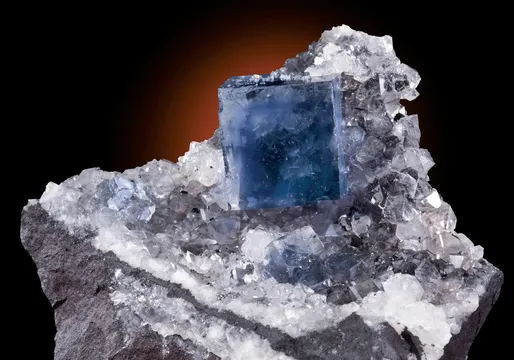
Cleator Moor, UK, a West Cumberland iron-field locality famed for reniform hematite and bright platy specularite, plus quartz habits prized by collectors.
Key facts
Cleator Moor is one of the great names of the West Cumberland iron-ore field: a cluster of old hematite mines on the western flank of the Lake District, where iron-rich fluids invaded Carboniferous limestones and converted them into heavy, red-brown to steel-black ore. For specimen collectors the place matters far beyond its industrial tonnage. Cleator Moor is a classic source of hematite in two highly collectible styles—reniform “kidney ore” and bright platy specularite—and of the famous short, pseudohexagonal, bipyramidal quartz habit long associated with Cumberland specimens. The best pieces have a theatrical contrast: smoky, colorless, or internally red quartz perched on sparkling black specular hematite, sometimes with reddish kidney ore visible underneath and small additions of calcite or dolomite.
Regional View
Country View
In geological terms Cleator Moor sits in the exposed northern part of the West Cumbrian orefield, between the Frizington and Egremont mining districts. The ore was not a simple bedded ironstone but a replacement deposit: limestone was metasomatically altered to hematite along faults, joints, and favorable limestone horizons, with preserved bedding, shale partings, and even fossil textures showing how completely the carbonate host could be transformed. Vugs and open cavities in the ore and adjoining wall rock supplied the collectible spar minerals, with quartz and hematite forming the locality’s signature association.

Photo: James St. John / Wikimedia Commons

Photo: Rob Lavinsky, iRocks.com / Wikimedia Commons
Historically the field supplied the high-grade, low-phosphorus hematite needed for Bessemer steel, and Cleator Moor itself grew with extraordinary speed as the mines, furnaces, railways, and immigrant labor force expanded in the nineteenth century. The locality name on specimen labels is often deliberately broad—“Cleator Moor,” “Cleator Moor Iron Mines,” or “West Cumberland Iron Field”—because old pieces were commonly saved as cabinet minerals without a precise pit name. Even so, Cleator Moor specimens have a look experienced collectors recognize at once: compact clusters of stubby quartz pyramids, glittering black plates of specularite, red hematite inclusions, and the dense, rounded surfaces of kidney ore.
Search for specimens: View all specimens from Cleator Moor, UK
Cleator Moor is best treated by collectors as a district locality rather than a single shaft. The Mindat-listed Cleator Moor Iron Mines are a group of mines in the old Cumberland part of present-day Cumbria, with the locality centered near NY025145, about 6 km southeast of Whitehaven. The documented mineral list is modest but important: hematite, quartz, aragonite, baryte, calcite, dolomite, fluorite, goethite, hausmannite, lepidocrocite, pyrite, and pyrolusite, with hematite varieties including kidney ore and specularite, and quartz varieties including rock crystal and smoky quartz.
The ore belongs to the West Cumbrian hematite field, a narrow belt extending from the Lamplugh area southward toward Calder Bridge. In the Cleator Moor–Frizington–Egremont sector, hematite bodies occur chiefly as irregular or flat-lying replacements of Carboniferous limestone, particularly favorable units within the Chief Limestone Group. Faults and joints provided the plumbing, while permeable Permo-Triassic rocks such as the St Bees Sandstone and Brockram helped localize mineralizing fluids where they directly overlie limestone. BGS work describes the ores as overwhelmingly hematite—massive ore, kidney ore, pencil ore, and specularite—with only small proportions of metallic accessories and spar minerals.
The current genetic model invokes warm, highly saline fluids moving through the East Irish Sea Basin and the western margin of the Lake District. These brines carried iron and interacted with limestone, replacing carbonate by hematite and leaving small open spaces where quartz, calcite, dolomite, aragonite, baryte, and fluorite could crystallize. Fluid-inclusion data from quartz, fluorite, and calcite in the broader field indicate hypersaline fluids at temperatures up to about 120°C. Paleomagnetic work has suggested a Permian or Early Triassic age for much of the mineralization, though older literature contains competing views on whether the iron was derived from deeper hydrothermal sources, Permo-Triassic sediments, granites, or iron-rich red beds.
The named mines around Cleator Moor include Crowgarth, Crossfield, Todholes, Jacktrees, Montreal, Longlands, Cleator Moor Mine, Cleator Mine, Fawncross, and related pits recorded in mining-cavity and local-history sources. Crowgarth was associated with Lord Leconfield, while Montreal Mine was opened by John Stirling’s interests and is especially notable because it functioned as both a coal and iron-ore mine. The Montreal mine was sunk in 1862 after Stirling’s earlier borings at Todholes found a rich irregular hematite deposit only a few feet below surface. Longlands Mine, southwest of the town near the River Ehen, first produced ore in 1879 and developed four pits between 1879 and 1904; by 1924 the workings had been abandoned.
Industrial activity around Cleator Moor was tightly connected to the surrounding furnaces and railways. The Whitehaven, Cleator and Egremont Railway was built to serve the orefield, ironworks, and associated mines, while local subsidence was serious enough to require railway deviations and engineering works. In the Montreal area, the River Keekle was carried across mined ground in an artificial steel conduit known locally as the “black ship.” At Longlands, water from the River Ehen was a persistent problem; after abandonment, low-lying ground subsided and flooded, ultimately becoming Longlands Lake, now a country-park nature reserve.
The best specimen material came from vugs and ore cavities rather than from the bulk ore itself. Classic Cleator Moor pieces show small to medium-sized bipyramidal quartz crystals on black specularite, sometimes with bubbly reddish-gray kidney ore on the underside. Some specimens show quartz as clear to milky “Cumberland habit” crystals; others are smoky, and some are red from abundant hematite inclusions. The finest examples have sharp quartz with glassy luster, undamaged terminations, and enough hematite matrix to show both the specular and kidney-ore character of the district. Old dealer and auction records also document calcite and dolomite as minor associated minerals on good quartz–hematite pieces.
There is no modern specimen-producing operation at Cleator Moor. The old mines are closed, many workings are flooded, and subsidence remains part of the landscape history. Longlands Lake is accessible as a public nature reserve, and the C2C cycle route passes through the former mining country, but underground collecting is not a reasonable or safe expectation. Any surface collecting on spoil or disturbed ground should be approached cautiously, with landowner permission and with awareness that mine cavities, unstable ground, and protected public amenity areas all affect access. Most serious collectors acquire Cleator Moor material through old collections, British-mineral dealers, and occasional estate or auction dispersals.
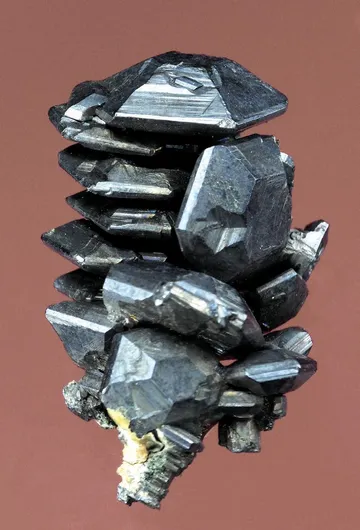
Hematite is the defining mineral of Cleator Moor, occurring as dense massive ore, rounded reniform “kidney ore,” sparkling black specularite, and the finely divided red material that stains and colors associated quartz. Collectible pieces are usually small cabinet to cabinet size, although old ore masses and museum specimens can be larger; the desirable cabinet material shows bright metallic blades or scales of specularite supporting sharp quartz, or rounded kidney-ore surfaces with strong form and reddish-brown to steel-gray color. Quality here is not simply a matter of size: the best Cleator Moor hematite has a lively, mirror-like sparkle, contrasting textures, and clean association with bipyramidal quartz, while ordinary pieces are massive, bruised, or too ore-like to display well.
Quartz from Cleator Moor is prized for its compact Cumberland habit: short, pseudohexagonal, bipyramidal crystals with little or no prism development, commonly perched on specular hematite or kidney ore. Crystals are typically colorless, milky, smoky, or brick-red to deep red from hematite inclusions; many good examples have crystals in the centimeter range, with documented specimens showing sharp smoky crystals to about 1.6–2.5 cm and especially fine old pieces carrying glassy crystals to roughly 2.1 cm tip to tip. The strongest examples combine sharp form, transparency or rich smoky color, undamaged pyramids, and a sparkling hematite matrix; lesser examples have the right habit but are dull, chipped, detached from matrix, or mislabeled simply as “beta quartz,” a visual comparison rather than a true high-temperature quartz identity.
Other documented minerals from the Cleator Moor Iron Mines include aragonite, baryte, calcite, dolomite, fluorite, goethite, lepidocrocite, pyrite, pyrolusite, and the manganese oxide hausmannite. The locality is not chiefly a type-locality district; its mineralogical importance rests instead on classic crystallized hematite–quartz associations and on the small suite of vug minerals formed in and beside the ore. Baryte, calcite, dolomite, aragonite, and fluorite are the principal spar minerals to watch for on old labels, while hausmannite and pyrolusite are notable manganese records in a field otherwise dominated by iron oxides. A published Cumberland Geological Society note also discusses reported siderite encrusting kidney ore at Crowgarth, while emphasizing that surviving confirmatory specimens were not known to the author, so such labels deserve scrutiny.
Cleator Moor specimens are classic, scarce, and label-sensitive. The most desirable pieces are old-time quartz on hematite, especially matrix specimens showing the Cumberland habit on bright specularite, with kidney ore or minor carbonate association as a bonus. Fine examples do appear on the market, but not continuously; the mines are closed, and the supply is essentially recycled from old British and American collections. Small, attractive miniatures can still trade at accessible prices, while exceptional, aesthetic small-cabinet specimens with sharp smoky quartz, sparkling hematite, and little damage are much more competitive.
The main authenticity issue is locality and terminology rather than artificial treatment. “Cumberland habit” quartz has been applied to specimens from many localities, and published commentary specifically notes that such quartz has been misrepresented on labels by some dealers. A Cleator Moor label should be supported by the right association: short bipyramidal quartz on specular or reniform hematite, not merely any stubby quartz crystal. The common old phrase “beta quartz” is also misleading when applied to Cleator Moor specimens; these are ordinary low-quartz crystals whose shape resembles beta-quartz morphology to the eye.
Mislabelling within West Cumbria is common and often understandable. Old specimens may say Cleator Moor, Frizington, Egremont, Cumberland, West Cumberland Iron Field, or simply “Cumberland,” and many were collected or sold before modern locality precision mattered. If a specimen is labelled only Cleator Moor but has a style equally consistent with Florence, Bigrigg, Frizington, or another West Cumbrian hematite mine, it is best regarded as a historically plausible district specimen unless an old mine-specific label accompanies it. Conversely, pieces with barite as the dominant show mineral may belong more naturally to the broader Frizington–West Cumberland tradition than to Cleator Moor proper, unless the label or provenance is strong.
Condition is critical. Quartz terminations chip easily, and the high-contrast geometry of the habit makes even small bruises obvious under a loupe. Specular hematite can show scuffs, rubbed edges, or dulled surfaces where old specimens were stored loose. Kidney ore is tough but may be naturally cavernous or broken where detached from an ore cavity wall. Many pieces have peripheral trimming damage from pocket extraction; this is normal if the display face is clean. Avoid washing old specimens aggressively: hematite-stained quartz and fine specularite surfaces are best cleaned gently, and old labels should be preserved as part of the specimen’s value.
Fluorescence is not a collecting driver for Cleator Moor material. The locality is about luster, habit, texture, and historical significance. A first-rate piece should display from a normal cabinet distance: glittering black hematite, crisp quartz pyramids, good contrast, and a clear old British iron-field identity.
Before the mining boom, Cleator Moor was literally moorland above the older village of Cleator. The transformation came with hematite. Local histories describe a settlement of only 763 people in 1841 swelling to 10,420 by 1871, with more than a third of the town Irish. The influx was not incidental to the minerals: the rich iron ore beneath the fells demanded labor, and Cleator Moor acquired the nickname “Little Ireland” because so many families arrived from Irish mining and rural districts to work the ore mines, coal pits, furnaces, railways, and mills. For collectors, that social history is part of the label. A small quartz on specularite from Cleator Moor is not just a mineral specimen; it is a remnant of a town built almost overnight on hematite.
John Stirling’s career gives the district one of its mining legends. In 1858 he began borings at Todholes in Cleator and was reportedly close to giving up when the drill found a rich, irregular hematite body only a few feet below the surface. Four years later came his great Cleator Moor success: the Montreal Mine, sunk in 1862 and remembered as an unusual combined coal and iron-ore mine. That pairing explains why some old Cleator Moor records show both coal and iron production and why the district’s mining landscape was so complicated—shafts, coal seams, hematite replacement bodies, furnaces, railways, and subsidence all competing in the same small townscape.
The ground itself could not always tolerate what was taken from beneath it. In Cleator Moor the ore bodies were shallow enough in places that mines followed them upward, and subsidence became a defining local problem. The BGS memoir records that the River Keekle was carried across the Montreal mining ground in a steel conduit called the “black ship,” a vivid piece of industrial improvisation: a river boxed and bridged so mining could continue beneath and around it. Elsewhere, railways had to be rerouted because the mining ground moved under them. The same subsidence story shaped Longlands. There, four pits were sunk between 1879 and 1904, flooding from the River Ehen was a persistent danger, and after the mines were abandoned in 1924 the low ground eventually flooded to form Longlands Lake. Today walkers circle calm water and woodland where shafts and iron ore once drove the local economy.
The old specimen trade left its own peculiar monuments. Some West Cumberland quartz–hematite pieces were not kept as single cabinet specimens at all; they were broken up and assembled into “spar boxes” or “spar cases,” miniature grottoes meant to reproduce the glittering crystal-lined cavities seen underground. To a modern collector this is both charming and painful: charming because it preserves a miner’s-eye memory of the vugs, painful because some fine natural groups were sacrificed to make them. When an intact Cleator Moor specimen survives with smoky bipyramidal quartz still on bright specular hematite, it has escaped both the mine hammer and the Victorian spar-box maker.
Cleator Moor’s wider history was not always picturesque. The town’s rapid growth brought sectarian tension as well as work. In April 1871, when the anti-Catholic preacher William Murphy appeared at Whitehaven, Catholic iron-ore miners from Cleator Moor marched to confront him; accounts describe 200 to 300 miners arriving at the Oddfellows Hall, where Murphy was assaulted before a meeting began. In July 1884, an Orange Order demonstration at Cleator Moor became a deadly riot. Marchers, including eight bands, passed the Catholic church and gathered at Wath Brow; as they returned toward the station, fighting broke out, stones were thrown, and some marchers used revolvers, cutlasses, and pikes. Henry Tumelty, a 19-year-old Catholic postal messenger, was shot in the head and killed. The episode belongs to social history more than mineralogy, but it is inseparable from the mining town that hematite created.
_(26921445140).jpg)
