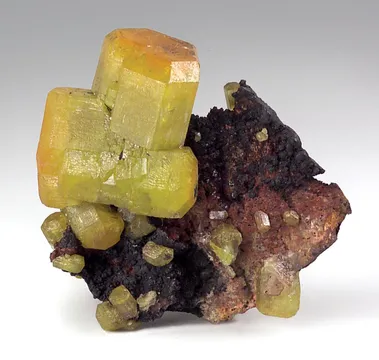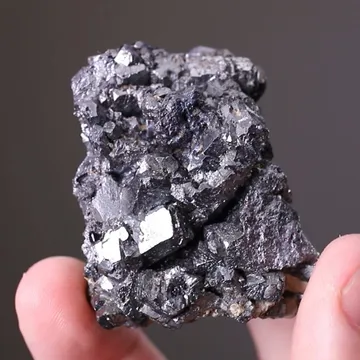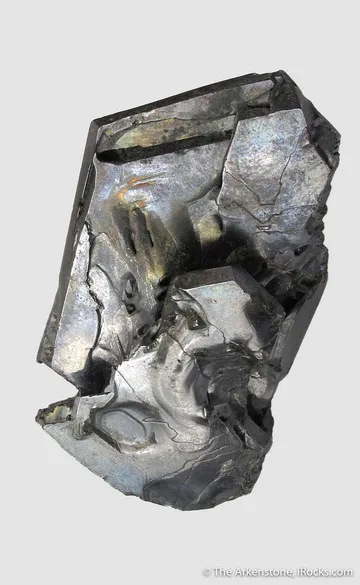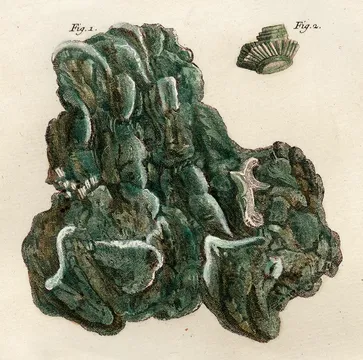
Clara Mine, Germany — Black Forest locality producing baryte and fluorite, renowned for rich mineral diversity and key type-localities like claraite.
Key facts
Clara Mine, the working baryte–fluorite mine of the Rankach valley near Oberwolfach and Wolfach in Baden-Württemberg, is one of Europe’s great collector localities and, by current mineral-count standards, one of the most species-rich mines on Earth. Its fame rests on a rare combination: a still-active industrial deposit, a long collecting culture, fresh material continually reaching a legal public collecting dump, and a mineralogy that ranges from cabinet-size baryte and fluorite specimens to some of the most coveted micromount rarities in European mineralogy.
Geologically, Clara is a hydrothermal vein system in the Central Black Forest. The principal veins cut the Variscan Black Forest gneiss complex and locally pass into or beneath Triassic Buntsandstein cover. The mine works a baryte vein and a roughly parallel fluorite vein, both crosscut and locally overprinted by the younger, quartz-rich “Diagonaltrum.” That structural intersection—where baryte, fluorite, quartz, sulfides, silver- and copper-bearing stages, later oxidizing fluids, and open cavities all overlap—is the key to the locality’s extraordinary diversity. Collectors know Clara not merely as “a barite and fluorite mine,” but as a living laboratory of secondary arsenates, phosphates, sulfates, tungstates, vanadates, carbonates, and rare mixed-anion species.
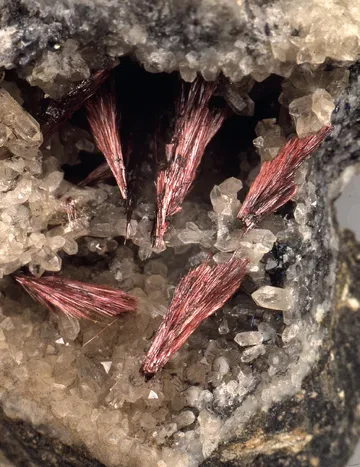
The best classic specimens have a distinctive Black Forest look: pale to water-clear fluorite cubes perched on bladed or chisel-shaped baryte; honey, caramel, white, or pinkish baryte blades in upright sprays; quartz-lined cavities carrying sulfides or secondary copper color; and small vugs in rusty, silicified baryte where blue-green, yellow, brown, or black microcrystals repay careful work under magnification. Clara is also a type-locality powerhouse, giving its name to claraite and yielding a long list of first-described species including agardite-(Ce), arsenogoyazite, bariopharmacosiderite, rankachite, nollmotzite, oberwolfachite, and slottaite.
Regional View
Country View
The mine entrance lies in the upper Rankach valley, while the processing and collecting area are down in the Kinzig valley near Wolfach-Kirnbach. That split geography matters to collectors: the underground workings themselves are an operating industrial mine, but selected run-of-mine and waste material is made available on the Mineralienhalde Grube Clara, the public collecting dump that has kept Clara specimens entering collections long after many historic Black Forest mines became closed names on old labels.

Photo: Wikimedia Commons

Photo: Wikimedia Commons
Search for specimens: View all specimens from Clara Mine, Germany
Clara Mine is situated at Benauer Berg in the Rankach valley, about 7 km north of Oberwolfach and roughly 9 km north of Wolfach, in the Central Black Forest of Baden-Württemberg. The adit locality and the industrial mine are in the Rankach valley; the processing plant and public collecting dump are at Wolfach-Kirnbach in the Kinzig valley, about 13 km from the underground workings. The mine is operated by Sachtleben Bergbau GmbH & Co. KG and remains the last active mine in the Black Forest.
The deposit is a polymetallic hydrothermal baryte–fluorite vein system. Three principal structures define the collector’s geology of Clara: the baryte vein, the fluorite vein, and the Diagonaltrum. The baryte and fluorite veins lie in the Black Forest gneiss complex, whose metamorphic history belongs to the Variscan orogeny. The baryte vein trends roughly northwest–southeast and dips steeply northeast; the fluorite vein lies east of it and is broadly parallel. The Diagonaltrum is younger, more east–west in trend, quartz-rich, and mineralogically crucial because it cuts the older baryte and fluorite structures. At these crossings, silicification, replacement of baryte and fluorite, sulfide introduction, and later oxidation created some of the richest pockets and rare-mineral associations in the mine.
The baryte vein has been described as about 600 to 650 m long and several meters thick, locally reaching far greater widths in lenses and cavities. The fluorite vein has been mined industrially since the late 1970s and is generally narrower, though locally much thicker in favorable structural positions. The Diagonaltrum is commonly much thinner—around a meter to a few meters—but its quartz, galena, chalcopyrite, and associated late minerals make it disproportionately important to specimen mineralogy. Underground, Clara is developed on multiple levels by ramps, spiral ramps, crosscuts, ore passes, and truck haulage. Modern stopes are drilled and blasted, ore is transported to Wolfach for crushing, washing, gravity separation, grinding, flotation, drying, and storage, and mined-out cavities are backfilled for stability.
Mining in the broader Benauer Berg area is recorded at least as early as 1652, and the name Clara is documented in the early eighteenth century. Modern industrial working dates from the late nineteenth century, with continuous baryte mining from 1898. The business developed through the Schwarzwälder Barytwerke and later Sachtleben; by the twentieth century the mine was supplying baryte for chemical, paper, paint, automotive, drilling, radiation-shielding, and other industrial uses. Fluorite became increasingly important in the 1970s, and fluorite concentrates were produced at the Sachtleben processing plant from 1978 onward. Silver and copper are not the principal modern commodities, but silver- and copper-bearing ore associations have long been important both economically and mineralogically.
For collectors, the decisive change in access came in 2007. Earlier generations searched the company dumps on the operating site under conditions that were exceptional but increasingly difficult to reconcile with safety and production. Since June 2007, the Mineralienhalde Grube Clara at Wolfach-Kirnbach has provided a separate, paid collecting area supplied with material from the mine. It is not a show-mine fantasy dump seeded with decorative stones; the material is genuine Clara mine rock, and its content depends on the part of the mine being worked. The dump operates on published opening days, generally with 9:00–17:00 hours on those dates, and occasional “Große Halde” events open larger production stockpiles that are normally inaccessible.
Several finds have become part of Clara lore. From June 1976 to October 1977, work on the 9th level intersected an approximately 30 m long baryte fissure that produced the famous caramel-brown “Meißelspat” specimens—chisel-shaped baryte blades that helped make Clara a cabinet-specimen locality, not merely a micromount locality. Old accounts also recall meter-scale silicified baryte boulders rich in quartz veins, dark blue scorodite to around 1 cm, and unexpected pockets of clear fluorite and snowy baryte. More recently, the public dump has continued to yield serious material: in 2024 a Silberspat-rich dump load produced clinoclase, cuprotungstite, scheelite, silver, cornwallite, azurite, malachite, azurite pseudomorphs after malachite or chrysocolla, large smoky quartz aggregates described as new for Clara, and a boulder weighing more than 100 kg with olivenite. The 2025 dump season was reported with lenoblite, anatase, chalcotrichite, cuprite, prosopite, rankachite, deep-blue fluorite, glass-clear baryte, chalcopyrite, and amethyst among finds.
Clara fluorite is most admired when it shows sharp, lustrous cubes on contrasting baryte, especially colorless, pale gray, pale blue, violet, pinkish, or deep-blue crystals with enough transparency to reveal the bladed baryte or quartz beneath. Most collector pieces are thumbnail to cabinet size, with individual cubes commonly in the millimeter to low-centimeter range; older specimens are known with especially fine water-clear cubes to about 1–1.5 cm, and exceptional pocket accounts record much larger clear crystals. The fluorite vein is a major orebody, but the prettiest specimens often come from cavities where fluorite grew with white to honey baryte, quartz, chalcopyrite, pyrite, marcasite, galena, or rusty goethitic coatings. Ordinary Clara fluorite is massive, bruised, gray, or too embedded in baryte ore; good pieces have crisp cubic form, clean separation from the matrix, attractive contrast, minimal edge bruising, and, in the best old material, a luminous clarity or soft blue tone that immediately reads as Clara.
Clara barite is the classic visual signature of the mine: bladed, tabular, blocky, parallel-growth, or chisel-shaped crystals in white, colorless, honey, pinkish, brown, caramel-brown, and iron-stained tones, commonly associated with fluorite, quartz, goethite, chalcopyrite, pyrite, and secondary copper minerals. The celebrated “Meißelspat” habit—upright, chisel-like baryte blades—comes especially to mind when discussing the 1976–1977 9th-level baryte fissure, whose caramel-brown crystals established much of the mine’s specimen reputation. Pieces range from small dump finds to large cabinet groups, and museum-quality examples can display aerial arrangements of sharp blades, phantom zoning, goethite “clouds,” second-generation overgrowths, or clear baryte crystals rising from contrasting fluorite. The difference between a common Clara barite and a first-rate one is form: sharp terminations, openness, undamaged blade edges, translucency, color zoning, and a matrix association that makes the habit legible rather than merely showing a dense mass of heavy spar.
“Baryte” is the IMA spelling of the same BaSO4 species often called barite in American usage, and Clara is one of the European localities where the name feels especially at home because so much of its collecting language is tied to Baryt and Schwerspat. Clara baryte occurs as the main industrial ore, but the collector material is cavity-grown: clear to honey tabular crystals, pink plates on fluorite, white blades with quartz, rust-brown Meißelspat, and complex parallel stacks from vugs in the baryte vein and at structurally disturbed intersections. Fine baryte from Clara should be judged not only on size but on sculptural quality—open bladed architecture, glassy faces, color contrast, and freedom from crushing—because much of the mine’s baryte is massive ore or brecciated vein fill rather than display-quality crystal groups. The locality’s baryte is also a substrate for many of its best micro-minerals, so matrix pieces with intact tiny cavities can be more important than showier trimmed plates if the vugs carry rare arsenates, tungstates, or copper secondaries.
Quartz at Clara is not just a gangue afterthought; it is central to the Diagonaltrum and to many of the mine’s most mineralogically interesting pockets. It occurs as massive silicification, drusy coatings, small rock-crystal groups, smoky quartz aggregates, amethyst, chalcedony and other silica varieties, and as veinlets through baryte or fluorite ore. Quartz-lined cavities can host sulfides and bright secondary species—scorodite, copper arsenates, tungstates, and uranium minerals among them—so collectors often keep quartz-rich Clara pieces for the microscope even when the quartz itself is modest. A good Clara quartz specimen has clean, sharp, lustrous crystals and, ideally, a locality-specific association such as baryte blades, fluorite cubes, galena, chalcopyrite, goethite, or colored microcrystals in protected pockets; ordinary examples are simply massive white quartz or broken druse with little mineralogical story.
Beyond the four major guide species, Clara’s real distinction is the breadth of its rare secondary suite. The mine has documented about 480 valid mineral species and 19 valid type-locality species in current Mindat reporting, with additional first-recorded or unnamed phases. Type-locality minerals include agardite-(Ce), arsenbrackebuschite, arsenogorceixite, arsenogoyazite, bariopharmacosiderite, benauite, bismutostibiconite, claraite, cualstibite, cualstibite-1M, hyblerite, nollmotzite, oberwolfachite, phosphofibrite, phyllotungstite, rankachite, slottaite, and tungstibite. The rare suite reflects repeated oxidation and low-temperature remobilization of primary baryte–fluorite–quartz associations containing Cu, Ag, Pb, Bi, Co, Ni, U, Sb, As, W, V, Sr, Ba, and REE components. For the serious collector, Clara is therefore two localities at once: a cabinet locality for baryte and fluorite, and a microscope locality where a pinhead-sized cavity may carry a species first recognized from this very mine.
Clara material is widely available, but quality is highly uneven. The mine is active and the public dump receives fresh material, so common fluorite, baryte, quartz, pyrite, chalcopyrite, goethite, malachite, azurite, and mixed baryte–fluorite vein pieces appear regularly. Fine old cabinet pieces with undamaged clear fluorite cubes on sharp baryte, caramel-brown Meißelspat, or aesthetically open baryte sprays are much scarcer and command a premium. Micromount material is abundant in potential but not in certainty: many rare Clara species require analytical confirmation, and visually similar green, blue-green, yellow, brown, and black crusts can be treacherous.
The most important authenticity issue is not widespread faking but identification. Clara is so species-rich that optimistic labels are common, especially among secondary copper arsenates, antimonates, tungstates, vanadates, REE phosphates, and alunite-supergroup minerals. “Agardite,” “cornwallite,” “olivenite,” “duftite,” “bariopharmacosiderite,” “rankachite,” “cualstibite,” and similar labels should be treated cautiously unless the specimen has a reliable collection pedigree, came from a knowledgeable Clara specialist, or has been analyzed. Old dump labels may also obscure material history: Mindat notes that in 1991, material from a Dorothea Mine exploration adit was temporarily dumped at the Clara dump, so unusually atypical pieces with early-1990s dump provenance deserve careful scrutiny.
Condition is the main physical problem. Fluorite cubes bruise easily along edges and corners, baryte blades cleave and chip, and many Clara matrices are heavy, friable, or iron-stained. Drusy quartz can look sturdy while protecting fragile micromineral crusts that are easily stripped by acid or vigorous cleaning. Avoid aggressive chemical cleaning unless the species are known: hydrochloric acid, oxalic acid, or reducing agents may damage carbonates, sulfates, phosphates, arsenates, uranium secondaries, or delicate hydrated species. Water is safer for common baryte–fluorite–quartz pieces, but even washing can detach clay-filled microcrystals. Micromount collectors should examine pieces first under magnification before trimming or soaking.
Fluorescence can be useful but is not diagnostic. Some Clara fluorite shows violet to purple fluorescence, and collector reports and photo notes mention moderate fluorescence in certain classic fluorite-on-baryte specimens. Baryte from Clara is not normally bought for fluorescence, though individual pieces can respond under ultraviolet light. Treat UV reactions as supporting observations only; they should not be used to identify the rarer secondary phases.
For radioactive-mineral collectors, Clara does produce uranium-bearing species such as uranophane, torbernite-group material, zeunerite, zippeite, and related secondary U phases. Most specimens are tiny and pose little risk if handled sensibly, but keep dusty uranium-bearing material boxed, avoid grinding or dry brushing, wash hands after handling, and store labels with any analytical or detector notes. Arsenate-rich material likewise deserves basic hygiene: do not lick, saw dry, or make jewelry from questionable secondary crusts.
The old story of Clara begins with a treasure that was never simply a vein on a mine plan. Around Benauer Berg, legend spoke of a vanished mining town called Benau, once so rich from silver that its people abandoned Christian devotion and worshipped a silver or golden calf. Divine punishment followed: the town was destroyed, the calf was hidden in the mountain, and generations of miners searched the rock for the wealth buried within it. In the language of later writers and collectors, the “Golden Calf” became a mythic shorthand for the richness of the Benauer Gang, the old ore structure that modern collectors know through Clara Mine.
The modern dump has its own initiation stories. Wolfgang Wendel recalled visiting the Clara dump as a teenager, when exceptional crystals could still be found without a loupe. His mineral club president attacked a roughly 1-cubic-meter, partly silicified baryte boulder and spent the rest of the morning hauling pieces away after revealing quartz veins set with dark blue scorodite crystals to 1 cm. Nearby, Wendel, then fifteen, struggled with another boulder until collector Walter Konrad brought down heavy blows with a 10 kg sledgehammer. When it split, the interior opened into step-like, water-clear fluorite crystals, 5 cm on edge, carrying snow-white tabular baryte crystals to 5 cm. Later trimming of another boulder from the same day produced acicular emplectite more than 1 cm long and free-standing olive-green bariopharmacosiderite crystals.
The 1976–1977 baryte fissure on the 9th level is the sort of discovery that explains why old Clara labels still quicken a collector’s pulse. Over roughly sixteen months, from June 1976 to October 1977, the mine encountered a baryte cleft about 30 m long. Its caramel-brown chisel-shaped baryte—the famous Clara Meißelspat—gave the mine one of its defining specimen styles. These were not anonymous white industrial baryte masses, but sculptural blades: upright, sharp, honey to caramel, sometimes translucent, often with the kind of geometric strength that survives in memory long after one has seen hundreds of ordinary baryte plates.
In 2023, German television found that the magic of the dump had not vanished. SWR described summer weekends when mineral friends from across Europe came to Oberwolfach, digging and hammering until “the hammers glow.” One collector from Saarland put the feeling perfectly: “Immer die Hoffnung, dass du was Neues findest - noch toller als das, was du daheim schon in der Vitrine hast.” Always the hope that you will find something new—something even better than what is already in your display case. That sentence is perhaps the purest description of Clara collecting: a working industrial mine, a legal dump, and the persistent possibility that the next broken block might contain a mineral you have never seen before.
The 2024 reopening under Heiko Titze’s operation of the Mineralienhalde started with the sort of details collectors love to retell. On Saturday, March 30, 253 visitors crowded onto the dump, the highest opening-day number reported there. Fresh Silberspat material arrived from the mine and produced clinoclase, cuprotungstite, scheelite, silver, cornwallite, azurite, malachite, azurite pseudomorphs after malachite or chrysocolla, huge smoky quartz aggregates not previously described from Clara, and a boulder over 100 kg carrying olivenite. It is rare for a public collecting site in modern Europe to produce both family-level pyrite excitement and serious specialist mineralogy in the same season; Clara does exactly that.