Champion Mine, USA — Mono County, California: famed for andalusite-rich quartz with rutile crystals and rare phosphate minerals, a site prized by collectors.
Key facts
The Champion Mine that matters most to mineral collectors is the Champion Sillimanite Mine—also called the Champion Spark Plug Mine, Jeffrey Mine, White Mountain Mine, Champion Andalusite Mine, Vulcanus workings, and Black Eagle area—on the west flank of White Mountain in Mono County, California. Its fame rests on an unusual andalusite-rich quartz body developed in intensely altered aluminous rocks of the White Mountains, where high-grade refractory ore was mined for spark-plug ceramics and where a remarkably specialized phosphate–sulfate assemblage made the locality a collector classic. The specimens that announce the locality at a glance are sharp, black to wine-red rutile crystals set in silky white, tan, or golden pyrophyllite; pale pseudo-cubic woodhouseite crystals sprinkled over quartz; and cabinets of white quartz carrying rare alunite-group phosphates, blue lazulite–scorzalite series minerals, augelite, topaz, trolleite, svanbergite, and related rarities.
The site is historically memorable because its industrial story and its mineralogical story are inseparable. The ore was not a metallic ore but andalusite, mined because it could be converted into a heat-resistant ceramic useful in early spark plug manufacture. In the hands of Champion Spark Plug Company and Champion Sillimanite, Inc., this remote mountainside became a mule-supported industrial outpost with camps, laboratories, hydroelectric power, compressor equipment, hand sorting, and sacks of ore packed down steep trails. At the same time, the mine’s managers and chemists were observing the odd phosphate minerals in the quartz veins; woodhouseite, CaAl3(SO4)(PO4)(OH)6, was first described from here and named for C. D. Woodhouse, the mine manager and an active mineral collector.
Regional View
Country View
In aesthetic terms Champion is a locality of contrast rather than gemmy abundance. Its best rutile specimens have the hard, metallic flash collectors associate with Graves Mountain or Swiss Alpine rutiles, but here the crystals sit in pale pyrophyllite and diaspore-rich matrices that give the pieces an unmistakable White Mountain character. Woodhouseite is usually a connoisseur’s mineral: small, pale, and best appreciated under magnification, yet visually rewarding when the pseudo-cubic crystals are perched on clean quartz faces. The locality also has a confusing marketplace footprint because “Champion Mine, USA” can refer to more than one American mine; pink rhodochrosite–pyrite pieces sold under the name generally belong to the Champion Mine at Cinnamon Pass, Hinsdale County, Colorado, rather than to the California andalusite mine.


Search for specimens: View all specimens from Champion Mine, USA
The classic Champion Mine locality is on the western face of White Mountain, above Jeffrey Mine Canyon, in the White Mountains of Mono County, California, north of Bishop and east of the Chalfant Valley. Published locality accounts place the mine in a steep alpine-desert setting where access historically depended on mule trails rather than a mine road. Mindat records the locality as Champion Mine, White Mountain Peak, White Mountains, Mono County, California, USA, with historical names including White Mountain Mine, Jeffrey Mine, Champion Sillimanite Mine, Champion Andalusite Mine, Vulcanus, and Black Eagle. The deposits and workings are spread over a sizable slope rather than concentrated at a single portal; older locality descriptions divide them into Vulcanus workings, the Black Eagle or Blackhawk tunnel area, the Diaspore Workings, the phosphate-pegmatite exposure, and the Vulcanus No. 8 tunnel.
Geologically, the California Champion is a metamorphic andalusite deposit hosted in quartzite and aluminous schist, modified by high-temperature hydrothermal and pneumatolytic alteration related to nearby granitic intrusive activity. J. F. “Fen” Cooper’s field-based account describes an andalusite-rich quartz mass enclosed in aluminiferous schistose rock, with the quartz body about two miles long and generally tens of feet thick, striking northwest and dipping steeply southwest. A USGS resource summary gives a more mine-focused ore zone as roughly 500 feet long, as much as 300 feet wide, and 50 feet thick, with andalusite containing up to about 3 percent rutile and occurring in the White Mountains fault zone. The ore occurred as irregular stringers, lenses, segregations, and high-grade masses associated with a large quartz body, bounded by altered sericite schist and quartz monzonite porphyry.
The ore mineral was andalusite, Al2(SiO4)O, commercially important because Champion converted it into artificial sillimanite or mullite-like refractory ceramic products for spark plug insulators and laboratory porcelain. The richer andalusite occurred as loose intergrowths of prismatic crystals, commonly blue-gray and sometimes pale green, with quartz, pyrophyllite, diaspore, corundum, rutile, topaz, pyrite, lazulite, and later phosphate–sulfate minerals in fractures and cavities. The walls and altered rocks around the quartz mass contain andalusite, diaspore, corundum, pyrophyllite, muscovite, and iron-oxide alteration; the mineralogically richest pockets are in quartz and in the unusual phosphate-pegmatite-like body near the quartz–schist contact.
The mineralization can be read as a series of environments. The andalusite masses supplied the ore and produced blue-gray prismatic andalusite, pockets with lazulite or scorzalite, pyrite, rutile, and accessory topaz. The surrounding quartz bodies and veins provided the best collector ground for woodhouseite, svanbergite, augelite, topaz, quartz crystals, and vug minerals. The phosphate-pegmatite zone is a small but extraordinary rock composed largely of white to colorless augelite and blue trolleite, with pockets carrying augelite crystals, trolleite, hydroxylapatite or carbonate-fluorapatite, diaspore, crandallite, goyazite, viseite, natroalunite, and related phases. The Diaspore Workings and Blackhawk Tunnel are especially important for rutile: the former yielded larger rutile crystals embedded in diaspore, while the latter produced somewhat smaller but often excellent crystals in pyrophyllite veins.
Mining began after the andalusite deposit was recognized in the 1910s and became commercially attractive during the spark-plug era. Development accelerated under the Champion Spark Plug Company and its California subsidiary, Champion Sillimanite, Inc. The mine was active principally from the early 1920s through the mid-1940s, with published summaries giving about 26,457 tons of andalusite ore produced between 1920 or 1921 and 1945, averaging about 53 percent andalusite. The operation included a 500-foot adit, a 400-foot adit, large stopes, shorter tunnels, pits, hand sorting, camps, and mule transport down to the valley. Cooper’s account emphasizes that the mine was unusually modern for its isolation, with electrical power supplied from a hydroelectric plant on Pine Creek or the Jeffery ranch area and transmitted uphill to run compressors and camp equipment.
The principal mine names collectors encounter on labels correspond to different parts of the workings. Vulcanus No. 1 was the main early producer and remains especially important for woodhouseite, with fracture faces in quartz carrying pale tan, pale yellow, pinkish tan, or pale pink pseudo-cubic crystals. The phosphate-pegmatite above the Vulcanus No. 1 workings is small but mineralogically dense and rewards careful micromount-level examination. The Blackhawk or Black Eagle tunnel area is a key source for rutile in pyrophyllite and for pyrophyllite specimens, and also produced protected soluble sulfates such as halotrichite. The Diaspore Workings produced rutile in massive diaspore. Vulcanus No. 8 is the southern locality of special interest for scorzalite, larger but less abundant woodhouseite, quartz crystals, schorl, orange svanbergite, and quartz–svanbergite–topaz associations.
Collecting access today should be approached with caution and respect. Historical sources describe the property as long abandoned to collectors, and later recreational accounts describe the old camp as a remote backcountry site maintained by volunteers; however, old patented claims, public-land status, modern land-management rules, unstable workings, private or conservation interests, and seasonal road and trail conditions must be verified before any visit. The terrain is steep, exposed, washed out in places, and high enough that water, weather, and altitude matter. The mine openings and dumps should be treated as hazardous abandoned mine features, not casual rockhounding stops. Collectors who pursue the locality today generally work old dumps, talus, and broken quartz rather than entering workings; the best finds historically came from fresh fracture surfaces, pockets in quartz, and pyrophyllite- or diaspore-rich boulders near the named workings.
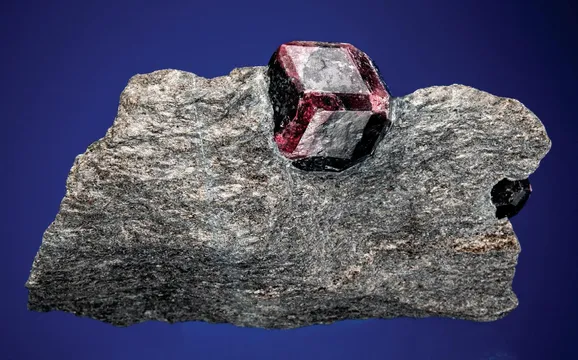
Champion rutile is the locality’s most recognizable display mineral: sharp, lustrous TiO2 crystals ranging from common small embedded crystals to exceptional pieces approaching 2 inches across in the Diaspore Workings, with somewhat smaller crystals in pyrophyllite veins around the Blackhawk Tunnel. Mindat describes the typical color as wine-red to red-brown, and good specimens often read almost black in hand specimen until a strong light reveals internal red reflections. Ordinary pieces are single small grains or partly buried crystals in massive aluminous rock; the desirable ones show isolated, well-formed tetragonal crystals, bright metallic to submetallic luster, crisp faces, red flashes, and a pale pyrophyllite or diaspore matrix that frames rather than overwhelms the crystal. Simple twins occur, but the locality is most admired for chunky, sharp, solitary crystals on contrasting matrix.
Rhodochrosite attributed to “Champion Mine, USA” should be separated carefully from the California andalusite locality: the documented rhodochrosite specimens in this market context match the Champion Mine at Cinnamon Pass, Park Mining District, Hinsdale County, Colorado, a high San Juan Mountains silver-base-metal locality known for pale pink MnCO3 rhombohedra on quartz and sulfides. The best pieces from the Colorado Champion show small compressed rhombohedra or rosette-like groupings of light to medium pink rhodochrosite associated with pyrite, sphalerite, chalcopyrite, bornite, or quartz; ordinary pieces are massive, pale, or sparse crusts with little relief. Because the California Champion Sillimanite Mine is famous for rutile, pyrophyllite, quartz, and phosphate–sulfate species—not rhodochrosite—any pink carbonate specimen labeled only “Champion Mine, California” deserves a second look, especially if it carries pyrite and quartz rather than pyrophyllite and rutile.
At the California Champion Sillimanite Mine, pyrite is not the trophy species but is a common associate of the andalusite masses and quartz bodies, occurring as cubes, pyritohedral crystals, and irregular masses within andalusite-rich rock. Cooper noted that larger crystals are often highly fractured and may break into small fragments when removed from matrix, which makes clean, intact pyrite specimens from the locality less common than the mineral’s abundance might suggest. The collector value here lies in context: pyrite with andalusite, lazulite or scorzalite, quartz, or pyrophyllite helps tell the Champion paragenesis, while pyrite–rhodochrosite associations are more consistent with the Colorado Champion Mine at Cinnamon Pass. Strong Champion pyrite pieces are stable, well-exposed crystals with a readable form and meaningful association; weak examples are crumbly, oxidized masses or goethite replacements without sharp morphology.
Pyrophyllite is abundant in the Champion rocks and is central to the locality’s specimen identity because it supplies the pale, silky, radiating matrix that makes the rutile crystals pop. It occurs in the aluminiferous schists enclosing the quartz body, in seams through andalusite-bearing rock, in the Diaspore Workings as iron-stained radiating seams carrying rutile, and in the Blackhawk Tunnel where pyrophyllite seams commonly enclose small brilliant rutile crystals. Specimens range from white radiating masses and tan silky seams to golden-brown fan aggregates; the best pieces have lustrous, well-formed radiating blades or fans, attractive color contrast, and sharply seated rutile or muscovite associations. Ordinary pyrophyllite from the site is friable, iron-stained, or massive and is valued mainly as matrix unless the radiating habit is strong.
Woodhouseite is the Champion Mine’s signature rare species and type-locality mineral, first described by Dwight M. Lemmon from small quantities in quartz veins adjoining and penetrating the commercial andalusite deposits. At Champion it occurs in fractures and cavities in quartz, usually as pseudo-cubic crystals but occasionally as less modified trigonal crystals, with colors from white and pale yellow to pale pink or pinkish tan; strontium-rich material can show stronger pink tones. The Vulcanus No. 1 workings are the classic source, where small crystals may be scattered singly or crowd fracture plates, and some of the finest specimens show tan pseudo-cubes sprinkled over prismatic quartz faces. Vulcanus No. 8 yielded fewer but sometimes larger pale yellow crystals, reportedly to about 1/4 inch, in cavities among intergrown quartz with occasional fine acicular schorl. Quality is determined by crystal sharpness, luster, color, placement on clean quartz, and freedom from bruising or clay masking.
Quartz is ubiquitous at the California Champion Mine, both as massive bull quartz surrounding and enclosing the andalusite bodies and as seams, pods, and vuggy zones in the altered schist. Its importance is less as a standalone species and more as the stage on which Champion’s phosphate–sulfate suite appears: woodhouseite, svanbergite, augelite, topaz, schorl, rutile, lazulite–scorzalite, and other rarities occur in quartz cavities and fractures. Crystals range from ordinary prismatic forms to tabular-looking crystals flattened on one pair of prism faces; some show corroded, rounded surfaces, small orange overgrowths at Vulcanus No. 8, scepter-like terminations, or distorted, bent forms in seams and pockets. The best quartz specimens are clean enough to display the associated rare minerals, especially pale pseudo-cubic woodhouseite or tan-to-orange svanbergite, while ordinary pieces are massive white quartz with only sparse inclusions.
Other documented California Champion minerals make the locality far broader than the six species above. Andalusite was the ore and can occur as blue-gray to pale green prismatic masses, sometimes with lazulite or scorzalite in cavities. Augelite was the first recognized U.S. occurrence and occurs as colorless to pale yellow tablets, notably in quartz pockets and in the phosphate-pegmatite. Lazulite and scorzalite occur as dark blue masses and occasional crystals, with magnesium-rich lazulite more characteristic of the northern portion and iron-rich scorzalite more typical in the south. Trolleite forms pale blue to greenish material with augelite in the phosphate-pegmatite. Svanbergite, the strontium analogue in the alunite group, has been reported as orange masses and pseudo-cubic crystals from Vulcanus No. 8 and related quartz seams. Natroalunite, baryte, topaz, diaspore, corundum, fluorite, goethite after pyrite, halotrichite, phosphosiderite, crandallite, goyazite, viseite, strengite, sulfur, muscovite, hematite, and other phases round out an unusually complex aluminous phosphate–sulfate assemblage.
The main authenticity issue with Champion specimens is not widespread fakery but locality confusion. “Champion Mine” is a common mine name in the United States, and at least two localities are active in the specimen market: the California Champion Sillimanite Mine of Mono County, famous for rutile, pyrophyllite, woodhouseite, and rare phosphates; and the Colorado Champion Mine at Cinnamon Pass, known for rhodochrosite with quartz and sulfides. A specimen labeled merely “Champion Mine, USA” needs mineralogical cross-checking. Rutile in pale pyrophyllite, woodhouseite on quartz, and quartz–svanbergite–topaz combinations point strongly to California. Pink rhodochrosite rhombohedra on pyrite, sphalerite, chalcopyrite, bornite, or quartz point strongly to Colorado. A “Champion Mine, California” rhodochrosite label should be considered suspect unless accompanied by unusually strong provenance or analysis.
Condition varies sharply by species. Rutile crystals are hard and durable, but their pyrophyllite and diaspore matrices can be soft, cleavable, flaky, or iron-stained; many pieces have contact points where crystals were embedded and exposed by breaking rather than naturally freestanding. Pyrophyllite fans and seams bruise easily and shed small flakes. Pyrite from the andalusite bodies can be fractured, crumbly, or oxidized, and goethite pseudomorphs after pyrite occur at the locality, so intact fresh pyrite is preferable to unstable granular material. Woodhouseite crystals are small and may be partly masked by clay, quartz overgrowths, or abrasion; magnification is often needed to judge quality. Soluble sulfate minerals from protected areas, especially halotrichite-like material, should be kept dry and handled as delicate, humidity-sensitive specimens.
There are no widely documented treatments or manufactured fakes specific to Champion rutile, pyrophyllite, or woodhouseite, but repairs and trimming are possible, particularly on older rutile specimens where the value lies in one exposed crystal on soft matrix. Watch for glued rutile crystals on pyrophyllite or mismatched matrix surfaces; natural Champion pieces usually show the rutile seated into the pyrophyllite or diaspore rather than perched on a gluey contact. On woodhouseite, verify that the crystals are not simply pale quartz or altered feldspar by checking habit, luster, and association. On quartz–svanbergite–topaz pieces, species identification can be difficult even for experienced collectors; topaz may resemble quartz, svanbergite can resemble woodhouseite or alunite-group relatives, and reliable labels from older collections or analytical notes add real value.
Market availability is intermittent. Rutile on pyrophyllite is the locality’s most liquid collector material and appears periodically as thumbnails to small cabinets, with strong pieces commanding a premium for sharpness and contrast. Woodhouseite is scarcer but still obtainable, usually as small-cabinet or miniature specimens requiring close viewing. Pyrophyllite alone is less commonly singled out unless the radiating fans are attractive. Quartz with svanbergite, topaz, augelite, or woodhouseite is a specialist market item and should be bought for verified association and provenance. Fine rhodochrosite under the Champion name belongs to the Colorado market and is comparatively uncommon, especially pieces with well-developed pink crystals rather than massive carbonate.
The Champion story begins with a problem in early engine technology: ordinary porcelain spark-plug insulators cracked under heat and vibration. Joseph Arthur Jeffery, a San Francisco dentist with training in chemistry and metallurgy and a deep interest in porcelain, believed the aluminum silicate minerals sillimanite and andalusite could make a better high-temperature ceramic. In the late 1910s he and a prospector worked into a narrow canyon on the western slope of White Mountain. One account has Jeffery sleeping on rough ground and tossing heavy stones from under his bedroll during the night. By morning, the annoying stones were no longer just campsite rubble; he recognized them as dense pieces of the refractory mineral he was seeking. Prospecting traced them upward to a light-colored cliff hundreds of feet high, so steep that samples had to be taken from above by a man lowered on a rope.
Once Champion committed to the deposit, the mine became a logistical exercise that seems almost improbable today. The upper workings clung to steep terrain thousands of feet above the ranch. There was no road to the mine and, by most accounts, there never would be. C. D. Woodhouse, Jeffery’s son-in-law and the general manager, designed and supervised a mule trail from the ranch to the camps. Every meaningful object in the operation had to pass along that line: food, forage, tools, compressors, cable, ore sacks, building material, power-line hardware, and even the disassembled parts of a commercial cooking range and a walk-in refrigerator for the lower camp.
The pack system was precise. Ore was hand-sorted, broken, sacked, and loaded on mules with an aparejo, a heavy Spanish-style pack saddle made as a leather envelope stuffed with hay. Sources describe sacks of roughly 95 to 100 pounds on each side of the animal. Strings of mules made repeated trips down the mountain to ore bins and truck-loading platforms, after which the material went to the narrow-gauge railroad and eventually to Champion’s plant in Detroit. Sixteen mules and two packers are recorded in the operation, with two strings of eight mules making two trips a day through summer heat and winter weather.
The most repeated Champion mule story concerns a 600-pound compressor component. At an Eastern California Museum showing in Bishop in 2017, George Clarkson—then 88 and once employed around the mine—recounted how a mule carried the huge cast-iron load up the steep trail. The crew rigged a tripod and chain fall to lift the weight off the animal so she could rest. While they were moving the tripod to the next rest point, the mule started uphill anyway, carrying the 600 pounds without stopping until she reached the camp. Another detail from Clarkson is even more vivid for anyone who has walked tight switchbacks: 43-foot power poles were carried by two mules using a turntable arrangement on their saddles. To negotiate the bends, the animals had to alternate forward and backward movement, a feat of training and nerve on a trail where a mistake could push an animal toward the drop.
The mine was remote, but it was not primitive. Champion built two camps and electrified the operation. A hydroelectric plant at the ranch or canyon base sent power miles up the mountain for lights and compressor-driven drills. The lower camp, Black Eagle, had a cookhouse, bunkhouses, washhouse, machine shop, blacksmith shop, cabins, and later a volunteer-maintained museum of artifacts. The upper camp sat closer to the stopes and portals in harsher, steeper ground. Mining was by open stope and pillar methods in rich andalusite bodies, with tunnels used for haulage and exploration; published summaries describe a 500-foot adit and stopes up to 100 feet long, 50 feet wide, and 75 feet high.
The mineralogical story is more intimate. C. D. Woodhouse and Dwight M. Lemmon were not simply moving ore; they were paying attention to the strange minerals in the quartz. Lemmon described woodhouseite from the mine in 1937, naming it for Woodhouse, whom he called the general manager of Champion Sillimanite, Inc. and a capable mineral collector. The type material came from small crystals in quartz veins adjacent to and penetrating the andalusite deposit—exactly the sort of feature a commercial mine might have ignored if the people on site had cared only about tonnage.
After mining ended, the camps and trails entered a second life. Recreational visitors and volunteers kept portions of Black Eagle Camp usable, and later accounts describe restored cabins, a cookhouse, stoves, a small museum, and a backcountry ethic of leaving the place better than one found it. The upper camp was less fortunate: several small cabins were destroyed by fire in 1987, leaving only remnants and a reminder that the dry White Mountain slope is unforgiving. Modern hikers still describe the place as a long, steep outing, with washed-out sections, scarce water, and a final approach over rough scree near the mine tunnels. That harshness is part of the locality’s identity: every rutile crystal, every woodhouseite plate, and every old ore sack belongs to a mountainside where geology, industrial ambition, mule craft, and collector mineralogy all converged.