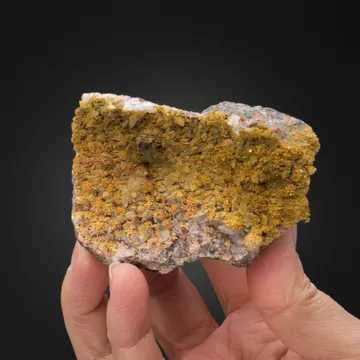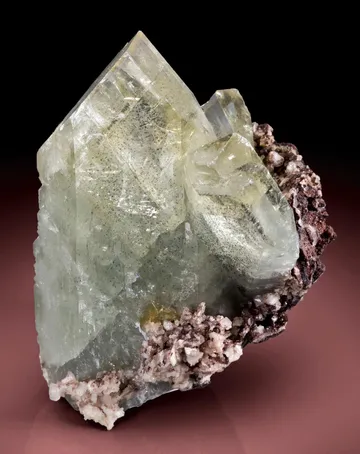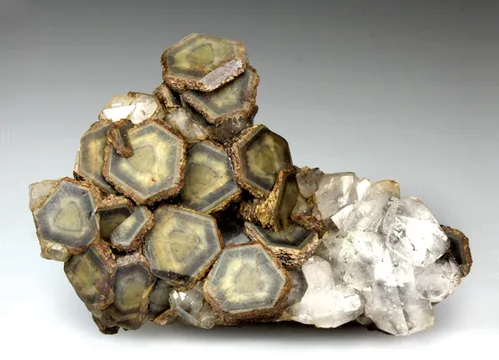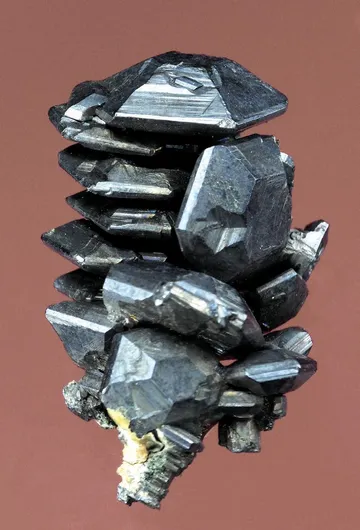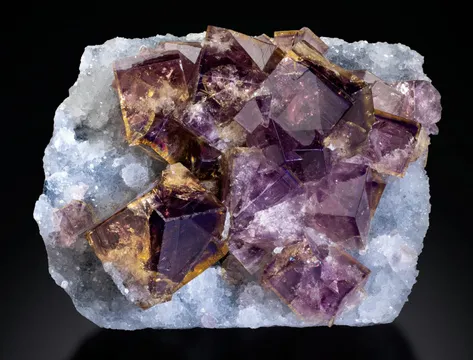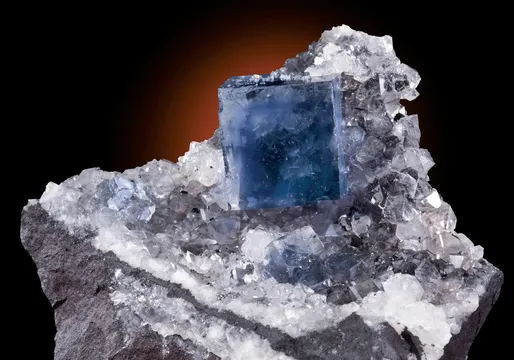
Carn Brea Mine, UK - classic Cornish collector locality renowned for old-time bornite crystals, with quartz, cassiterite, cuprite and native copper.
Key facts
Carn Brea Mine is one of the classic collector localities of the Camborne–Redruth district, the hard-working heart of Cornish copper and tin mining. It sat on the northern flank of the Carn Brea granite, close to the contact between granite and metamorphosed killas, where east-north-east lodes, elvan dykes, chloritic tin-copper veinstone, and later oxidized copper minerals gave the mine a character distinct from the better-known tin lodes south of the hill. For collectors, Carn Brea’s name is carried above all by old-time bornite: dark metallic, pseudo-cubic to pseudo-hexagonal crystals, sometimes perched on quartz, sometimes gathered into branching, almost sculptural clusters. The locality also produced quartz, cassiterite, chalcocite, cuprite, native copper, fluorite, arsenopyrite, stannite, tennantite-group minerals, secondary copper species, and uranium minerals from oxidized ground.
Regional View
Country View
The mine’s significance is not only mineralogical. Carn Brea Mines was created in 1832 by the amalgamation of earlier workings, including Wheal Druid, Wheal Fanny, Tregajorran, and Barncoose, and it became one of the largest setts in this part of Cornwall. It was a copper mine at its commercial height in the 1840s, then, like much of the district, increasingly followed tin downward as copper fortunes declined. In 1896 Carn Brea joined Tincroft and Cook’s Kitchen in a larger concern, and the old mine’s final identity became entangled with Carn Brea and Tincroft United and, ultimately, the enlarged South Crofty field.

Photo: Wikimedia Commons
The best specimens look unmistakably Victorian-Cornish: steely grey bornite crystals with sharp faces and a subdued iridescent skin, set against colorless to smoky quartz, cellular quartzose veinstone, or oxidized copper-rich matrix. Fine examples are rarely bright “peacock ore” in the modern, acid-cleaned novelty sense; the most desirable pieces retain an old, sober metallic patina, an antique label, and crystal form strong enough to rise above the mine’s more common massive sulfide material.

Photo: Wikimedia Commons
Search for specimens: View all specimens from Carn Brea Mine, UK
Carn Brea Mine lay just north and northwest of the granite hill of Carn Brea, overlooking the Camborne–Redruth area. Its old sett was bounded by Carn Brea village and the Wheal Union–Wheal Uny ground to the east, East Pool, Wheal Agar, and Tehidy ground to the north, Tincroft, Illogan Mines, and Crofty to the west, and the North Frances and South Carn Brea rights over the hill to the south. The mine is now largely built over and altered by modern industrial and urban development, but its position on the northern fringe of the Carn Brea granite explains both its ore sequence and its specimen suite.
Geologically, the chief lode exploited at Carn Brea was the Tincroft North Lode. The granite-killas junction at the surface trends roughly east-north-east, while the underground granite surface dips northward. Several elvan dykes cut both granite and killas in the northern part of the area. Tin and copper ore were reported to about 200 metres depth; below that, the characteristic lode filling was dominated by finely divided chlorite carrying grains of cassiterite and arsenopyrite. The lode passed from killas into granite at shallower depth in the west than in the east, a relationship typical of the district’s structurally complex roof-zone mineralization.
The working history is a story of consolidation. In 1832, Wheal Druid was amalgamated with Wheal Fanny, Tregajorran, and Barncoose to form Carn Brea Mines. Copper production from the wider Camborne–Redruth belt was at its peak in the 1840s and 1850s, and Carn Brea was then a major copper producer. As copper declined from the 1850s onward, deeper tin became increasingly important. The Tregajorran section was noted as the deepest from around 1860, while Barncoose was an important tin-producing section before being abandoned in 1873 because of cost. In 1892 the mine still carried a formidable surface plant, with eighteen steam engines and twenty-seven boilers recorded. In 1896 Carn Brea amalgamated with Tincroft and Cook’s Kitchen to form Carn Brea and Tincroft Mine; the Carn Brea section closed in 1913–1914, while the broader Tincroft operation continued until 1921.
The named shafts and lodes reflect the pieced-together nature of the sett. Shafts recorded for the mine include Harvey’s Engine, Martin’s East, Downright, Chappels, Highburrow, Highburrow East, Highburrow West, Dunkin’s, Martin’s, Roger’s, Old Sump, Western, Fanny, New, Miner’s, Teague’s, Trestrail’s, Polkinghorn’s, Pearce’s, Poddler’s, Man Engine, Monument, Barker’s, Druid Engine, and MacDonald’s. Lodes listed for the sett include Tincroft North, Barncoose, South, Highburrow, Martin’s, Dunkin’s, Chappel’s, Teague’s, Druid’s, and Pryce’s. This is one reason old labels can be imprecise: a “Carn Brea” specimen may have come from the central Carn Brea workings, Wheal Druid, Tregajorran, Barncoose, or from material later grouped under Carn Brea and Tincroft United.
Recorded production from Carn Brea’s independent life was substantial. The mine sold large quantities of copper in the 1840s, and later production figures include copper ore, tin, arsenic, and mispickel. Carn Brea and Tincroft together are credited in modern summaries with very large lifetime outputs of copper and tin, reflecting their position among the great central Cornish mines rather than a small collector-only occurrence.
For today’s collector, Carn Brea is primarily an old-collection locality. The mine is recorded as built over, the remaining surface ground is limited, and the most visible standing remains sit on private land, though they can be seen from public rights of way. A small tip remains at the foot of the hill, now largely overgrown, and copper and uranium minerals have been noted there; the hillside above includes a long, deep trench following the contour of the hill, with a narrow cutting down the slope. In summer the bracken can be over head height. Any field visit demands permission, caution around historic workings, and a realistic expectation that fine bornite crystals are no longer being found in quantity. The specimens that built the locality’s reputation came from nineteenth-century mining, not from casual modern dump collecting.
Bornite is the collector species for Carn Brea Mine, where old specimens show dark grey to subtly iridescent metallic crystals rather than garish artificially colored “peacock ore.” The finest pieces are pseudo-cubic to pseudo-hexagonal crystals, commonly a few millimetres across but documented to about 2 cm on notable matrix specimens, set on colorless to smoky quartz or on oxidized, massive bornite-rich matrix; especially admired are sharp crystals perched on quartz and branching, tree-like clusters with complete crystals crowning the specimen. Ordinary Carn Brea bornite is massive or poorly crystallized and easily lost among other Cornish copper sulfides, while top examples have crisp faces, a stable antique patina, good separation from the matrix, and ideally an old label linking them to the nineteenth-century Carn Brea or Carn Brea–Tincroft workings.
Quartz at Carn Brea is best understood as the architectural matrix of the lode rather than as the mine’s main display mineral. It occurs as rock crystal, agate, chalcedony, and cellular quartzose veinstone, with small transparent to translucent crystals forming drusy plates, shards, and cavities that host bornite, cassiterite, cuprite, native copper, and other copper sulfides. On the best bornite specimens, clear quartz crystals to around 1 cm give contrast and relief to the metallic bornite crystals; on copper-oxide pieces, grey boxwork or sintered-looking quartz frames wine-red cuprite microcrystals and sponge-like native copper. Good quartz pieces from Carn Brea are therefore judged less by standalone quartz perfection than by how well the quartz preserves the lode setting and displays the associated copper or tin mineralization.
Other minerals documented from Carn Brea Mine and its included workings form a compact but very Cornish assemblage: arsenopyrite, cassiterite, chalcocite, chalcopyrite, covellite, cuprite, native copper, domeykite, stannite, tennantite-group minerals, pyrite, marcasite, fluorite, siderite, hematite including specularite, goethite, malachite, brochantite, connellite, tyrolite, olivenite, pharmacosiderite, chrysocolla, chalcanthite, schorl, wolframite-group minerals, and uraninite including pitchblende. The wider Carn Brea field is also important for type-locality and rare uranium phosphate minerals: Tincroft is tied to pharmacosiderite, while nearby Wheal Basset in the Carn Brea district is the type locality for bassetite and also central to the histories of uranospathite and vochtenite. For strict labelling, however, specimens should not be upgraded from “Carn Brea district” to “Carn Brea Mine” unless the old label or collection record supports it.
Carn Brea specimens need careful label discipline. The name was used for a mine, a hill, a parish, a broad mining field, and, after 1896, an amalgamated Carn Brea and Tincroft enterprise. Old labels may read Carn Brea Mine, Carn Brea Mines, Illogan, Redruth, Pool, Wheal Druid, Tregajorran, Barncoose, or Carn Brea and Tincroft. Those are not all interchangeable. A specimen from Tincroft, Cook’s Kitchen, Wheal Basset, South Carn Brea, or the broader Carn Brea area may be geologically nearby but should be sold with the wording on its label, not silently collapsed into Carn Brea Mine.
The chief authenticity issue for bornite is surface appearance. Natural bornite tarnishes readily, and old Carn Brea crystals can show blue, purple, brown, steel-grey, or subdued iridescent films. That is not the same as the aggressively bright artificial “peacock ore” commonly produced by treating chalcopyrite or bornite for the tourist trade. Fine Carn Brea bornite should show real crystal form, not just rainbow-coated massive sulfide. Be wary of loose, brightly colored masses sold with vague “Cornwall” or “Carn Brea” claims but no provenance, especially if the color looks freshly chemical and the specimen lacks matrix, old label, or collection history.
Condition issues are typical of old Cornish sulfide specimens. Bornite is relatively soft and can abrade on crystal edges; old pieces may have bruised corners, rubbed high points, old adhesive, or trimmed matrix. Quartz matrix can be friable where cellular, and cuprite or native copper on quartz can be delicate. Secondary copper sulfates such as chalcanthite are humidity-sensitive and should be treated as unstable unless identified and stored properly. Uranium minerals from the remaining tip and old oxidized material call for sensible radioactive-mineral handling: keep dust contained, avoid abrasion, store away from prolonged close contact, and do not use aggressive wet cleaning without identification.
Market availability is thin. Carn Brea bornite appears periodically from old British, European, and American collections, often as miniatures or small cabinet specimens; exceptional sharp bornite on quartz, especially with early labels or named provenance, is far scarcer than the number of “Carn Brea” references in books might suggest. Quartz-only specimens are much less sought after unless they carry notable associations. Cuprite-native copper-quartz combinations, crystallized chalcocite, and well-documented uranium pieces from the Carn Brea field can be highly desirable, but they require sharper locality scrutiny because nearby mines produced superficially similar material.
At six o’clock on a Wednesday morning in December 1842, the changing house at Carn Brea Mines was already full of men preparing to go underground. The room was described in the Royal Cornwall Gazette as a long, narrow building about 150 feet by 8 feet, with only one outlet near the end. A young man named Waters was pouring gunpowder from a cask into a canister for his day’s work when a candle, apparently placed above his head, fell. The powder exploded at the very place where escape was most difficult.
The report is chilling in its practical detail. Waters was killed instantly. His father and nine other men were badly injured, and the cupboards along both sides of the room—where the men kept clothing and materials—caught fire. Some of those cupboards held more gunpowder. As further explosions tore through the changing house, the men trapped inside escaped only by breaking through the wall at the inner end. Four hundred working men were said to have lost more than twenty shillings each on average in underground clothes and equipment, a serious blow to men whose ability to earn depended on having those things ready at the start of every shift.
A week later, the casualty list had worsened. Eight men had died from the fire and explosion: the younger Waters, his father, Harvey, Cock, Hockin, Martin, Nichollas, and Rogers, though a later editor noted uncertainty about a death recorded under the surname Rogers. The inquest jury returned accidental death but added a pointed recommendation: the agents should make arrangements to prevent the keeping of powder in the changing house. Collections were planned in Redruth church on Christmas Day and in neighbouring chapels to help the widows, fatherless children, and injured men. For collectors who handle the elegant bornite and copper specimens today, the episode is a hard reminder of the human cost behind the labels.
There is another, quieter story in the labels themselves. A chalcocite specimen from Carn Brea passed through the orbit of Sir Arthur Russell, one of the great British mineral collectors, and carried a label noting “Chalcocite on bornite, Carn Brea Mine, Illogan, Cornwall.” The same label trail associated the specimen with J. Lavin of Penzance and the Baroness Burdett-Coutts collection. That is the sort of provenance chain that makes Carn Brea material especially evocative: a Cornish mine, a nineteenth-century copper-sulfide specimen, a Penzance dealer or collector, aristocratic cabinet history, and finally one of the most important British systematic collections. The mineral is only part of the object; the label is part of the specimen’s geology in time.