Capelinha, Brazil — renowned for titanite-epidote mineralization in metamorphic-hydrothermal veins; Campo do Boa and Fanadinho sources yield sharp crystals.
Key facts
Capelinha is one of the essential modern Brazilian names for collectors of titanite and epidote. The celebrated specimens are not products of the younger, lithium-rich granitic pegmatites for which eastern Brazil is so famous, but of titanite-epidote mineralization in and around pegmatoid feldspar veins cutting titanium-rich basic metavolcanic schists of the Capelinha Formation, Macaúbas Group. That distinction matters: the classic material has the visual drama of alpine-cleft minerals—sharp, isolated, transparent to translucent crystals on contrasting feldspar, quartz, or epidote—but it formed in a metamorphic-hydrothermal system tied to altered basic host rocks.
The district’s two great names are Campo do Boa, northwest of Capelinha, and Fanadinho, northeast of town. Campo do Boa is the older classic source, discovered in the 1960s, and is especially associated with superb greenish yellow titanite: flattened wedge-shaped crystals, commonly twinned, glassy, bright, and in the finest examples distinctly gemmy. Fanadinho became important later and is richer in epidote-bearing associations, producing darker green epidote crystals and mixtures of titanite, epidote, albite, adularia, and quartz. A more recently recognized Bananal-Glucínio area has also supplied comparable titanite-epidote material to the market.
Regional View
Country View
The best Capelinha titanites are instantly recognizable: flat, spearhead-like crystals in grassy green, lime green, honey-green, or yellow-green shades, often with a central twin plane and unusually lively luster. The crystals can stand upright on pale feldspar or dark green epidote, and even modest miniatures can have the balance collectors want—sharp form, daylight color, clean termination, and a visible internal glow. Epidote specimens from the district are less famous internationally than the titanites, but the finest are strong in their own right: blackish green to deep olive, prismatic to bladed groups, sometimes forming a rugged dark stage for the brighter titanite.

Photo: Wikimedia Commons
Search for specimens: View all specimens from Capelinha, Brazil
The collector locality “Capelinha” covers a set of titanite-epidote occurrences in northern Minas Gerais, especially Campo do Boa and Fanadinho, with Bananal-Glucínio recognized later as another productive area. The setting is the Capelinha Formation of the Macaúbas Group. The host rock is a titanium-rich basic metavolcanic schist whose protolith has been interpreted as alkali basalt, subsequently metamorphosed under amphibolite-facies conditions during the Brasiliano Cycle. In hand specimen terms, this means that the specimen minerals are not simply late-stage cavity minerals in an ordinary granitic pegmatite; they are part of a feldspar-rich, metamorphic-hydrothermal vein system developed by alteration and fluid flow through reactive basic rocks.
The productive bodies are feldspar-rich pegmatoid veins and pockets, ranging from only a few centimeters or decimeters up to about 4 meters thick. They are composed mainly of albite and/or adularia, locally altered to kaolinite, with drusy titanite and epidote developed only in favorable places. Quartz is present but not abundant in the main titanite-epidote assemblage, and micas are notably absent from the titanite-epidote veins. Accessory minerals recorded from the veins include apatite, ilmenite, and actinolite. At Fanadinho, the feldspar is commonly more strongly kaolinized and the deposits tend to be richer in epidote than the Campo do Boa workings.
Campo do Boa is the historical anchor of the district. The deposit was found accidentally in 1966 when a vein carrying exceptionally well-crystallized titanite was opened; early workers and local miners mistook the mineral for brazilianite, a confusion that lingered in the local term “brasilionita.” The Campo do Boa mineralized belt is not a single little pocket but an elongate area of several kilometers with numerous mineralized veins. Workings have included small adits and hand-driven garimpo cuts in lateritic ground, with pockets followed underground where quartz-feldspar-titanite stringers could be traced.
Fanadinho entered the specimen story later, with new deposits found in the lower Ribeirão Fanadinho area during the 1990s. It has been especially important for specimen associations: titanite with epidote, epidote on or with albite, titanite on white feldspar, and mixed cabinet pieces where yellow-green titanite rises from dark, nearly black-green epidote. Field descriptions of Fanadinho distinguish workings connected with Sítio do Adão and Fazenda Rubinho Pimenta; the locality is commonly seen on older labels as Fazenda Rubin or Rubinho Pimenta. Compared with the more classic Campo do Boa titanites, Fanadinho material is often more matrix-rich and mineralogically more varied.
Mining has been artisanal rather than industrial specimen extraction. The work is associated with garimpeiros following veins, pockets, and weathered feldspar bodies by hand, with some bulldozer cuts reported at Fanadinho but most selective underground work done manually. These are specimen and gem-rough sources, not large ore mines in the conventional sense. The very best pieces came from open pockets and druses where titanite or epidote had room to crystallize freely; the common material is massive feldspar, altered feldspar, quartz-feldspar vein matter, epidote-rich rock, and broken or included titanite.
For collectors today, Capelinha should be treated as an active-to-intermittent classic locality rather than a casual public collecting site. Specimens circulate through Brazilian dealers, older private collections, and international dealer stock, while access to the actual workings depends on private property, active claims, local permission, and safety conditions. Old labels are particularly valuable because many specimens sold simply as “Capelinha” may in fact come from Campo do Boa, Fanadinho, or later nearby finds; precise sublocality is a premium when credible.
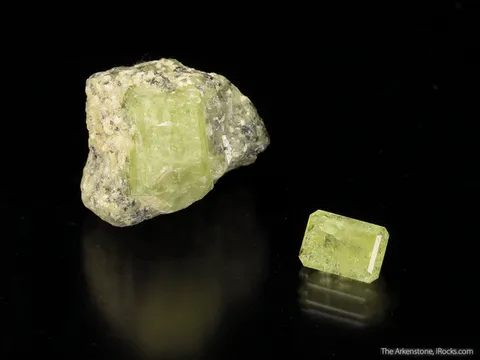
Capelinha titanite is the locality’s signature species and one of the reasons the district is internationally known: the best crystals are sharp, flattened, wedge-shaped to spearhead-like monoclinic forms, commonly twinned, in bright yellow-green, grassy green, lime green, honey-green, or greenish brown shades, with glassy to bright luster and real internal translucency. Crystals of a few centimeters are common enough in collections to define the locality, while exceptional larger pieces and matrix specimens have made Capelinha a reference point for the species. Campo do Boa tends to represent the classic clean, dramatic titanite habit, often on pale albite/adularia or with minor epidote and ilmenite, whereas Fanadinho material is more often matrix-rich and associated with dark green epidote and white feldspar. The best pieces here are not merely large; they have an intact termination, crisp twin line, open presentation on matrix, minimal edge bruising, and the luminous yellow-green daylight color caused by iron in the crystal structure.
Epidote from Capelinha ranges from dark olive-green crystal coatings and sprays to robust blackish green prisms and bladed groups, with Fanadinho especially known for epidote-rich associations in albite/adularia matrix. It may occur as the principal specimen mineral, as dark green matrix for titanite, or as fine subsidiary crystals with albite, quartz, and titanite. Well-crystallized epidote is rarer than titanite as a show specimen from the district, and the best examples have individual lustrous terminations, three-dimensional groups, and enough separation from the feldspar or quartz to avoid looking like massive epidosite. Condition is important: damaged terminations and bruised prism edges are common, while complete dark green groups with a small contrasting titanite accent can be far more desirable than larger but massive pieces.
Albite is the main feldspar of the Capelinha titanite-epidote veins and is more important as matrix and paragenetic context than as a stand-alone species. It appears as white to pale feldspar masses, cleavable crystals, and in some Fanadinho specimens as pericline-type albite crystals associated with titanite and epidote. Because much of the feldspar is partly kaolinized, attractive albite specimens require unusually fresh, defined crystal faces and strong contrast with the green titanite or epidote. In Capelinha pieces, good albite matrix should be clean, pale, and structurally supportive, setting off a bright titanite twin or a dark epidote spray rather than overwhelming the specimen as chalky altered feldspar.
Quartz is a documented but comparatively subordinate mineral in the titanite-epidote system, despite its visual importance on some specimens. It occurs in quartz-feldspar vein material, as small quartz crystals with titanite, as quartz-titanite vein fillings at working faces, and in some pieces with epidote or actinolite. The research record describes quartz as rare in the main feldspar-rich veins, which makes sharply crystallized quartz associations more notable than ordinary milky vein quartz. The most desirable Capelinha quartz specimens are those where quartz contributes sparkle, architecture, or pocket context while still leaving the titanite or epidote visually dominant; massive quartz lumps with scattered damaged titanite are far less compelling.
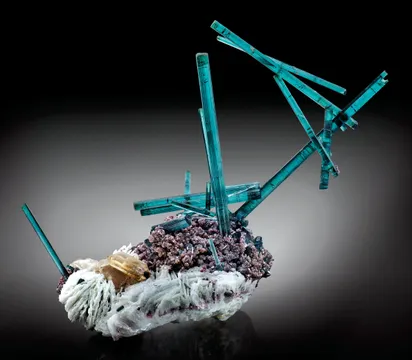
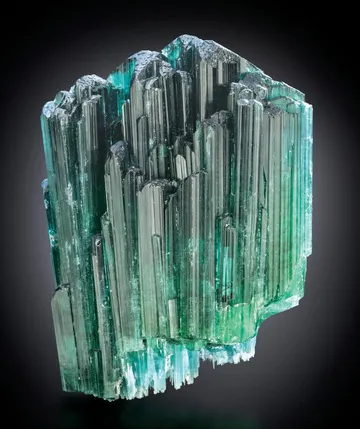
Elbaite and elbaite-like tourmaline specimens from Capelinha belong to a different collecting story than the titanite-epidote veins: they are tied to the district’s lithium-bearing pegmatitic material rather than the metamorphic titanite pockets. Documented Capelinha tourmaline specimens include small, gemmy, sherry-colored to green-terminated crystals on lavender lepidolite and feldspar, and such pieces are scarce compared with the abundant fame of titanite. A fine Capelinha elbaite should therefore be judged by gemminess, clean termination, color contrast against lepidolite or feldspar, and credible locality documentation; the name “Capelinha” alone is not enough, because Minas Gerais has many tourmaline districts and vague labels are common.
“Sphene” is the older collector and gem-trade name for titanite, and many classic Capelinha labels, articles, and gem references use it. Capelinha sphene is therefore the same essential CaTiSiO5 material described under titanite: flattened, often twinned, yellow-green to green crystals from Campo do Boa, Fanadinho, and related deposits, prized for brilliance, dispersion, and sharp form. The sphene label is most often encountered on older specimens, gem rough, and faceted stones, including stones cut from Campo do Boa material. For collectors, a good “sphene” label from Capelinha is attractive when it accompanies an old, sharp, gemmy crystal or a well-provenanced faceted stone, but it should not be interpreted as a different mineral species from titanite.
Orthoclase in the Capelinha specimen trade overlaps with the geological use of adularia and K-feldspar in the titanite-epidote veins. The feldspar-rich veins are dominated by albite but may contain adularia, and titanite-on-adularia or titanite-on-orthoclase labels occur on classic pieces. These are matrix minerals: pale gray, white, or cream feldspar surfaces that give the green titanite its contrast and support. The best Capelinha orthoclase/adularia-associated specimens have sharp, elevated titanite crystals on clean feldspar with minimal kaolinization; ordinary pieces can look dull or chalky where feldspar alteration has softened the faces and reduced the contrast.
Other minerals documented from the Capelinha district include actinolite, apatite, ilmenite, muscovite, kyanite, topaz, beryl including aquamarine, euclase, and uncertain tourmaline-group material. The titanite-epidote veins themselves are a relatively focused assemblage—albite, adularia/K-feldspar, titanite, epidote, quartz, with minor apatite, ilmenite, and actinolite—while several of the rarer collector minerals reflect nearby pegmatitic or metamorphic occurrences grouped under the broader municipality. Capelinha is not primarily a type-locality name; its importance rests instead on the exceptional quality and abundance of titanite, the associated epidote, and the unusual metamorphic-hydrothermal origin of specimens often mistaken for pegmatite products.
The first authenticity issue with Capelinha is locality precision. Many specimens are labeled only “Capelinha, Minas Gerais,” even when they likely came from Campo do Boa, Fanadinho, Fazenda Rubinho Pimenta, or later Bananal-Glucínio material. A precise old label is a meaningful value point, especially for top titanites. “Fazenda Rubin Pimenta,” “Rubinho Pimenta,” and “Fanadinho” labels may refer to the same collecting area in older trade usage, and “sphene” labels should simply be understood as titanite.
Misidentification is historically part of the locality’s story. The original Campo do Boa titanite was mistaken for brazilianite, and the local term “brasilionita” persisted among miners. In modern collecting, the more likely confusion is not brazilianite but overly broad labeling: titanite from Capelinha sold without sublocality, K-feldspar called orthoclase or adularia inconsistently, and tourmaline from the broader municipality assumed to be elbaite without analysis or strong provenance.
Condition is the central grading issue. Capelinha titanite has excellent luster but is brittle, and the thin flattened crystals are vulnerable at the edges, terminations, and twin seam. Small chips at the tip or along the knife edge are common; on a high-end piece they matter greatly because the form is the specimen. Look closely for repaired twins, reattached crystals, filled breaks, and edge bruising hidden by dark matrix. Epidote groups should be inspected for broken terminations and cleaved prism ends. Feldspar matrix may be friable where kaolinized, particularly in Fanadinho material, so avoid aggressive cleaning and expect some powdery alteration on matrix specimens.
The finest titanites from Capelinha are prized because they combine traits that seldom meet in titanite: size, sharp twinning, lively green-yellow color, transparency, and attractive matrix. Miniatures and small cabinet specimens remain obtainable, but superb, damage-free, well-balanced old pieces are difficult and command strong prices. Epidote is more affordable in ordinary examples, though large, complete, lustrous dark green groups with titanite or albite contrast are much less common than loose or massive epidote-rich pieces.
Fluorescence is not a selling point for the classic Capelinha titanite-epidote assemblage, and gemological records of Campo do Boa titanite report no fluorescence under longwave or shortwave ultraviolet. Handling should be conservative: keep titanite out of ultrasonic cleaners and avoid heat, acids, and steam cleaning. For display, strong oblique light brings out the internal yellow-green glow and dispersion, while backlighting can make even darker crystals come alive.
The Capelinha story begins with a mistake good enough to launch a classic. In 1966, at Campo do Boa, Manoel Pimentel Figueiredo encountered a vein carrying bright, well-crystallized greenish yellow crystals and thought he had found brazilianite. It was an understandable confusion in Minas Gerais, where pegmatite minerals are part of the local vocabulary and brazilianite has a famous Brazilian identity. But the crystals were not brazilianite at all. They were titanite—sphene to older collectors—and the mistake left a local echo: garimpeiros continued to call the mineral “brasilionita” for years.
The Campo do Boa workings were not a single romantic pocket but a working mineral field. The mineralized zone extends for several kilometers, with many veins and small garimpo openings. At its busiest, accounts describe roughly 500 miners working the deposit in teams of 15 to 20 people. That explains why Capelinha titanites entered the international market in real numbers while still retaining enough individuality for great specimens to feel rare. The best pieces were not scooped from a broad orebody; they came from selective work along narrow veins and cavities, where a pocket might suddenly reward weeks of digging with sharp green twins on feldspar.
Field geologists recorded one of the most memorable local prospecting clues: a “bucho” of imperfectly crystallized quartz and altered feldspar. Literally a “belly,” the term is wonderfully apt. In the workings, these swollen quartz-feldspar masses could mark the path toward better mineralization, a practical garimpeiro sign rather than a textbook abstraction. In a district where much of the host is weathered, red, and lateritic, the collector’s treasure was often hidden behind dull altered feldspar and unpromising vein matter.
Fanadinho added the second act. New titanite-epidote deposits were found northeast of Capelinha in the 1990s, around the lower Ribeirão Fanadinho area. The material was not just a repeat of Campo do Boa. It was richer and more varied as specimen rock, producing abundant epidote associations and matrix pieces where dark green epidote, white albite, adularia, quartz, and yellow-green titanite intergrew. If Campo do Boa supplied the classic clean titanite identity, Fanadinho broadened the district into a specimen assemblage collectors could recognize across a room: green wedges, black-green epidote, and pale feldspar from the hills around Capelinha.
A later chapter came with Bananal-Glucínio, recognized as a similar titanite-epidote area in 2015. Material from that source reached the market even before the locality had the same published field detail as Campo do Boa and Fanadinho. For collectors, that is typical of Brazilian classics: the stones travel faster than the literature. Labels begin as town names, dealer shorthand, or garimpo nicknames, and only later do geologists and curators try to pin them to maps, formations, and parageneses.