Bor Pit, Russia — Dalnegorsk borosilicate skarn locality yielding datolite, danburite, quartz, calcite; famed for large green crystals and rare dalnegorskite.
Key facts
Bor Pit—also called the Boron Pit or Bor Quarry—is the collector name for the open-pit borosilicate skarn workings of the Dal’negorsk B deposit at Dalnegorsk in Primorsky Krai, Russian Far East. It matters because it is not merely a picturesque specimen locality: it is an industrial boron deposit whose ore mineralogy placed datolite, danburite, axinite, quartz, calcite, and calc-silicate skarn minerals in the path of large-scale mining. The best specimens are therefore a distinctive hybrid of ore-deposit geology and cabinet-mineral beauty: blocky green datolite crystals from boron-rich cavities; etched, champagne to amber danburite; glassy quartz with interrupted growth; lustrous black ilvaite; pale calcite plates and “poker-chip” forms; and garnet-pyroxene skarn associations that tell the story of repeated mineralizing stages.
Published geological work treats the Dalnegorsk borosilicate deposit as a giant calcic-skarn boron system developed in the Dalnegorsk ore field, surrounded by the better-known Pb-Zn-Ag skarn deposits that made the wider district famous to collectors. The deposit’s large-scale mineralization is restricted to skarnized Upper Triassic Tetyukha Formation limestones, and the skarn zone has been described as about 3.5 km long and 500 m thick. In collector language, that means Bor Pit specimens are not “vein odds and ends” from a small prospect; they are the collectible crystalline expressions of a major boron orebody.
Regional View
Country View
For mineral collectors, Bor Pit’s great historical importance came with the opening of Russian Far East material to the international market in the late Soviet and post-Soviet period. Datolite from Dalnegorsk reset expectations for the species: large, glassy, often green crystals from a working skarn mine, not just smaller basalt-cavity crystals or colorful massive nodules. The locality also became important for specialist rarities, most notably dalnegorskite, a calcium-manganese pyroxenoid described from the Dalnegorskoe boron deposit and named for the locality.

Photo: Wikimedia Commons
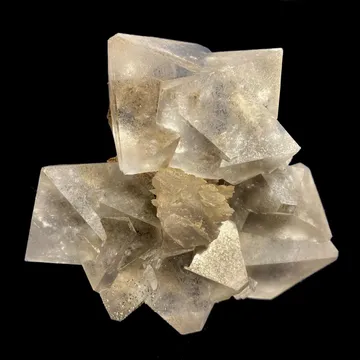
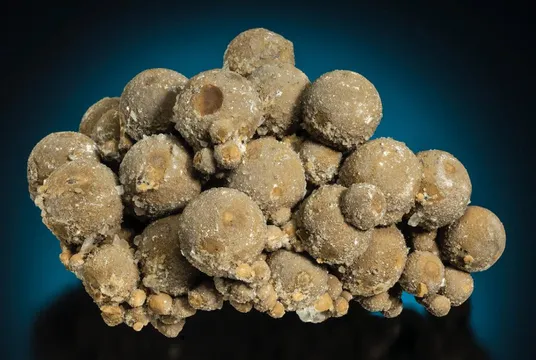
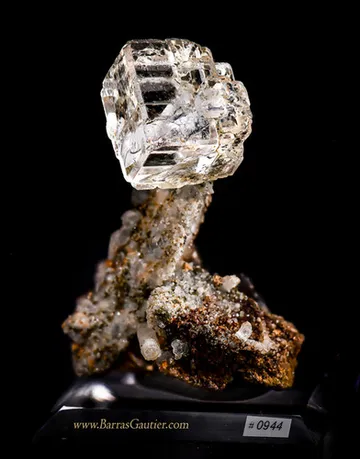
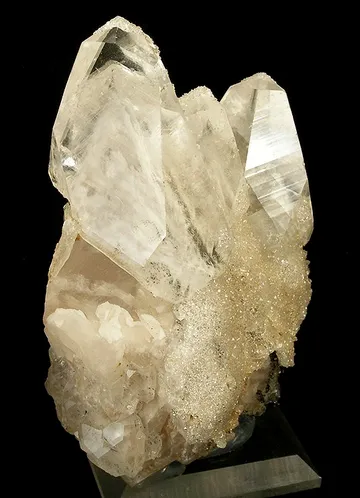
The visual identity of the finest Bor Pit pieces is unusually coherent. Good datolite has a thick, beveled, glassy architecture, commonly pale green to seafoam, yellow-green, or nearly colorless, and may sit with quartz or calcite in compact, three-dimensional clusters. Quartz can be milky, clear, smoky, or faintly amethystine, and some Bor Pit quartz shows interruption surfaces left by vanished calcite plates. Calcite ranges from transparent prismatic crystals to bladed and disk-like aggregates. Ilvaite provides one of the most dramatic contrasts in the suite: sharp, glossy, jet-black crystals set on pale quartz or calcite. Even when modest in size, a strong Bor Pit specimen usually announces itself by that boron-skarn assemblage rather than by any single mineral alone.

Photo: Wikimedia Commons
Search for specimens: View all specimens from Bor Pit, Russia
Bor Pit is an open pit within the Dal’negorsk B borosilicate deposit at Dalnegorsk, Primorsky Krai, Russia. Older labels may read Dal’negorsk, Dalnegorsk, Tetyukhe, Tjetjuche, Tetjuche, Primorskiy Kray, Far-Eastern Region, Boron Pit, Bor Quarry, Bor Mine, or simply “Dalnegorsk.” Modern locality practice separates the Bor Pit borosilicate-skarn material from the district’s nearby polymetallic mines, especially Nikolaevskiy, 1st Sovetskii, 2nd Sovetskii, Verkhnii, and the Danburitovyi workings. That distinction matters: “Dalnegorsk” is a world-class district label, but a specimen from Bor Pit should normally show a boron-skarn association rather than the classic sulfide-rich Nikolaevskiy look.
The deposit type is best summarized as a boron-bearing calcic skarn. Geological papers distinguish a sequence of mineralizing stages. An early skarn stage includes wollastonite, hedenbergite, and andradite; a borosilicate stage includes danburite, axinite, datolite, and quartz; and a later quartz-carbonate stage includes quartz, calcite, apophyllite, and fluorite. Later work on danburite and datolite emphasizes that the two minerals belong to different stages of formation: danburite is tied to early borosilicate mineralization, while much of the economic datolite belongs to a later redeposition event associated with andradite-hedenbergite skarn.
The orebody sits in a complex tectonic setting within the Sikhote-Alin region. Published descriptions place the borosilicate deposit in skarnized limestones of the Upper Triassic Tetyukha Formation, within a broader ore field cut by major fault systems and by basic to intermediate dikes. The boron story is not a simple contact-metamorphic footnote: isotopic and fluid-inclusion studies have debated the relative roles of magmatic, meteoric, and metasedimentary sources, and later papers proposed that boron was extracted in significant part from sedimentary or metasedimentary rocks, possibly including evaporite-bearing sequences or Early Cretaceous arkosic material of the Taukha accretionary prism.
Mining history around Dalnegorsk began with the wider district’s lead-zinc ores, but the Bor Pit belongs to the industrial boron side of the camp. The Dalnegorsk borosilicate deposit was discovered in the 1940s, and Soviet development turned it into a domestic source of boron products. Modern studies still describe the borosilicate deposit as lying directly within Dalnegorsk town and worked by open-pit methods using drilling and blasting. The ore mineral processed is datolite, and industrial sources connect the mining and chemical complex to boric acid, datolite concentrate, calcium borate, and related boron products.
Operators and corporate names have changed through time. Historical and modern sources refer to the Bor mining and chemical operation, JSC or LLC Mining and Chemical Complex “Bor,” GC Bor, and Dalnegorsky GOK. Current industrial reporting in 2026 places the Dalnegorsk boric-acid production complex under Roschem ownership, with GC Bor and Dalnegorsky GOK among the key companies associated with the production chain. For collectors, the important practical point is that Bor Pit is an active or industrially controlled mining locality, not a public fee dig.
Collecting access should be treated as permission-only industrial access. Specimens seen on the international market have come from mine production, miners, local intermediaries, older Soviet and post-Soviet stocks, dealer purchases, and collection dispersals. Rock Currier’s 1993 field note on the open pit describes benches with already-collected pockets of datolite and quartz, a revealing glimpse of how closely specimen recovery was tied to mine exposure. The same blasting that opened cavities for collectors also destroyed untold specimens in the normal course of ore extraction.
The most famous specimen production consists of glassy datolite clusters from the 1980s and early 1990s, many in pale green, yellow-green, seafoam, or bluish green colors. Fine datolite with quartz, datolite with calcite, and datolite with axinite are classic. Danburite from Bor Pit is much scarcer than datolite but highly prized when gemmy, champagne to amber, and well terminated. Ilvaite on quartz and calcite, sharp andradite on quartz, fluorite with calcite, and quartz showing growth interference from dissolved calcite plates all round out the locality’s collectible character.
Calcite from Bor Pit is part of the late quartz-carbonate expression of the borosilicate skarn and appears in several collectible styles: transparent prismatic crystals with quartz attachments, pale pinkish to colorless platy or bladed aggregates, and sharp “poker-chip” crystals massed into lustrous plates and walls. Verified specimen records show fine examples in the 7–13 cm range, including terminated transparent crystals with natural etching, plateau-like aggregates of sharp disk-shaped crystals, and calcite with pyrite, quartz, ilvaite, axinite, or datolite. Good Bor Pit calcite is judged less by sheer size than by glassy transparency, crisp faces, completeness, and the contrast it makes with the skarn suite; ordinary pieces are often cleaved, etched without elegance, or crowded into dull massive calcite, while the better ones have the architectural sharpness and pale, icy luster that make Dalnegorsk calcite instantly recognizable.
Quartz from Bor Pit is unusually diverse for a single skarn locality: milky and colorless crystals occur with datolite and calcite, smoky quartz is recorded, amethystine quartz is documented, and some of the most characteristic pieces show interrupted or “interference” growth where thin calcite plates once obstructed the quartz and were later removed. Quartz may form the pale matrix beneath datolite, ilvaite, pyrite, and andradite, or it may overgrow datolite as sparkly druse, including specimens described as mounded clusters of datolite and beta-quartz crystals almost entirely coated by fine quartz. The strongest Bor Pit quartz specimens have a specific locality voice—growth-interrupted forms, pale lavender or smoky tones, or borosilicate-skarn associations with datolite, danburite, calcite, axinite, and ilvaite—whereas unassociated white quartz labeled only “Dalnegorsk” can be difficult to place confidently within the wider district.
Datolite is the signature collector mineral of Bor Pit and the species by which the locality entered the world stage: large, lustrous, blocky to thick-tabular crystals in pale green, yellow-green, lime-green, seafoam, bluish green, nearly colorless, and honey-tinted shades, commonly in crystals from about 1–4 cm and in clusters ranging from miniatures to impressive cabinet specimens. It is the ore mineral of the boron deposit as well as the great specimen prize, and it occurs with quartz, calcite, axinite-(Fe), danburite, hedenbergite, and ilvaite in cavities and fractured skarn zones. Fine examples show glassy luster, beveled geometry, translucency, strong but delicate color, undamaged terminations, and three-dimensional composition; ordinary pieces are pale, contacted, crusty, or heavily damaged. Rare twinned datolite from Dalnegorsk has received specialist attention, making well-documented twins especially important study specimens rather than simply aesthetic pieces.
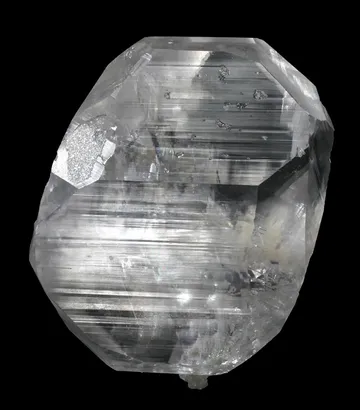
Danburite from Bor Pit is much less common on the market than datolite but is geologically central to understanding the deposit, because published work places danburite in an earlier borosilicate stage that preceded much of the later datolite deposition. Collectible specimens include gemmy champagne, amber, and dark sherry-colored crystals, sometimes etched and associated with calcite blades, quartz, or skarn matrix; one well-documented old specimen shows a 5.6 cm amber danburite crystal paired with a cut gem from the same Dalnegorsk material. The best pieces are transparent to gemmy, strongly terminated, and aesthetically isolated enough to show the characteristic prismatic form; ordinary examples tend to be etched fragments, contacted crystals, or pieces overwhelmed by matrix. Because Dalnegorsk district labels may also refer to the nearby Danburitovyi Mine, a Bor Pit attribution is strongest when supported by old labels or by a convincing quartz-calcite-datolite skarn association.
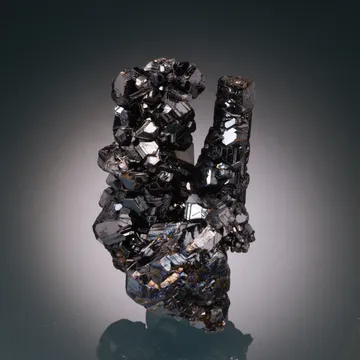
Ilvaite from Bor Pit forms sharp, highly lustrous black prismatic crystals and divergent aggregates, most memorably on pale quartz and white calcite, with hedenbergite or other skarn minerals in the matrix. Verified Bor Pit examples include miniature and small-cabinet specimens with jet-black crystals around 1.6 cm on glassy light gray quartz, as well as calcite-ilvaite-quartz combinations that show the classic black-white skarn contrast; much smaller crystallized aggregates are also known, including photogenic millimeter-scale sprays with calcite. Good specimens require bright luster, intact terminations, contrast, and separation of the black crystals from the pale matrix, since damaged or crowded ilvaite quickly becomes visually heavy. The finest Bor Pit ilvaite belongs to the same post-Soviet wave of Dalnegorsk material that made the district famous, and high-quality pieces are no longer abundant in fresh supply.
Andradite at Bor Pit belongs to the garnet-pyroxene skarn architecture of the deposit and appears both as part of the ore-forming assemblage and as collectible crystals on quartz or hedenbergite-rich matrix. Older Bor Pit andradite specimens are typically brown to greenish brown, while a notable 2020 find produced crisp dodecahedral crystals in gemmy, medium olive-green clusters, including a documented 3.9 cm miniature that stood out on the recent market. Strong pieces have sharp dodecahedral form, luster, unusual green color, and minimal damage; more routine andradite is present as duller brown garnet in skarn matrix or as less aesthetic crusts. Association with quartz, hedenbergite, datolite, or the broader Bor Pit calc-silicate suite helps separate genuine locality pieces from the many other Russian andradites that circulate under less precise labels.
Pyrite from Bor Pit is a subordinate but visually useful species, most often seen as brassy metallic crystals associated with calcite and quartz rather than as the main event of the specimen. Wikimedia and Mindat-hosted records document pyrite-calcite pieces from the locality, and published environmental and ore-deposit work also notes sulfide minerals in the broader Dalnegorsk mining environment. Collectors should value Bor Pit pyrite for contrast—bright metallic accents on pale calcite, quartz, or skarn matrix—rather than expecting large stand-alone pyrite crystals. Better pieces have fresh, untarnished luster, sharp crystal faces, and stable associations; ordinary examples are small, scattered, oxidized, or visually lost among more important calcite and quartz.
Axinite from Bor Pit is one of the locality’s most diagnostic borosilicates, occurring as brown, clove-brown, or darker wedge-shaped crystals in skarn cavities, commonly with calcite, datolite, quartz, and garnet-pyroxene matrix. Current database practice records axinite-(Fe) for the locality and treats axinite-(Mn) as an erroneous literature entry, so older labels reading “manganaxinite” or “axinite-(Mn)” should be handled cautiously unless backed by analysis. Documented specimens include large plates from late-1990s material with robust curving crystals to about 4 cm, as well as smaller 2004 finds with sharp, acute, deep-colored axinite-(Fe) crystals around 1.5 cm associated with calcite. The best Bor Pit axinite is sharp, lustrous, and well separated from matrix, with the heavy, robust habit that differs from many more transparent alpine-style axinites; damaged edges and species-level uncertainty are the main drawbacks.
Other minerals documented from Bor Pit include fluorapophyllite-(K), fluorite, chalcopyrite, galena, sphalerite, pyrrhotite, hedenbergite, johannsenite, grossular, arsenolite, native antimony, native arsenic, native bismuth, and stibarsen. The locality’s most important rarity is dalnegorskite, Ca5Mn(Si3O9)2, a triclinic pyroxenoid of the wollastonite group and the type-locality mineral named for the Dalnegorsk borosilicate deposit. Dalnegorskite is described as a rock-forming mineral in boron-bearing calcic skarns, associated with hedenbergite, datolite, andradite, galena, sphalerite, and pyrrhotite; it is a locality-defining mineralogical record, though not a cabinet-specimen species in the usual marketplace sense.
Bor Pit material is authenticating by assemblage as much as by species. Datolite with quartz, calcite, axinite-(Fe), danburite, ilvaite, and garnet-pyroxene skarn matrix is strongly characteristic. A loose “Dalnegorsk” label is not enough to prove Bor Pit origin, because the district contains multiple prolific mines with overlapping species. This is especially important for quartz, calcite, ilvaite, and andradite, all of which occur at several Dalnegorsk sublocalities.
The most specific mislabeling concern is axinite. Older specimens, dealer descriptions, and even Wikimedia file names may use manganaxinite or axinite-(Mn), but modern locality data treat axinite-(Mn) from Bor Pit as an erroneous literature entry and record axinite-(Fe). Unless a specimen has analytical support, “axinite” or “axinite-(Fe)” is the safer label for Bor Pit pieces.
Condition is a serious issue. Datolite and quartz pockets were exposed by industrial drilling and blasting, so repaired, contacted, bruised, or incomplete specimens are common. Datolite often shows edge nicks along bevels; quartz may have broken tips or missing contacted sides; calcite cleaves easily and may be naturally etched as well as damaged; danburite commonly shows contacts, etching, or basal breakage; and ilvaite, while harder to mistake visually, can lose terminations and luster on exposed edges. A premium Bor Pit specimen should be examined under side light for tiny chips on datolite bevels, bruising on calcite plates, and subtle repairs where crystals meet matrix.
No broad, locality-specific treatment tradition defines Bor Pit the way oiling defines some gem minerals, but cleaning and preparation matter. Calcite associations can be acid-sensitive, so any quartz or garnet specimen that might have been acid-cleaned should be inspected for dulled calcite remnants, undercut contacts, or unnatural roughness. Conversely, quartz with apparent “interference” growth should not automatically be viewed as damage: at Bor Pit, interrupted growth from thin calcite plates later dissolved away is a documented and desirable habit.
Datolite remains available in the collector market because the deposit produced substantially, but high-grade pieces are far less common than ordinary examples. Small to medium datolite clusters, quartz-datolite pieces, calcite specimens, and minor pyrite/calcite combinations appear regularly. Fine danburite, sharp axinite, top ilvaite on quartz, gemmy olive-green andradite from the 2020 find, and large undamaged glassy datolite clusters are much scarcer and increasingly dependent on old collections. Provenance to a known 1980s–1990s source, a respected dealer, or a collection such as Charlie Key, David Hardman, Joan Massagué, or other documented holdings adds value when the specimen itself supports the locality.
In 1993, Rock Currier photographed the open pit at Dalnegorsk and left one of the most vivid collector descriptions of the Bor Pit. The scene was not a quiet prospect or a remote alpine fissure; it was a working boron mine where datolite was mined as ore and sent to a large refinery for borate products. His field note captures the strange overlap of industry and specimen collecting: “Almost every bench we investigated showed collected out pockets of datolite and quartz.” That single observation explains a great deal about the locality’s specimen history. The crystals were not discovered in one famous pocket and exhausted; the benches themselves repeatedly cut through cavities, and by the time visiting collectors walked them, earlier hands had already stripped many of the obvious openings.
Currier also framed the deposit in historical terms. Before the end of the Iron Curtain, the Soviet Union needed a domestic boron source rather than relying on California or Turkey. Dalnegorsk’s boron-rich skarn answered that industrial need, even though, in his view, such an operation would have looked uneconomic beside richer borate deposits in an open global market. That is part of Bor Pit’s fascination: the same strategic necessity that kept a Soviet boron mine working also placed thousands of collectible datolites, quartzes, calcites, and borosilicates into circulation.
The post-Soviet specimen wave added its own drama. The great datolites that Western collectors encountered in the 1990s had often been mined earlier, held locally, or released through new trade channels only after Russia opened more freely. One documented datolite specimen from 1980s mining, later in the Charlie Key Collection, measures 3.9 x 3.7 x 2.5 cm and shows the pale green, glassy blocky habit that made the locality famous. Another market record describes a classic 1990s or early-2000s Bor Pit datolite-quartz specimen with a 4.3 cm gemmy mint-green datolite monolith perched on mounded datolite and interrupted-growth quartz. These are not huge by mining standards, but in datolite collecting they are exactly the sort of pieces that made Dalnegorsk a benchmark.
The locality also has a quieter crystallographic story. Twinned datolite from Dalnegorsk is sufficiently rare that a short 2009 article in The Mineralogical Record was devoted to the subject. In a mine that produced abundant normal datolite crystals, a true penetration twin becomes an intellectual prize: a specimen whose value lies not only in luster and color, but in the fact that it records an uncommon growth event in one of the world’s great datolite deposits.
A more recent chapter came in 2020, when a small and little-known Bor Pit find produced gemmy olive-green dodecahedral andradite. A later market report singled out a 3.9 cm cluster as crisp, clean-looking, apparently undamaged, and unusually attractive in color. The episode is a reminder that Bor Pit is not only a historical locality frozen in the 1990s; even after its classic era, the skarn can still produce small surprises that make experienced collectors stop and look twice.