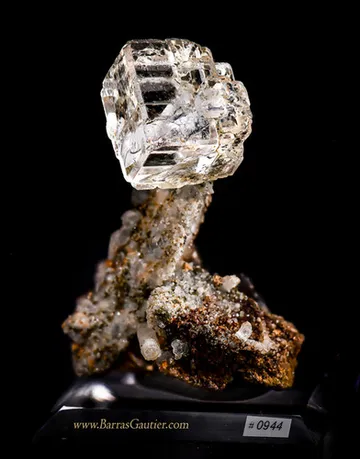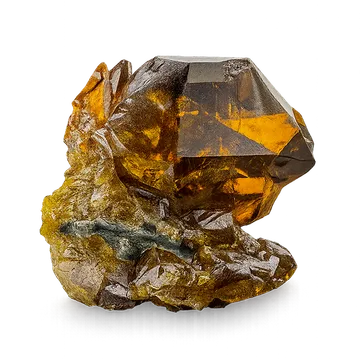
Sphalerite from Dal’negorsk, Russia — black, glassy ZnS crystals from a famed district; prized for sharp twinned forms and striking contrasts with galena and c…
Key facts
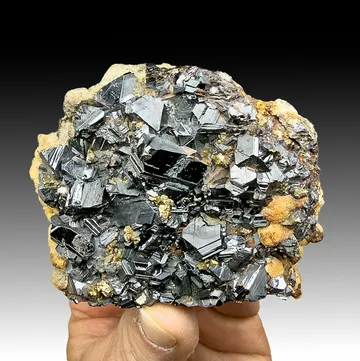
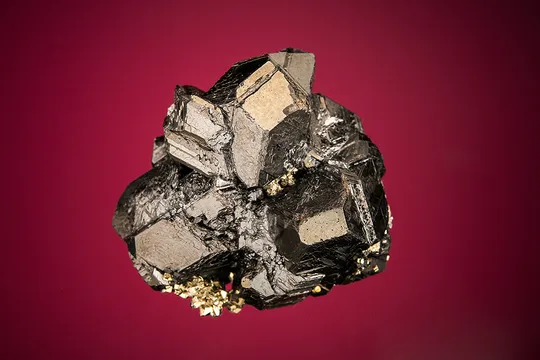
Dal’negorsk sphalerite is one of the great modern sulfide classics: black, glassy to mirror-bright ZnS from a remote mining district in the Russian Far East, most admired when it sits in sharp contrast with silver galena, bronze pyrrhotite, pale calcite, clear quartz, chalcopyrite dusting, or colorless fluorite. The look is unmistakable when the piece is good: stacked, twinned, sharply stepped crystals with a lacquer-black luster, often arranged as sculptural clusters rather than ordinary ore fragments.

Photo: Wikimedia Commons
The locality’s appeal comes from the way ore geology and specimen geology overlap. The Dal’negorsk ore district is dominated by lead-zinc skarn and polymetallic vein systems developed in carbonate-rich blocks and volcanic-sedimentary rocks. At the Nikolaevskiy Mine, one of the district’s flagship specimen localities, hot sulfide-bearing fluids entered cavities in limestone and had room to crystallize freely. That open-space growth is the reason collectors see Dal’negorsk sphalerite as actual crystals—modified tetrahedra, twins, stepped faces and large lustrous aggregates—rather than merely as massive zinc ore.
The best sphalerites from Dal’negorsk are high-iron, very dark specimens: black to nearly black in hand, sometimes with yellow-brassy areas where chalcopyrite dusts or coats the sphalerite. The locality is especially valued for combination pieces. Sphalerite with etched or spinel-twinned galena is the classic association; sphalerite with pyrrhotite gives a more dramatic bronze-and-black composition; sphalerite with calcite can be visually softer, with white or pale carbonate perched over black sulfide; and sphalerite with quartz and fluorite brings the famous Dal’negorsk “clean crystal” aesthetic into the sulfide suite.

Photo: Wikimedia Commons
Historically, Dal’negorsk specimens entered the Western collector market in strength from the late Soviet and early post-Soviet period onward. Older labels may use variant spellings such as Tetyukhe, Tetjuche, or Tjetjuche, reflecting the former name of the district and older transliterations. For serious collectors, the label matters: “Dal’negorsk” is useful but broad, while a mine-level attribution such as Nikolaevskiy Mine, 1st Sovetskii Mine, or 2nd Sovietskii Mine adds value when reliable.
Search for specimens: View all sphalerite specimens from Dal’negorsk, Russia
Dal’negorsk lies in Primorsky Krai in the Russian Far East, within the Sikhote-Alin region, a mineral belt long recognized for tin, lead, zinc, tungsten, boron, silver, bismuth, copper, and related polymetallic mineralization. For sphalerite collectors, the most important context is the Dal’negorsk ore district’s lead-zinc skarn and vein systems. Regional work groups many Dal’negorsk lead-zinc deposits into skarn and vein types, with skarn deposits forming the dominant commercial class.
The Nikolaevskiy deposit is the central name for world-class sphalerite from the district. Its ore bodies are associated with limestone blocks and skarned carbonate rocks near intrusive and volcanic units of the Dalnegorsky complex. Hedenbergite skarn, quartz-carbonate-sulfide assemblages, and massive to disseminated sulfide zones are all part of the mineralizing system. Sphalerite and galena are the principal ore minerals; pyrrhotite, chalcopyrite, pyrite, arsenopyrite, quartz, calcite, chlorite, epidote, fluorite, and other species complete the collector-visible associations.
The broad Dal’negorsk district also includes the 1st and 2nd Sovetskii mines, Verkhnii Mine, Danburitovyi Mine, Bor Pit, Partizansky-related skarn systems, and other polymetallic or borosilicate-skarn localities. This is why good old labels should be read carefully. A specimen simply labeled “Dal’negorsk” may be entirely legitimate, but it may not identify the precise mine. A specimen labeled “Nikolaevskiy Mine” should show the typical sulfide-skarn vocabulary: black sphalerite, galena, pyrrhotite, quartz, calcite, fluorite, chalcopyrite, and sometimes siderite.
Mining history is tightly linked to specimen history. The Nikolaevskiy Mine appears in modern specimen literature as a locality opened in 1982, and Dalpolimetall’s own company history records Nikolaevskiy mine construction in 1981 and development of the first stage of the Nikolayevskiy deposit with self-propelled mining machines in 1983. In 1991 the company reported a record annual ore output of 1,245,000 tons, and the firm entered the post-Soviet corporate period in 1993. Those dates align with the collector market’s memory: much of the revered Dal’negorsk sulfide material seen in older Western collections came out in the 1980s and 1990s, often first reaching the market under older place names or older transliterations.
Collecting access should be understood as mining-related, not casual field-collecting. These are active or historically industrial ore workings, not open dig sites for tourists. Specimens that reach collectors normally come through miners, local dealers, Russian supply chains, international dealers, and recycled collections. Fine old pieces with reliable mine attributions, collection labels, or early-market provenance command more attention than anonymous “Russia” or “Siberia” material.
Notable finds include very large, free-grown sulfide crystals from open cavities in limestone and skarn. Mindat’s Nikolaevskiy entry records sphalerite as modified tetrahedra and twins to 16 cm and describes the material as extremely fine high-iron sphalerite. The district is also famous for large galena twins, etched “melted-looking” galena, pyrrhotite plates, clear fluorite, calcite groups, and unusually rich multi-species cabinet specimens. The great Dal’negorsk sphalerite is rarely just “sphalerite”; it is usually a record of open-space skarn mineralization written in black, silver, bronze, white, and glass-clear crystals.
Dal’negorsk sphalerite is typically dark, high-iron material: black, jet-black, or very dark brown-black, with an adamantine to resinous-metallic luster that can look almost wet under strong light. On the best crystals the faces are sharply defined and highly reflective; lower-grade examples may be more granular, rough, or merely massive beneath other sulfides.
The principal habits are modified tetrahedra, twinned crystals, blocky aggregates, and stepped or skeletal-looking growths. Good specimens often show triangular face development, trigonal-looking stacked growth, and repeated twin geometry. The crystals may appear like black architectural blocks rather than simple equant grains. A number of dealer-described and photo-documented specimens show individual sphalerite crystals in the 3–5 cm range; Mindat records crystals and twins to 16 cm from Nikolaevskiy, putting the locality in the top tier for crystal size as well as luster.
Associations are central to identification and quality. The most classic pairing is sphalerite with galena. Dal’negorsk galena may occur as cubes, cuboctahedra, spinel twins, skeletal forms, hoppered crystals, or etched “melted-looking” crystals. Sphalerite provides the black base or intergrowth, while galena supplies metallic silver geometry. With pyrrhotite, sphalerite commonly appears beside bronze, tabular, hexagonal to pseudohexagonal crystals. With calcite, it forms a black matrix or crystal cluster under white, cream, tan, or manganese-bearing pinkish carbonate. With chalcopyrite, sphalerite may appear brassy or yellowed on the surface. Quartz is frequent as small clear to white crystals, and fluorite can appear on exceptional combination pieces from the district.
Quality depends first on luster and crystal definition. A Dal’negorsk sphalerite should not be merely black; it should flash. The finest examples have glassy, mirror-bright faces, visible twin structure, crisp edges, and an aesthetic placement on contrasting associated minerals. Next comes completeness: many good Dal’negorsk sulfides grew in cavities but were extracted from hard ore, so edge bruising, peripheral contact, and cleaved or scuffed areas are common. A specimen with large, undamaged black sphalerite crystals and no distracting contacts is much scarcer than an ordinary ore matrix with small dark crystals.
Color contrast is a major value factor. Black sphalerite on black sulfide is interesting mineralogically but can be visually heavy; black sphalerite with silver galena, white calcite, bronze pyrrhotite, or clear quartz is far more desirable. Cabinet pieces with multiple balanced species can be more important than isolated sphalerite crystals, especially when the sphalerite remains sharp and prominent rather than acting as a background mass.
Size categories are broad. Thumbnail and miniature pieces are readily available in modest quality, especially galena-sphalerite and calcite-sphalerite combinations. Small-cabinet specimens with sphalerite crystals over 2 cm are common enough to be actively collected but not trivial in fine condition. Cabinet pieces with sphalerite crystals of several centimeters, strong association, and old provenance are serious locality specimens. Large cabinet or museum-size pieces with undamaged, well-placed sphalerite and major galena, pyrrhotite, fluorite, or calcite are significantly rarer.
The main authenticity issue with Dal’negorsk sphalerite is not widespread fake sphalerite itself; it is locality precision, repair, and undisclosed restoration. Black sphalerite with galena, calcite, quartz, chalcopyrite, pyrrhotite, and fluorite is geologically credible for Dal’negorsk, but similar-looking lead-zinc specimens can come from Bulgaria, Romania, Kosovo, China, Trepča, Naica, or other polymetallic districts. A believable Dal’negorsk specimen should have an association and style consistent with the district, and ideally a label trail to Nikolaevskiy, 1st Sovetskii, 2nd Sovietskii, or another recognized Dal’negorsk locality.
Labels deserve close reading. Older specimens may be labeled Tetyukhe, Tetjuche, Tjetjuche, Dalnegorsk, Dal’negorsk, Primorskiy Kray, Primorsky Krai, Nikolaevsky, Nikolaevskiy, Nikolayevskiy, 2nd Sovietskii, or 2nd Sovietsky. These spelling variations are normal in the market. A vague “Siberia” label is less satisfactory; Dal’negorsk is in the Russian Far East, not Siberia in the strict collecting-label sense, though older commercial descriptions sometimes used Siberia loosely.
Condition is the great separator. Sphalerite is softer than quartz and more brittle than its glossy appearance suggests. It can chip along exposed edges, show bruised corners, or develop tiny cleaved flashes that break the continuity of the luster. Galena associations add another problem: galena is soft, heavy, cleaves perfectly, and can tarnish. Pyrrhotite may be stable on many specimens but should be kept dry and watched for surface alteration. Calcite can be scratched or etched by acids, and fluorite can chip on corners. The weight of galena-rich Dal’negorsk pieces also means old contact points on the underside are normal, but damage to display crystals should be assessed carefully.
Documented locality-specific faking of Dal’negorsk sphalerite is not a major theme in the literature or collector discussions. That said, repaired sulfides exist throughout the mineral market. Watch for black-painted fills, reconstructed corners, glued galena or sphalerite crystals on matrix, suspiciously glossy adhesive in recesses, and mismatched luster where a crystal has been reattached. Ultraviolet inspection, magnification, and careful checking around contact points can reveal glue or restoration. High-value pieces should come from dealers willing to discuss repair history plainly.
Rarity is tiered. Representative Dal’negorsk sphalerite is available. Fine Dal’negorsk sphalerite is not. Thumbnail and small-cabinet galena-sphalerite combinations still appear regularly through dealers and auctions. Superb old combinations with large black twinned sphalerites, highly lustrous galena, good calcite or pyrrhotite association, and minimal damage increasingly come from recycled collections rather than steady fresh production. Specimens specifically tied to the 1980s and early 1990s market, or carrying a well-known collection provenance, have an added historical premium.
Current market availability remains healthy at the modest to mid-range level. Recent dealer and auction listings show Dal’negorsk sphalerite combinations from under a few hundred dollars for smaller or imperfect pieces to much higher prices for cabinet specimens with large crystals, complex associations, and strong aesthetics. The best pieces are judged less like ore specimens and more like sculptural sulfide compositions: crystal size, reflectivity, contrast, balance, and provenance all matter.
The modern story of Dal’negorsk specimens begins underground, but it became a collector story only when the district opened to the world. Nikolaevskiy mine construction was underway in 1981; the mine is described in modern mineral records as having opened in 1982; and by 1983 Dalpolimetall was developing the first stage of the Nikolayevskiy deposit with self-propelled mining machines. That short window matters. It places the birth of the locality’s great specimen era at the end of the Soviet period, just before Russian minerals began moving more freely into Western collections.
Collectors who bought Dal’negorsk sulfides in the late 1980s and early 1990s often encountered them under older names. Some labels read Tetjhe, Tetjuche, or Tetyukhe rather than Dal’negorsk. Those old labels are not flaws; they are historical evidence. A pyrrhotite-sphalerite specimen from the Gene Meieran Sulfide Collection was described in the trade as older material from the late 1980s to early 1990s, “when Dalnegorsk specimens were first coming to the US market,” and as material then attributed to Tetjhe. For a serious sulfide collector, that sort of label can be as evocative as the crystals themselves: it marks the moment when a remote Far Eastern mining town became a world locality.
There is also a very human Dal’negorsk trade story. Vladimir Kuvshinov, a collector and dealer from Dal’negorsk, has written that he has provided top-quality Dal’negorsk specimens to collectors since 1982, later living in Prague while returning to Dal’negorsk three or four times a year and spending five to six months there annually. His “Crown of Russian Empire” account concerns a fluorite rather than a sphalerite, but it captures the specimen culture that also brought out the district’s best sulfides: early-1980s mine production, remote locality logistics, half-capacity mining, and a sense that the finest pieces were not volume commodities but singular survivors.
The specimens themselves carry the drama of their cavities. Dal’negorsk sulfides can look almost too metallic to be natural: galena appears as flat spinel twins, hoppered plates, or etched forms with a “melted” look; black sphalerite stacks against them in glossy twinned blocks; pyrrhotite grows in bronze plates; calcite rises in pale blades or discs. Collectors sometimes ask whether the galena surfaces were melted, polished, or altered, but experienced observers note that highly lustrous and etched galena and pyrrhotite are part of the district’s natural style. The caution is practical rather than romantic: that dazzling fresh sulfide shine can dull with time if surfaces oxidize, so the best old Dal’negorsk pieces are both mineral specimens and preservation stories.