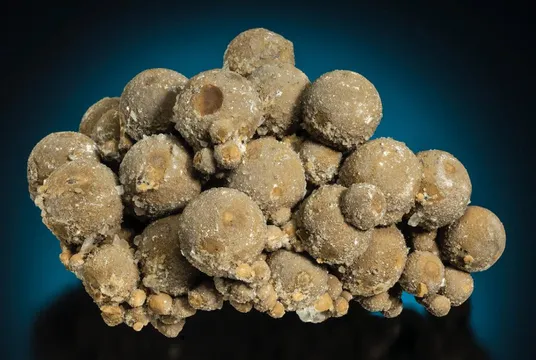
A collector's guide to Dalnegorsk, Russia: its geology, mining history and notable minerals, illustrated with the 424 specimens documented from this locality on EarthWonders.
Key facts
Dalnegorsk is one of the indispensable modern names in mineral collecting: not a single mine in the simple sense, but a compact Russian Far East ore district whose labels may read Dalnegorsk, Dal’negorsk, Tetyukhe, Tjetjuche, Tetjuche, Nikolaevskiy, 1st or 2nd Sovetskii, Partizanskoe, Verkhnee, Sentyabr’skiy, or Bor Pit. The town sits in Primorsky Krai on the eastern flank of the Sikhote-Alin region, where skarn mineralization developed in and around blocks and plates of limestone in a complex Mesozoic basement. That geological accident produced two collector worlds side by side: a giant borosilicate skarn famous for datolite, danburite, axinite, quartz, calcite, and rare boron-bearing assemblages, and a suite of Pb-Zn-Ag skarn and vein deposits whose cavities yielded some of the finest late-twentieth-century combinations of galena, sphalerite, pyrrhotite, fluorite, calcite, quartz, chalcopyrite, siderite, hedenbergite, and ilvaite.
The best Dalnegorsk specimens have a look collectors recognize across a room. Colorless fluorite cubes and cuboctahedra sit like ice on quartz and carbonate. Black, sharply prismatic ilvaite stands in high relief against pale quartz, white calcite, and greenish hedenbergite. Sphalerite is often jet-black and bright enough to flash under a lamp; galena may appear as highly modified cuboctahedral and spinel-twinned forms rather than simple cubes; pyrrhotite forms bronzy pseudo-hexagonal plates perched on quartz needles or calcite. From the boron skarn, datolite can form glassy pale green to bluish green clusters, and the skarn silicates add the earthy, fibrous, bladed, and replacement textures that make Dalnegorsk pieces more than just clean sulfide cabinet specimens.
Regional View
Country View
Dalnegorsk’s importance to the specimen market grew sharply as Russian material reached Western shows in the late Soviet and post-Soviet period. The district was already an industrial mining center long before that: the old Tetyukhe lead-zinc operation dates to the turn of the twentieth century, while the borosilicate deposit became a strategic Soviet source of boron. For collectors, the consequence is unusually rich provenance. An old Dalnegorsk label may be perfectly legitimate but geologically broad; a more useful label will name the mine or deposit and place the piece in the correct skarn or polymetallic context.

Photo: Wikimedia Commons

Photo: Wikimedia Commons

Photo: Wikimedia Commons
Search for specimens: View all specimens from Dalnegorsk, Russia
Dalnegorsk lies in a metallogenic setting where limestone, volcanogenic rocks, clastic sequences, and intrusive or dike-related hydrothermal systems interacted repeatedly. In collector terms the district divides most clearly into the borosilicate skarn at the Dal’negorsk B deposit, especially the Bor Pit, and the Pb-Zn-Ag skarn-polymetallic mines operated historically and presently around the town. The boron deposit is localized in calcic skarns replacing Triassic limestone blocks and breccias within a structurally complicated basement; published work emphasizes its position at the intersection of major fault systems and its close relationship to altered basaltic and latitic dikes that served as conduits for boron-rich fluids. The mineralizing system produced datolite-danburite-axinite-quartz-calcite assemblages overprinted by sulfides and later hydrothermal minerals.
The polymetallic deposits belong mostly to skarn and vein systems. Nikolaevskoe is a deep, blind deposit without ore outcrop at the surface; the ore follows displaced limestone plates and occurs as irregular, lens-like bodies along upper and lower contacts. The official mining description of the Nikolaevskoe orebody gives the Vostok-1 limestone plate as roughly 1800 m by 700 m by 280 m, with individual ore bodies reaching up to 80 m thick and 220 m along strike, and mineralization traced by drilling to deep levels. Partizanskoe, worked through the 2nd Sovetskii mine, is another skarn-polymetallic system tied to limestone contacts in olistostromal rocks and mixed volcanic-sedimentary packages; there, quartz-carbonate veining and galena-sphalerite mineralization with hedenbergite form the collector-relevant assemblages. Verkhnee, the earliest industrial object in the district, is also a skarn-polymetallic deposit, now largely mined out except for remaining pillars, fill, and material accessible by later mining methods.
The mining history is unusually well documented for a mineral-specimen locality. On April 2, 1897, Vladivostok entrepreneur Yuliy Ivanovich Briner staked a rich silver-lead-zinc deposit in the Tetyukhe, now Rudnaya, River valley and named it Verkhnee. Industrial mining at Verkhnee began in 1907, and the Tetyukhe mining company was organized in 1909 with Russian, German, and English capital. A concentrating plant followed in 1914, and the early ore was rich enough that secondary zinc-lead material was shipped by sea to England for treatment. The district later became the Soviet Sikhote-Alin polymetallic combine, then Dalpolimetall, whose modern raw-material base includes Nikolaevskoe, Partizanskoe, Verkhnee, Maiminovskoe, Yuzhnoe, and Silinskoe deposits.
The boron side has its own chronology. Datolite was identified in samples from the Tetyukhe, later Dalnegorsk, boron deposit in 1931; Soviet Academy work confirmed the boron mineralization in 1936–1937; a formal expedition in 1946 produced the first detailed description of the deposit. The first datolite concentrate from Dalnegorsk boron ore was obtained on September 25, 1959, and the boron enterprise became one of the defining industrial institutions of the town. Open-pit mining of the borosilicate deposit has supplied Russia’s boron industry for decades, while the polymetallic mines supplied lead, zinc, silver, and related metals.
For collectors today, Dalnegorsk should be treated as an active mining district, not an open collecting ground. Current and former mine workings, pits, dumps, processing areas, and underground access points are industrial property and require permission from the operator or rights holder. Most collector pieces in circulation come through mine recovery, old Russian stock, dealer imports, and established collections rather than casual field collecting. The best modern purchases are those that preserve a more precise sublocality: Nikolaevskiy for many great fluorites, galenas, sphalerites, pyrrhotites, siderites, and ilvaites; 1st and 2nd Sovetskii and Partizanskoe for sulfide-skarn combinations, red or unusual quartz, fluorite-calcite associations, and ilvaite-hedenbergite pieces; Bor Pit for datolite, danburite, axinite-(Fe), unusual quartz, and borosilicate-skarn specimens.
Important pockets and finds came to market in waves. Older fluorites include the admired “ice cube” colorless material as well as less common purplish-blue stepped octahedral habits, some with provenance to collections formed when Dalnegorsk material first became available internationally in the early 1990s. Ilvaite finds from the late 1980s through the mid-1990s remain benchmarks for the species: black, glossy, sharply terminated prisms on pale quartz or hedenbergite, sometimes with calcite and sulfides. Siderite and pyrite pseudomorphs after ilvaite add another distinctly Dalnegorsk theme. From the Bor Pit, datolite and axinite-(Fe) specimens, twinned datolite, and later uncommon finds such as olive-green andradite keep the borosilicate quarry relevant well beyond its industrial importance.
Calcite is one of the great visual binders of the Dalnegorsk suite, occurring in the polymetallic skarns as white to colorless rhombs, scalenohedra, flattened disc-like crystals, stacked aggregates, and later coatings on sulfides and silicates; in the Bor Pit it belongs to the datolite-danburite-axinite-quartz skarn assemblage, while at Nikolaevskiy and the Sovetskii mines it is the pale foil for black sphalerite, silver galena, bronzy pyrrhotite, glassy fluorite, and black ilvaite. Specimen sizes range from thumbnails and miniatures to large cabinet plates, and old references record a remarkable diversity of habits from Dalnegorsk, including large crystals, twins, fluorescent examples, and pseudomorphic or inclusion-rich material. The best calcites here are not merely big: they show sharp form, transparency or attractive translucency, intact scalenohedral tips or rhombic edges, clean contrast with sulfides or fluorite, and minimal bruising on the exposed points and pocket-wall contacts.
Dalnegorsk quartz is unusually varied because it belongs to several parts of the district: clear, white, smoky, amethystine, red, doubly terminated, needle-like, drusy, Japan-law twinned, “beta-style” bipyramidal, starburst, and growth-interference habits are all seen on legitimate Dalnegorsk specimens. Nikolaevskiy quartz commonly acts as the matrix for fluorite, pyrrhotite, galena, sphalerite, calcite, siderite, chalcopyrite, and ilvaite; 2nd Sovetskii material includes distinctive red and included forms; Bor Pit quartz can appear with datolite, danburite, axinite-(Fe), and unusual borosilicate-skarn textures. Strong pieces have more than generic quartz appeal: a believable sublocality, undamaged terminations, sculptural three-dimensional architecture, and associations that point clearly to Dalnegorsk rather than to the many worldwide localities that can supply colorless quartz on sulfides.
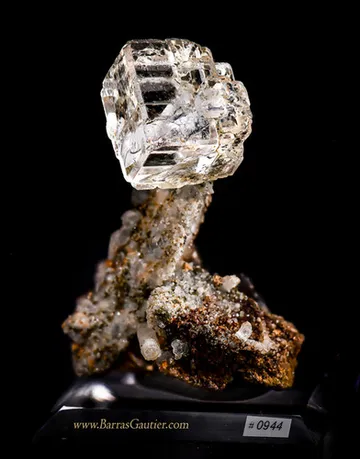
Dalnegorsk fluorite is prized above all for clarity and form, especially the colorless to pale green “ice cube” cubes, cuboctahedra, dodecahedral or modified forms, and rarer purplish-blue octahedral habits that appear on quartz, calcite, sphalerite, galena, and pyrrhotite matrices from Nikolaevskiy and the Sovetskii-Partizanskoe system. Crystals are often miniature to small-cabinet in scale, with individual fluorites commonly in the centimeter range, though large, dramatic cabinet specimens exist. The best examples are water-clear, lustrous, sharply edged, and visually isolated enough to read as fluorite rather than as a colorless accessory lost in white quartz; ordinary pieces tend to be cloudy, contacted, edge-worn, or too embedded in carbonate to show the famous Dalnegorsk geometry.
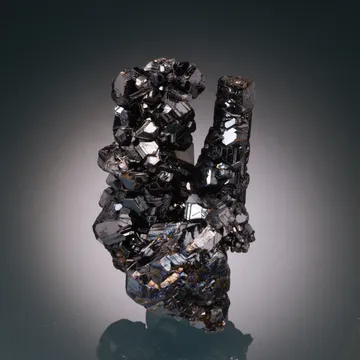
Dalnegorsk sphalerite is typically black to very dark brown, bright, and sharply crystallized, occurring as complex tetrahedral, dodecahedral, twinned, tiered, and sparkling aggregates in the Pb-Zn skarns, especially Nikolaevskiy and Partizanskoe/2nd Sovetskii. It is one of the district’s most dependable association minerals: classic pieces show sphalerite with modified or spinel-twinned galena, white calcite, quartz sprays, fluorite cubes, chalcopyrite accents, and bronzy pyrrhotite. Fine specimens are judged by luster, crispness, lack of bruising on exposed points, and composition; a miniature of black mirror-bright sphalerite on white quartz can outrank a larger dull mass, while combinations with transparent fluorite or sculptural galena are the most recognizably Dalnegorsk.
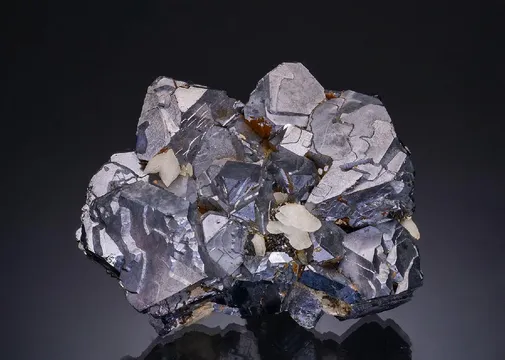
Galena from Dalnegorsk is best known not as plain cubic ore but as highly modified, lustrous, silver-gray crystals, including melted-looking cuboctahedra and spectacular spinel-law twinned forms from Nikolaevskiy and related polymetallic skarns. It commonly sits with black sphalerite, calcite, quartz, pyrrhotite, fluorite, chalcopyrite, and siderite, and the contrast between bright lead sulfide and black zinc sulfide is one of the district’s signature cabinet looks. Top galenas show clean metallic luster, sharp or elegantly modified faces, complete twin development, and attractive spacing on matrix; because galena is soft, dense, and cleaves easily, edge chips, rubbed high points, and old repairs matter more here than on many harder Dalnegorsk species.
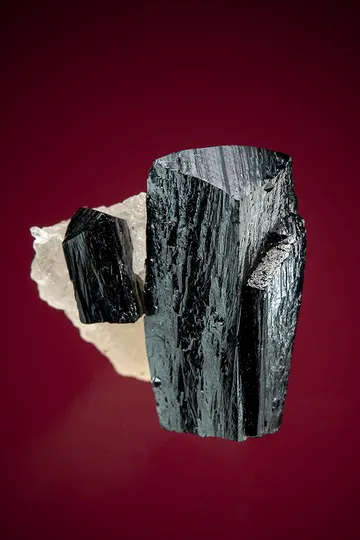
Ilvaite is one of the defining Dalnegorsk minerals, especially from Nikolaevskiy, 1st and 2nd Sovetskii, Partizanskoe, Sentyabr’skiy, Verkhnii, and the broader skarn suite: it forms black to jet-black, lustrous, sharply prismatic crystals, commonly with chisel-like terminations, strong striations, and the dramatic contrast of pale quartz, calcite, siderite, greenish hedenbergite, fluorite, or datolite-rich matrix. Most market specimens are miniatures and small cabinets with crystals in the 1–3 cm range, though larger crystals to several centimeters are well documented and crystals to about 10 cm have been reported for Nikolaevskiy. The collector sweet spot is a complete, isolated, glossy crystal on a light matrix; crowded black aggregates, repaired crystals, altered surfaces, and vague district labels are less desirable unless the piece is a demonstrably fine pseudomorph or old find.
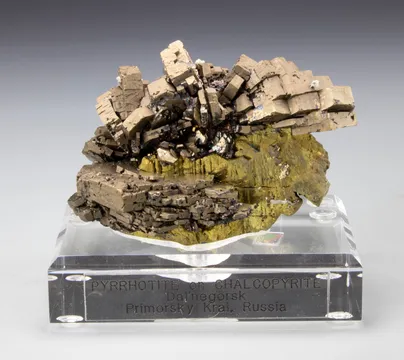
Dalnegorsk pyrrhotite is a world-class habit mineral, forming brassy to bronzy pseudo-hexagonal plates, tabular crystals, beveled discs, and stacked aggregates in the polymetallic skarns, particularly Nikolaevskiy and the Sovetskii mines. It appears on quartz needles, calcite rhombs, sphalerite, galena, and sometimes with chalcopyrite or ilvaite-related assemblages, giving specimens a warm metallic color that contrasts beautifully with the district’s black sphalerite and white quartz. Fine examples have sharp pseudo-hexagonal outlines, reflective bronze faces, strong three-dimensional placement, and little oxidation; mediocre pieces are dull, granular, edge-worn, or altered to rusty films that obscure the crystal architecture.
Datolite is the emblematic boron mineral of Dalnegorsk and the industrial heart of the Bor Pit: it occurs in the borosilicate skarn as pale green, gooseberry-green, bluish green, colorless to milky, glassy monoclinic crystals and rich aggregates, often with quartz, calcite, danburite, fluorapophyllite-(K), axinite-(Fe), hedenbergite, and rare dalnegorskite. Crystals may be small but sharp, and cabinet-size crystallized masses are known; reported fine specimens include blocky gemmy green crystals over 2 cm and larger crystallized aggregates with crystals to roughly 3 cm. The best datolites combine fresh glassy luster, pleasing color, clear crystal form, and honest Bor Pit provenance, while massive pale borosilicate rock or bruised mining fragments have far less collector presence.
Chalcopyrite is a less common but important accent and specimen mineral in the Dalnegorsk Pb-Zn systems, appearing with quartz, sphalerite, galena, pyrrhotite, calcite, and tetrahedrite-group mineralization, especially in the Sovetskii and Nikolaevskiy suites. It may form sharp brassy crystals, well-placed yellow accents on quartz and black sphalerite, or epitaxial overgrowths in sulfide assemblages; exceptional Dalnegorsk chalcopyrite has been noted for unusually large crystals, though most collector examples are miniature to small-cabinet combinations rather than freestanding giants. Good pieces need fresh, untarnished metallic luster, distinct crystal form, and compositionally useful association; small brassy blebs without form are common ore-mineral accessories and should not be priced as important Dalnegorsk chalcopyrite specimens.
Dalnegorsk siderite is most collectible in two modes: as tan to brown rhombs and aggregates with quartz, calcite, pyrite, pyrrhotite, sphalerite, and galena from the polymetallic skarns, and as pseudomorphs after ilvaite that preserve the black silicate’s prismatic habit in carbonate. Nikolaevskiy is the name most collectors associate with siderite-after-ilvaite, including specimens from 1990s finds where a tan pseudomorph projects from quartz points or sits with later sulfides and calcite. A strong siderite here has clear rhombohedral form or an unmistakable pseudomorphic story, crisp texture, and attractive contrast; ordinary rusty carbonate masses, incomplete replacements, and dull brown coatings should be treated cautiously unless the label and morphology justify them.
Dalnegorsk axinite is principally axinite-(Fe) in collector usage, especially from the Bor Pit borosilicate skarn, where old specimens show clove-brown to brown, lustrous, wedge-shaped blades associated with quartz, datolite, calcite, hedenbergite, and other skarn silicates. Erroneous axinite-(Mn) labels occur in older or loose usage, but analyses cited for Bor Pit material indicate that the attractive collector axinites from this setting are iron-dominant. Fine pieces show sharp bladed crystals with glassy luster, good separation from matrix, and convincing Bor Pit provenance; broken blades, dark indistinct masses, and specimens labeled only “Dalnegorsk axinite” without sublocality should be evaluated carefully.
Pyrite is not the first mineral collectors seek from Dalnegorsk, but it adds real interest when it appears as bright cubes or druses on quartz and calcite, as a sulfide companion to galena, sphalerite, pyrrhotite, and chalcopyrite, or—most distinctively—as pyrite pseudomorphs after ilvaite from Nikolaevskiy. The best pseudomorphs preserve the chisel-pointed ilvaite habit in brassy sulfide and may sit with pyrrhotite, quartz scepters, calcite rhombs, and other skarn minerals, making them far more locality-specific than ordinary pyrite on quartz. Quality depends on freshness, complete crystal faces, and the clarity of the replacement texture; dull, oxidized, or powdery pyrite should be avoided because it loses the metallic snap that makes these pieces work.
Hedenbergite is a fundamental skarn mineral at Dalnegorsk and an important aesthetic partner even when it is not the headline species: it forms dark green to greenish-black fibrous, radiating, granular, and crystalline matrices for ilvaite, quartz, calcite, sphalerite, galena, datolite, and garnet-group minerals. At Nikolaevskiy and 1st or 2nd Sovetskii, hedenbergite-rich bases give ilvaite specimens their green-black skarn character, and some quartz from the district shows green hues or inclusions attributed to hedenbergite. The best hedenbergite pieces are either well crystallized in their own right or provide a clean, contrasting stage for ilvaite and quartz; dark massive skarn with no visible crystal definition is geologically honest but seldom a top collector specimen unless tied to an important association or pseudomorph.
Beyond these headline species, Dalnegorsk is documented for an impressive supporting cast: danburite, andradite, grossular-andradite garnet, fluorapophyllite-(K), aragonite, prehnite, goethite, hematite, bournonite, jamesonite, tetrahedrite-group minerals, greenalite, palygorskite, aurichalcite, vesuvianite, wollastonite-group minerals, tremolite, chlorite, and numerous ore and skarn accessories. The type-locality mineral to know is dalnegorskite, Ca5Mn(Si3O9)2, a pyroxenoid described from the Bor Pit at the Dalnegorskoe boron deposit; it occurs as beige to pinkish-white and milky-white thinly radiated or fibrous aggregates in boron-bearing calcic skarn and is a serious systematic-species interest rather than a showy cabinet mineral.
Dalnegorsk is common enough on the market that availability can deceive newer collectors. Average specimens—small calcite-quartz plates, broken sulfides, cloudy fluorites, dark sphalerite clusters, massive datolite, and nondescript skarn fragments—are plentiful. Top pieces remain scarce: fine transparent fluorite on matrix, sharp spinel-twinned galena, lustrous pyrrhotite plates, complete ilvaite crystals on quartz, good datolite from the Bor Pit, and convincing pseudomorphs after ilvaite all command serious attention.
The main authenticity issue is labeling rather than outright fabrication. “Dalnegorsk” can mean the town, district, mine group, or simply an old trade name attached to Russian Far East material. Older labels may use Tetyukhe or Dal’negorsk; modern labels may overgeneralize a specimen that should be assigned to Nikolaevskiy, 1st Sovetskii, 2nd Sovetskii, Partizanskoe, Verkhnee, Sentyabr’skiy, or the Bor Pit. Nearby Primorsky and Kavalerovo-region material has also been confused with Dalnegorsk in the trade, particularly when the mineral style resembles the famous district. A specific, plausible sublocality is especially important for fluorite, ilvaite, datolite, axinite, and galena.
Repairs are a real consideration, especially on ilvaite, fluorite, galena, and large calcite specimens. Ilvaite crystals can be reattached to quartz or skarn, and black repair lines may hide well unless inspected under strong side lighting. Fluorite should be checked for chips along edges and corners; colorless material shows damage readily. Galena is soft and heavy, so cleaved corners, flattened rubbed high points, and old bruises are common. Pyrrhotite can dull or oxidize if stored in damp conditions; keep it dry and avoid unnecessary washing. Calcite cleaves easily and may show bruised scalenohedral tips, etched faces, or peripheral pocket-wall breaks, but some etched surfaces are natural and even attractive.
Dalnegorsk calcite can be strongly fluorescent, and some specimens are collected specifically for their UV response. Fluorescence should be described separately from daylight aesthetics; a spectacular UV specimen may be ordinary in cabinet light, while a glassy colorless calcite with sulfides may be more valuable visually even if its fluorescence is modest. Datolite and fluorite should not be harshly cleaned: acids that attack calcite or carbonate matrix can change the look of mixed specimens, and mechanical cleaning can damage the fine quartz, calcite, and sulfide associations that give Dalnegorsk pieces their identity.
The district’s origin story begins not with a mineral show but with a stake in a remote valley. On April 2, 1897, Yuliy Ivanovich Briner, a well-known Vladivostok entrepreneur, claimed a rich silver-lead-zinc deposit in the valley of the Tetyukhe River, now the Rudnaya. He named it Verkhnee, “Upper,” and the mining settlement that grew around it kept the Chinese-derived name Tetyukhe for decades before becoming Dalnegorsk in the 1970s. The Briner name also carries an unexpected cultural echo for American readers: Yuliy Briner’s family line is connected to the actor Yul Brynner, but the mineral story is older, colder, and more industrial—ore, narrow valleys, sea transport, and a mining town built around lead, zinc, silver, and later boron.
The early figures are stark. In 1902, four mining allotments were formalized at Verkhnee; that year the miners produced the first 97 tons of ore. Industrial exploitation began in 1907. On March 20, 1909, the Tetyukhe joint-stock mining company was formed with Russian, German, and English capital, and from 1911 to 1916 the Verkhnee mine alone produced more than 100,000 tons of ore. Much of the early near-surface material was secondary calamine-type ore, rich enough to be sent by sea to England for processing. In 1912 the German firm Humboldt began building a concentrating plant at Tetyukhe, and in June 1914 the plant produced its first lead concentrate at a capacity of 8 tons of ore per hour.
The railway story is just as tangible. In 1908 construction began on the narrow-gauge line from Tetyukhe-Pristan, now Rudnaya Pristan, to Tetyukhe. It opened in 1911 as a 38 km, 600 mm-gauge railway funded by Briner’s company, with four steam locomotives, 80 ore wagons, and 14 timber platforms. At its peak, the line extended to at least 70 km, carrying ore, timber, machinery, mine supplies, and passengers. Later it was rebuilt to 750 mm gauge; after 1991 it became part of Dalpolimetall’s transport system. The main route to Rudnaya Pristan was dismantled in 2006 as the company shifted concentrate haulage to road transport, but for collectors the image is unforgettable: a mineral district whose specimens reached the world through a landscape once stitched together by narrow-gauge ore trains.
The boron chapter began with a different kind of recognition. In 1931, a boron-bearing mineral—datolite—was found in samples from what became the Dalnegorsk boron deposit. Soviet Academy work in 1936–1937 confirmed the analyses, and a 1946 expedition produced the first formal description of the deposit. On September 25, 1959, the enterprise obtained its first datolite concentrate from Dalnegorsk ore. The date matters because it marks the shift from geological curiosity to national resource: the same skarn that gives collectors pale green datolite crystals and brown axinite blades also underpinned Russia’s boron industry.
The specimen-market story has its own drama, quieter but powerful. As Dalnegorsk minerals began appearing internationally in the late 1980s and early 1990s, collectors suddenly encountered Russian pieces with an unfamiliar combination of industrial freshness and cabinet-level aesthetics: glass-clear fluorite perched on quartz, black ilvaite on pale matrix, pyrrhotite plates, strange modified galenas, and sulfide combinations unlike the older European classics. Some old collection labels from that period still record the sense of arrival: early-1990s fluorites were described as unusual older habits from a renowned locality just entering the broader market. For many Western collectors, Dalnegorsk was one of the first post-Soviet localities that felt instantly classic rather than merely new.