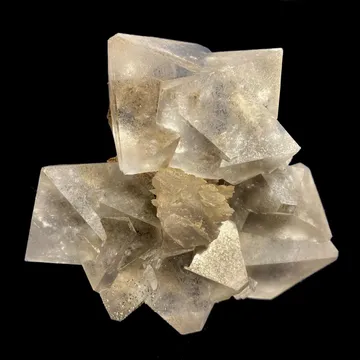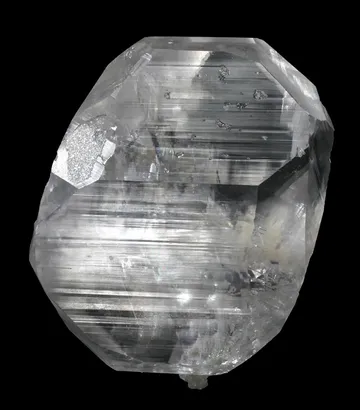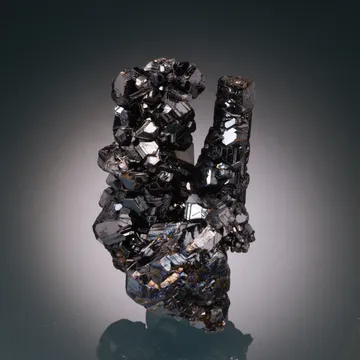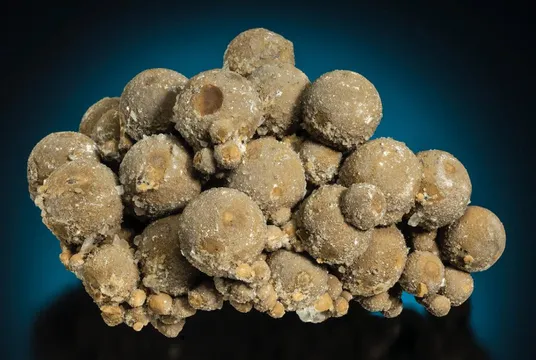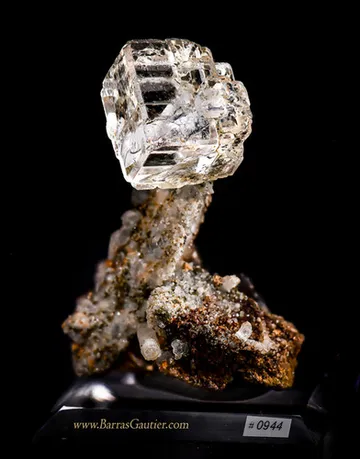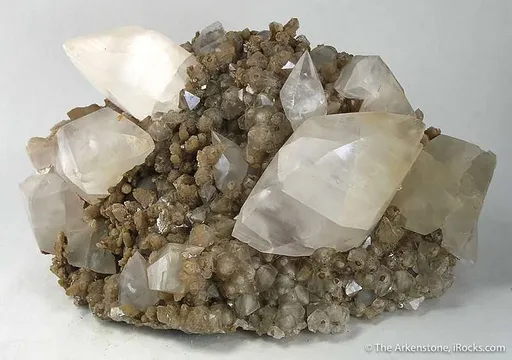
Verkhnii Mine, Russia — historic Dalnegorsk locality yielding sharp calcite crystals and manganese-rich varieties; prized by collectors for provenance.
Key facts
Verkhnii Mine is the old “Upper” mine of Dalnegorsk, the mine that gives the district’s modern collecting story its first industrial chapter. It lies in Primorsky Krai in Russia’s Far East, in the Sikhote-Alin region, where displaced limestone plates and volcanic-sedimentary rocks became the host for skarn-polymetallic lead-zinc-silver mineralization. For collectors, Verkhnii matters in two overlapping ways: it is a historically important ore mine, active in one form or another from the earliest Tetyukhe workings into the modern Dalpolimetall era; and it is one of the classic sources of Dalnegorsk calcite, including sharp, transparent, complex crystals and manganese-bearing material with the pink to orange response that made the district’s calcites famous.
The mine’s best specimens have the clean, architectural look that collectors expect from Dalnegorsk but with a Verkhnii accent: clear to slightly honeyed calcite crystals, blocky or complexly modified, sometimes on bubbly or banded calcite matrix, sometimes with quartz, aragonite inclusions, hedenbergite, datolite, ilvaite, galena, sphalerite, or other skarn and base-metal companions. Good pieces are not merely “a Dalnegorsk calcite”; they preserve a precise Verkhnii label, show undamaged terminations and lustrous faces, and ideally retain some clue of the mine’s skarn-sulfide setting rather than being a detached, contextless single crystal.
Regional View
Country View
Historically, the locality appears under several spellings and translations: Verkhnii, Verkhniy, Verchniy, Verkhnee, Verkhnee Rudnik, and sometimes “Brenner” or “Bryner” mine in older Western collector literature. Older labels may also use Tetyukhe, Tetjuche, or Tjetjuche for Dalnegorsk. Those names are not red flags by themselves; in fact, for this locality, they can be exactly the kind of period language that supports an old provenance.

Photo: Wikimedia Commons
Search for specimens: View all specimens from Verkhnii Mine, Russia
Verkhnii is part of the Dalnegorsk polymetallic ore field, a district built around lead, zinc, silver, and associated minor metals in the Russian Far East. The mine is tied to the Verkhnee deposit, one of the skarn-polymetallic deposits of the Dalpolimetall raw-material base. Company geology describes the Dalnegorsk ore field as lying in the southern East Sikhote-Alin volcanic belt, with Mesozoic host rocks and two closely related styles of ore: lead-zinc-silver mineralization in calcareous skarns, and silver-zinc-lead mineralization in vein structures. Verkhnee, Nikolayevskoye, and Partizanskoye belong to the skarn-polymetallic group.
At Verkhnee, mineralization is associated chiefly with the upper contact of displaced limestone plates and overlying volcanogenic rocks. That geometry is important for specimen collectors: the mine is not a simple fissure-vein locality, but a replacement and open-space skarn environment in which carbonate gangue, calc-silicates, sulfides, and late oxidation minerals occur in close succession. The collector assemblage reflects that: calcite and manganese-bearing calcite are the headline species, but the documented suite also includes galena, sphalerite, chalcopyrite, pyrite, datolite, hedenbergite, ilvaite, adamite including copper-bearing adamite, aurichalcite, and iron-oxide “limonite” material.
The earliest recorded modern development goes back to Julius Joseph Bryner, the Vladivostok businessman who staked the silver-lead-zinc ground in the Tetyukhe, now Rudnaya, river valley on April 2, 1897 and named it Verkhniy. Four mineral land patents were issued for the future Verkhniy mine in 1902, and that same year the first 97 tons of ore were mined. Commercial development began in 1907. In 1909 the Tetyukhe Industrial Mining Stock Corporation was formed in partnership with Bryner & Co. and German and English capital; from 1911 to 1916, Verkhnii was the district’s only mine and produced more than 100,000 tons of ore.
The early ore was especially rich near-surface supergene zinc material: calamine and smithsonite from undersurface ore bodies, rather than the deeper sulfide-skarn ore most collectors now picture when they hear “Dalnegorsk.” Before 1909, the mine had already produced 566,000 poods of calamine ore, with 62,000 poods sent to Antwerp. A German-built enrichment plant began construction in 1912 and produced its first lead concentrate in June 1914. The mine stopped during the Civil War period, was conserved from 1918 to 1924, and then passed through the concession period before becoming state property in 1932 as the foundation of the Sikhali enterprise.
Verkhnii’s production history is long enough that “old mine” and “active industrial site” have both been true in different senses. The underground workings were developed first by adits and later by shafts and deeper levels. A major reconstruction from 1961 to 1971 included new shafts, ventilation works, and surface infrastructure. In 1978 the mine was producing about 400,000 tons of ore per year; by the early 1980s, as Nikolayevskoye became the district’s new major focus, Verkhnii’s annual output fell sharply. The mine was considered for closure more than once, but additional exploration, remnant pillars, mineralized fill, and ore beyond older structural assumptions repeatedly extended its life.
Modern company material describes Verkhnee as structurally belonging to the Nikolayevskiy Mine division, with open-pit work at the Verkhnii section. The same raw-material description lists most of the original deposit as mined out, except for remaining pillars and ore-bearing backfill whose combined lead-zinc content exceeds 5 percent. It gives 59,000 thousand tons? No—read carefully: 59 thousand tons of underground reserves in category C1, and 1,285 thousand tons of previously written-off Verkhnee reserves placed back into geological and mine-survey accounting for open-pit extraction. A 2025 Russian industry article described the mine’s industrial extraction as reaching its end in 2025; company production pages current on the web still list Verkhnee in the raw-material base and the Verkhnii open-pit section under the Nikolayevskiy Mine structure. For collectors, the practical conclusion is simple: Verkhnii should be treated as a controlled industrial mining locality, not as a casual collecting site. Permission, safety clearance, and current operator rules are essential.
The notable specimen finds collectors encounter today are mostly older and trade-circulated: early-1990s calcites of very high clarity, Verkhnii calcite with aragonite or quartz, calcite with hedenbergite, calcite with datolite and ilvaite, and oxidation-zone rarities such as cuprian adamite on gossan. High-end museum-grade calcite is not theoretical here: public collection records and dealer archives document Verkhnii calcite crystals in the 4–10 cm range, and exhibition records include a 14 x 15 x 9 cm Verkhnii calcite with a 13.6 cm main crystal that turns pink-orange under ultraviolet light. That scale, clarity, and fluorescence explain why precise Verkhnii labels remain desirable even in a district crowded with famous Dalnegorsk mine names.
Calcite is the defining collector mineral of Verkhnii Mine. The classic pieces are transparent to translucent, colorless, faintly honeyed, or pale pink manganese-bearing crystals, commonly complex rather than simple textbook rhombs: blocky hexagonal crystals with striated terminations, scalenohedral groups rich in secondary faces, flattened rhombs, and lustrous modified forms on calcite or quartz-rich matrix. Verified Verkhnii examples range from small miniatures around 4 cm, such as water-clear blocky crystals on banded calcite matrix, to cabinet specimens with main crystals around 7–10 cm, and museum-display pieces exceeding 13 cm on the principal crystal. Associations documented from Verkhnii include aragonite inclusions, quartz, hedenbergite, datolite, ilvaite, galena, and sphalerite; the best pieces combine undamaged glassy faces, crisp geometry, a true mine-level label, and either transparency or ultraviolet response, while ordinary pieces tend to be bruised, etched, cloudy, or stripped of matrix context.
Beyond calcite, Verkhnii’s documented mineral list is compact but characteristic of a lead-zinc skarn-polymetallic mine. Galena and sphalerite are the ore backbone, with chalcopyrite and pyrite as additional sulfides; hedenbergite and ilvaite carry the calc-silicate skarn signature; datolite records the boron-bearing chemistry that makes the wider Dalnegorsk district so distinctive. The oxidation and supergene story is represented by adamite, copper-bearing adamite, aurichalcite, manganese-bearing calcite, and iron-oxide “limonite” material. No valid type-locality mineral is currently documented specifically from Verkhnii Mine in the standard locality records I checked; the mine’s rarity value instead lies in unusual combinations and in species that are scarce at this exact mine level, such as cuprian adamite hemispheres on gossan, old calamine/smithsonite-zone material, and calcite-datolite-ilvaite combinations.
The most important authenticity issue for Verkhnii is not synthetic fakery; it is locality precision. Dalnegorsk specimens have circulated internationally for decades, and many older labels say only “Dalnegorsk,” “Tetyukhe,” or “Primorskiy Kray.” Those can be perfectly legitimate district labels, but they are not the same as a mine-specific Verkhnii attribution. Because Nikolaevskiy, 2nd Sovetskii, Verkhnii, and the Bor Pit can all produce calcite-rich specimens, later relabeling is a real risk. A specimen sold as Verkhnii should ideally have an old label, a reputable dealer or collection chain, or an association that makes sense for this mine.
No well-established, locality-specific problem of dyed, irradiated, or systematically fabricated Verkhnii calcite is documented in the standard collector sources. The higher-probability hazards are over-specific labeling, repaired crystal terminations, hidden bruising on transparent crystals, and acid-cleaned or trimmed pieces that have lost the matrix evidence that once made the locality believable. Calcite from Verkhnii can be glassy enough that cleavages and internal cracks are easy to miss in photographs; examine reflections across the termination, not just the general outline.
Manganese-bearing calcite from the mine may fluoresce pink to orange under ultraviolet light, and some dealer and museum records specifically note shortwave and weaker longwave fluorescence. Fluorescence is an asset, not a proof of locality: use it as one supporting feature, not as the basis for authentication. Handle specimens as you would any good calcite—avoid acids, prolonged soaking, ultrasonic cleaning, and thermal shock. Transparent Dalnegorsk calcite often has internal veils, inclusions, or cleavage planes; those are part of the look, but they can also be points of weakness.
Market availability is moderate for calcite and sparse for anything else with a trustworthy Verkhnii label. Miniature and small-cabinet calcites still appear from old Russian stock, European collections, and dealer archives. Superb Verkhnii calcite—the water-clear, pristine, large-crystal material associated with the early 1990s and with older high-end collections—is much less common than generic Dalnegorsk calcite. Cuprian adamite, aurichalcite, datolite-bearing combinations, and well-crystallized galena or sphalerite from Verkhnii are best regarded as specialist locality pieces rather than routine market material.
The story begins before Verkhnii had a modern name. A 1939 geological report by V. S. Bulygo recorded that the unnamed deposit had been worked by local people in the 13th–14th centuries, then later by Chinese miners in the late 19th century. Another geologist, F. V. Kozlov, writing in 1949, noted that Chinese workings targeted silver-rich areas and that primitive smelting remains were found in the Inza River valley. The slag still carried 50–70 percent lead, meaning the old smelters had been taking silver and leaving enormous amounts of lead behind. Their fuel was larch charcoal, scattered in the valley as a material memory of that early, small-scale silver work.
The modern industrial chapter starts with Bryner. On April 2, 1897, Julius Joseph Bryner staked the rich silver-lead-zinc deposit in the Tetyukhe valley and called it Verkhniy. The numbers at first look tiny: 97 tons of ore in 1902. But by 1907 commercial work had begun, and by March 20, 1909, a corporation backed by Bryner & Co. and German and English capital had been formed. The young mine quickly became an export engine. By January 1, 1909, it had produced 566,000 poods of calamine ore, of which 62,000 poods had gone to Antwerp. From 1911 to 1916, while Verkhnii was the only operating mine in the district, it yielded more than 100,000 tons of ore.
The early mine was not chasing the same material collectors prize today. Its fame came from rich oxidized and supergene zinc ore, the “iron hat” and calamine zone of the upper deposit. By 1916, that upper oxidized part was already nearly exhausted. Then politics interrupted geology: work stopped in 1918, the mine was conserved until 1924, and the Soviet government later granted the deposit as a concession to the English Tetyukhe corporation managed by Boris Bryner. In 1932 the concession ended; Verkhnii became state property and the foundation of Sikhali, the enterprise later inherited by Dalpolimetall.
Verkhnii’s long life was repeatedly rescued by geology. In the Soviet period the mine was rebuilt on a major scale between 1961 and 1971, with new shafts, deepening work, ventilation, and surface facilities. Alexey Trofimovich Mogilny, who headed Verkhnii for many years, later remembered that in 1978 the mine produced 400,000 tons of ore per year. By 1980 it had slipped to 280,000 tons, and then to about 150,000 tons as attention shifted to the new Nikolayevskoye mine. Closure was proposed; people were expected to move to Nikolayevskiy. Instead, the mine was re-examined—apophyses 1 and 2, the Porfiritovaya ore body, and enriched sections around the Artem adit level—and Verkhnii gained another two decades.
The last chapter has the feel of a mine refusing to end. In 2006 the company returned to the Verkhnii open pit to work pillars and mineralized backfill after the old underground shaft and adit levels had been liquidated. The first-stage plan called for 470,000 tons of ore; that gradually became 900,000. Geologist Anatoly Andreevich Katruk, remembered as never being seen at Verkhnii without his geological hammer, pushed the idea further: lower the pit floor by another 50 meters, strip the east flank, and keep going. Two million tons of ore were calculated there, and later work beyond the main fault added more. The final stage produced nearly 3 million tons of ore.
Katruk’s working style sounds like old-school mine geology at its best. He would pass a drill rig, glance at the glittering sulfide chips around the collar of the hole, and know the bit had crossed ore. He would tap a boulder with his hammer, mark a pillar, and explain the next move to the section chief or excavator operator. In the final years, ore was found and won “point by point,” partly by documents, partly by experience, partly by the practiced eye of a geologist who knew the mine better than the plans did.
For mineral people, one image from recent field writing lingers: the old calamine vein, now mined out, as a man-made gorge. Tourists and students were taken to see “pockets” and dug-out caves with traces of hand-drilled blast holes, oxidized ore pieces to carry away, and terraces of broken limestone stacked carefully by hand a century earlier. Dmitry Tonkacheev, a geology tour organizer and mineral specialist, described standing on those old terraces and seeing not only the surroundings of Dalnegorsk but a panorama of the mine’s past. That is exactly what Verkhnii has become for collectors as well: part specimen locality, part industrial monument, part geological cross-section through the birth of Dalnegorsk.
Raymond W. Grant and Wendell E. Wilson, “Famous Mineral Localities: Dal’negorsk, Primorskiy Kray, Russia,” The Mineralogical Record, vol. 32, no. 1, 2001, pp. 3–30. A key English-language collector reference for the Dalnegorsk district, including Verchniy/Verkhnii context, mine history, and the district’s specimen mineralogy. Mindat district reference excerpt
V. N. Kolesnikov, “Geology and Mineralogy of Pb-Zn Deposits of the Northern Primorye, Russian Far East,” Society for Mining, Metallurgy & Exploration, 1998. Discusses Dalnegorsk lead-zinc deposits as dominantly skarn deposits, with pipe-lens ore bodies, vertical zonation, and major ore minerals including galena, sphalerite, pyrrhotite, chalcopyrite, hedenbergite, quartz, and calcite. OneMine abstract
Warren J. Nokleberg and coauthors, Metallogenesis and Tectonics of the Russian Far East, Alaska, and the Canadian Cordillera, U.S. Geological Survey Professional Paper 1697, 2005. Places the Dalnegorsk lead-zinc skarns in the Taukha metallogenic belt and describes the regional relationship among limestone blocks, Early Cretaceous olistostromes, postaccretion volcanism, and skarn mineralization. USGS PDF
V. A. Baskina and coauthors, “The Dal’negorsk borosilicate skarn deposit, Primorye, Russia: Composition of ore-bearing solutions and boron sources,” Geology of Ore Deposits, vol. 51, no. 3, 2009. Although centered on the borosilicate skarn, the paper explicitly compares Dalnegorsk boron and base-metal skarns and includes isotopic data for datolite from Pb-Zn ore of the Verkhny deposit. ResearchGate page
The Mineralogical Record, vol. 31, no. 6, 2000, “Notes from the Editor.” Includes a Tucson-market note on brilliant apple-green cuprian adamite hemispheres on gossan matrix from the Verchniy mine at Dalnegorsk, reportedly collected from old upper workings. Digital issue PDF
Fersman Mineralogical Museum, Russian Academy of Sciences, “Form of Occurrence of Minerals in Nature” exhibition list. Documents Verkhnii/Tetyukhe specimens in the museum display, including calcite from Verkhnii Mine and quartz from Upper Mine, Dalnegorsk. Fersman Museum exhibition page
Mindat locality entry for Verkhnii Mine, Dalnegorsk. A practical species-level reference for the currently documented mineral list, variant locality names, and linked specimen photos. Mindat: Verkhnii Mine
“#24. Дальнегорск. Рудник ‘Верхний’. 05.10.2021г.” — Дальнегорск. Город и окрестности. A local Russian-language video visit to the Verkhnii Mine area, useful for seeing the modern landscape and mine setting. URL: https://www.youtube.com/watch?v=pSGJvJUrLtA
“Дальнегорск 2018 - Верхний рудник (Часть 2)” — Ramzes S. A short Russian-language field video from the Verkhnii mine area, useful as a visual supplement to the locality’s industrial setting. URL: https://www.youtube.com/watch?v=28YpTEJ9YWM
Mindat: Verkhnii Mine, Dalnegorsk, Primorsky Krai, Russia — Best single reference for the mine-level mineral list, variant locality names, and photo-linked specimen records.
MMC Dalpolimetall: Our History — Primary company history for Bryner, the 1897 claim, early Verkhniy production, the concession period, and Dalpolimetall’s development.
MMC Dalpolimetall: Production — English company overview of current mining and processing structure, including Verkhneye among Dalpolimetall’s deposits.
АО ГМК Дальполиметалл: Raw-material base and production — Russian company page with the most specific public geology and reserve summary for Verkhnee, Nikolayevskoye, Partizanskoye, and related deposits.
“Эпоха рудника «Верхнего»,” Глобус: геология и бизнес — Rich Russian-language historical article on Verkhnii’s production, people, old calamine workings, open-pit return, and final years.
Wikimedia Commons: Calcite-205925.jpg — Licensed image and specimen description of a water-clear blocky calcite crystal from Verkhnii Mine.
Fabre Minerals: Calcite with Aragonite from Verkhnii Mine — Dealer archive documenting a 4.4 cm clear Verkhnii calcite with aragonite, a useful reference for habit and association.
Fersman Mineralogical Museum: Exp97 exhibition list — Museum listing that includes Verkhnii/Tetyukhe calcite and quartz specimens.
OneMine: Geology and Mineralogy of Pb-Zn Deposits of the Northern Primorye — Technical abstract for Dalnegorsk lead-zinc skarn geology and ore mineralogy.
USGS Professional Paper 1697 PDF — Regional metallogenic framework for the Russian Far East and Dalnegorsk skarn setting.
The Mineralogical Record digital issue, vol. 31 no. 6 — Includes a market note on Verchniy cuprian adamite from old upper workings.