A collector's guide to Nikolaevskiy Mine, Russia: its geology, mining history and notable minerals, illustrated with the 346 specimens documented from this locality on EarthWonders.
Key facts
Nikolaevskiy Mine is the collector face of the Nikolayevskoye lead-zinc-silver skarn deposit at Dalnegorsk, in Primorsky Krai of the Russian Far East. In specimen terms it is one of the great late-20th-century sulfide localities: a deep, blind, carbonate-hosted ore system whose solution cavities allowed metallic crystals and transparent gangue minerals to grow freely instead of merely filling fractures. The classic assemblage is unmistakable—galena, sphalerite, pyrrhotite, pyrite, chalcopyrite, quartz, calcite, fluorite, siderite, and ilvaite—developed in and around hedenbergite-rich skarn and later quartz-carbonate-sulfide mineralization.
The mine matters because it gave collectors a combination of scientific importance and show-case aesthetics. Nikolaevskiy specimens can look almost engineered: bronze pyrrhotite “ribbons” standing on quartz, black sphalerite and silvery galena set into pale carbonate, glass-clear fluorite perched like ice on a white quartz base, pink manganoan calcite brightening otherwise somber sulfide plates, and jet-black ilvaite prisms rising from light matrix. The best pieces are not merely rich ore samples; they are open-space crystals from a productive industrial mine, with the polish and isolation usually associated with smaller pocket localities.
Regional View
Country View
Nikolaevskiy also anchors the modern Dalnegorsk label problem. “Dalnegorsk” appears on many older mineral labels, but the district contains several distinct mines and deposits. Nikolaevskiy is the name serious collectors want preserved when the specimen is truly from this mine, because it points to a specific deep skarn-polymetallic system rather than to the broad district that also includes the Bor borosilicate deposit, Verkhnii, 1st and 2nd Sovetskii, Partizanskoe, and other occurrences.

Photo: Wikimedia Commons

Photo: Wikimedia Commons

Photo: Wikimedia Commons
Search for specimens: View all specimens from Nikolaevskiy Mine, Russia
Nikolaevskiy Mine works the Nikolayevskoye deposit, a skarn-polymetallic lead-zinc-silver deposit in the Dalnegorsk ore field. The district lies in the southern part of the East Sikhote-Alin volcanic belt, where Mesozoic carbonate rocks, volcanic and volcanogenic-sedimentary units, intrusive rocks, and later hydrothermal systems produced several economically important polymetallic and borosilicate deposits. Nikolaevskoye belongs to the lead-zinc-silver skarn group, not to the separate boron skarn deposit that made Dalnegorsk famous for datolite and danburite.
The mine is a blind underground orebody: there are no ore outcrops at the surface. Mineralization is traced at depths greater than 700 m below the surface, in displaced limestone plates enclosed between upper tuffaceous rocks and basaltic olistostrome units that include breccias, sandstones, and siltstones. At the Vostok-1 orebody, the limestone plate is reported as roughly 1800 m by 700 m by 280 m. Ore occurs at both the upper and lower contacts of the limestone plates, where replacement and open-space crystallization produced a non-continuous, lens-like geometry rather than a simple vein.
The principal mined bodies include Vostok-I and Kharkovskaya. Vostok-1 is the dominant orebody; it is reported with thicknesses from a few metres up to about 80 m and is traced through deep levels. Kharkovskaya occurs in the central and eastern parts of the deposit and is a separate important ore lens. The geometry is irregular, with ore bodies reaching roughly 220 m along strike in some descriptions, dipping gently eastward above the -320 m level and more steeply below. Drilling has confirmed mineralization down to about -1200 m below Baltic sea level.
Mineralogically, the deposit is a classic skarn-polymetallic system. The ore assemblage is led by sphalerite and galena, with pyrrhotite, pyrite, chalcopyrite, arsenopyrite, magnetite, cassiterite, silver minerals, bismuth minerals, sulfosalts, and tellurides forming lesser but important components. The skarn and gangue suite includes hedenbergite, quartz, calcite, siderite, ilvaite, fluorite, axinite, tourmaline, epidote, amphibole, garnet, wollastonite, rhodochrosite, dolomite, and related alteration minerals. The best specimen pockets came from cavities in the limestone and replaced skarn where late sulfide and quartz-carbonate fluids had open room to build crystals.
Dalpolimetall’s company history records Nikolaevskoye entering operation in 1982, after construction in the early 1980s. The mine is notable industrially as a deep operation: company materials describe shafts more than 800 m deep, and the mine page describes three round, concrete-lined and metal-reinforced shafts, including Skipovoy and Vspomogatelny shafts driven from about +400 m to -420 m. Its designed production capacity is 500,000 tonnes of ore per year. Dalpolimetall continues to list Nikolaevskiy Mine as an active, central part of its operations, structurally including the Nikolayevskoye deposit and related company mining areas.
Collecting access today should be understood in that context: this is an active industrial underground mine, not a public collecting locality. Fine specimens reached the market through mining activity, mine contacts, dealers, collectors, and historic Dalnegorsk export channels, especially from the late Soviet and post-Soviet specimen boom. Current specimen availability is therefore market-based rather than field-collecting-based. Modern collecting requires permission through the operator and compliance with Russian mining, safety, and export regulations; casual collecting underground is not a realistic or appropriate assumption.
The most famous finds are not single named pockets in the way American pegmatite pockets are sometimes named, but repeated mineralized cavities and ore openings that yielded distinct styles. The “ice cube” fluorites—water-clear to pale green or faint lilac cubes and modified crystals, often on quartz, calcite, galena, or sphalerite—are the most widely recognized. Equally important are crystallized sulfide plates: galena with melted-looking modified cubes or spinel twins, lustrous black sphalerite, bronze tabular pyrrhotite, and pyrite or pyrite-after-pyrrhotite pieces. Ilvaite specimens, especially glossy black prisms on pale quartz or carbonate, represent the skarn side of the mine’s personality.
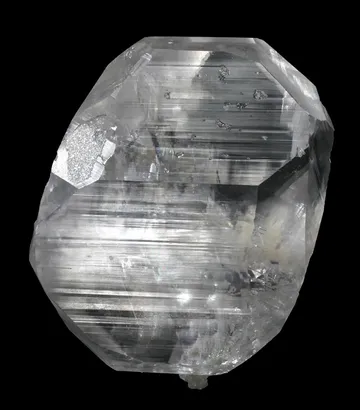
Fluorite from Nikolaevskiy is the mine’s most visually famous gangue mineral, prized for water-clear to pale yellow, pale green, and light purple crystals that commonly occur as cubes, modified cubes, cuboctahedral forms, and rarer dodecahedral or highly modified habits on quartz, calcite, galena, sphalerite, siderite, and sulfide-rich matrix. Documented collector specimens range from miniatures with single crystals around 2–2.5 cm across to small-cabinet and cabinet combination pieces; a particularly showy fluorite-galena specimen has been described with fluorite crystals to 4 cm on edge, while a Fersman Museum acquisition records a colorless rhombododecahedral fluorite crystal 5 cm across on fine crystalline quartz from the Nikolaevsk ventilation shaft. The best pieces are “ice” specimens: transparent, lustrous, sharply edged crystals with minimal bruising, strong relief on matrix, and attractive contrast with white quartz, dark sulfides, or pink calcite; ordinary pieces tend to be crowded, contacted, etched without sculptural appeal, or too included to show the clarity for which the locality is famous.
Quartz at Nikolaevskiy is both a major display mineral and the stage on which many of the mine’s better sulfides and fluorites perform. It occurs as colorless to milky druses, glassy points, needle-like sprays, radiating “starburst” groups, and quartz-coated matrix, commonly associated with fluorite, calcite, galena, sphalerite, pyrrhotite, pyrite, siderite, chalcopyrite, ilvaite, and hedenbergite-rich skarn. The finest quartz specimens from this mine are rarely just “quartz”; they are sculptural combinations, where clear or white quartz gives contrast to bronze pyrrhotite, silvery galena, black sphalerite, glass-clear fluorite, or black ilvaite. Better examples show clean terminations, bright luster, undamaged points, and an uncluttered composition, while more ordinary quartz is drusy matrix, broken ore support, or overgrown material without a strong main crystal or association.
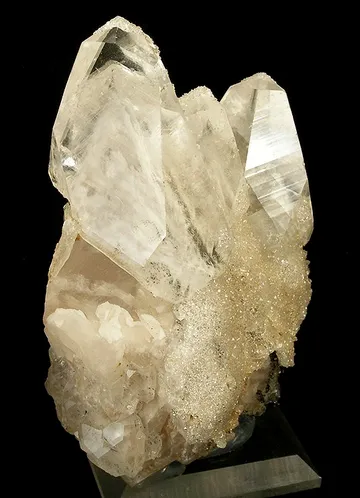
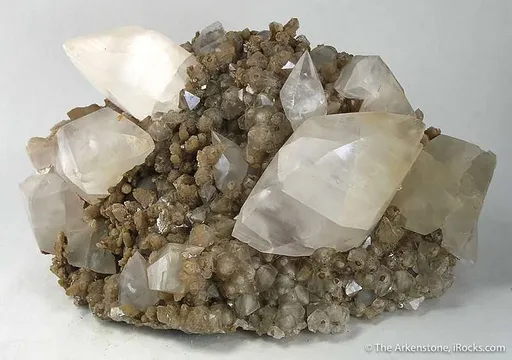
Calcite from Nikolaevskiy is unusually varied for a sulfide mine, with scalenohedra, rhombs, nailhead crystals, hexagonal barrel-like forms, twins, rosettes, and complex later-generation overgrowths recorded from the locality. Colors include colorless, white, brown, blackened or included crystals, and especially pink manganoan calcite, which gives some Nikolaevskiy specimens a soft, fluorescent accent against galena, sphalerite, pyrrhotite, pyrite, quartz, fluorite, siderite, chalcopyrite, dolomite, hedenbergite, and ilvaite. The most desirable pieces show calcite as an intentional part of the composition—lustrous pink or glassy colorless crystals perched on fluorite or sulfides, or aesthetic calcite rosettes on quartz—rather than as late, dull carbonate crust. Condition matters sharply: calcite cleaves, bruises, and etches readily, so complete terminations, undulled faces, and a clean relationship to the matrix separate strong pieces from routine carbonate gangue.
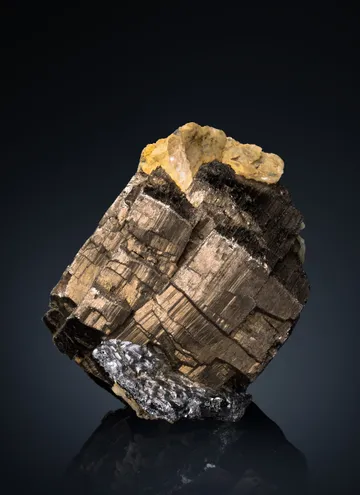
Pyrrhotite is one of Nikolaevskiy’s great signature sulfides, forming bronze to brassy tabular crystals, hexagonal-looking plates, stacked composite crystals, and curved or “ribbon” aggregates on quartz, calcite, siderite, sphalerite, galena, pyrite, chalcopyrite, and fluorite. Fine examples are often small-cabinet sized, with exposed crystals several centimetres across; one well-known photographed specimen shows a roughly 4 cm pyrrhotite ribbon standing on quartz, the kind of open presentation that made the mine famous. Good Nikolaevskiy pyrrhotite must have metallic luster, sharp stepped edges, an intact silhouette, and minimal oxidation; lesser examples are dull, bruised, corroded, or buried in massive sulfide. Association with quartz is especially valued because the pale matrix makes the bronze crystal form easy to read.
Galena from Nikolaevskiy is a world-class occurrence for aesthetic crystals, typically grey to bright silvery and occurring as modified cubes, “melted” cubes, octahedrally modified forms, and flattened spinel twins to several centimetres. It is commonly associated with quartz, pyrrhotite, sphalerite, chalcopyrite, calcite, siderite, fluorite, pyrite, tetrahedrite-group minerals, arsenopyrite, dolomite, and hedenbergite. The best pieces have isolated, lustrous, three-dimensional crystals rather than massive lead ore, and many of the strongest specimens are combinations: galena cutting through or rising behind water-clear fluorite, galena with black sphalerite and bronze pyrrhotite, or sharp twins on quartz-siderite matrix. Ordinary pieces are easy to recognize by heavy contacts, dull surfaces, sawn bases that dominate the display, or galena that lacks crystal individuality.
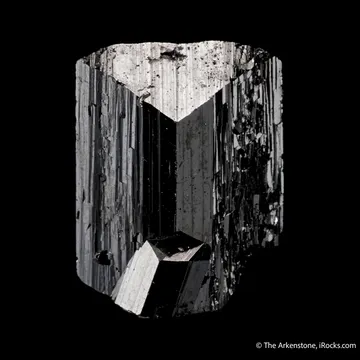
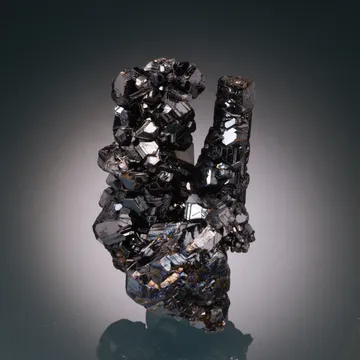
Nikolaevskiy sphalerite is usually dark brown to black, iron-rich, and often close to the marmatite style, forming modified tetrahedral crystals, twins, complex lustrous clusters, and large crystals reported in the collector literature to impressive sizes. It occurs with the mine’s core ore suite: galena, pyrrhotite, quartz, chalcopyrite, calcite, siderite, fluorite, pyrite, arsenopyrite, tetrahedrite-group minerals, and hedenbergite. The best specimens show glossy, sharply defined sphalerite with enough separation to reveal individual form, ideally contrasted against pale quartz or carbonate or combined with galena and pyrrhotite in a balanced sulfide plate. Less desirable examples are massive black ore, broken cleavage lumps, or crowded clusters where the sphalerite absorbs light and loses visual structure.
Ilvaite from Nikolaevskiy represents the skarn heart of the deposit: black to jet-black, highly lustrous prismatic crystals, commonly stout and chisel-like, set on quartz, calcite, siderite, hedenbergite-rich matrix, or other pale gangue. Crystals to about 10 cm are recorded from the locality, but most collector pieces are miniatures and small cabinets with individual ilvaite crystals around 1–3 cm; these are often more aesthetic than larger massive clusters because the black crystal form is readable against light matrix. The best pieces have sharp terminations, reflective faces, strong contrast, and minimal later coating; especially interesting examples preserve ilvaite habit in partial replacements or associations with siderite, hedenbergite, pyrite, or quartz. Ordinary pieces tend to be dark-on-dark, contacted, or so overgrown that the ilvaite is only a locality mineral rather than the visual subject.
Pyrite at Nikolaevskiy occurs as yellow metallic cubes, crystal groups, and notably as pyrite pseudomorphs after hexagonal pyrrhotite, a style that ties it directly to the mine’s pyrrhotite-rich sulfide assemblage. Crystals to about 10 cm are recorded, but the better collector pieces are those with clean cubic form, bright luster, or recognizable replacement textures on quartz, calcite, siderite, sphalerite, galena, pyrrhotite, fluorite, or dolomite. The most interesting specimens are not generic pyrite cubes but paragenetic pieces showing the relationship between pyrite and pyrrhotite, or bright pyrite providing yellow metallic accents on pale carbonate-quartz matrix. Lesser material is massive, tarnished, crushed, or visually lost among darker sulfides.
Chalcopyrite is a lesser but important copper-bearing sulfide at Nikolaevskiy, occurring as brassy crystals, crystal coatings, and sulfide associations with galena, sphalerite, pyrrhotite, quartz, calcite, siderite, fluorite, pyrite, and arsenopyrite. It is rarely the sole star of a Nikolaevskiy specimen, but in the best pieces it adds warm golden contrast to darker sphalerite, bronze pyrrhotite, and pale quartz-carbonate matrix; a documented monumental Nikolaevskiy combination of optic fluorite, galena, chalcopyrite, pyrrhotite, and quartz was described as measuring 36.7 x 19.5 x 17.7 cm and weighing 6.5 kg. Strong chalcopyrite pieces from this mine need sharpness, brightness, and a clear role in the composition; ordinary examples are small brassy patches on ore, easily overshadowed by the more famous galena, sphalerite, pyrrhotite, or fluorite.
Siderite from Nikolaevskiy is part of the carbonate gangue that accompanies the lead-zinc-silver ore system, occurring as brown to tan rhombs, curved aggregates, spherical to botryoidal-looking clusters, and coatings on quartz, commonly with galena, sphalerite, pyrrhotite, calcite, pyrite, chalcopyrite, fluorite, and dolomite. It is most attractive when it forms a warm, textured base for metallic crystals, such as galena on siderite-coated quartz, or when it occurs as well-defined rhombohedral crystals rather than massive brown carbonate. Because similar siderite appearances are reported from nearby Dalnegorsk localities, mine-specific labeling is important. Better Nikolaevskiy siderite shows crisp crystal form, lively luster, and a balanced association; ordinary siderite is dull, earthy, or merely a coating beneath more important species.
Other documented Nikolaevskiy minerals include acanthite, actinolite, albite, anatase, andorite, ankerite, arsenopyrite, axinite-(Mn), baryte, boulangerite, cassiterite, clino-ferro-suenoite, clinochlore, diaphorite, epidote, fayalite-forsterite series minerals, freibergite subgroup minerals, galenobismutite, hedenbergite, hessite, hisingerite, jamesonite, magnetite, marcasite, matildite, miargyrite, muscovite, native bismuth, native silver, native gold reported with caution in some summaries, owyheeite, prehnite, pyrargyrite, rhodochrosite, rutile, scheelite, stannite, stibnite, tellurobismuthite, tetrahedrite-group minerals including tetrahedrite-(Zn), tremolite, wollastonite, zoisite, and rare sulfosalt or bismuth-tellurium species known mainly from ore studies and polished sections. Nikolaevskiy is not best known as a type-locality mine for accepted display species; its rarity significance lies instead in the breadth of its base-metal skarn assemblage and in polished-section minerals such as matildite, galenobismutite, tellurobismuthite, owyheeite, diaphorite, hessite, and related Ag-Bi-Sb-Pb phases.
The principal authenticity issue is not widespread documented fakery but locality precision. “Dalnegorsk” labels are common, and older labels may use Dal’negorsk, Dalnegorsk, Tetyukhe, Tjetjuche, Tetjuche, Nikolaevsky, Nikolaevskiy, Nikolaevsk, or Nikolayevskoye. Those spellings can all be historically understandable, but a broad Dalnegorsk label should not automatically be upgraded to Nikolaevskiy unless the mineral association, provenance, or dealer history supports it. Fluorite, calcite, galena, sphalerite, pyrrhotite, and siderite all occur elsewhere in the district, so serious collection records should preserve the exact mine name only when it is actually known.
Condition standards should be high. Fluorite is vulnerable to cleavage and edge bruising; even fine “ice cube” pieces commonly show peripheral contacts or cleaved corners. Quartz points can be tipped, calcite can be bruised or etched, galena can be contacted or dulled, sphalerite can chip along cleavage, and pyrrhotite can tarnish or oxidize if stored poorly. Pyrrhotite-rich specimens should be kept dry and stable, away from acidic paper, damp storage, and large humidity swings. Galena and other lead-bearing sulfides should be handled with ordinary mineral hygiene: avoid dust, do not lick or wet-test specimens, and wash hands after handling.
Fluorescence can be worthwhile, especially in calcite and some fluorite-bearing pieces. Pink manganoan calcite from Nikolaevskiy may show attractive orange-red to red response under ultraviolet light, while fluorite reactions vary by specimen. Ultraviolet appeal should be treated as a bonus rather than the basis for attribution, because fluorescent calcite and fluorite occur at multiple Dalnegorsk localities.
Market availability is uneven. Small fluorites, quartz-fluorite combinations, calcite pieces, and sulfide miniatures appear regularly enough that a patient collector can acquire one, but top Nikolaevskiy specimens—large water-clear fluorite on matrix, aesthetic pyrrhotite on quartz, major galena-sphalerite-pyrrhotite plates, and sharp ilvaite on pale matrix—are far scarcer and can bring strong prices. The best provenance includes old Dalnegorsk export labels, iRocks or other major dealer histories, museum-published examples, or collection labels from the 1990s and early 2000s.
Nikolaevskiy was not a romantic hilltop dig; it was an engineering campaign into a deep, blind orebody. Company history places construction in 1981 and operation in 1982, but the most vivid account comes from a Dalpolimetall newspaper remembrance: by 1982, shaft builders had sunk two shafts more than 800 m deep, built headframes, equipped them with multi-rope hoists and main ventilation installations, and miners from the Verkhnii operation had driven a haulage crosscut more than 3 km long. More than 30 ministries, departments, design institutes, and construction organizations were involved. The orebody was rich, but the underground conditions were unforgiving: high temperature, increased water inflows, unexpected combustible gases, and rock pressure forced engineers to invent practical solutions as the mine advanced.
The first-stage development in 1983 marked a technological turn for the operation, with self-propelled mining machines recorded in company history. For collectors, that mechanized era is important because it coincides with the period when Nikolaevskiy began producing the pockets that later defined Dalnegorsk in Western collections. The mine’s best specimens are children of industrial mining: not surface float, not weekend collecting, but crystals saved from deep ore extraction.
A later official visit gives a sense of the mine as a living workplace rather than a historic name on labels. In 2014, Primorsky Krai governor Vladimir Miklushevsky visited Nikolaevskiy, which regional media described as the deepest underground mine in Primorye and a 500,000-tonne-per-year producer. He descended more than 500 m below the surface to visit the repair base for self-propelled mining equipment and meet workers. The mine was described as highly mechanized, with work proceeding mechanically from drilling to mucking. The same report noted more than 350 people working there, a reminder that the mineral specimens collectors prize are side-products of a large industrial community.
Modern Nikolaevskiy has also had its alarms. On January 25, 2024, a smoke incident at the mine led rescuers from Russia’s Emergency Situations Ministry to evacuate all miners who were on the mine face. Reports described visible smoke rising 275 m above the horizon at the Nikolaevsky mine in the Dalnegorsk urban district. The event was a production and safety story rather than a collecting story, but it underscores why access to an active deep mine is controlled and why specimens from Nikolaevskiy should be understood as saved industrial material, not casual field finds.