






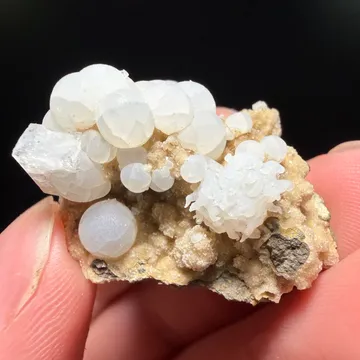
Blue Bed 1, USA — Oregon thunderegg locality known for blue chalcedony, agate and opal in lithophysae; prized for calm palettes, cut surfaces, and Priday prove…
Key facts
Blue Bed #1 is a collector’s name attached to thunderegg material from Richardson Ranch near Madras, Jefferson County, Oregon—one of the classic central Oregon agate districts and part of the broader Priday/Kennedy thunderegg tradition. To a mineral collector, its importance is not in metallic ore or crystal-lined mine pockets, but in cut surfaces: compact spheroidal lithophysae in rhyolitic volcanic rock, opened to reveal pale to deep blue chalcedony, agate, common opal, waterline structure, mossy inclusions, and occasional small quartz-lined openings. The best pieces have a composed, almost architectural look—brown rhyolitic shell framing blue-gray translucent silica, with horizontal “waterline” layers, fortification banding, and enough opacity-to-translucency contrast to make a slab read like a miniature landscape.
Geologically, the ranch lies in the north-central Oregon volcanic province where John Day Formation rhyolitic ash flows, tuffs, perlitic zones, and altered volcanic glass host the spherulitic cavities that collectors call thundereggs. The Priday agate deposit was already singled out in twentieth-century geological literature as one of Oregon’s best-known thunderegg localities, and the Richardson family’s rock business made the Madras beds a pilgrimage stop for several generations of lapidaries. Specimens from Blue Bed #1 matter because they sit at the intersection of science, state-symbol folklore, and the practical craft of cutting: the outside gives little away, while a well-oriented saw cut can expose a clean blue core, level banding, opal floors, or a star-like geometry inherited from the original lithophysal cavity.
Regional View
Country View
The Blue Bed look is more restrained than the riotous red-and-yellow plume material that made some Priday agates famous, but that restraint is part of its appeal. Fine examples show an unusually calm palette: blue chalcedony or blue agate, white to cream opal or chalcedony, gray-lavender translucency, and a chocolate-brown to tan rind. The most desirable pieces are not simply the bluest; they are the halves in which the cutter caught the egg at the right angle, preserving symmetry, a complete rind, crisp waterlines, and a satisfying relationship between shell, core, and any mossy or opaline internal features.

Photo:
Search for specimens: View all specimens from Blue Bed #1, USA
Blue Bed #1 is best understood as a named collecting bed within the Richardson Ranch thunderegg field north of Madras, Oregon, rather than as a conventional mine. The deposit is a gemstone and lapidary locality developed in silicic volcanic rocks—chiefly rhyolitic ash-flow and lava-related units of the John Day Formation in the Madras–Ashwood–Pony Butte area. The collectible “ore” is the thunderegg itself: a resistant, rounded to subrounded spherulitic or lithophysal body in altered rhyolite, commonly with a brown rind and an interior filled by chalcedony, agate, opal, jaspery silica, and locally quartz.
The regional geological framework is unusually favorable for thundereggs. Weakly welded rhyolitic ash flows, perlitic glass, pumiceous zones, and altered tuffaceous material supplied both the cavities and the silica that later filled them. In the Priday deposit described by the U.S. Geological Survey, chalcedony-filled spherulites occur in the lower part of a weakly welded rhyolitic ash flow; typical bodies average about three inches across and consist of a chalcedonic core enclosed by altered welded tuff. For the collector, that means the best Blue Bed #1 specimens are not accidental river cobbles but pieces from a specific volcanic bed in which cavity shape, rind texture, internal layering, and color all repeat well enough to give the material a recognizable identity.
There are no metallic ore bodies here in the ordinary mining sense. The productive horizons are thunderegg-bearing zones in altered volcanic rock. Older geological descriptions of the Priday agate deposit place most recoverable spherulites in a layer roughly 10 to 20 feet below the surface, exposed historically by open-pit work, bulldozing, blasting, and hand digging. Paul Colburn’s detailed thunderegg work describes the Priday Blue Bed exposure as a sequence including topsoil, pumiceous and perlite-breccia zones, black glassy perlite containing lithophysae, a downward transition through altered perlite into clay, and a rhyolite bedrock zone crowded with eggs. This vertical zoning matters to cutters: material from more altered clayey zones is more likely to have filled, collectible interiors, while unaltered perlite-hosted “duds” may look promising outside and disappoint inside.
Historically, the locality belongs to the Priday and Kennedy agate beds that later became central to Richardson Ranch. Richardson’s Rock Ranch opened its rock shop in 1974 after Johnnie and Norma Richardson and their son John built on a smaller rock business. The Priday Agate Beds were purchased in 1976 and added to the ranch, while the older Kennedy agate ground and the numbered Richardson beds remained part of the same collecting landscape. Collector usage can be confusing: labels may read Richardson Ranch, Richardson’s Rock Ranch, Priday Blue Bed, Blue Bed, Blue Bed #1, Kennedy Bed, or simply “Madras, Oregon,” depending on when the piece was collected, who cut it, and how carefully the bed was recorded.
The ranch became famous because visitors could once dig their own thundereggs from named beds and then have the rough cut or polished. That era effectively ended in 2019, when the Richardson family announced that the digging areas on the ranch were closed and that the business would focus on the rock shop and finished or rough material rather than public collecting. Current specimens therefore come from old collections, dealer inventories, ranch stock, and newly handled material controlled by the operators rather than from casual fee-dig collecting by visitors. Serious buyers should treat accurate old labels as part of the specimen’s value, especially when they distinguish Blue Bed or Blue Bed #1 from the visually related Richardson Ranch beds such as Red Bed, Moss Bed, Opal Bed, South Blue Bed, Pony Butte, and the numbered Kennedy beds.
Notable finds from Blue Bed-style material include single eggs with clear blue chalcedony, doubles and triples, waterline interiors with white opal floors, mossy or plume-like inclusions suspended in translucent silica, and specimens with small open centers or crystal pockets. Pieces measuring roughly cabinet size—around 7 to 10 cm across once cut and polished—are common in the market, but larger or unusually symmetrical eggs are prized when they show a complete rind and a centered, clean internal figure. The cutting orientation is critical: exterior ribs, pressure ridges, and rind geometry may hint at how to saw the egg to reveal the best star, landscape, or waterline effect.
Quartz at Blue Bed #1 is represented chiefly by chalcedony and agate in thunderegg interiors, with occasional clearer quartzy zones or small open cavities rather than freestanding crystal specimens. The strongest pieces show blue to gray-blue silica in a complete brown rhyolitic rind, often as level-banded “waterline” agate, fortification bands, or translucent chalcedony surrounding opal-rich floors and mossy inclusions. Ordinary halves may show only pale, patchy chalcedony or off-center fill; better collector pieces have a centered core, clean polish, intact matching halves, good translucency, and internal layering that remains horizontal across the cut face. Small-cabinet and cabinet pairs around 7 to 10 cm across are typical of marketed examples, while the most memorable Blue Bed material combines blue chalcedony, white opal, and a well-preserved thunderegg shell in one balanced composition.
Agate is the collector’s heart of Blue Bed #1: nodular thunderegg agate in a rhyolitic shell, most admired for subdued blue, blue-gray, lavender-gray, white, and cream banding. Classic Blue Bed pieces are level-banded or waterline agates, in which fine horizontal layers record the original gravitational “down” direction during silica deposition; some also show fortification banding, mossy streamers, opal layers, and small internal voids. The best agates here are judged as lapidary specimens rather than loose gems—complete rind, matching halves, high polish, a centered blue core, pleasing contrast between rind and interior, and minimal fractures or saw scars all count heavily. Collectors should also watch for label precision, because visually related Richardson Ranch thundereggs from South Blue, Opal Bed, Pony Butte, and older Priday material can be confused when old stock has been separated from its original field notes.
Other minerals and mineral varieties documented from the Richardson Ranch locality include opal, opal-AN, chalcedony, calcite, baryte, clinoptilolite-Na, and mordenite, along with the rock/lapidary category “thunderegg.” In Blue Bed #1 specimens, opal is the most collector-relevant companion to agate, appearing as white, cream, bluish, or lavender-toned layers and linings within the egg. Jaspery silica, moss agate, plume agate, and chalcedony cores occur more broadly across the Richardson/Priday beds, though not every named bed produces them equally. No verified type-locality mineral is tied to Blue Bed #1; its significance rests instead on being a classic named thunderegg source within one of Oregon’s best-known silica-nodule districts.
For authenticity, the main issue is label accuracy, not a documented epidemic of artificial Blue Bed fakes. Richardson Ranch thundereggs have circulated for decades as rough, slabs, polished halves, bookends, cabochon stock, and old collection pieces, and many labels were written by hobbyists rather than stratigraphers. “Blue Bed,” “Priday Blue Bed,” “Blue Bed #1,” “Richardson Ranch,” “Priday Ranch,” and “Madras, Oregon” may all appear in the market; some are usefully specific, while others blur several beds on the same ranch. A top-quality label should preserve the bed name, ranch name, county, state, and ideally the collector or acquisition date.
Treatment concerns are mostly ordinary lapidary concerns. Nearly all display pieces have been sawn and polished, and that is normal for this locality: an uncut thunderegg gives only rind texture, while the specimen value is in the revealed interior. Be wary of colors that look unnaturally saturated, especially electric blues or pinks inconsistent with the subdued Richardson palette; dyed agates exist widely in the trade, even if Blue Bed material is normally collected and sold for its natural blue-gray chalcedony and opal. Resin or oil can temporarily improve the look of fractures or undercut opal-rich zones, so examine high-value pieces under strong light for filled cracks, cloudy polish, or unnatural surface sheen.
Condition is central. The ideal specimen is a matching pair with both halves present, a flat and even saw cut, clean polish to the edges, minimal bruising on the rind, and no distracting fractures through the blue core. Many otherwise attractive eggs have chipped rims, incomplete backs, undercut softer opal, or a saw cut that missed the best internal symmetry. Waterline pieces are especially unforgiving: if the layers are tilted because of a poor display orientation or the cut face is uneven, the whole visual effect weakens.
Fluorescence is worth checking but should not be assumed. Opal-bearing Richardson Ranch thundereggs may show fluorescence, and dealer-reported Blue Bed opal interiors can fluoresce green under shortwave ultraviolet light. Because response varies with the exact opal, chalcedony, and included impurities, fluorescence should be treated as an added feature rather than a primary identification test. Avoid leaving opal-rich halves in hot sun or very dry display conditions for prolonged periods; common opal can craze or dull more readily than dense agate, especially along thin layers and small open cavities.
Market availability is moderate. Ordinary cut Richardson Ranch thunderegg halves remain available from old stock and current shop or dealer inventories, but accurately labelled Blue Bed #1 pieces with fine blue waterline agate, complete rind, strong symmetry, and known provenance are less common. Prices remain accessible for modest halves and small pairs, while large, dramatic, or unusually clean Blue Bed specimens command a premium because the bed is no longer a public dig source and because good interiors are never guaranteed until the saw reveals them.
The Blue Bed story begins with the odd humility of a thunderegg. On the outside, it is a lumpy brown volcanic nodule—nothing like a crystal pocket, nothing like a gem. That is precisely why central Oregon rockhounds became so attached to them. The reward is delayed until the saw cut, when a dull rind may open into a blue core, a waterline horizon, an opal floor, or a tiny landscape. Richardson Ranch built a reputation on that suspense: people came to dig, hauled away buckets of rough, then waited for the blade to decide whether they had a dud or a keeper.
Oregon’s thunderegg became a state symbol through a surprisingly grassroots campaign. In the early 1960s, Harold M. Dunn of Lane County, active in the Springfield Rock and Gem Club and the American Federation of Mineralogical Societies, heard that a South Dakota girl had asked for a list of state rocks and learned that no such list existed. His club told him to “do something about it.” Dunn contacted Glen M. Stadler, a newly elected state senator, while Oregon rock and gem clubs were asked to vote on a state rock. The thunderegg won among the clubs; the Oregon Museum of Science and Industry then held its own public vote, where the thunderegg won “two to one.” The measure missed the 1963 legislative deadline, returned in 1965, and passed the Senate 23 to 2 and the House 48 to 5. On March 29, 1965, the signatures of Senate President Harry Boivin and House Speaker F. F. Montgomery made the thunderegg Oregon’s state rock.
The legislative story even had a lapidary prop. A pen set made from the new state rock, shaped in the outline of Oregon, was presented to Governor Mark O. Hatfield on March 29, 1965, and used in the signing ceremony. Around it on the governor’s desk were other thundereggs, both sawn and uncut—the perfect visual argument for the rock. Senator Stadler later joked that people had called the idea frivolous, but publicity around the “storied and romantic” thunderegg was already helping Oregon’s tourist trade. For Richardson Ranch and the Madras beds, that public symbolism mattered: it elevated a local lapidary material into a statewide emblem.
The old name carries its own folklore. Early writers credited the Warm Springs people with the term “thunder egg,” tied to stories of Mount Hood and Mount Jefferson. In one widely repeated version, the two snow-capped peaks grew angry and hurled spherical stones at one another during thunderstorms, with stray shots landing across the high plateau. Another version speaks of thunder spirits in the craters and of thunderbirds’ eggs. Whatever the exact origin, the legend suited the stones perfectly: they looked like dull eggs from the outside, but when broken or cut they held sky, storm, landscape, and fire.
The Richardson Ranch chapter is more recent but just as important to collectors. The rock shop opened in 1974, after Johnnie and Norma Richardson and their son John expanded a small rock business on ranch land north of Madras. The Priday Agate Beds came up for sale in 1976, and the family bought them, joining the older Kennedy agate ground to the named Priday beds that would become famous among thunderegg cutters. For decades, the ranch functioned as both a collecting locality and a lapidary crossroads: visitors dug, bought rough, compared beds, and learned that Red Bed, Moss Bed, Blue Bed, Opal Bed, Pony Butte, and the numbered beds each had their own look.
There is also a scientific field story embedded in Blue Bed material. Colburn’s work on thunderegg formation describes standing at the Priday Blue Bed exposure and reading the bed almost like a cut specimen at outcrop scale: topsoil above, pumiceous and perlitic zones below, black glassy perlite, altered clay, and then a rhyolite zone crowded with lithophysal bodies. The waterline layers inside the eggs remained level across the deposit, a small but powerful clue that the fills formed after the cavities had settled into their present orientation and that little post-filling deformation had disturbed them. In a good Blue Bed slice, those horizontal lines are not just decoration; they are a gravity mark preserved in silica.
Dallas L. Peck, 1964, “Geologic reconnaissance of the Antelope-Ashwood area, north-central Oregon, with emphasis on the John Day Formation of late Oligocene and early Miocene age,” U.S. Geological Survey Bulletin 1161-D — The essential geological reference for the Antelope–Ashwood area, including the Priday agate deposit and its chalcedony-filled spherulites in weakly welded rhyolitic ash flow.
Lloyd W. Staples, 1965, “Origin and History of the Thunder Egg,” in The ORE BIN, Vol. 27, No. 10, Oregon Department of Geology and Mineral Industries — A classic Oregon geological and historical treatment of thundereggs, including Priday Ranch examples, state-rock context, terminology, and formation models.
“Thunderegg: Oregon’s State Rock,” The ORE BIN, Vol. 27, No. 10, October 1965 — Documents the 1965 state-rock designation, the Oregon rock-club vote, and contemporary public understanding of thundereggs.
Paul Colburn, “The Formation of Thundereggs” — A detailed collector-geology treatment with specific discussion and diagrams of the Priday Blue Bed exposure at Richardson’s Recreational Ranch.
Mindat.org, Richardson Ranch, Madras, Jefferson County, Oregon, USA — Mineralogical database entry for the broader Richardson Ranch locality, documenting quartz, agate, chalcedony, opal, zeolites, calcite, baryte, and thunderegg-related records.
Mindat.org gallery, Thunderegg photos including Richardson Ranch Blue Bed material — Useful visual record of thunderegg specimens, including Blue Bed examples with chalcedony, agate, and opal.
James St. John, “Thunder Egg Agate (Priday Blue Bed, John Day Formation, Miocene; near Madras, Oregon, USA),” Wikimedia Commons / Flickr — Openly licensed specimen photograph with stratigraphic and locality metadata for Priday Blue Bed material.
Richardson’s Rock Ranch — About Us — Official ranch history, including the 1974 rock-shop opening, 1976 purchase of the Priday Agate Beds, and closure of public digging areas in 2019.
Richardson’s Rock Ranch — Story of the Thunderegg — Official overview of thunderegg folklore, formation, and the ranch’s view of central Oregon material.
Richardson’s Rock Ranch — Driving Directions — Current official location and access directions for the rock shop north of Madras.
U.S. Geological Survey — Peck 1964, Bulletin 1161-D — The best primary geological source for the John Day Formation and Priday agate deposit setting.
DOGAMI — Fossils, Minerals & Gems: Thunderegg — Official Oregon Department of Geology and Mineral Industries summary of the thunderegg as Oregon’s state rock and collectible material.
The ORE BIN, Vol. 27, No. 10, October 1965 — Historical and scientific issue devoted to the thunderegg, including state-rock adoption and Lloyd Staples’s classic paper.
Paul Colburn — The Formation of Thundereggs — Detailed field-oriented explanation of thunderegg formation, with specific Blue Bed diagrams and observations.
Wikimedia Commons — Priday Blue Bed thunderegg photographs — Open image source for Priday Blue Bed and other Oregon thunderegg specimens.
Thundereggs.co.uk — Jefferson County, Oregon thunderegg localities — Collector-oriented locality index distinguishing Richardson/Kennedy numbered beds from Priday named beds.
Thundereggs.jimdofree.com — Madras and Richardson Ranch beds — Collector photo notes on Richardson Ranch, Blue Bed, South Blue Bed, Opal Bed, Moss Bed, Red Bed, and related Madras-area sources.
_3_(33992544563).jpg)