A collector's guide to Batopilas, Mexico: its geology, mining history and notable minerals, illustrated with the 62 specimens documented from this locality on EarthWonders.
Key facts
Batopilas is one of the great native-silver names in mineral collecting: a canyon-bottom mining town in southwestern Chihuahua whose best specimens are instantly recognizable—bright to gunmetal spinel-twinned silver in white to pinkish calcite, often forming herringbone sprays, arborescent “sails,” spear-like crystals, wires, sheets, and dense masses. The district sits in the deeply dissected Sierra Madre Occidental, where steep barrancas cut through volcanic and intrusive rocks and expose a native-silver system unlike the quartz-rich, polymetallic epithermal veins that dominate much of western Mexico. Here, the classic ore was not merely argentiferous sulfide: it was native silver, commonly in calcite, with acanthite, proustite, pyrargyrite, polybasite, galena, sphalerite, arsenopyrite, and trace cobalt-nickel arsenides in the paragenesis.
The collector’s Batopilas is both a mineral locality and a legend. Its mines were known from the early colonial period, and for centuries produced bonanza shoots so rich that old accounts describe silver being cut from the vein, hauled in decorated mule trains, smelted directly, or made into bars. The great mine groups—San Miguel-Santo Domingo, Roncesvalles-Todos Santos, New Nevada or Nevada Valenciana, Pastrana, San Antonio, Carmen, Animas, and related workings—are tied to a history of Spanish-era prospectors, Tarahumara knowledge of the canyon, John R. Robinson’s 19th-century American venture, and Alexander Robey “Boss” Shepherd’s ambitious consolidation of the district. For collectors, though, the essential truth is visual: Batopilas made some of the most architectural silver specimens in the Western Hemisphere.
Regional View
Country View
The finest Batopilas pieces reward close looking. Many are not loose wires in the Kongsberg sense, but flattened, elongated spinel twins that branch with a crisp, feathery rhythm; others are more robust “nails,” stout crystals, or silver-rich calcite masses in which the metal seems to stitch the carbonate together. Old specimens can carry a soft gray, brown, or black patina from acanthite alteration, while cleaned or freshly exposed surfaces may show a brighter silver luster. Calcite is not incidental gangue here—it is the stage on which the district’s native silver performs, and its fluorescence is an important diagnostic and aesthetic feature on many pieces.

Photo: Fabre Minerals
Search for specimens: View all specimens from Batopilas, Mexico
Batopilas lies along the Río Batopilas in the Copper Canyon region of southwestern Chihuahua, in one of the most dramatic physiographic settings of any classic silver locality. The district is part of the Sierra Madre Occidental, a high volcanic province deeply cut by canyons that descend from cool uplands into warm, humid river bottoms. The town occupies the canyon floor; the old mines climb both sides of the river and are reached by adits, levels, steep paths, and older workings driven into the vein systems from different elevations.
Mineralogically, Batopilas is best understood as a native silver-calcite vein district with five-element-vein affinities: silver in calcite, with arsenic, cobalt, nickel, and locally bismuth-related signatures, rather than a typical quartz-rich epithermal silver-base-metal system. The principal ore bodies are persistent structures that may be barren or only weakly mineralized for long intervals, then open abruptly into very high-grade shoots or clavos. Historic and modern descriptions repeatedly emphasize this extreme irregularity: the veins could be followed for distance, but the silver occurred in pods, pockets, pipes, and shoots that made the district famous for bonanza mining and frustrating for reserve-based planning.
The main silver-bearing veins are steep structures, many of them trending roughly north-south to north-northeast. Earlier descriptions placed the veins in diorite or andesite cut by a coarse granite or granodioritic intrusive; later work placed the system within the broader volcanic-intrusive framework of the Sierra Madre Occidental. Gangue in the classic silver veins is overwhelmingly calcite, with lesser quartz and barite. Base-metal minerals—galena, sphalerite, pyrite, chalcopyrite—occur, but in the classic native-silver shoots they are subordinate. Arsenopyrite, safflorite, rammelsbergite, acanthite, proustite, pyrargyrite, polybasite, stephanite, and halide silver minerals such as chlorargyrite, bromargyrite, and iodargyrite help give the district its unusually rich silver mineralogy.
The district’s vein types have been described as calcite-silver veins; quartz-barite-galena-sphalerite veins with silver commonly as acanthite; chlorite-actinolite-silver veins developed in sheared mafic rocks; and quartz-pyrite-molybdenite veins essentially lacking silver. For specimen collectors, the calcite-silver veins are the decisive class. These veins carry native silver and acanthite in a calcite matrix, commonly manganoan and strongly fluorescent, with minor galena, sphalerite, quartz, and trace cobalt-nickel arsenides. The fluorescence of the calcite is more than a parlor trick: in underground exploration and specimen recovery it has served as a useful field clue for distinguishing generations and styles of carbonate veining.
The named mine groups form a collector’s geography. West of the river, the Roncesvalles-Todos Santos group includes major historic veins accessed by the Porfirio Díaz Tunnel and older surface workings. The Pastrana vein, famous in the 18th century, remained outside Shepherd’s control and is one of the great old names in the district. The Animas area was worked largely in colonial times. East of the river, the San Miguel-Santo Domingo group includes the San Antonio and Carmen veins, and the New Nevada or Nevada Valenciana mine became especially important for late-20th-century crystallized specimens. The Caballo-Camuchin and Descubridora-El Triunfo groups are less familiar to collectors but belong to the broader network of Batopilas silver structures.
Mining began with near-surface outcrops and river-bank discoveries, then migrated upward and downward as miners traced the veins. Early operations exploited bonanza pockets by hand; rich native silver could be cut out, hammered free, or smelted directly, while lower-grade silver-bearing material was treated by amalgamation. Historic ore terminology preserves the collector’s eye of the miners: plata maciza for massive silver that would not break readily; plata alambrada for wire silver; plata de clavos for nail-like silver; plata de hoja for leaf or sheet silver; bolas de plata for rounded masses; plata negra for rich black acanthite; cardenilla for ruby silver, chiefly proustite; brosa and chispedo for spectacular mixtures of native silver and calcite; and azogues for lower-grade amalgamation ores containing strings and small bonanzas of rich material.
The production history is immense but difficult to total because of fires, incomplete colonial records, private shipments, and the erratic nature of bonanza extraction. Estimates commonly place historic output in the hundreds of millions of ounces of silver, with very large production before reliable modern records and roughly a million ounces per year during the Shepherd period. One celebrated San Miguel pocket measured about 1 m by 8 m by 12 m and reportedly yielded 2 million ounces of silver. A Santo Domingo pocket was recorded as one of the largest in the district, roughly 100 m long and up to 3 m wide. These figures explain why Batopilas occupies such a large place in both mining history and mineral collecting: the ore shoots were not merely rich; they were physically extraordinary accumulations of native silver.
The modern chapter of specimen collecting is especially tied to the New Nevada mine. In the early 1970s, Manuel Limones discovered an orebody there, and a group of local miners later worked it under an arrangement in which each partner had a designated day to mine and keep his finds. Three pockets, each reportedly in the 200 to 450 kg range, produced the spiky, herringbone, and arborescent crystallized silvers now seen in many fine cabinets. Much of this material was freed from calcite by leaching, so collectors should expect many classic New Nevada pieces to show etched or relieved silver with only remnants of calcite. Associated acanthite, sphalerite, galena, and arsenopyrite are useful locality-consistent accessories.
Commercial mining on the historic scale is long past, but the district has not been geologically forgotten. MAG Silver consolidated much of the historic ground in the early 2000s and carried out modern exploration, including mapping, geochemistry, geophysics, and drilling. Reyna Silver later held and drilled Batopilas, and in 2025 Torex Gold acquired Reyna Silver, making Batopilas part of Torex’s early-stage exploration portfolio. Current collecting is not a matter of wandering into old workings and finding obvious exposed silver. Much of the accessible material has come from local gambusinos working dumps, old mines, and river gravels after rains, or from documented exploration activity. Any field collecting should be approached as permission-based and safety-conscious; the old workings are steep, complex, partly flooded, and locally unstable, and surface rights and mineral rights are not the same thing.
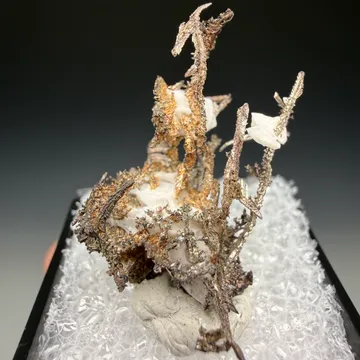
Batopilas silver is famous for native Ag in calcite, especially elongated spinel-twinned crystals that build herringbone sprays, feather-like branches, arborescent fans, spear points, wires, sheets, nails, and dense silver-rich masses. The color ranges from bright silver-white on fresh or cleaned faces to soft gray, brown, or blackened patinas where acanthite and tarnish have developed; the most characteristic collector pieces show sculptural metallic silver standing free from white to pinkish fluorescent calcite, commonly with minor acanthite, galena, sphalerite, arsenopyrite, and locally proustite or other silver sulfosalts. Sizes range from thumbnail crystallized pieces to cabinet specimens, while old records also describe very large masses and rich brosa ore; for modern collectors, top pieces are judged by crispness of the twinning, three-dimensional branching, balance of silver to calcite, undamaged terminations, attractive patina, and confidence of sublocality—especially New Nevada/Nevada Valenciana for the classic late-20th-century herringbone forms.
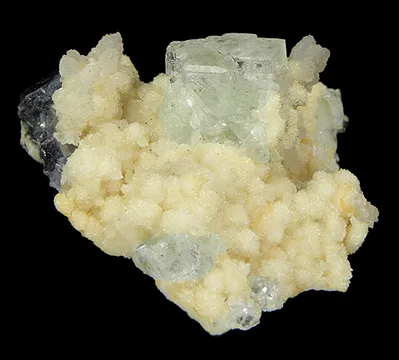
Calcite from Batopilas is not collected chiefly as isolated competition calcite crystals, but as the essential gangue and matrix of the district’s native-silver veins: white, pale gray, cream, and locally pinkish to manganoan carbonate that may be massive, vein-filling, cleavable, drusy, or partly etched away to reveal embedded silver. In the calcite-silver veins it hosts native silver, acanthite, minor quartz, galena, sphalerite, arsenopyrite, and trace cobalt-nickel arsenides, and many specimens show strong fluorescence under both longwave and shortwave ultraviolet light. The best calcite-bearing Batopilas pieces are those in which the carbonate frames the silver rather than hiding it—contrasting white or softly colored matrix with sharp metallic branches, protected pockets, or crystallized silver emerging naturally from the vein material; ordinary pieces are massive calcite with sparse disseminated silver, while the finest examples preserve the textural relationship between the calcite vein and the bonanza metal.
Beyond silver and calcite, Batopilas has an important suite of silver sulfides, sulfosalts, halides, base-metal sulfides, arsenides, and gangue minerals. Acanthite is abundant enough to form black coatings, masses, and alteration products after native silver; proustite and pyrargyrite account for the historic “ruby silver” component; polybasite, stephanite, xanthoconite, freieslebenite, and dufrénoysite add depth to the sulfosalt assemblage. Chlorargyrite, bromargyrite, and iodargyrite record the oxidized silver-halide part of the system near surface. Safflorite and rammelsbergite are small but genetically important cobalt-nickel arsenides in the classic primary native-silver paragenesis. Galena, sphalerite, pyrite, chalcopyrite, arsenopyrite, quartz, barite, dolomite, fluorite, gypsum, malachite, azurite, molybdenite, actinolite, and chlorite-group minerals are also documented from the district. Batopilas is not chiefly celebrated as a type-locality district; its mineralogical distinction lies instead in the rare abundance, richness, and preservation of primary native silver in calcite veins.
Batopilas silver is common enough on the market to be a recognizable classic, yet truly fine specimens are not common. The most available pieces are small crystallized silvers, silver in calcite, and older leached New Nevada material dispersed through dealer stocks and collections. Large, highly aesthetic, undamaged herringbone or arborescent groups remain desirable and expensive, particularly when they have old labels, an identified mine such as New Nevada, Pastrana, San Miguel, Santo Domingo, or San Antonio, or documented provenance through a known collection.
The chief authenticity concern is not a famous, well-documented Batopilas fake industry, but rather mislabeling and over-cleaning. Native silver from Mexico, Morocco, Germany, Norway, Canada, and the western United States can all appear as wires or branches, but Batopilas has a particular look: flattened spinel-twinned herringbone crystals, dense “sails,” silver emerging from or formerly embedded in calcite, and a common association with acanthite and white to manganoan calcite. Specimens labeled simply “Batopilas” may in fact represent the broader Andrés del Río district or a sublocality within the municipality; older labels may use variants such as “Batopillas,” “Andres del Rio,” “Nevada Valenciana,” “La Nevada,” or only “Chihuahua.” A precise sublocality is a premium, but broad Batopilas attribution is normal for historic material.
Condition is central. Silver is ductile: tips bend, sprays compress, and “feathers” can be flattened by careless wrapping. Many specimens were freed from calcite by acid or other leaching, and although that treatment is historically normal for New Nevada material, aggressive preparation can leave unnatural-looking surfaces, weakened junctions, or isolated wires with little geological context. Calcite matrix can be bruised, etched, or cleaved; silver protrusions can be bright where recently cleaned and dark where naturally patinated. Collectors often prefer an honest gray to brown patina over harshly stripped, unnaturally shiny surfaces. Do not polish Batopilas silver; polishing rounds crystal edges, erases patina, and converts a mineral specimen into bullion-like metal.
Acanthite coatings and tarnish are part of the district’s natural behavior. Chemical dipping can brighten silver briefly but may reduce value if it removes contrast or attacks associated sulfides. Store specimens dry, handle them by the matrix or mount, and keep them away from sulfur-bearing paper, rubber, wool, and polluted display environments if a bright surface is desired. Calcite-bearing pieces should be protected from acids, including household cleaners and acidic storage materials. Fluorescent calcite is worth checking with ultraviolet light, but fragile silver sprays and soft carbonate matrix should not be repeatedly handled for casual UV viewing.
From a market standpoint, Batopilas occupies a sweet spot: important enough to be a world classic, available enough that collectors can pursue examples at several price levels, and distinctive enough that connoisseurship matters. A small but sharp herringbone silver with old provenance can be preferable to a larger, shapeless silver-rich lump. The best cabinet pieces combine sculptural silver, visible twin structure, balanced calcite, minimal damage, and a label history that supports the locality.
The old stories of Batopilas read like mineralogical folklore because, in this district, folklore was often anchored in native silver. One 19th-century account describes the Carmen mine, associated with the fortune of the Marqués de Bustamante, yielding a mass of solid silver weighing 17 arrobas—about 425 pounds. The Pastrana ore was said to be so rich that miners worked the lode with iron bars sharpened at one end and chisel-shaped at the other, cutting silver out of the vein rather than merely breaking ore. Pastrana’s owner sent ore down from the mine with flags flying and mules dressed in colored cloths. When the Bishop of Durango visited, the same owner reportedly laid silver bars from the door of his house to the sala for the bishop to walk on; the bishop rebuked the display of pride, but, in the later telling, did not fail to accept the “generous donation to the church.”
Another story begins with water. After a great flood on the Río Batopilas, an Indigenous discoverer swam across the river and found the force of the flood had stripped open the crest of a great lode. The exposed vein was described as massive silver, glittering in the sun. When the river became fordable, the whole town came out to look. The mine was called Buen Suceso—Good Success—but the luck was shallow: after only three varas of depth, water forced abandonment, and the exposed wonder slipped back into the category that haunts old mining districts, a fortune seen but not fully captured.
Rafael Alonzo de Pastrana’s 18th-century workings at Nuestra Señora del Pilar became one of the enduring Batopilas legends. Opened around 1730, the mine reportedly produced an average of 40,000 pesos of silver per year for many years. Local tradition gives the mine owner a theatrical sense of silver’s power: for his daughter’s wedding, when the Bishop of Durango came to preside, the street from the hotel to the church was said to have been paved with silver ingots. Pastrana died in 1760, by which time the main pocket was mined out and parts of the mine had caved. The story endures because it captures the essence of Batopilas: the bonanza was spectacular, but finite; the pocket could make a fortune and then vanish into barren calcite and dangerous ground.
In 1775, Cristóbal Pérez obtained rights to the San Antonio mine and struck a large silver pocket that made “many millions of dollars” over 14 years. The fortune did not survive the family. By the time his son died in 1814, it had been squandered. The Batopilas pattern repeats: a pocket, a fortune, a collapse—geological, financial, or both.
By the 1840s, a formidable woman entered the story. Doña Natividad Ortiz, described as a woman of “strong character,” began acquiring and reopening properties with the aid of a Tarahumara associate named Avila. In less than a decade she had acquired or reopened the Santo Domingo, San Nestor, Animas, Todos Santos, San Pedro, and La Aurora mines. In a district remembered too often only through male mine owners and foreign capital, Ortiz stands out as one of the most forceful local figures in the revival of Batopilas before the American consolidations.
John R. Robinson’s Batopilas venture began in the atmosphere of mid-19th-century speculation. By the late 1850s, new silver discoveries in California had slowed, while stories of Mexican native-silver veins still pulled investors south. Robinson, backed by associates connected with Wells Fargo, raised $50,000 and left for Mexico in February 1861. On May 25, 1861, he acquired the San Miguel mines and hacienda, along with the San Antonio complex, for 27,700 pesos. The property was transferred in 1862 to the Batopilas Silver Manufacturing Company. Robinson improved operations, shipped silver south to Mazatlán, and sent metal onward to San Francisco, Asia, or New York. Mexico’s loss of tax revenue from this trade was serious enough that President Sebastián Lerdo de Tejada required, in 1872, that silver be shipped to a newly established mint in Chihuahua City. Robinson eventually sold to a group led by Alexander Robey Shepherd for $600,000.
Shepherd’s arrival in 1880 brought the most flamboyant industrial chapter. The former boss of Washington, D.C., came to Batopilas after political disgrace and bankruptcy and remade himself as the “King of Batopilas.” Through purchase, concession, and consolidation, he gained control of hundreds of claims and formed the Consolidated Batopilas Mining Company. His works were extravagant by canyon standards: stamp mills, concentrators, retorts, a foundry capable of casting pieces up to 2,500 pounds, a hospital, schools, a bridge, an 800 m aerial tram from the San Miguel mine to the San Antonio hacienda, and a masonry aqueduct nearly 6 km long. He drove the Porfirio Díaz Tunnel for 14 years, beginning in May 1885 and finishing in February 1899, to bring gravity and haulage efficiency to mines that had once depended on brutal uphill labor. The tunnel reached the mineralized Roncesvalles structure 2.14 km from the portal.
The logistics of Shepherd’s Batopilas were as dramatic as the ore. Until the late 20th century, supplies reached the town by mule train from Creel, Cuauhtémoc, and Chihuahua City. In Shepherd’s time, bullion left the canyon monthly by mule: 50 to 100 bars per month, each weighing 60 to 75 pounds, bound for the Banco Minero in Chihuahua. Production delivered to Chihuahua averaged roughly 80,000 to 120,000 ounces per month in the high years. Batopilas also became famous for electricity: Shepherd installed a hydroelectric plant, making the town one of the earliest electrified communities in Mexico, remembered as second after Mexico City.
The district also produced ceremonial silver. In 1887, Shepherd commissioned the Gorham Silver Company to make 15 Batopilas flasks embossed with views of the valley and mines. They were distributed in 1888, five to Mexican government officials and 10 to Americans. One later sold for $12,500. These objects are not mineral specimens, but they belong to the collector’s mythology of Batopilas: silver from the canyon transformed into portable monuments to the mines that produced it.
Specimen history has its own set of landmarks. Joel Roberts Poinsett—the first American minister to Mexico and the man whose name became attached to the poinsettia—acquired several excellent Batopilas native silvers during his 1822–1830 tenure and gave them to the American Philosophical Society. Most were fist-sized pieces of brosa, but the gift included stout wires to 3 cm and elongated crystals to 5 cm. By 1886, Batopilas silvers were already being sold as cabinet specimens. The A. Dohrmann collection of San Francisco, auctioned in Philadelphia at the Davis and Harvey Art Gallery on December 13–15, 1886, contained 1,867 mineral specimens, including 212 silvers; more than 100 of those silvers were from Batopilas, and 73 of the Batopilas examples were from Pastrana.
At the 1893 Columbian Exposition in Chicago, the Batopilas Mining Company displayed a 380-pound silver specimen. A primitive voltmeter was reportedly used to demonstrate complete electrical conductivity across the mass. Then the specimen vanished after the fair. No detailed description survives, and its exact source is uncertain, though it probably came from the Porfirio Díaz Tunnel workings on the Roncesvalles-Todos Santos structures or from San Miguel. Few lost mineral objects are more tantalizing: a single mass large enough to be both ore, exhibit, and electrical demonstration, then gone.
The New Nevada story belongs to the modern collecting era. Before the road from La Bufa was completed in 1977, John Whitmire obtained a substantial amount of specimen material. The productive orebody, discovered in the early 1970s by Manuel Limones, was later worked by a four-man local consortium under an unusual system: each miner had his own day to work the mine and keep whatever he found, without splitting with the others. Three pockets, each between about 200 and 450 kg, produced spiky crystals and herringbone growths that had to be leached from calcite. These are the pieces that taught many collectors to recognize Batopilas at a glance.
One of the best summaries of Batopilas mining philosophy comes from Alexander Shepherd Sr. A mining engineer was sampling veins in several parts of the mine to determine ore “in sight.” Shepherd objected with the line that still explains the district better than many technical paragraphs: “We have no ore in sight. Just as soon as it gets in sight, we take it out of sight.” In a district of narrow calcite seams that suddenly swell into silver-rich shoots, the joke was also a working rule.