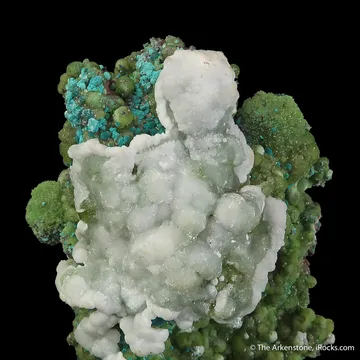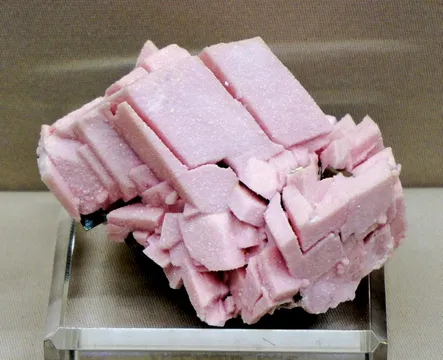
Avessalos, Serifos, Greece — a defining Fe-skarn locality noted for prase-dominant green quartz, bi-colored prase–amethyst crystals, and iron-rose hematite ros…
Key facts
Avessalos, often rendered Avissalos or Avyssalos on older labels, is one of the defining mineral localities of Serifos, the iron-skarn island of the western Cyclades. Its collector fame rests on a spectacular skarn assemblage developed around Miocene granodiorite-related hydrothermal activity and deformation along the West Cycladic Detachment System. Here, brecciated amphibolite and carbonate-rich rocks were replaced and opened into large geodes lined first by dark green hedenbergitic skarn minerals and andraditic garnet, then by quartz, hematite-group iron-oxide rosettes, calcite, and related late minerals. The result is a locality whose best specimens look unlike anything else in Europe: green prase quartz standing like tapered candles on dark hedenbergite, bi-colored prase-amethyst crystals with abrupt color breaks, red-brown andradite on green pyroxene, and the famous “iron rose” forms that long circulated under hematite labels.
Regional View
Country View
The locality sits above and inland from Avessalos Bay on the western to southwestern side of Serifos, with the named collector areas of Avessalos, southern Avessalos, and Neroutsika forming part of a broader mineralogical belt that also includes Agia Marina, Koundouros, Megalo Livadi, Megalo Chorio, and Koutalas. For collectors, the place is more precise than “Serifos” on a label: Avessalos is the name to look for when the specimen is prase-dominant, especially if it shows the characteristic lustrous, translucent green quartz from hedenbergitic skarn geodes, amethyst caps or scepters, red-brown andradite, calcite intergrowths, or compact rosette-like iron oxides.

Photo: Géry Parent, Wikimedia Commons
Search for specimens: View all specimens from Avessalos, Serifos, Greece
Avessalos is part of the Serifos Fe-skarn and hydrothermal ore system, a mineralized Cycladic metamorphic-core-complex setting where a hornblende-biotite granodiorite intruded gneiss, schist, marble, amphibolite, and related metamorphic rocks. The collector pockets are not simple quartz veins in country rock; they are open spaces within skarn breccias, particularly hedenbergitic and garnet-bearing bodies formed near major detachment structures. In the Avessalos area, mineralized cavities developed in cockade-style megabreccia, with epidotized amphibolite fragments overgrown by hedenbergite and garnet during prograde skarnization, followed by retrograde quartz, amethyst, calcite, and iron oxides in the open spaces.
The best-known Avessalos material comes from huge geodes and irregular open cavities within brecciated skarnified amphibolite. Published descriptions note spaces that can reach meter scale, commonly triangular or irregular between blocks. The crystallization sequence that matters to collectors begins with dark hedenbergitic skarn lining the cavities, followed locally by andradite and ilvaite-bearing assemblages, then the prase-amethyst quartz event, hematite or magnetite-after-hematite rosettes, and carbonate, especially calcite. This is why good specimens so often show strong mineralogical architecture: a dark green to nearly black skarn base, reddish or orange-brown garnet, green quartz prisms, iron-oxide rosettes, and late white to translucent calcite.
Serifos mining is much older than the specimen trade. The island’s copper and iron resources were worked from antiquity; Avessalos Bay and the nearby Skouries area preserve slag heaps and remains of ore processing, while the broader southwestern coast still carries the physical memory of galleries, loading facilities, rail systems, ore wagons, and ruined company buildings. Modern industrial exploitation expanded in the nineteenth century. After Greek state initiatives and the Greek Mining Company period, the French-interest company Serifos-Spiliazeza took over the island’s mines in the 1880s, and the German mining engineer Emile Grohmann assumed management. Under the Grohmann family, Megalo Livadi became the chief iron-ore shipping center, though Avessalos, Koutalas, Megalo Chorio, and related districts remained part of the island’s mining landscape.
The island’s industrial ore output was overwhelmingly iron: magnetite, hematite, limonite, and related Fe ore, with barite-bearing bodies in marbles also part of the mined mineralization. The heyday of the modern mines ran from the late nineteenth century into the middle twentieth century, with operations declining before final closure in the 1960s. The collector specimens, however, largely entered European collections from pockets opened in skarn and later from dumps, roadcuts, and rediscovered geodes rather than from a single formal specimen mine.
Today, collecting at Serifos must be treated as restricted. Published collecting discussions and geotourism work emphasize that mineral collecting on public land has been prohibited, and the western part of the island is valued as geoheritage rather than as an open collecting field. Serious collectors should assume that modern pieces require clear pre-ban provenance, estate provenance, or established dealer history. The finest Avessalos specimens now circulate mainly from older European collections, Greek collections, and material already dispersed through the mineral trade.
The most important finds are the Avessalos and Neroutsika prase-amethyst pockets. Avessalos proper is known for vivid, lustrous green prase crystals in geodes within hedenbergitic skarn, while Neroutsika is repeatedly singled out for exceptional bi-colored prase-amethyst crystals. Southern Avessalos produced scepter and reverse-scepter habits, amethyst over prase, prase over amethyst, and alternating green-violet zones within single crystals. Some geodes also yielded unusual calcite-prase intergrowths, where platy calcite and quartz alternate, preserving the rhythm of late hydrothermal growth.
Quartz is the signature mineral of Avessalos, chiefly as prase: translucent to semi-transparent green crystals colored by minute actinolitic to ferro-actinolitic amphibole inclusions rather than by the older, often-repeated “hedenbergite-included quartz” explanation. The best crystals are lustrous, tapered to cigar-shaped or spindle-like at the base and more hexagonal toward the termination, with individual crystals and groups ranging from thumbnail scale to cabinet specimens; exceptional pieces show sharp terminations, strong even green color, and architectural growth from fine-grained hedenbergite matrix. Avessalos and Neroutsika also produced amethyst-prase combinations with abrupt color breaks, amethyst caps, negative scepters, and “rocket-like” forms, and the most prized examples preserve the green-violet zoning cleanly without bruised tips, contacted backs, heavy iron staining, or flattened display geometry.
Hedenbergite is both a major skarn-forming mineral and the visual stage on which many Avessalos specimens are built: dark green to green-black, commonly fine-grained, fibrous, columnar, or compact crystalline material that lines geodes and breccia cavities before later quartz, garnet, and iron oxides. In the classic assemblage it forms the dense matrix from which prase crystals project, and in better pieces it appears as distinct, terminated or radiating crystals rather than merely massive skarn. The most attractive hedenbergite-bearing Avessalos specimens are those where the pyroxene remains clean and dimensional, contrasting sharply with translucent green quartz or red-brown andradite; ordinary pieces tend to be heavy, dull, massive skarn with broken quartz or poorly individualized crystal growth.
Avessalos and nearby Agia Marina are known for red-brown to orange-brown, locally transparent andraditic garnets in garnetitic and hedenbergitic skarn, with crystals reported up to about 5 cm in the Serifos skarn system. At Avessalos the desirable collector habit is euhedral, often dodecahedral, reddish-brown andradite perched on green hedenbergite, sometimes later accompanied or partly overgrown by prase quartz and iron oxides. Good specimens show sharp faces, gemmy or translucent edges, distinct zoning, and open placement on the dark matrix; lesser examples are embedded in massive garnet rock, lack luster, or have only small broken garnets scattered through skarn.
Hematite from Avessalos is most familiar in the collector vocabulary as “iron roses” associated with prase quartz, but this is also the locality’s most important labeling caveat: at least some, and perhaps many, rosette specimens formerly sold as hematite have been analytically shown to be magnetite pseudomorphs after hematite, the mushketovite-style material of the locality. In the classic appearance, the iron oxide occurs as compact, dark metallic rosettes, coatings, or rose-like aggregates at the bases of prase crystals or on skarn matrix, providing the red-black metallic contrast that makes Avessalos quartz specimens instantly recognizable. The best pieces retain sharp rosette form and balanced association with green quartz; unattractive examples are massive, dull, granular, or heavily oxidized without crystal definition.
Ilvaite is a classic Serifos species, best known from the Koundouros–Megalo Livadi part of the same western skarn belt a short distance north of Avessalos, but it belongs to the mineralogical story of the Avessalos district because the same hedenbergitic skarn system hosts ilvaite-bearing retrograde assemblages. In Serifos material, ilvaite occurs as black to very dark brown elongated prisms, commonly striated and chisel-terminated, sometimes doubly terminated and associated with quartz or calcite; published accounts describe radial aggregates and crystals in the broader Koundouros skarn reaching extraordinary sizes. Avessalos-labeled ilvaite should be scrutinized carefully, because many fine “Serifos” ilvaites are properly from Koundouros or nearby Megalo Livadi rather than Avessalos itself; a strong specimen should have sharp individual prisms, natural luster, intact terminations, and credible old provenance.
“Garnet” on Avessalos labels usually refers to the andradite-rich garnet of the Serifos Fe-skarn, though older labels may simply say garnet group or “brown garnet.” At Avessalos, garnet occurs in massive garnetitic skarn and as euhedral red-brown, orange-brown, or coffee-colored crystals associated with hedenbergite, quartz, and iron oxides; some specimens show appealing edge zoning or translucent corners. The most desirable garnet-group pieces are not merely massive garnet rock but sculptural combinations in which garnet crystals sit visibly on dark hedenbergite or carry later prase quartz; good luster, well-defined dodecahedral form, and transparency at the edges separate collector-grade pieces from geological hand samples.
Barite is part of the late hydrothermal and ore assemblage of Serifos and is recorded from Avessalos, especially the slag locality and broader Fe-rich mineralization, though the island’s most often pictured barite specimens tend to be labeled from Megalo Livadi or Koutalas rather than from Avessalos proper. In the Serifos district it appears as tabular, lamellar, book-like, water-clear to grayish-white or yellowish crystals, often on iron-oxide-coated matrix and locally with calcite. Avessalos-labeled barite is best regarded as a locality-sensitive minor species: desirable pieces need sharp translucent blades, pearly luster, and a trustworthy label; ordinary examples are small, rusty, incomplete, or more accurately attributable only to the broader Serifos mining district.
Other documented minerals from Avessalos include magnetite, including magnetite pseudomorphs after hematite, ferro-actinolite, calcite, goethite, gypsum, malachite, chrysocolla, atacamite, brochantite, connellite, cuprite, chalcanthite, nantokite, and spangolite, many of them especially tied to the ancient slag and copper-mineral micro-locality above Avessalos Bay. No IMA species is widely treated as having Avessalos as its type locality; the scientific rarities here are instead paragenetic and locality-specific, especially the actinolite-included prase-amethyst association, the documented re-identification of “hematite roses” as magnetite-after-hematite in some specimens, and the copper secondary minerals from the slag heaps.
The most common authenticity issue is mislabeling at the species level rather than outright fabrication. For decades, Serifos prase was widely described in the trade as quartz colored by hedenbergite inclusions; modern analytical work shows that the green color in studied Serifos prase is caused by tiny acicular amphibole inclusions, chiefly actinolitic to ferro-actinolitic amphibole. Hedenbergite remains real and important as the matrix and skarn mineral, but it should not automatically be cited as the coloring inclusion without analysis. A precise modern label might read “quartz var. prase with hedenbergite matrix” rather than “hedenbergite-included quartz.”
The second major label problem concerns “hematite roses.” Some Avessalos iron-rose specimens have been XRD-tested as magnetite pseudomorphs after hematite, and collectors should test suspicious rosettes with a strong magnet before paying hematite premiums. A magnetic response does not by itself describe the whole paragenesis, but it is a practical warning sign that the old hematite label may need revision. For EarthWonders-style cataloging, “magnetite after hematite” or “mushketovite-style magnetite pseudomorph after hematite” is often the safer description when a specimen is strongly magnetic and matches the known Avessalos rosette habit.
Condition is critical. Avessalos prase crystals are often long, tapered, and exposed, so tip bruises, cleaved side contacts, repaired breaks, and sawn or trimmed bases are common. The best specimens show intact terminations, natural attachment, good luster, and an open, upright composition. Repairs should be expected on some large display pieces, especially those with isolated green crystals or amethyst caps, and should be disclosed. Calcite intergrowths can be visually important but also fragile; avoid aggressive acid cleaning, which can remove calcite and alter the specimen’s geological evidence.
True Avessalos prase-amethyst combinations remain scarce, especially clean scepters and bi-colored crystals with good transparency and strong zoning. Small single prase crystals are more available, but attractive matrix pieces with sharp green quartz on hedenbergite, garnet, and iron roses are increasingly difficult to source from old collections. Ilvaite labeled “Avessalos” deserves extra scrutiny because many excellent Serifos ilvaites are more accurately from Koundouros, Megalo Livadi, or the broader Serifos skarn belt. Barite and garnet labels likewise benefit from old collection tags, dealer invoices, or photographs tying them to Avessalos rather than simply to Serifos Island.
Fluorescence is not a major buying criterion for the classic Avessalos suite. The practical handling concerns are mechanical and health-related: protect projecting quartz, garnet, and ilvaite terminations; keep loose fibrous skarn dust contained; and avoid abrading amphibole-rich material. As with many old skarn specimens, stable display conditions are sufficient, but friable matrix should be boxed or mounted to prevent shedding.
The story behind Avessalos begins with a name that still carries the island’s hard history. Local tradition derives Avessalos from the Venetian word “vassale,” meaning slave, a reference to the period of Hermolaus Minotto and to the use of enslaved labor in mining around the bay. The same landscape that collectors now associate with prase and andradite also preserves the darker residues of older metallurgy: at Skouries, whose name evokes rust, ancient copper-processing remains and dark slag heaps survive near the bay. Those slag heaps are not merely scenery. They produced their own miniature mineral suite of copper secondaries, linking Avessalos cabinet specimens to a chain of metalworking that reaches far deeper than the nineteenth-century mines.
A different drama unfolded in the summer of 1916, not at Avessalos alone but across the Serifos mining world to which it belonged. Konstantinos Speras, born on Serifos in 1893, had left for Egypt at fourteen, studied in a French school, worked as a tobacco worker in Cairo and Alexandria, and entered the labor movement before returning to organize the miners of his native island. On July 24, 1916, the miners founded an association said to have counted 460 members. Their demands were direct: an eight-hour workday, higher wages, and safety measures inside and outside the galleries. On August 7 they refused to load the ship Manousi of Andros, which had been ordered to take ore and depart immediately for northern Europe.
The standoff lasted until August 21, when a gendarmerie detachment under Lieutenant Chrysanthou arrived at Megalo Livadi. Miners had gathered on the plateau by the loading bridge, together with women and children. Chrysanthou detained Speras and union representatives, lined his men up opposite the strikers, and issued a five-minute ultimatum. Before the five minutes had passed, shots were fired. Four miners were killed: Themistoklis Kouzoupis, Michalis Zoilis, Michalis Mitrofanis, and Giannis Protopappas. The crowd answered with stones; Chrysanthou and other gendarmes were killed, and for about fifteen days the workers effectively held the island before state authority was restored. Speras was imprisoned in Syros and later helped found the GSEE, the Greek General Confederation of Labor, before being murdered in 1943. Today his bust and the miners’ memorial stand at Megalo Livadi, only a few meters from the shore and the old police-station building.
The mineral story has its own modern revelation. For years, collectors repeated two neat explanations: the green quartz was “hedenbergite-included,” and the dark rosettes were hematite roses. Both labels became part of the romance of Serifos. Then analytical work complicated the story. Electron microprobe studies of the prase showed tiny amphibole needles and inclusions, not hedenbergite, as the cause of the green color. Around the same time, XRD testing of Avessalos “hematite roses” by collectors in Vienna showed magnetite in rosette specimens that had been sold as hematite. Suddenly two of the locality’s most familiar trade names needed rewriting. For a serious collector, that is not a loss; it is exactly the kind of correction that makes Avessalos more interesting. The specimens did not become less beautiful. They became more specific.