






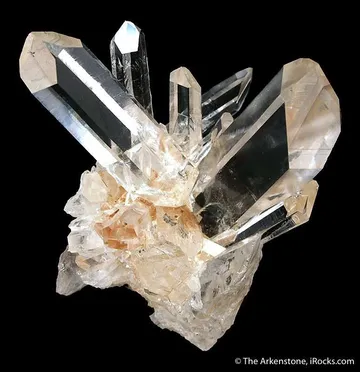
Avant Mine, USA — Ouachita locality known for glassy quartz crystals and bright wavellite; notable for color zoning, spherules, and strong collecting appeal.
Key facts
Avant Mine, in the old mineral country around Avant, Garland County, Arkansas, occupies a special place in American collecting because the name sits at the intersection of two classic Ouachita Mountain specimen traditions: clear Arkansas quartz from veins in Ordovician shale and sandstone, and brilliantly colored aluminum phosphates—especially wavellite—from the Dug Hill–de Linde workings just north of Avant. The strictly recorded Avant Mine locality is a World War II–era quartz working about 1¼ miles east of Avant, developed by pits and trenches on quartz veins in the Womble Shale. In the collector trade, however, “Avant” has long been used more broadly for the surrounding Garland County district, especially the Dug Hill/de Linde wavellite and variscite ground that made the locality name famous.
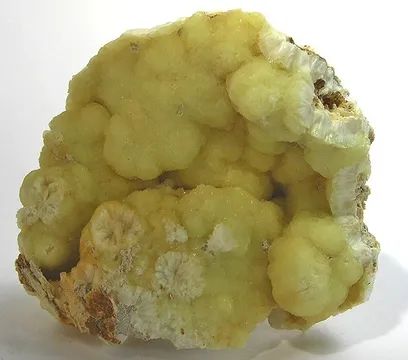
The best-known specimens from the Avant district are not ore specimens in the usual metallic sense, but cabinet minerals with a distinctly Arkansas character: glassy quartz points and groups from folded Ouachita strata, and green to blue-green wavellite spherules, rosettes, hemispheres, and radiating “cat’s-eye” sections on gray chert or novaculite-like matrix. Fine wavellite pieces show sparkling, closely packed hemispheres; sawed or broken examples reveal concentric and radial structure, sometimes with dramatic color zoning from pale green to bluish green or yellow-green. That combination—color, geometry, and an unmistakable sedimentary host—has made Avant one of the locality names collectors expect to see on serious wavellite labels.
Regional View
Country View
The geological setting is the central Ouachita Mountains: tightly folded, faulted Paleozoic marine strata, including the Womble Shale and Bigfork Chert. Quartz crystal pockets formed in fractures related to that structural grain, while the phosphate minerals of the Avant–Dug Hill area occur in brecciated and fractured Bigfork Chert. The distinction matters to advanced collectors. A label reading “Avant Mine” may refer to the quartz mine sensu stricto; a label reading “Avant,” “Dug Hill,” “de Linde,” “H. de Linde No. 3,” or “Stuart Schmitt/Schmidt deposit” usually points to the famous wavellite-variscite phosphate material.

Photo: Wikimedia Commons

Photo: Wikimedia Commons
Search for specimens: View all specimens from Avant Mine, USA
Avant Mine, as recorded in mineral-locality databases, is in the Avant area of Garland County, Arkansas, with workings described as pits and trenches about 1¼ miles east of Avant. The deposit was worked for quartz veins in Womble Shale during World War II, when clear quartz had strategic importance for optical and oscillator applications. The documented mineral list for the mine proper is small—quartz, calcite, and K-feldspar including adularia—but the locality name has become entangled with the nearby phosphate deposits because dealers and collectors have used “Avant” for both the quartz locality and the adjacent Dug Hill wavellite district.
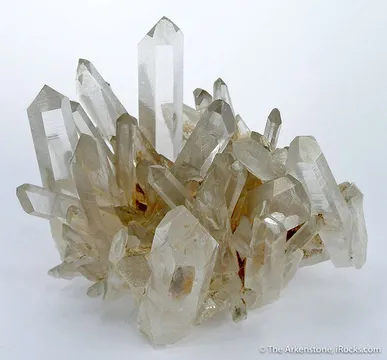
The quartz occurrence belongs to the western Arkansas quartz-crystal belt of the Ouachita Mountains. These quartz deposits are controlled by fractures in folded Paleozoic rocks; in the broader district, the highest-grade material is classically associated with the Blakely and Crystal Mountain sandstones, though quartz veins also occur in shales and cherts. At Avant Mine itself, the recorded host is Womble Shale. Collectors should expect the typical Arkansas suite of clear to milky quartz, commonly iron-stained when freshly collected, with individual points and small groups rather than the exotic phosphate textures that made the Avant name famous in phosphate circles.
The wavellite story belongs especially to Dug Hill, north of Avant, and to the de Linde Pits, also cited as H. de Linde No. 3 and connected in the literature with the Stuart Schmitt or Stuart Schmidt deposit. There the host is brecciated Bigfork Chert, a Middle to Late Ordovician unit composed chiefly of thin-bedded dark-gray chert with interbedded black siliceous shale, siltstone, and limestone. The wavellite and variscite formed along fractures, seams, and breccia openings, not as a metallic ore body. Their mineralization is best understood as a phosphate-rich, vanadium-bearing secondary assemblage in a broken siliceous sedimentary host.
Historically, wavellite was collected near Avant by at least 1870, and old specimen labels may place early pieces in Montgomery County because Garland County had not yet been formed when some of the earliest material entered collections. Dug Hill was later examined scientifically for the unusual colors of its wavellite, and samples collected by W. T. Schaller with H. D. Miser and C. S. Ross in 1937 became the basis for a classic American Mineralogist study of vanadium color in the mineral. That paper fixed several features still useful to collectors today: the spherulitic habit, the banded and bicolored interiors, and the unusual range of blue, green, yellow, and gray tones.
Modern commercial interest revived the district. Avant Mining LLC, associated with James Zigras, acquired the de Linde wavellite and variscite property in 2009 and began extracting rough material in early 2010. The company later became far more widely known for Arkansas quartz, operating public and private quartz-dig experiences at Fisher Mountain near Mount Ida and acquiring multiple quartz properties. For locality-purist labeling, that modern company history should not be confused with the exact historical Avant Mine locality east of Avant; for the marketplace, however, it explains why “Avant” is now attached to both phosphate and quartz specimens.
Collecting access today is mixed and should be treated as private-property dependent. Avant Mining’s public quartz dig is currently advertised at the Ocus Stanley Claim on Fisher Mountain near Mount Ida, not at the historical Garland County Avant Mine locality. Their quartz public dig is run through the company’s rock shop, with permits, posted hours, and rules that prohibit power tools. Public wavellite access is not generally equivalent to public quartz access: occasional wavellite dig events have been announced by the operator with reservations required, 4WD/AWD access recommended, hand tools only, and bucket-based pricing. Old road cuts, pits, and hillsides in the Avant district have attracted collectors for generations, but no serious collector should assume access without current permission from the landowner or claim holder.
The notable specimen finds from the district center on wavellite seams, pockets, and breccia surfaces. Older Dug Hill pieces can show large embedded spherules, sometimes several centimeters across, while modern de Linde workings produced more surface-rich matrix pieces with bright, small, sparkling spheres and hemispheres. One widely noted modern de Linde reworking involved deeper access with mechanized equipment to material around 25 feet down, yielding unusually deep green wavellite in tight seams. Variscite from the same phosphate ground may occur as vivid green drusy coatings, and polished wavellite and variscite from the deposit entered the gem trade as freeforms, cabochons, and ornamental pieces.
Wavellite is the signature mineral of the Avant district, especially from Dug Hill and the de Linde Pits north of Avant, where it occurs in Bigfork Chert as radiating spherulites, hemispheres, rosettes, seams, and botryoidal crusts in green, blue-green, yellow-green, yellow, gray, and locally very pale tones; the color is tied to vanadium in varying valence states, and some material historically labeled wavellite has been shown by later work to be fluorwavellite or compositionally close to it. Collector-grade pieces are judged by saturated color, intact sparkling hemispheres, sharp radial structure, attractive contrast with gray chert matrix, and freedom from bruised or abraded ball surfaces; ordinary pieces tend to be massive, dulled, fractured, or sawed without strong pattern, while the best display the classic “cat’s-eye” circular cross sections or carpets of lustrous green spheres on matrix.
Quartz from the recorded Avant Mine is documented from veins in Womble Shale and belongs to the broader western Arkansas quartz-crystal belt, where collectors prize clean single points, small groups, doubly terminated crystals, and water-clear to milky specimens from fracture-controlled pockets in folded Ouachita strata. Avant-labeled quartz should be evaluated with the same disciplined eye used for better Arkansas material: glassy luster, transparency, sharp terminations, minimal bruising on prism edges and tips, and good proportions matter more than sheer size; iron-oxide staining is common in fresh Arkansas quartz and can be attractive if it forms natural phantoms or inclusions, but dull, clay-filled, or heavily contacted pieces are much less desirable unless they show unusual habit.
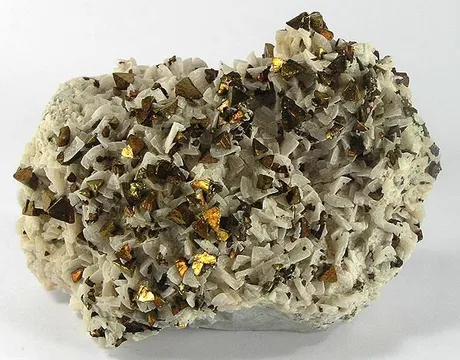
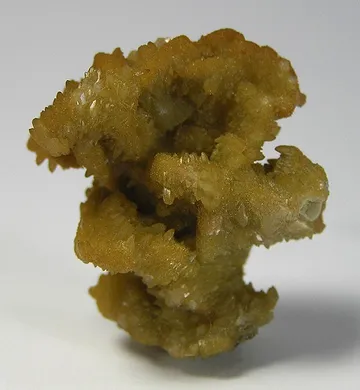
Other minerals documented from the Avant locality and its immediate district include calcite and K-feldspar, including adularia, at the quartz mine proper, and the broader Avant–Dug Hill phosphate suite of variscite, fluorwavellite, crandallite, planerite, cacoxenite, and goethite. Variscite is the most collectible companion mineral, occurring as green coatings and drusy surfaces in the same general phosphate environment as the wavellite. Planerite and crandallite are of interest to systematic phosphate collectors, while fluorwavellite is especially important because modern analytical work has shown that some classic Arkansas “wavellite” compositions fall into or near the fluorwavellite field. No type-locality mineral is securely attached to the Avant Mine sensu stricto in the major records used for this guide, but the Avant area remains mineralogically important because it supplied classic study material for color in wavellite and continues to challenge old labels with the wavellite–fluorwavellite distinction.
Avant labels require careful reading. “Avant Mine” in the strict sense refers to a quartz locality east of Avant in Womble Shale, whereas many wavellite specimens labeled simply “Avant,” “Avant Mine,” or “Garland Co.” may actually be from Dug Hill, the de Linde Pits, or the Stuart Schmitt/Schmidt deposit north of Avant. This is not necessarily deception—old and commercial labels often used the nearest familiar place name—but advanced collectors should preserve any more specific sublocality information, especially “Dug Hill,” “de Linde,” or “H. de Linde No. 3.”
The most important authenticity issue is analytical rather than visual: some Arkansas material long sold as wavellite may be fluorwavellite. For most display collectors this does not diminish the specimen, but for systematic collectors a high-value thumbnail or micromount should be treated as “wavellite/fluorwavellite group” unless supported by analysis or a reliable published determination. The visual habits overlap completely, and color is not a safe species-level discriminator.
For wavellite, condition is everything. The radial balls are tougher-looking than they are: they chip, bruise, and frost easily along exposed high spots. Broken spherules can be attractive when they show the bull’s-eye structure, but random fractures through the balls lower value. Avoid oiling or waxing rough wavellite to improve luster; it can make later conservation difficult and may be confused with stabilization. Gem material from the de Linde deposit has been reported as commonly stabilized with Opticon, particularly polished wavellite, so cut stones and polished freeforms should be disclosed as stabilized unless there is strong evidence otherwise.
For quartz, the usual Arkansas cleaning cautions apply. Fresh specimens may carry red-brown iron oxide and clay; patient soaking and mechanical cleaning are safer than aggressive acid use on associated or inclusion-rich material. Do not use strong acids on specimens that include phosphate minerals, calcite, or unknown coatings. Quartz can tolerate more cleaning than wavellite, but chipped terminations, rehealed contacts, and clay-filled internal fractures are easy to overlook in wet specimens.
Market availability is split. Avant/Dug Hill wavellite appears regularly enough that collectors can be selective, but top pieces with saturated green or blue-green color, undamaged lustrous hemispheres, and old labels are far scarcer than the frequency of the locality name suggests. Quartz from the broader Avant Mining/Fisher Mountain sphere remains widely available through current fee digs and commercial production, but strict historical Avant Mine quartz is less commonly separated out in the trade. Buy the specimen, not just the locality name: a precise old label, intact surfaces, and strong aesthetics matter more here than another generic “Avant, Arkansas” tag.
Dug Hill owes its name to a practical cut through the landscape. W. T. Schaller’s 1937 collecting trip with H. D. Miser and C. S. Ross later fed the scientific work on color in Avant wavellite, and the paper preserves a small but memorable local explanation: according to Miser, the steep ridge was called Dug Hill because a road had been dug through it to provide north-south passage across the country. That bit of roadwork gave a collector’s landmark to one of the most recognizable phosphate localities in the United States.
The early labels tell a second story, one that matters every time an old wavellite turns up in a collection. Wavellite and variscite were probably collected at the Dug Hill diggings before 1870, but Garland County did not exist until 1873. As a result, early material could carry Montgomery County labels even when the collecting site is now in Garland County. For a collector handling an old green Arkansas sphere on chert, the county name can be a historical artifact rather than an error.
The laboratory story is unusually vivid for a locality guide because the specimens themselves almost seem to have invited the chemistry. Schaller had already been thinking about vanadium and color in related phosphates, and the Dug Hill material offered a puzzle in hand specimen: spherulites that could be green, blue-green, yellow, gray, or bicolored, with color changing from core to rim or from one fiber direction to another. The 1966 American Mineralogist paper describes spherulites with dark bluish-green outer portions, yellow cores, pale canary-yellow banding, and fibers that looked different when crushed or viewed microscopically. The answer was not chromium or iron in any meaningful amount; the dominant chromatic element was vanadium, and the colors tracked the amount and valence state of vanadium present.
The modern revival brought machinery back to the old phosphate ground. When the de Linde property was worked under Avant Mining, the operation was described as an open pit worked by a single trackhoe, with mining typically carried out twice a year for two-week periods. That rhythm is striking: not a continuous industrial mine, but a controlled, episodic extraction of specimen and cutting rough from a small, highly localized phosphate body. In the gem trade, the material moved beyond natural specimens—variscite as drusy green surfaces, wavellite as polished freeforms and cabochons showing concentric and radiating texture.
At Tucson in 2018, the Avant story had already shifted from an old Arkansas collector locality to an active mine-to-market brand. James Zigras reported that the de Linde material was being cut in sizes from 10 to 500 carats and that roughly 1,000 pieces of wavellite had been polished. He also spoke of reopening the de Linde mine for larger production aimed at Tucson 2019. For specimen collectors, that commercial jewelry phase is a mixed blessing: it introduced many people to Avant wavellite, but it also means that some vivid patterned material that might once have remained as matrix specimens was cut, polished, and stabilized for the lapidary market.
A. E. J. Engel, R. H. Wilpolt, J. P. Albers, and E. W. Heinrich, 1943, “Quartz crystal deposits of western Arkansas,” U.S. Geological Survey Open-File Report 43-26 — Wartime USGS study placing western Arkansas quartz in its strategic optical and oscillator context.
A. E. J. Engel, 1952, “Quartz crystal deposits of western Arkansas,” U.S. Geological Survey Bulletin 973-E, p. 173–260 — The foundational published treatment of Arkansas quartz crystal deposits, essential background for Avant Mine quartz.
Margaret D. Foster and Waldemar T. Schaller, 1966, “Cause of colors in wavellite from Dug Hill, Arkansas,” American Mineralogist, 51, 422–428 — Classic analytical study showing vanadium as the principal chromophore in Dug Hill wavellite.
Henry L. Barwood and H. de Linde, 1989, “Arkansas phosphate minerals—A review and update,” Rocks & Minerals, 64(4), 294–299 — Important review tying the Avant-area phosphate minerals to the broader Arkansas phosphate assemblage.
Arthur E. Smith Jr., 1988, “Arkansas Mineral Locality Index,” Rocks & Minerals, 63(2), 104–125 — Locality-index reference cited in mineral databases for Avant-area minerals.
Arthur E. Smith, 2010, “Exploration and Mining History of the de Linde Wavellite Mine: East Dug Hill Area, Near Avant, Garland County, Arkansas,” Rocks & Minerals, 85(4), 346–351 — The key historical article for the de Linde wavellite workings.
Anthony R. Kampf, Paul M. Adams, Henry Barwood, and Barbara P. Nash, 2017, “Fluorwavellite, Al3(PO4)2(OH)2F·5H2O, the fluorine analog of wavellite,” American Mineralogist, 102(4), 909–915 — Modern species-level work that complicates older “wavellite” labels from several classic localities, including Arkansas occurrences.
Brendan M. Laurs, 2018, “Wavellite and Drusy Variscite from Arkansas,” Journal of Gemmology, 36(1), 15–17 — Gemological note on de Linde wavellite and variscite, including modern mining, cutting, and stabilization information.
Mindat: Avant Mine, Avant, Garland County, Arkansas, USA — Concise locality record for the strict Avant Mine quartz occurrence, including coordinates, minerals, and historical note.
Mindat: Avant, Garland County, Arkansas, USA — Broader Avant-area locality page useful for understanding how quartz, wavellite, variscite, fluorwavellite, and related minerals are grouped in databases.
Mindat: Dug Hill, Avant, Garland County, Arkansas, USA — Essential sublocality page for the classic wavellite-variscite material north of Avant.
Mindat: Wavellite from de Linde Pits, Dug Hill, Avant, Garland County, Arkansas — Species occurrence page for de Linde wavellite, with photo references and database notes.
Arkansas Geological Survey: Bigfork Chert/Formation — State geological description of the Bigfork Chert host unit central to the Avant-area phosphate occurrences.
USGS Geolex: Womble Shale — Stratigraphic background for the Womble Shale that hosts the recorded Avant Mine quartz veins.
Arkansas Geological Survey: Quartz (Industrial) — Overview of Arkansas quartz production and the state’s quartz-crystal significance.
Avant Mining Fisher Mountain: Mine Your Own Crystals — Current operator information for public quartz digging at Fisher Mountain; useful for access rules, fees, and private pocket-dig policies.
Avant Mining Fisher Mountain: Events — Current event page where occasional wavellite or other special digs may be announced.

_2.jpg)