






Antetezambato, Madagascar — premier skarn locality yielding demantoid garnets and topazolite; mint-green to amber hues and sculptural crystals prized by collec…
Key facts
Antetezambato is one of those rare localities whose importance is not simply that it produced a desirable species, but that it changed what collectors expected that species to look like on matrix. The mine lies west of the village of Antetezambato, near Ambanja in northern Madagascar, in a low mangrove-swamp setting where the productive ground is invaded daily by tidewater. The garnets occur in a skarn developed where alkaline, syenitic to trachytic intrusive rocks and related dikes affected Mesozoic calcareous sedimentary rocks of the Isalo sequence. In collector terms, the result was extraordinary: lustrous, transparent to translucent andradite crystals, including green demantoid and honey-yellow to cognac-brown topazolite, perched on pale skarn, quartz, calcite, and occasional stilbite-Ca.
The locality came to international attention in 2009, almost overnight. Local people had been recovering green stones from the estuary area between about 2006 and 2008, initially interpreted in the trade as zircon or sapphire. Once the material was recognized as demantoid, the rush began. The best crystals and matrix pieces were shown to the collecting world at Sainte-Marie-aux-Mines and Tucson, and Antetezambato rapidly became Madagascar’s first truly important collector and gem locality for skarn-hosted andradite. It is especially important because it yielded both facetable rough and world-class specimens: modified dodecahedra and trapezohedra, complex color zoning, green demantoid cores with yellow-brown topazolite rims, and rare sculptural habits such as scepters, dumbbells, phantoms, skeletal plates, and hopper-like topazolite.
Regional View
Country View
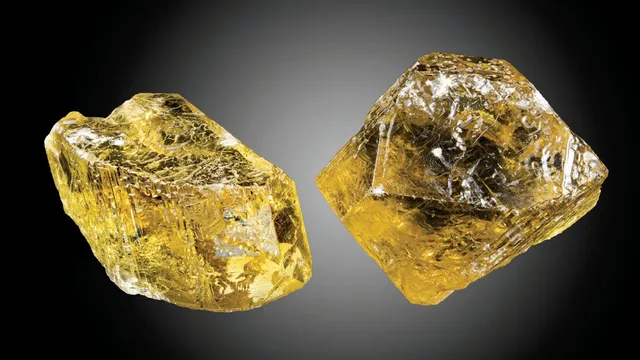
The best Antetezambato specimens are immediately recognizable. Demantoid tends toward fresh mint, yellow-green, grass-green, army-green, emerald-green, and occasionally bluish green; topazolite ranges through honey, amber, olive, cognac, brownish yellow, and brown. The finest collector pieces combine sharp glassy crystals with strong internal brightness, high luster, and contrasting pale matrix. Unlike the serpentinite-hosted demantoids of the Urals and Val Malenco, these Malagasy stones do not show classic chrysotile “horsetails.” Their identity is instead written in skarn inclusions: diopside, wollastonite or channels after it, calcite, quartz, fluorapatite, pyrite, fluid inclusions, hollow tubes, negative crystals, and other growth features.

Photo: Wikimedia Commons
One reason collectors prize the locality is the tension between abundance and excellence. The 2009 rush produced a great deal of rough and many specimens, but genuinely top material was always a small fraction: clean green crystals of meaningful size, undamaged groups, strong matrix contrast, and topazolite crystals of cabinet quality remain difficult to obtain. The deposit also produced some of the most curious garnet-related objects of recent mineralogical history, including garnet-and-quartz replacements of fossil shells, corals, and even reported ammonites, demonstrating how completely the metasomatic process could preserve shapes from the original sedimentary environment.
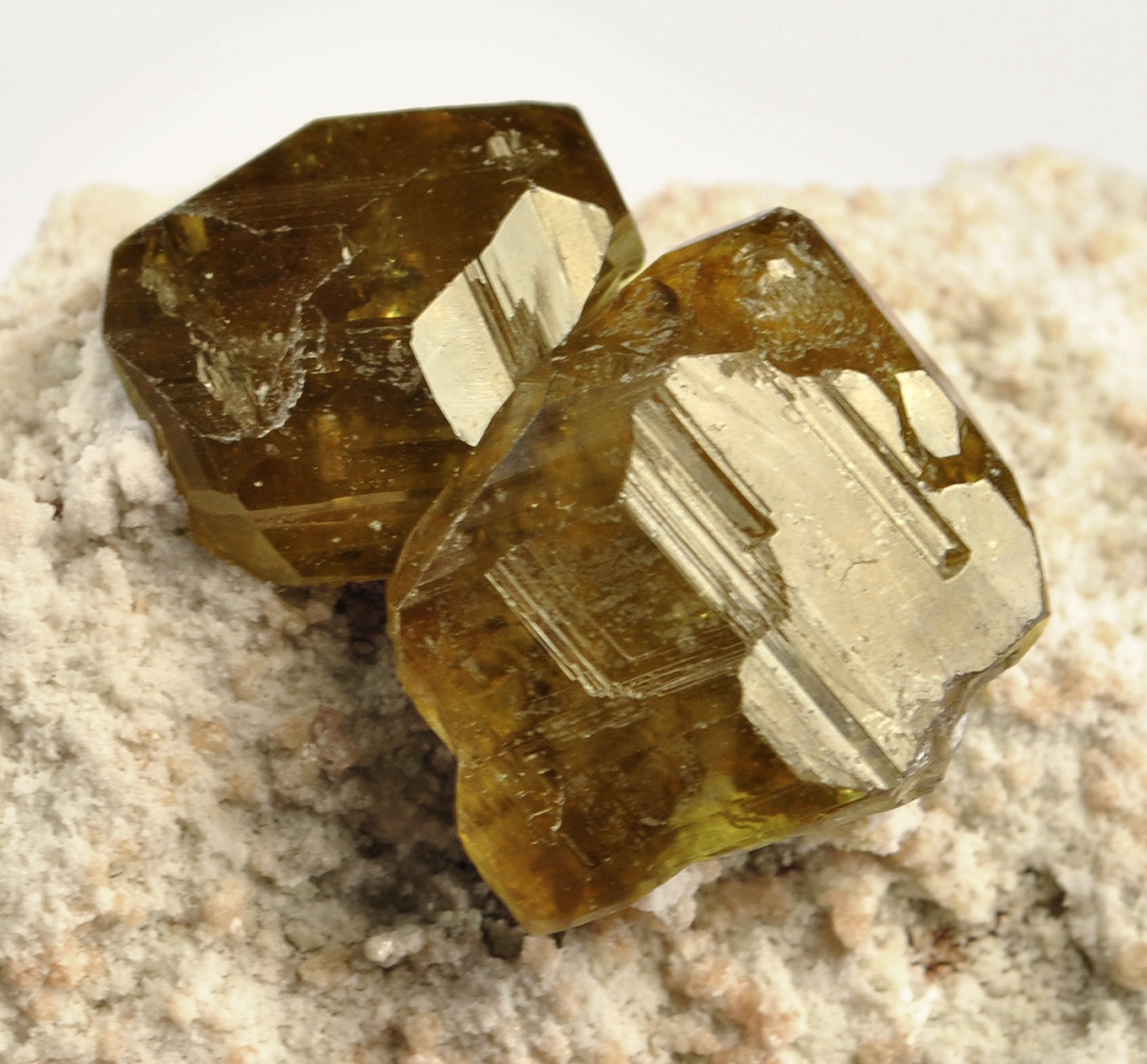
Photo: Wikimedia Commons
Search for specimens: View all specimens from Antetezambato Demantoid-Topazolite Mine, Madagascar
The Antetezambato Demantoid-Topazolite Mine is a skarn deposit in the Antsakoamanondro area of Ambanja District, Diana Region, northern Madagascar. It lies about 2.5 km west of Antetezambato village, with Ambanja roughly to the south, and the productive zone occupies a mangrove-swamp environment near the coast. The collecting and mining field has been described as about 20 hectares, with the garnets dug from weathered intertidal rocks and from skarn veins and cavities below the superficial altered zone.
Geologically, the deposit sits in the northwestern Malagasy magmatic province, where younger alkaline magmatism affected the sedimentary cover of the Mahajanga Basin. The host sequence includes fossiliferous sandstones and silica-rich limestones of the Isalo Formation, locally described in later work as lime-rich argillitic to calcareous sedimentary rocks. These beds were cut and heated by alkaline igneous rocks, including lamprophyric dikes and rocks interpreted as trachytic to syenitic in composition. The sedimentary block at the deposit dips steeply southward, about 45–60°, unlike the more nearly subhorizontal surrounding sedimentary rocks.
Mineralization developed as a network of skarn veins along bedding planes, fractures, and intrusive contacts. Pneumatolytic and hydrothermal fluids generated by the intrusions metasomatized the sedimentary rocks and produced fine-grained white, gray, and pale green garnet-rich skarn. In the main specimen-producing material, cavities in the andradite-rich skarn allowed gemmy demantoid and topazolite crystals to grow freely. Two skarn generations have been recognized in the literature: an earlier white to gray skarn in which the garnets are grossular-rich, and a later pale green to white skarn in which near-end-member andradite dominates. The demantoid crystals occur in fissures and cavities in the later andradite-bearing skarn. Grossular-rich granular garnet may carry thin rims of near-end-member andradite, which helps explain why massive pale matrix can be compositionally zoned even where the show crystals are essentially andradite.
The primary ore body is not an ore body in the metallic-mining sense, but a metasomatic garnet body exploited for gem rough and specimens. The weathered upper horizon released broken crystals and rough into soft material that could be hand-washed, while the more desirable matrix specimens came from cavities in skarn veins. The position inside mangrove flats made mining unusually difficult. At high tide, seawater moves through a system of channels and floods the diggings; miners had to reinforce pits and remove water before work could resume. During the peak of hand mining, thousands of miners worked numerous pits, but deeper mining became progressively harder because pits and tunnels flooded and collapsed more readily.
The discovery sequence is now well established. Between 2006 and 2008, local people recovered small quantities of green stones from the tidal-estuary area. The deposit was recognized and publicized in 2008–2009, and the major rush took place in 2009. Most of the total production was mined between April and November 2009, when both rough and specimens moved rapidly through Madagascar and into the international trade. At the peak, gem material was estimated at roughly 20 kg per week, accompanied by a much larger volume of lower-quality material. Total gem rough production has been estimated in the hundreds of kilograms, but top material—clean, strongly green, and weighing more than 1 g—represented only a few kilograms, while eye-clean green rough over 2.5 g was exceptional.
The early mining was largely artisanal and poorly regulated. Some Malagasy individuals registered claims over the area in 2009, although boundaries and mining rights were not always practically aligned with the actual producing ground. In December 2010, claims covering the deposit were reported to have been legally acquired by a joint venture of Italian, German, and Malagasy operators, with the goal of investigating the down-dip extension and the possibility of organized mining. Later work cited in gemological literature records that Ruby Red Madagascar held mining rights, that a joint venture with a local gem-trading company conducted open-cast work in 2013–2014, and that in 2018 a new Ruby Red Madagascar–Prosperity Earth LLC venture used mechanized equipment to explore the deposit to depths of roughly 15–18 m.
Production after the rush declined sharply. By late 2010 only a few dozen miners remained active, and near-surface production had largely played out in the following years. Later mechanized projects targeted deeper material, but the swamp setting, high tide, mud, and seawater intrusion remain the fundamental constraints. For collectors, that means modern supply appears episodic rather than continuous: specimens show up from old 2009–2010 material, from later organized mining, and from dispersed dealer inventories, but fresh waves of matrix classics are uncommon.
The most famous finds include groups of green demantoid crystals to around 1–1.5 cm on pale skarn matrix, topazolite crystals to about 2 cm on matrix, larger individual topazolite crystals and skeletal flattened crystals in small fissures, and rare exceptional specimens with several lustrous eye-clean crystals up to about 2.8 cm showing green cores and thin brown-yellow overgrowths. Pezzotta’s descriptions also record quartz crystals reaching 10 cm, occasional amethyst-tinted quartz, Japan-law quartz twins, calcite pockets with transparent lustrous crystals to 10 cm, demantoid associated with white stilbite-Ca, and highly unusual fossil-related pieces in which shells, corals, and ammonites were replaced by garnet and quartz.
Collecting access should be regarded as restricted and specialized, not a casual field-collecting opportunity. The mine lies in a tidal mangrove environment, access may require local boats and guides, and formal mining rights have existed over the productive ground. The site has also had a history of security problems during the rush period. Any legitimate modern collecting or acquisition should proceed through legal operators, established Malagasy dealers, or well-documented secondary-market specimens.
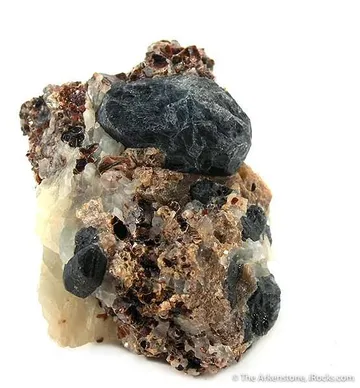
Andradite is the essential mineral of Antetezambato, occurring both as the gem varieties demantoid and topazolite and as fine-grained garnet-rich skarn matrix. The show crystals are commonly combinations of dodecahedron 110 and trapezohedron 211, with demantoid more often dodecahedral and topazolite more often trapezohedral, but the locality is especially prized for complex modified forms involving hexoctahedral faces, rare cube faces, phantoms, color zoning, skeletal flattened crystals, scepters, and dumbbell-shaped growths. Colors range from yellow-green, grass-green, army-green, emerald-green, and bluish green through honey-yellow, amber-yellow, cognac, brownish yellow, brown, and rare brownish red; many transparent crystals show green cores with more yellow-brown outer growth. The best andradites here are sharply crystallized, glassy, bright, and positioned on contrasting pale skarn, calcite, quartz, or stilbite-Ca, while ordinary pieces tend to be small, fractured, dull, embedded, or brownish with weak transparency.
Antetezambato demantoid occurs as lustrous green andradite crystals in cavities and fissures of the later andradite-rich skarn, typically in yellow-green to bluish green hues with low to moderate saturation and, in the best pieces, enough transparency to show the variety’s characteristic fire. Crystals are commonly modified dodecahedra and trapezohedra, generally from a few millimeters to around 1 cm on many collector specimens, with notable matrix crystals reported around 1.2–1.5 cm and exceptional groups showing crystals up to 2.8 cm; associations include pale garnet-rich skarn, quartz, calcite, stilbite-Ca, pyrite/goethite, and fossil-replacement matrix. Good demantoid specimens from this mine are judged by saturated clean green color, high adamantine-to-glassy luster, transparency, intact terminations, aesthetic spacing on pale matrix, and freedom from glued repairs; the finest pieces do not need Russian-style horsetails, because their skarn identity is shown by diopside, wollastonite-channel, fluid-inclusion, and growth-structure features.
At Antetezambato, “garnet” on labels normally refers to the andradite-dominant garnet suite, but the matrix itself can contain grossular-andradite solid-solution microcrystals, and an early skarn generation is grossular-rich before later andradite rims and fissure crystals developed. This distinction matters to collectors because many pale, white, gray, pinkish, and greenish fine-grained matrix coatings are garnet rather than simple limestone or quartz, and the fossil pseudomorphs and perimorphs owe their form to fine garnet plus quartz replacing original shells and corals. The most desirable garnet specimens here are those in which the matrix is not merely a support but part of the locality story: a pale skarn surface, fossil-shaped garnet-and-quartz framework, or grossular-andradite granular base carrying sharper demantoid or topazolite crystals.
Other documented minerals from Antetezambato include quartz, chalcedony, opal-like silica, calcite, stilbite-Ca, pyrite, goethite after pyrite, diopside, wollastonite or quartz-filled channels after fibrous inclusions, fluorapatite, dolomite, fluorite, fluorine-bearing vesuvianite, and rare native bismuth reported as inclusions in demantoid. Quartz is the most common visible associate, though attractive quartz and top demantoid quality rarely coincide; crystals can be milky, elongated, as long as about 10 cm, and locally amethyst-tinted or Japan-law twinned. Calcite is common only in certain veins but produced one November 2009 pocket with transparent crystals to 10 cm. Stilbite-Ca is a particularly attractive but uncommon associate, forming small ivory to white crystals or druses on demantoid and topazolite. No mineral species is known to have its type locality at Antetezambato; the locality’s rarities are paragenetic and morphological rather than nomenclatural.
Antetezambato specimens require unusually careful inspection. Glued fakes from the locality have been explicitly documented: garnet crystals were sometimes attached to suitable matrix, occasionally matrix already bearing poor-quality garnet, using glue or cement mixed with pocket dust to disguise the join. These were reported from both the mine area and Antananarivo, especially aimed at inexperienced buyers. On any important matrix piece, inspect the contact between garnet and matrix under magnification, look for unnatural dust-filled seams, different luster at the base of crystals, repeated “perfect” placements, excess cement in pockets, and crystals whose orientation or contact geometry does not fit the cavity.
Condition is the next major issue. The best demantoid and topazolite crystals are glassy and can show very sharp edges, but fractures are common, both naturally and from extraction in soft weathered skarn. The material was dug in mud, water, and unstable pits, so contacts, bruised edges, repaired matrix, and cleaned-out clay seams are not unusual. Transparent crystals often contain liquid veils, two-phase fluid inclusions, negative crystals, hollow tubes, diopside grains, and wollastonite-related features; these should not automatically be treated as damage. Conversely, open cracks reaching the surface, white stress fractures, or dull abraded corners affect specimen value strongly.
Treatments are more a concern for cut stones than matrix specimens. Rumors circulated in the Madagascar market that heating could improve the green of demantoid, analogous to treatment reported for some Russian material, but experiments on Antetezambato garnets up to 800°C in oxidizing and reducing atmospheres did not show significant color change. The stones examined in major gemological studies were inert to long-wave and short-wave ultraviolet radiation, so fluorescence is not a useful collecting feature. Their green color is not chromium- or vanadium-driven in the way many collectors might expect; analyses found nearly pure andradite with very low Cr and V, and the color is attributed mainly to iron-related absorption.
Mislabelling is common in three directions. First, “demantoid” is sometimes applied loosely to any green-to-yellow andradite from the deposit, even where the stone is really yellow-green, brownish yellow, or topazolite-like. Second, pale granular matrix may be dismissed as limestone when it is actually garnet-rich skarn. Third, old labels may say Ambanja, Tetezambato, Antetezambato, Antsiranana Province, or Diana Region; these can all refer to the same collecting district depending on the era and precision of the label. For refined cataloguing, “Antetezambato Demantoid-Topazolite Mine, Antsakoamanondro, Ambanja District, Diana Region, Madagascar” is the most specific modern style.
Rarity depends sharply on quality. Small green crystals and lower-grade matrix pieces are not rare on the market, but fine miniatures with gemmy undamaged demantoid crystals around or above 1 cm, showy topazolite crystals, demantoid with stilbite-Ca, and pieces with excellent composition are scarce. Larger high-quality topazolite specimens are especially significant, because Antetezambato produced some of the finest known collector examples of that variety. Fossil pseudomorphs, demantoid on fossil-shaped garnet-and-quartz matrix, large clean crystals, and well-documented specimens from the 2009–2010 classic production are premium locality pieces.
The Antetezambato story begins in a place that sounds improbable for a great garnet deposit: not an alpine cleft, not a marble quarry, not a hard-rock mine, but a mangrove swamp. The productive area sits inland from the coast, tied to the sea by channels through the mangroves. At low tide the ground could be worked; at high tide, seawater moved back in. By the time the deposit was fully recognized in 2009, thousands of miners had cut pits into this wet, unstable ground. They washed material with metal sieves, reinforced pits against collapse, and pumped or bailed water before they could return to the garnet-bearing zones. The name “mangrove garnets,” sometimes used in the gem trade, is not poetic exaggeration—it is a literal description of how the stones were reached.
The rush had the familiar velocity of a Madagascar gem discovery. A village of about twenty huts became the center of a demantoid boom. The earliest recovered stones had been misunderstood as zircon or sapphire, understandable in a region where sapphire trading routes and instincts were already well developed. Once their identity became clear, the swamp filled with miners, brokers, and dealers. For a few months in 2009, the production was extraordinary: roughly 20 kg of gem material per week at the peak, plus far more low-grade rough. Then the easy ground failed. Deeper pits meant more water, more danger, and more expense. By November 2010, only a few dozen miners were still working, and the boom settlement had contracted dramatically.
The security situation deteriorated as quickly as the production grew. Organized crime already linked to the Ilakaka and Ambondromifehy sapphire trades moved toward Ambanja and Antetezambato, and armed robberies became part of the history of the find. Authorities regained partial control beginning in October 2009, but the locality’s early record is inseparable from the social pressure of sudden value appearing in a small coastal community. For collectors, that context explains why many classic specimens have early, sometimes imprecise labels and passed quickly through Malagasy, Thai, European, and American hands.
One of the most memorable Antetezambato episodes involves a fossil that became a garnet specimen. In late April 2010, an unusual piece was found and sold to Julien Raoul during the first week of May. It was a demantoid perimorph after fossil coral, 2.4 cm across, later verified at the French Natural History Museum in Paris. The coral itself had vanished, but the garnet preserved its architecture. Workers at Antetezambato reportedly did not recall seeing anything comparable, and the part of the diggings that produced it was already largely abandoned. Later studies of related pieces described coral and gastropod pseudomorphs composed of demantoid and quartz, with tiny lozenge-shaped crystal faces preserving fossil shapes—objects that sit at the border of mineral specimen and paleontological ghost.
The microscopic stories are just as strange. A 1.5 x 0.6 cm greenish demantoid from the mangrove swamps contained a giant two-phase fluid inclusion with a bubble about 2 mm across, visible to the naked eye and mobile when the stone was turned. X-ray computed tomography showed that the fluid-inclusion cavity occupied 6.2% of the crystal’s volume and had a negative-crystal shape aligned with the host garnet. Raman work showed the fluid to be aqueous, with a salinity of about 8 wt.% equivalent NaCl. In plain collector language, a small Malagasy demantoid had trapped a visible droplet of the hydrothermal system that made it.
Another small cut stone supplied a different kind of spectacle. A 0.33 ct round brilliant demantoid from Antetezambato was examined because of a large internal feature resembling a flower. Under magnification, the “flower” proved to be a growth blockage followed by a large etch tube; under Rheinberg illumination it glowed with a red rose-like color. The classic demantoid romance belongs to horsetail inclusions in Russian stones, but Antetezambato has its own inner world: tubes, negative crystals, diopside grains, fluid inclusions, and, occasionally, a tiny rose in the garnet.


.jpg)