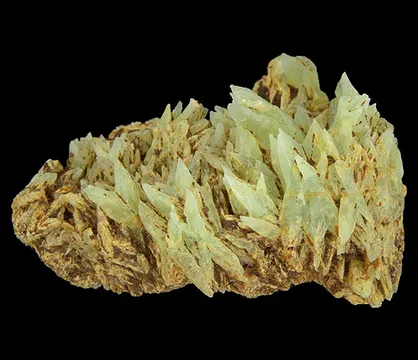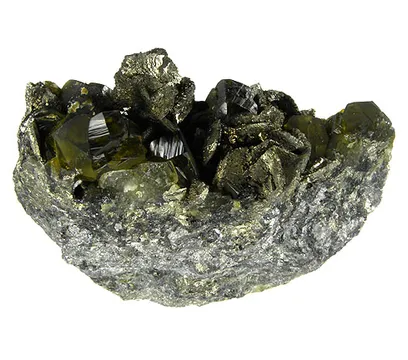
Anahi Mine, Bolivia — a renowned locality for ametrine quartz, with sector-zoned violet-to-citrine colors and cabinet-quality crystals, prized by collectors.
Key facts
Anahi Mine is the collector’s name that made natural ametrine famous: a remote quartz deposit in eastern Bolivia where purple amethyst and yellow to orange-yellow iron-bearing quartz occur as sharply sector-zoned parts of the same crystal. For mineral collectors, its importance is not just that it supplies faceting rough, but that it produces cabinet-worthy quartz crystals and clusters with a look unlike the basalt-geode amethysts of Brazil and Uruguay. The best pieces show transparent to translucent interiors, violet zones crossing honey to orange-yellow sectors, frosted or etched outer surfaces, and complex, sometimes almost sculptural terminations shaped by late-stage dissolution in the pockets.
Geologically, Anahi is an unusual quartz occurrence. The deposit is hosted by dolomitic limestones of the Murciélago Group in the lowland Pantanal–Chaco region near the Brazil border, not in the high Andes. Silica-rich hydrothermal fluids moved along a regional fault system, fractured and brecciated the carbonate host, and precipitated quartz in open cavities. In places, those chambers were large enough to be lined with prismatic quartz crystals several decimeters long, with milky bases grading into gemmy amethyst, citrine-colored, and bicolored sectors toward the tips. That carbonate-hosted hydrothermal-breccia setting is a major part of why Anahi specimens look so different from the amethyst geodes, pegmatitic quartz crystals, and quartzite-vein amethysts that dominate the broader quartz market.
Historically, the mine sits at the intersection of legend, gem-trade confusion, and modern gemological proof. Trade lore ties the name Anahi to an Ayoreo princess and a 17th-century Spanish conquistador; the documented modern story is clearer. Production resumed sporadically in the 1960s, intensified in the late 1970s, and came under organized private development by Minerales y Metales del Oriente S.R.L. around 1989–1990. Because early material was moved through Brazil and sold under uncertain locality information, ametrine was long suspected by some buyers to be artificial. The classic GIA field and laboratory study of 1994 was important because it tied the natural amethyst-citrine color zoning directly to the Bolivian mine and its hydrothermal-breccia geology.
Regional View
Country View
The collector-grade material is a narrow slice of a much larger gem operation. Much Anahi quartz is cobbed, sawn, preformed, faceted, or carved, so complete natural crystals with strong color contrast, attractive etching, and limited bruising are much scarcer than cut stones. Fine specimens tend to reward transmitted light: held to a lamp, a seemingly smoky violet surface can open into zones of grape, lavender, champagne, honey, and orange-yellow, with the sector boundaries made vivid by the crystal’s internal architecture.
Search for specimens: View all specimens from Anahi Mine, Bolivia
Anahi Mine lies in the tropical lowlands of Santa Cruz, eastern Bolivia, west of the Brazil border and north of Puerto Suárez. Published coordinates place the mine near 18°03'S, 57°48'42"W; older literature often uses La Gaiba, Anay, Anahí, or broader border-region designations, and some early trade labels misleadingly placed the material in Brazil or Uruguay. The setting is the Pantanal–Chaco borderland of seasonally flooded plains, lagoons, low hills, dense vegetation, and difficult logistics. The mine is reached by private arrangements only: historically by airstrip during dry periods, by boat routes through Laguna Mandioré and the Paraguay River system, or by combinations of road, boat, and rough jungle track.
The deposit occurs at the northern base of a dolomitic limestone hill in a north-south ridge rising roughly 200 m above the surrounding plains. That ridge is part of a regional fault system about 70 km long, along which other quartz occurrences are known. The immediate host rock is dolomitic limestone of the Murciélago Group, a roughly 500 m thick carbonate sequence interpreted as Proterozoic shallow-marine strata. In the mine area, the limestone is faulted, rotated, brecciated, iron stained, and strongly silicified; massive milky quartz cements the limestone blocks and passes into coarser crystalline quartz and open-space growth.
The ore bodies are best understood as quartz-filled hydrothermal breccias rather than simple straight veins. Explosive fracturing of the carbonate created open spaces, silica-rich fluids depressurized and boiled, and quartz precipitated rapidly on cavity walls, later continuing as slower growth of larger crystals into open pockets. The result is a complex network of quartz pods, veins, chambers, and clay-filled vugs. Some chambers described in the literature reached about 5 m long, 3 m wide, and 5 m high, completely lined with prismatic quartz crystals. One reported chamber produced more than 10 metric tons of ametrine crystals, while a documented 37.5 kg ametrine cluster yielded approximately 1,760 carats of faceted amethyst, citrine, ametrine, and champagne-colored stones after cobbing, preforming, and cutting.
The productive quartz is zoned on several scales. At the wall rock contact it may begin as microcrystalline quartz, then turn coarse and milky, then produce euhedral crystals whose tips carry violet, yellow, and bicolored sectors. Small, well-formed crystals from clay-carbonate matrix can be 1–8 cm long, lustrous, and gem quality but typically pale. Larger loose crystals, commonly 10–40 cm long, may have much stronger color and cleaner interiors. The most familiar specimen material consists of complex points and clusters growing from milky quartz bases, with crystals attached near their bases and showing rhombohedral terminations rather than simple textbook prisms. Two particularly notable pocket types yielded deeply etched crystals floating in red clay, with resorbed prism faces, frosty terminal faces, and sharp dissolution textures; these etched crystals are among the most distinctive Anahi specimens on the collector market.
Modern mining began as shallow digging in soil and outcropping vugs, then advanced into shafts and underground tunnels as near-surface material was depleted. By the early 1990s the mine was being worked underground by M&M personnel, with the main breccia zone trending roughly east-west and reached by north-south tunnels. Later GIA reporting described the mine as active in multiple tunnels, using washing and presorting at the mine before transport to Santa Cruz. Production statistics vary by period, but published figures include more than 100 metric tons of rough crystals recovered from 1989 into the early 1990s, and later annual production around 2,500–3,500 kg of gem-quality quartz from roughly 120 tonnes of mined quartz. In reported averages, amethyst made up the largest share by weight, followed by ametrine and citrine, while ametrine remained the most valuable product.
Collector access today should be considered closed unless arranged directly through the operator. This is not a public collecting locality, and it is not a casual field-collecting stop. The mine has been operated as a private commercial gem property by Minerales y Metales del Oriente S.R.L., which has advertised exclusive mineral rights to the Anahi Mine and a claim area of about 6,250 acres. Collectors encounter Anahi material through mineral dealers, gem dealers, old collections, and parcels of rough or specimens released from the mine-to-market operation, not by self-collecting at the pocket face.
Quartz at Anahi is the entire story: colorless to milky quartz, pale lavender “anahíta,” amethyst, citrine-colored iron-bearing quartz, and natural ametrine are all expressions of the same SiO2 system grown in carbonate-hosted hydrothermal breccia cavities. Collector pieces range from small 1–8 cm lustrous euhedral crystals embedded in clay-carbonate matrix to much larger 10–40 cm loose crystals and complex clusters on milky quartz bases; exceptional pieces show transparent interiors, bicolored violet and yellow-orange sector zoning, and natural etched surfaces from late hydrothermal resorption. Ordinary Anahi quartz is pale, fractured, milky, or cuttable rather than sculptural, while the better specimens combine strong color contrast, clean internal zones, undamaged terminations, and attractive etching that reads as natural texture rather than abrasion.
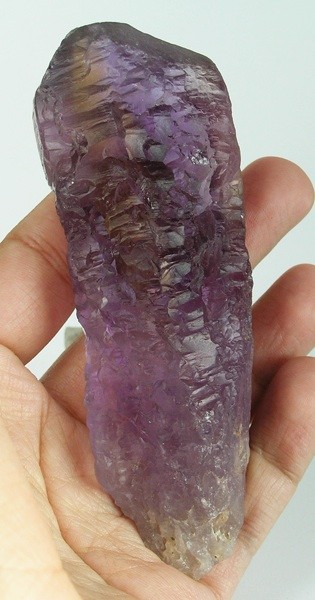
Anahi amethyst is chiefly recovered from the amethyst sectors of the mine’s larger quartz crystals and from single-color violet material in the same pockets, with colors ranging from near-colorless lavender to intense, clean violet-purple. The best amethyst here is valued for a comparatively pure purple hue without the brownish or yellowish cast that cutters often remove from mixed-sector stones; in rough crystals the amethyst zones can be strongly controlled by Brazil twinning and may show internal fluid inclusions, “tiger stripe” or rippled fracture features, and sharp boundaries against citrine-colored sectors. Fine collector specimens are those in which the amethyst is saturated enough to show without backlighting, yet transparent enough to reveal the zoning and internal architecture; pale, bruised, heavily milky, or badly cobbed pieces are commoner and less desirable.
Other documented minerals and mineral materials from the mine are mostly part of the quartz-pocket environment rather than a diverse species suite. Ametrine is the locality-defining quartz variety, but it is a gem-variety name rather than a separate IMA mineral species. Citrine-colored Anahi quartz is important because the deposit provided a major documented natural source of iron-bearing yellow quartz not produced by heat treatment of amethyst. “Bolivianite” and “anahíta” are trade names applied to Anahi quartz varieties, especially bicolored ametrine and pale lavender material, not formal mineral species. The clay filling in ametrine-bearing vugs has been reported to contain kaolinite, smectite-group clay minerals, quartz, hematite, goethite, and minor muscovite, while calcite or carbonate matrix reflects the dolomitic limestone host.
Anahi specimens are both abundant and easy to misunderstand. Cut ametrine is widely available, but natural, complete, display-quality crystals with strong zoning are scarcer because the mine has always been primarily a gem-producing operation. Much good material was historically broken, cobbed, boiled, sawn, or preformed for cutting; therefore, intact crystals with attractive natural surfaces command a premium over rough fragments that are merely colorful.
Authenticity questions are central to this locality. Natural ametrine from Anahi is real, well documented, and not simply a laboratory product, but synthetic hydrothermal ametrine and artificially color-zoned quartz do exist. There is also heated amethyst sold as citrine in the broader market, and pale or yellow-purple quartz from other sources can be loosely or incorrectly represented as “Bolivian ametrine.” For serious collectors, the strongest provenance is an old dealer label or mine-source documentation tying the piece to Anahi, plus the right visual character: crystallographically controlled color zoning, natural etching, fluid-inclusion features, and a plausible relationship between the amethyst and yellow-orange sectors. Be wary of material with unnaturally even, theatrical color splits in cheap faceted goods, especially when sold without provenance; such pieces may be synthetic or treated even though natural Anahi material can also show sharp boundaries.
Older locality labels deserve special attention. Because early Anahi production passed through Brazilian trade channels, specimens and gems have appeared under labels such as Brazil, Mato Grosso, Mato Grosso do Sul, Uruguay, or vague “South America” attributions. Conversely, not every “Bolivianite” label is a mineralogical statement; it is a trade and provenance term for Bolivian ametrine, and “anahíta” is a pale lavender quartz trade name. A collector should not treat those names as species names.
Condition is often the decisive value factor. Natural etching is desirable when it is crisp, continuous, and integrated with the crystal form; random abrasion, bruised edges, saw cuts, and broken bases are not the same thing. Many Anahi crystals have frosty surfaces, resorbed prisms, clay residues, or naturally complex terminations, so do not expect the glassy textbook luster of an alpine quartz point. At the same time, chips on rhombohedral edges, cleaved-looking internal fractures, shattered milky zones, and badly bruised terminations can strongly reduce specimen value.
Handling should be conservative. Quartz is hard, but Anahi crystals commonly contain internal fluid inclusions and healed fractures, and the gem literature documents that thermal shock from boiling water can drive fractures from milky surfaces into cleaner cores. Avoid hot-water shocks, ultrasonic cleaning, sudden temperature changes, and strong acids around clay- or carbonate-associated specimens. Rinse gently if necessary, use soft brushes, and leave stable clay in protected recesses if removing it would risk damaging etched faces.
Light exposure matters for display. Experiments on Anahi material showed measurable fading of the amethyst color after prolonged direct sunlight, and surface crystals from the mine area were sometimes found showing only the yellow color. Anahi amethyst and ametrine should be displayed away from direct sun and intense long-term light, especially for specimens where purple saturation is the main value.
The Anahi story begins with a legend that has survived because it fits the stone so well: a bicolored gem, half royal purple and half golden light, presented in the 1600s to a Spanish monarch after a conquistador married an Ayoreo princess named Anahi. In the tale, the mine itself was part of the dowry. Then the locality vanished into rumor for more than three centuries. Gemologically, the modern material belongs to the 20th century, but the legend still clings to the mine because the geography makes it believable. This is not a roadside deposit in a famous mining camp. It is hidden in a seasonally flooded frontier of jungle, limestone ridges, lagoons, and long river approaches.
The modern field accounts are almost as vivid as the legend. Before legal private exploitation, early miners and dealers reportedly moved into the area by boat along the Paraguay River to Amolar, then walked west on jungle trails for about 30 km, a two-day trip on foot. They carried tools and supplies in, cobbed rough at the mine to keep only the gemmy cores, and moved the material out under the pressure of changing military authorities and inspectors. When new officials appeared, miners fled into the jungle with whatever tools and rough they could carry. That chaotic period explains the old locality confusion: Bolivian stones were registered or represented through Brazilian channels, and the world market heard competing stories of Brazil, Uruguay, and Bolivia before Anahi was firmly documented.
A later visit to the mine reads like an expedition through two Bolivias. From La Paz and the high, cold Andes, the route drops toward Santa Cruz and then into the lowland heat. One approach required the road to Roboré and Puerto Suárez, then another 8 to 10 hours by barge or motorboat northward through the Pantanal waterways to Laguna Mandioré, followed by a final rough hour over jungle tracks and hills. The fast way was no less dramatic: a three-and-a-half-hour single-propeller flight from Santa Cruz to a grass airstrip near the mine, with armed guards waiting at the landing area. Even now, the first practical rule is simple: arrive by invitation.
At the mine, the romance gives way to quartz underfoot. Field visitors described chunks of quartz, including outright hexagonal crystals, embedded along the road and throughout the workings. The hills are dolomitic limestone cut by quartz veins, and the mine follows those veins and breccia bodies underground. In a good year, Ramiro Rivero estimated production of 3,000–3,500 kg of gem-quality quartz. The working population could reach 70 to 100 people, and the camp was run as a remote industrial village: miners played soccer daily, ate at the mine, watched satellite television, used company phones to call home, and worked under a prohibition on alcohol.
The pocket work itself is a study in contrasts: dynamite and delicacy. In active tunnels or in the small open-pit area, blasting could occur once or twice a day. After the alarm, everyone took cover; then the air had to clear before miners returned to chisel amethyst-bearing zones and move broken rock. Loaded carts rolled down slight grades, overburden was hauled up an elevator shaft, and material went to washing. A water cannon broke down rock-and-mud masses, sieves separated the quartz, and sediments were trapped in holding ponds to keep particulates from flowing downstream into the Pantanal. The good pieces then went to protected presorting, where roughly 20 workers evaluated the quartz and cobbed some material to reduce weight before transport.
One of the most memorable documented pieces was not a museum jewel but a mine-run cluster: 37.5 kg of ametrine collected from a producing pocket during the GIA study. After cobbing, preforming, and cutting, that single cluster yielded about 1,760 carats of faceted stones in amethyst, ametrine, citrine, and blended champagne tones. It is a sobering number for specimen collectors, because it shows why so many fine crystals were sacrificed to the cutting wheel. A crystal that would anchor a cabinet today may once have been valued mainly as a container for its clean interior.