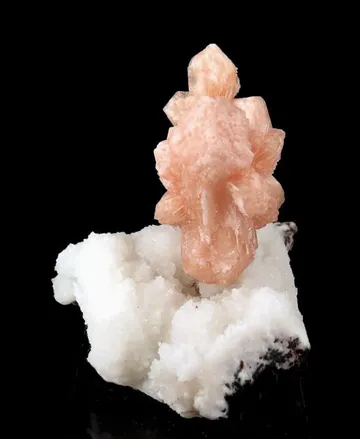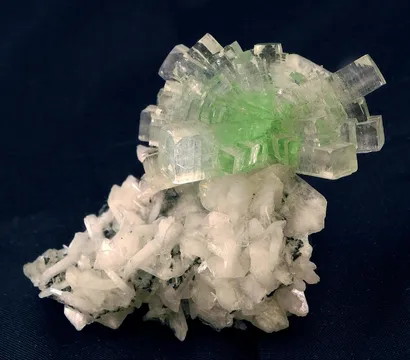
Ahmednagar District, India — zeolite-rich Deccan Traps locality known for apophyllite, stilbite, and Rahuri crystals; prized for distinctive, undamaged example…
Key facts
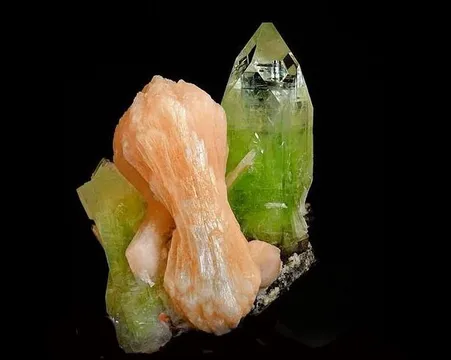
Ahmednagar District—now officially Ahilyanagar District, though older mineral labels overwhelmingly read “Ahmednagar,” “Ahmadnagar,” or simply “Maharashtra, India”—belongs to the great zeolite country of the Deccan Traps. For collectors, its importance is not an ore deposit in the conventional sense but a specimen province: basalt flows full of amygdales, geodes, seams, pipe amygdules, and water-well cavities that yielded some of the most distinctive Indian apophyllite and zeolite specimens of the modern market. The district’s best-known look is unmistakable: pale green to colorless fluorapophyllite-(K) in flat-terminated radial balls, sprays, hemispheres, and “disco ball” aggregates perched on creamy white stilbite. Those Momin Akhada well specimens, found near Rahuri, are sufficiently unlike the more familiar pyramidal apophyllites from Jalgaon, Nashik, Pune, and Aurangabad that serious collectors often treat them as a sub-class of their own.
Regional View
Country View
The collecting story is spread across several parts of the district. Rahuri supplied the celebrated Momin Akhada water-well apophyllites; Sangamner includes Sakur, with celadonite-included heulandite, stilbite, apophyllite, calcite, mordenite, powellite, and related cavity minerals; Rankhamb is documented for scolecite on stilbite from a water-well discovery; and older “Ahmednagar District” labels also attach to pale green nail-head calcites, green celadonite-included stilbite and heulandite, powellite, okenite-bearing vugs, and quartz after calcite. The unifying geology is basalt: the upper portions of lava flows are vesicular and amygdaloidal, and their cavities were later lined or filled by low-temperature secondary minerals—chiefly zeolites, calcite, silica minerals, celadonite-rich coatings and inclusions, and apophyllite.

Photo: Dguendel, Wikimedia Commons
The finest Ahmednagar specimens have the qualities Deccan collectors prize most: undamaged, lustrous crystals with strong contrast against dark basalt or creamy stilbite, open composition rather than massive cavity fill, and enough locality precision to separate a Rahuri well piece from the far larger stream of generically labelled “India” or “Maharashtra” apophyllite. The district also matters historically because its finds arrived during the period when Indian zeolites moved from inexpensive decorator pieces into the high-end cabinet market. Momin Akhada’s 2001 discovery, followed by later well finds, became one of the most repeated modern Deccan stories precisely because it combined rural water digging, specimen mining, distinctive crystal habit, and genuinely world-class aesthetics.

Search for specimens: View all specimens from Ahmednagar District, India
Ahmednagar District lies within the Deccan volcanic province, where stacked basalt lava flows dominate the bedrock. District geological descriptions note hard, compact, dark lower and middle portions of flows, overlain by softer reddish-pink to purplish vesicular flow tops. Those vesicles and amygdales are the spaces that matter to collectors: many were later filled or lined with zeolites, calcite, quartz, chalcedony, greenish alteration minerals, and ferruginous material. Flow thicknesses in the district have been described from a few metres to about 40 metres, averaging roughly 15 metres, with a much larger aggregate volcanic thickness reported for the district. At the Mula river near Ahmednagar cantonment, older district geology records porphyritic trap with pink vesicular patches, geodes and amygdules ranging from pea-sized bodies to larger elliptical cavities, stringers, and veins.
The specimen “deposit type” is therefore amygdaloidal basalt cavity mineralization rather than a vein mine or stratiform ore body. Primary basalt minerals—plagioclase feldspar, clinopyroxene, iron oxides, and associated mafic constituents—were altered by fluids moving through cooling joints, flow tops, and interflow zones. Cavities could be sealed, partly open, or lined in stages. In collector terms, the productive horizons are the vesicular and amygdaloidal parts of individual flows, especially where cavities remained open enough for free crystal growth. Stilbite, heulandite, mordenite, scolecite, calcite, chalcedony, quartz, powellite, celadonite, and apophyllite-group minerals are all part of that district-scale secondary assemblage.
The most famous mining episode was not a mine at all. At Momin Akhada, near Rahuri, wells dug for water intersected mineralized basalt cavities. Well No. 1 produced the celebrated flat-terminated green apophyllite in 2001; Well No. 2 followed in 2004; and Well No. 3 was discovered in 2013 by chance drilling while seeking water. These wells were close together: Well No. 3 is recorded about 100 metres from Well No. 1 and about 50 metres from Well No. 2. The three productive cavities were worked by M. F. Makki and Sami Makki of Matrix India, Pune, whose names are closely attached to the modern Rahuri story.
Sakur Quarry, near Sakur in Sangamner taluka, is another key collector locality. It is documented as a hard-rock quarry and has produced apophyllite-group minerals, fluorapophyllite-(K), calcite, celadonite, heulandite subgroup, mordenite, powellite, and stilbite-Ca. Sakur material is especially notable for celadonite-included heulandite and stilbite, giving specimens a soft green cast that is easily confused with true green body colour in the zeolite. Some heulandites from Sakur form curved, lustrous, frond-like or fan-like groups, sometimes free of matrix or with only a little clay, and are best when three-dimensional rather than flattened against basalt.
Rankhamb village, also in Sangamner, is documented for scolecite and stilbite from a water-well occurrence. Museum and publication records describe the find as a fortuitous discovery made during well digging, with basalt blocks carrying white balls or sprays of scolecite needles on dark brown basalt. Chandanapuri has documented quartz, chalcedony, and scolecite; Vambori near Rahuri is important because some spheroidal green apophyllite material formerly attributed to Momin Akhada has been suggested instead to have come from that area; and broader Ahmednagar District labels appear on specimens of calcite, powellite, okenite, quartz pseudomorphs after calcite, and mixed apophyllite-stilbite-scolecite pieces.
Commercial mining in the district has historically focused on basalt trap rock for building stone, road metal, aggregate, and local construction materials rather than on mineral specimens. The specimen supply is a by-product of quarrying, road work, field excavation, and water-well digging. That matters for collectors because productive pockets are episodic. A single cavity may yield a memorable suite for a season and then disappear completely; an adjacent quarry bench or well may produce nothing of specimen quality. Today, collecting access should be treated as private and permission-based. Active quarries, farms, and wells are working sites, and the best material normally reaches collectors through Indian dealers and established international dealers rather than casual field collecting.
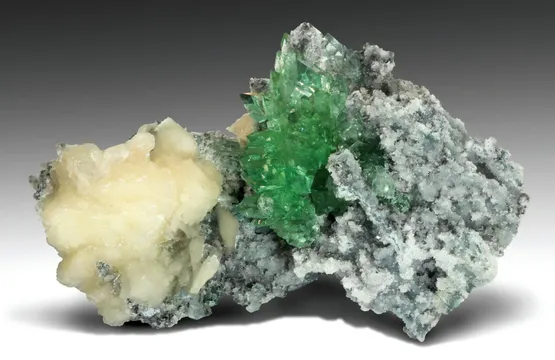
Ahmednagar apophyllite is best known from Momin Akhada near Rahuri, where the important pieces are fluorapophyllite-(K) in squat tetragonal prisms with dominant flat basal pinacoid terminations rather than the steep pyramidal habit familiar from many other Maharashtra localities. The classic crystals are colorless to pale green or green, commonly arranged as radial balls, bow-ties, hemispheres, or nearly spherical “disco ball” clusters on white to cream stilbite; individual crystals are often around 1–2.5 cm on cabinet pieces, while balls and sprays range from thumbnails to dramatic multi-inch groups, with some large plates carrying more than twenty separate clusters. The finest pieces have saturated green centers fading toward water-clear terminations, sharp square cross-sections, bright glassy lustre, open separation between the balls, minimal basalt, and undamaged outer tips; ordinary pieces tend to be flatter, paler, contacted, or broken where the fragile radiating clusters were detached from a tight cavity.
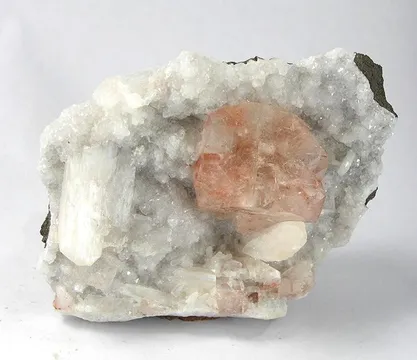
Stilbite from Ahmednagar District appears both as the indispensable matrix for Rahuri apophyllite and as attractive specimens in its own right from Sakur and other district localities. At Momin Akhada it is usually cream, white, satiny, pearly, or lightly pinkish, forming bladed crusts and bow-tie sheaves that provide a soft base for the green disco-ball apophyllite; at Sakur and on broader Ahmednagar labels it may occur as lustrous colorless to white crystals, peach to tan bow-ties, green celadonite-included groups, or dramatic cabinet clusters up to around 12–13 cm and larger. Fine Ahmednagar stilbite is judged by lustre, separation, undamaged blade edges, sculptural three-dimensional form, and association—especially sharp apophyllite, heulandite, celadonite colour, calcite, or chalcedony—while common material is massive, chalky, heavily contacted, or too densely intergrown to show individual crystal form.
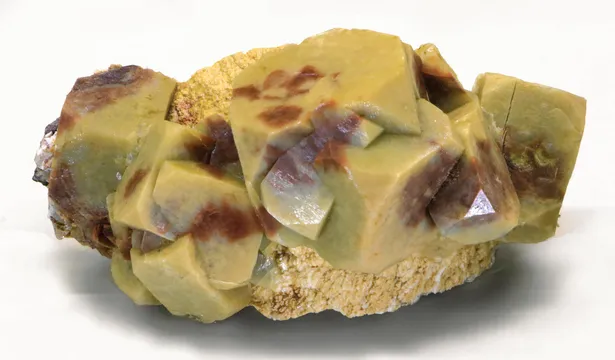
Calcite is a recurring cavity mineral in Ahmednagar basalts, but the district’s most distinctive collector calcites are the pale grayish-green, translucent, lustrous nail-head groups recorded from a find around 2007. These specimens show broad, stepped, nail-head faces with growth patterns likened by one cataloguer to terraced rice paddies, commonly perched on smaller disc-like calcite crystals or minor matrix; documented examples include miniatures around 5 cm across and crystals reaching roughly 3–4 cm. Other Ahmednagar calcite occurs as rhombs, scalenohedrons with stilbite and heulandite, light-yellow crystals in okenite vugs, and calcite forms later replaced or coated by quartz; good pieces are those with sharp terminations, clean translucency, glossy surfaces, and unusual greenish colour, while bruising on the broad terminations is the common flaw to watch.
Ahmednagar heulandite is best represented by Sakur material, especially curved, pearly heulandite-Ca groups tinted green by celadonite inclusions. The finest examples form elegant fronds, fans, or platy aggregates with a waxy to pearly lustre and soft internal green colour, sometimes with a contrasting white tip or with associated apophyllite and stilbite; documented small-cabinet pieces fall around 5–7 cm, while auction records also show larger Sakur heulandite plates more than 15 cm across. Good Ahmednagar heulandite is sculptural, complete-looking, and lustrous from several angles, with the green inclusion colour distributed through the crystals rather than merely smeared on a surface; ordinary pieces are dull, clay-filled, incomplete at the edges, or labelled only broadly as “India,” losing much of the locality premium.
On Ahmednagar labels, “zeolite” is often a practical field or dealer term for mixed cavity assemblages rather than a single species, and the label may cover stilbite, heulandite, scolecite, mordenite, laumontite, mesolite, natrolite, epistilbite, chabazite, stellerite, and related species from the district’s basalt cavities. The most collectible zeolite plates show clearly separated species: cream stilbite under green apophyllite from Rahuri, green celadonite-included heulandite or stilbite from Sakur, white scolecite balls on dark basalt from Rankhamb, or combinations with calcite, chalcedony, quartz, and mordenite. The best “zeolite” specimens from Ahmednagar are not merely species-rich but textural: soft bladed stilbite, glassy apophyllite, fibrous or acicular scolecite, and pearly heulandite all visible at once, with enough open space to preserve the order of crystallization and enough matrix contrast to make the assemblage readable.
Other documented Ahmednagar District minerals include celadonite, chabazite, epistilbite, fluorite, gyrolite, laumontite, mesolite, mordenite, natrolite, nontronite, okenite, palagonite, plagioclase, powellite, quartz, agate, amethyst, chalcedony, scolecite, smectite-group minerals, stellerite, and the julgoldite subgroup. Powellite is an important rarity in the district: Ahmednagar specimens include translucent amber to tan crystals and radiating clusters, with unusually large examples exceeding 4 cm across, and powellite is strongly fluorescent. Rankhamb scolecite on stilbite is documented by both museum and publication records, while Sakur’s julgoldite-subgroup occurrence gives the district an additional layer of interest for collectors who follow rare basalt-cavity mineralogy rather than only showy zeolites.

The first authenticity issue is locality precision. “Ahmednagar,” “Ahmadnagar,” “Ahilyanagar,” “Rahuri,” “Momin Akhada,” “Sakur,” “Sangamner,” and “Maharashtra” may all describe real relationships, but they do not carry the same specimen value. A true Momin Akhada disco-ball apophyllite should have the flat-terminated, squat-prismatic radial habit and cream stilbite association expected of the well finds. Many ordinary Maharashtra apophyllites are green and attractive, but they lack the flat pinacoid-dominated crystal habit and ball-like construction that made Rahuri famous.
Older labels may use “Apophyllite-(KF),” “Apophyllite-KF,” “apophyllite,” or “fluorapophyllite-(K).” For high-end pieces, especially those marketed as Momin Akhada, modern species naming should not distract from the bigger questions: is the locality exact, does the crystal habit match the well find, and is the piece repaired, mounted, or reconstructed? Serious buyers should look for older dealer records, publication history, collection labels, and photographs tying a specimen to Well No. 1, Well No. 2, Well No. 3, Momin Akhada, or Rahuri. A generic “India” label on a disco-ball specimen may still be correct, but it leaves money and scientific value on the table.
The district has a particular mislabelling problem involving look-alike or nearby material. Some spheroidal green apophyllite on pink thomsonite-like zeolite has been reported as formerly attributed to Momin Akhada but probably from Vambori, close to Rahuri. That does not make such specimens unattractive, but it does mean that “Momin Akhada” should be treated as a claim requiring habit, matrix, and provenance support, not merely a convenient market name for any green radial apophyllite from Maharashtra.
Condition matters intensely. Apophyllite disco balls are made of many projecting crystal ends; even a small rub can dull the outer surface of the ball. Check flat terminations under side light for bruises, cleaves, or missing corners. Stilbite blades chip and abrade along thin edges; heulandite fronds separate along cleavages; calcite nail-head terminations show bruises easily; scolecite needles break with little pressure; and okenite balls are nearly impossible to clean once dusty. Many Deccan specimens also carry soft clay or basalt residue in pockets, and aggressive washing can loosen delicate zeolites or remove useful matrix contrast.
No widespread documented fake industry is specifically attached to Ahmednagar District, but repairs, reattachments, glued contacts, disguised broken bases, and re-trimmed matrix should be expected in the broader Indian zeolite market, especially for showy cabinet pieces. Matrix-mounted disco balls deserve close inspection because loose hemispheres can be tempting to re-seat or combine. UV handling is worthwhile for powellite, which can fluoresce strongly; it should also be kept away from abrasion because lustrous powellite faces and calcite associations are easily marked. Apophyllite and zeolites are generally display-stable under normal indoor conditions, but prolonged heat, rough ultrasonic cleaning, acids, and heavy water soaking are poor choices for mixed basalt-cavity specimens.
Availability is polarized. Mixed Ahmednagar zeolite specimens and broadly labelled district calcites or stilbites appear regularly enough that patient collectors can be selective. Precisely labelled Momin Akhada disco-ball apophyllites are much less common, and fine pieces from the 2001 and later well finds are treated as modern classics. Recent dealer and auction records show ordinary or small locality pieces in the low hundreds, Sakur heulandites selling modestly, and exceptional Rahuri disco-ball apophyllites offered or valued in the thousands depending on size, colour, damage, and provenance.
In August 2001, Momin Akhada was not a mineral locality in the way collectors now use the name. It was a village near Rahuri where a well was being dug for water. At a depth of 55 feet, the excavation broke into basalt pockets lined with extraordinary hemispherical fluorapophyllite aggregates. The crystals were squat, square-sectioned tetragonal prisms, nearly uniform in length, with flat basal terminations. Most were transparent to colorless, but enough pale green lay within them to give the balls a cool green cast. Collectors soon gave them the name that stuck: “disco apophyllite,” because the glittering hemispheres looked like mirrored dance-floor balls.
The geology made the discovery possible, but chance made it famous. The well was only meant to find water. Instead, it found one of the most visually distinctive Indian apophyllite pockets of the modern era. The balls grew on cream to white stilbite, and the best pieces looked deliberately composed: a green sphere rising from a silky base, with the apophyllite crystals fading from stronger green at their inner cores to clear outer tips. That colour zoning created a paradox familiar to anyone who has handled the material: shorter or cleaved crystals could look greener, while longer, more complete crystals could appear paler because their clear terminations diluted the body colour.
The story did not end with Well No. 1. A second well was dug in 2004, and a third followed in 2013. All three were close together—roughly aligned over only a few hundred metres—with Well No. 3 about 100 metres from the original 2001 well and about 50 metres from Well No. 2. Father and son M. F. Makki and Sami Makki of Matrix India, Pune, are recorded as having worked the cavities. By the time Well No. 3 came into the literature, the locality had become a small mineralogical map in itself: three wells, three pockets, subtle differences in habit and association, and a collector market ready to distinguish them.
The later finds added nuance rather than simply repeating the first pocket. Reports describe differences among the three wells in individual crystal size, symmetry of the aggregates, abundance of bow-tie clusters, and the presence of calcite and stalactitic stilbite. Some later material was paler, and a 2012 report noted a new Rahuri well-digging that produced loose hemispheres of lustrous apophyllite with a faint pink cast rather than the classic pale green, accompanied on some pieces by small sheaves of snow-white stilbite. For collectors, those distinctions matter: “Momin Akhada” is not one visual formula but a family of related pocket styles.
There is also a harder-edged human story behind the sparkle. A 2013 account described the history of the three Momin Akhada discoveries as a “three chapter saga” involving competition between Indian mineral dealers, including corruption, threats of violence with guns, and litigation. That sentence is often remembered because it punctures the romantic idea that Deccan zeolites simply emerge from harmless holes in the countryside and travel peacefully to Tucson. In reality, a pocket that can produce museum-level green apophyllite balls has economic value, and in rural, privately controlled ground, the line between opportunity and conflict can become very thin.
Rankhamb supplied another kind of Deccan story: a water well again, but this time the prize was scolecite. A large museum specimen from the find is described as a 26 x 20 x 15 cm basalt block, weighing 4700 grams, covered on its upper side with three well-formed balls of white needles. The appeal is completely different from Rahuri apophyllite. Instead of glassy green spheres on cream stilbite, the Rankhamb specimen is a study in contrast—white acicular balls against brown basalt—and it records the same basic truth of Ahmednagar collecting: the most important pockets were not always sought as mineral pockets. They were found because someone needed stone or water.
Sukheswala, R. N.; Avasia, R. K.; Gangopadhyay, M. (1974). “Zeolites and associated secondary minerals in the Deccan Traps of Western India.” Mineralogical Magazine, 39(306), 658–671. DOI: 10.1180/minmag.1974.039.306.04. A foundational scientific treatment of Deccan secondary minerals and their zeolite assemblages.
Currier, Rock H. (1976). “The Production of Zeolite Mineral Specimens from the Deccan Basalt in India.” The Mineralogical Record, 7(5), 248–264. The classic collector-facing article that helped bring Indian Deccan zeolite specimen production to an international audience.
Phadke, A. V.; Kshirsagar, L. K. (1984). “Zeolites and other cavity minerals in Deccan Trap volcanics of Western Maharashtra.” Geological Survey of India Special Publication, 12, 129–134. A regional publication specifically addressing cavity minerals in western Maharashtra’s Deccan volcanics.
Ottens, Berthold (2003). “Minerals of the Deccan Traps, India.” The Mineralogical Record, 34(1), 5–82. A major modern overview of Deccan Trap minerals, cited widely in later discussions of Indian zeolite localities.
Makki, Muhammad F. (2002). “Der Fund der neuen Apophyllite aus den Basalten des indischen Dekkan Trapp” / “The discovery of new apophyllites from the basalts of the Indian Deccan Traps.” Mineralien Welt, 13(3), 56–62. One of the key references for the Momin Akhada apophyllite discovery.
Moore, Thomas P. (2002). “What’s New in Minerals—Tucson Show 2002.” The Mineralogical Record, 33(3), 261–275. Includes early collector-world notice of the Rahuri/Momin Akhada material.
Wilson, Wendell E.; Bartsch, Joel A.; Mauthner, Mark (2004). Masterpieces of the Mineral World. Houston Museum of Natural Science. Mindat records connect Momin Akhada green fluorapophyllite-(K) to Plate 38 and pages 108–109 of this museum publication.
Makki, M. F.; Makki, S. (2013). “Neufund grüner Apophyllite in Form von ‘Diskokugeln’ aus Rahuri, Maharashtra, Indien.” Mineralien-Welt, 24(6), 90–97. A later account of green apophyllite disco-ball finds from Rahuri.
Praszkier, Tomasz; Makki, Mohammad Fasi (2013). “‘Disco balls’ from Rahuri, India.” Minerals: The Collector’s Newspaper, 7, 1–11. A detailed collector article on the Rahuri disco-ball apophyllites and the circumstances of the Momin Akhada discoveries.
Makki, Muhammed F.; Makki, Sami (2017). “Scolecite on stilbite from Rankhamb, Maharashtra, India.” The Mineralogical Record, 48(6), 783–789. Publication documenting the Rankhamb scolecite-on-stilbite find in Ahmednagar District.
Makki, Muhammad Fasihuddin; Makki, Sami (2017). “La grande géode de scolécite de Rankhamb, Maharashtra, Inde.” Le Règne Minéral, 23(137), 40–43. French-language article on the large Rankhamb scolecite geode.
Museum Victoria specimen M 52882: Heulandite, Sangamner, Ahmednagar District, Maharashtra, India. A museum-documented heulandite specimen from Sangamner, noted as possibly coloured green by celadonite.
mim Museum specimen 2022: Scolecite, water well at Rankhamb, Sangamner, Ahmadnagar District, Maharashtra, India. A large museum specimen from the Rankhamb water-well discovery, described as a basalt block with three balls of white scolecite needles.
Mindat — Ahilyanagar District, Nashik Division, Maharashtra, India District-level mineral list, synonymy, and locality hierarchy for the former Ahmednagar District.
Mindat — Momin Akhada, Rahuri, Ahilyanagar District Locality page for the famous Rahuri apophyllite and stilbite well finds.
Mindat — Well No. 3, Momin Akhada, Rahuri Specific well locality with notes on discovery, spacing from earlier wells, mineral list, and references.
Mindat — Sakur Quarry, Sakur, Sangamner Quarry locality page for Sakur’s apophyllite, heulandite, stilbite, calcite, mordenite, powellite, and celadonite-bearing material.
Maharashtra Gazetteers — Ahmadnagar geology Official-style district geology account describing Deccan Trap basalts, vesicular flow tops, amygdales, zeolites, calcite, quartz, and related secondary minerals.
Maharashtra Gazetteers — Ahmadnagar minerals Historical district mineral note, including zeolites and stilbite at Ahmadnagar.
Wikimedia Commons — Minerals of Ahmednagar District Freely viewable image category with apophyllite, stilbite, calcite, heulandite, powellite, and other Ahmednagar mineral photographs.
Heritage Auctions — Apophyllite on Stilbite, Well No. 3, Momin Akhada, Rahuri Archive description of a large Momin Akhada disco-ball apophyllite plate with measurements and condition notes.
Mineral Auctions — Apophyllite with Stilbite, ex Kay Robertson Collection, Well No. 3, Momin Akhada Useful small-cabinet example documenting habit, association, size, and provenance.
UC Minerals — Apophyllite-KF on Stilbite, Momin Akhada near Rahuri Dealer record showing current market-style description of a cabinet Rahuri specimen with flat pinacoid apophyllite and stilbite.
Mineral Auctions — Calcite, unusual material, Ahmadnagar District Archive record for the pale grayish-green nail-head calcite material found around 2007.
Museum Victoria — Heulandite specimen M 52882 Museum collection entry for a Sangamner heulandite specimen from Ahmednagar District.
PASCAL/INIST — Phadke and Kshirsagar, “Zeolites and other cavity minerals in Deccan Trap volcanics of Western Maharashtra” Bibliographic record for a Geological Survey of India Special Publication paper on western Maharashtra cavity minerals.
Mineralogical Record digital back issue — September–October 1976 Back issue containing Rock Currier’s classic article on Deccan basalt zeolite specimen production.
Mindat reference — “‘Disco balls’ from Rahuri, India” Bibliographic record for the 2013 collector article on Rahuri disco-ball apophyllites.
Mindat reference — “La grande géode de scolécite de Rankhamb, Maharashtra, Inde” Bibliographic record for the Rankhamb scolecite geode article.