






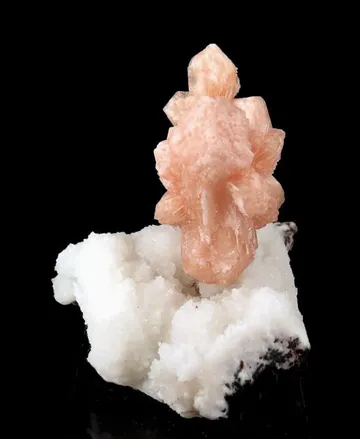
Jalgaon District, India - a premier Deccan Traps locality yielding striking zeolites from basalt cavities, including stilbite, heulandite, and apophyllite.
Key facts
Jalgaon District is one of the great modern names of Indian zeolite collecting: not an ore camp in the old mining sense, but a district-scale basalt-cavity province where road metal and aggregate quarries cut into the Deccan Traps and opened pockets of extraordinary secondary minerals. The classic Jalgaon specimen is an interior of a basalt bubble made visible—dark volcanic matrix, gray-white chalcedony or drusy quartz, peach to salmon stilbite, glossy reddish or tan heulandite, and sharp apophyllite crystals that may be colorless, pale green, mint green, or more rarely a deeper, saturated green. Good pieces have a stage-set quality: a bow-tie of stilbite poised in the center of a vug, a glassy apophyllite spray at one edge, a calcite crystal emerging through quartz, or a rarer powellite tucked among later apophyllite.
The geology is the Deccan Volcanic Province, the immense Late Cretaceous–Paleogene flood-basalt pile that covers much of western and central India. In Jalgaon, the specimen-producing cavities are most famously associated with the Savda/Sawda quarry complex near Sawade Pr Chandsar, west of Jalgaon city. Individual lava flows there show a collector’s anatomy: vesicular tops and bottoms with smaller amygdales, and a denser flow-core zone where larger irregular cavities—several decimeters across and in some cases approaching a meter—preserved space for well-formed crystals. Those cavities were later bathed by mineralizing fluids in multiple stages, producing clay minerals and green celadonitic fabrics, calcite, chalcedony and quartz, heulandite, stilbite, mordenite, powellite, and finally apophyllite.
Regional View
Country View
Historically, Jalgaon became important as collectors and dealers learned that the Indian Deccan basalts were not merely a source of abundant zeolites, but a world-class aesthetic province. By the 1990s and early 2000s, Jalgaon had entered the serious specimen literature and the international trade alongside Pune, Nashik, Mumbai, Aurangabad, Ahmednagar, and related Deccan localities. The district’s finest specimens are now collected both for beauty and locality significance: they represent the period when Indian quarry specimens changed what collectors expected from zeolites.

Photo: Wikimedia Commons

Photo: Wikimedia Commons

Photo: Wikimedia Commons
Search for specimens: View all specimens from Jalgaon District, India
Jalgaon District lies in northern Maharashtra, in the Nashik Division. The mineral locality name is used at several levels in the specimen trade. A label reading simply “Jalgaon” may refer to the district, to Jalgaon city as the nearest familiar name, or to a more specific quarry area. The best documented and most important specimen-producing sublocality is Savda, also written Savada or Sawda, at Sawade Pr Chandsar. Mindat records Savda as a quarry and notes that the quarries near this hamlet are the source of many specimens labeled “Jalgaon.” Other Jalgaon District names encountered on mineral labels and locality records include Paldhi in Dharangaon, Jamner, Shendurni, Chalisgaon, and unnamed basalt localities.
The deposit type is secondary mineralization in basalt cavities. The host is Deccan Trap basalt, commonly described in district geological summaries as massive, vesicular, and amygdaloidal basalt with secondary minerals occupying cavities. The collectible specimens are not mined from ore veins; they are extracted from open cavities, amygdales, fissure-connected voids, and cavity linings in basalt flows exposed by quarrying. In the Savda quarry complex, published work describes individual flows about 7 m thick, with a weathered or vesicular upper part, a dense core line containing the largest irregular cavities, and a lower part with smaller vesicles and amygdales.
The ore-body language of metal mining does not quite fit Jalgaon. The “ore bodies” for collectors are pockets: discontinuous cavities in basalt that may be empty at the center but lined or partly filled with secondary minerals. The Savda cavities vary sharply even within neighboring parts of the same flow. Some are rounded; others have flat bottoms, arched roofs, or upward-convex skirted forms. Some cavities carry only thin linings of chalcedony, stilbite, or apophyllite; others contain enough crystallization that a single species such as stilbite or apophyllite can dominate the whole opening. The most productive flow-core cavities are the ones that allowed centimeters of open growth rather than tight amygdaloidal filling.
The paragenesis at Savda is unusually well studied for a commercial specimen locality. Early alteration produced clay minerals and green filamentous fabrics on cavity walls. A later burial-related stage introduced early calcite, small zeolites including heulandite, stilbite, and mordenite, feldspar, chalcedony or quartz, more calcite, and a second generation of larger zeolites. A still later hydrothermal stage produced another calcite generation, powellite, and apophyllite. This sequence explains the layered look of many Jalgaon pieces: a basalt cavity first coated by green or gray alteration products, then quartz or chalcedony, then zeolite blades, calcite, powellite, and glassy apophyllite.
Mining history is tied to industrial quarrying rather than a single named specimen mine. The quarries were opened and worked for basalt aggregate and road stone, with mineral specimens recovered as pockets appeared. Western literature began emphasizing Jalgaon as a specific new Deccan locality in the 1990s, and the district was treated prominently in the 2003 Mineralogical Record special issue on Indian zeolites and related species. Scientific work on the Savda complex in the 2010s drew on freshly opened cavities, showing that commercial quarrying continued to expose material over a long period. Specimen dealers, local miners, and exporters have all played roles in moving material from quarry walls to the international market, but access has always depended on working industrial sites and local permission.
Collecting access today should be regarded as private, commercial, and hazardous. These are working quarries, not public collecting areas. Permission from quarry operators, landholders, and local authorities is essential, and casual field collecting is unrealistic for most visitors. Fresh pockets are found episodically when quarrying cuts the right flow-core cavities; in quiet periods, the market is supplied largely by older stock, dealer inventories, and collection recycling. A serious buyer should value labels that preserve the specific locality—Savda/Sawda, Sawade Pr Chandsar, Paldhi, Jamner, Shendurni, or another Jalgaon District source—over labels that say only “India” or “Maharashtra.”
Notable finds include cabinet-scale stilbite bow-ties and florets, green apophyllite on quartz-lined or chalcedony-lined basalt vugs, peach heulandite with later stilbite, honey to golden calcite, powellite with apophyllite, drusy chalcedony plates, amethyst-lined pieces, scolecite sprays, mordenite spheres and fibrous crusts, epistilbite rosettes, and uncommon combinations with goosecreekite, stellerite, fluorite, okenite, gyrolite, cavansite, and thomsonite-subgroup minerals. The locality’s strongest specimens are rarely just “a zeolite”; they are miniature cross-sections through a multi-stage basalt cavity.
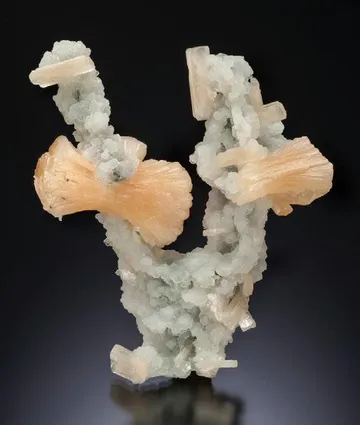
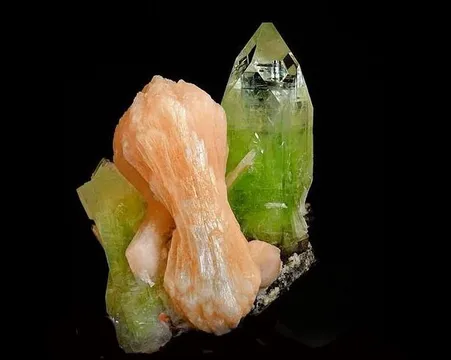
Jalgaon stilbite is normally encountered in the trade as stilbite-Ca or simply “stilbite,” and its best forms are the soft, architectural shapes that made the district famous: bow-ties, wheat-sheaves, fans, rosettes, florets, and bladed sprays in cream, ivory, tan, peach, salmon, orange-pink, and occasionally deeper reddish tones. The classic pieces came from basalt cavities around Savda and neighboring Jalgaon quarry areas, where stilbite grew on chalcedony, quartz, heulandite, mordenite, calcite, or dark basalt and was later accompanied in many pockets by glassy fluorapophyllite-(K). Ordinary specimens are crowded crusts or bruised sprays; good Jalgaon stilbite has complete bladed terminations, a clearly readable bow-tie or floret, attractive color without dye-like intensity, and enough contrast against gray-white chalcedony, drusy quartz, dark basalt, or green apophyllite to give the specimen depth.
Jalgaon apophyllite is among the district’s signature minerals, typically occurring as fluorapophyllite-(K) in glassy tetragonal crystals ranging from small sparkling druses to cabinet-scale crystals several centimeters across, with the most desired examples showing water-clear luster, pale mint to apple-green color, sharp pyramidal terminations, or attractive zonation from green cores to colorless terminations. At Savda and related quarries it is a late mineral in the cavity sequence, commonly perched on quartz, chalcedony, stilbite, heulandite, calcite, or, in rarer pieces, powellite; this late position often makes it the visual focal point of a specimen. Ordinary pieces are abundant pale or colorless druses; fine Jalgaon apophyllites stand out by crystal sharpness, transparency, undamaged corners, vivid but natural green color, and placement that turns a lined basalt cavity into a balanced display specimen.
Quartz from Jalgaon is usually a cavity-lining mineral rather than the headline species, but it is crucial to the locality’s best compositions: drusy gray-white, flesh-colored, or sparkling quartz coats basalt vugs, forms thin crusts over earlier calcite and clay fabrics, and provides the glittering stage on which stilbite, heulandite, epistilbite, apophyllite, and calcite are set. Published work at Savda places chalcedony and quartz after an early generation of calcite and small zeolites, and many collector specimens show exactly that relationship as a quartz or chalcedony skin separating older growth from later cabinet crystals. The best quartz pieces are not merely crusts; they have clean, sparkling coverage, stalactitic or curved vug geometry, amethyst tint where present, and well-positioned later minerals that reveal the layered history of the pocket.
Calcite at Jalgaon ranges from early, unusual twinned and distorted crystals later overgrown by chalcedony to later golden, honey, colorless, or pale lemon crystals associated with stilbite, apophyllite, quartz, and heulandite. The Savda study documents three calcite generations, including early twinned crystals commonly up to 15 cm long that were overgrown by chalcedony, and later calcite associated with the zeolite and apophyllite stages. Collector-grade pieces may show gemmy scalenohedral or complex forms rising from quartz or apophyllite-stilbite matrix, but many calcites are contacted, cleaved, or partly hidden by later coatings; the best examples combine transparency, warm color, crisp form, and an intact relationship to the vug rather than being isolated trimmed fragments with no geological context.
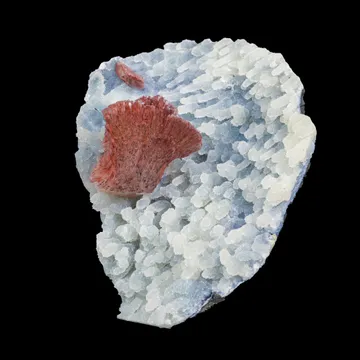
Jalgaon heulandite is commonly heulandite-Ca or heulandite-subgroup material, appearing as glossy tabular, wedge-shaped, fan-like, saddle-like, and stacked crystals in peach, salmon, orange-red, brownish, tan, and pale translucent colors. In the Savda paragenesis, heulandite appears both as an early small zeolite and as a later, larger zeolite generation, so it may underlie later stilbite and apophyllite or share space with them in the same vug. Fine Jalgaon heulandite has luster, color contrast, and form: raised blades or fans on basalt, quartz, chalcedony, or mordenite are far more desirable than dull crusts, and the most satisfying pieces show heulandite as a deliberate architectural element rather than a reddish background mineral mislabeled as stilbite.
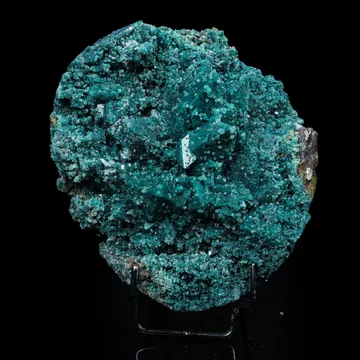
Chalcedony is one of Jalgaon’s great supporting actors and, in some specimens, the star: it coats basalt cavities as gray-white, blue-gray, greenish, cream, or flesh-colored botryoidal, stalactitic, mammillary, and drusy surfaces, commonly acting as the platform for stilbite, apophyllite, heulandite, calcite, quartz, and rarer zeolites. At Savda it records a major silica stage that overgrew earlier calcite, clay minerals, and early zeolite growth, which is why some specimens show chalcedony skins preserving the shape of earlier pocket architecture. Ordinary chalcedony is a plain lining; good Jalgaon chalcedony has sculptural vug curvature, clean sparkling druse, botryoidal or stalactitic relief, celadonite-influenced color where natural, and attractive later crystals rather than broken, chalky, or overcleaned surfaces.
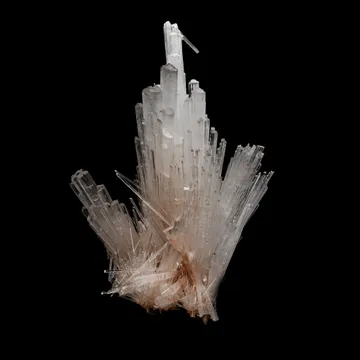
Scolecite from Jalgaon occurs as white to colorless, silky, acicular to prismatic sprays, tufts, and radiating bundles in basalt-cavity assemblages, commonly associated with stilbite, apophyllite, heulandite, quartz, chalcedony, and calcite. Although Maharashtra’s most famous scolecite reputation is often attached to other Deccan districts as well, Jalgaon material is well represented in specimen records and is particularly attractive when the sprays rise cleanly from peach stilbite or dark basalt rather than lying as a flattened felt. Fine pieces are judged by delicacy without damage: complete needles, radial symmetry, open spacing, and minimal bruising make the difference between a cabinet-worthy Jalgaon spray and a common white zeolite cluster.
Powellite is one of the most interesting Jalgaon accessories because it appears late in the Savda sequence with calcite III and before or with apophyllite, despite the host basalts being poor in molybdenum. The district’s powellite is typically seen as pale yellow, tan, honey, or colorless to yellowish tetragonal bipyramidal crystals, commonly small but locally reported to reach remarkable sizes for the species, and it may sit on stilbite or be nestled among apophyllite. Ordinary powellite is an easy-to-miss accessory; good Jalgaon powellite has distinct crystal form, luster, visible placement, and association with apophyllite or stilbite, and it is especially prized when a few sharp crystals are not overwhelmed by the surrounding zeolite matrix.
Mordenite from Jalgaon is part of the documented Savda zeolite sequence and is commonly represented by fibrous, felted, acicular, woolly, or spherical aggregates rather than large individual crystals. Mindat photo associations place it with stilbite-Ca, fluorapophyllite-(K), quartz, chalcedony, amethyst, calcite, heulandite, and celadonite, and scientific work at Savda records mordenite among the early zeolites and in silica-related stages. Good Jalgaon mordenite specimens are those in which the normally background fibrous mineral becomes sculptural—rounded balls, clean white sprays, or attractive coatings beneath later crystals—while ordinary pieces can be visually confused with other fibrous zeolites and deserve skepticism unless the label or analysis is credible.
Epistilbite is much less common than stilbite at Jalgaon and appears as colorless, white, pale pinkish, or orange-toned bladed crystals, rosettes, and radial aggregates, often on quartz or amethyst-drusy surfaces with apophyllite, heulandite, mordenite, calcite, mesolite, and stilbite in the broader Savda-area assemblage. The best documented collector pieces show epistilbite as a distinct glassy rosette or bladed accent in a basalt vug rather than as a generic pale zeolite crust. Fine examples are valued for crisp crystal form, placement, and correct identification, because small epistilbite groups can be overlooked, mislabeled as stilbite, or visually lost against the pale quartz-lined cavities in which they commonly occur.
“Zeolite” on a Jalgaon label is often a trade convenience rather than a precise species name, but the district’s real strength is exactly this zeolite assemblage: stilbite-Ca, heulandite-Ca, mordenite, scolecite, mesolite, epistilbite, stellerite, goosecreekite, thomsonite-Ca, chabazite, and clinoptilolite-subgroup material have all been recorded at the district level or in related Jalgaon sublocalities. In practical collecting terms, the word should prompt closer examination, because a specimen sold as “zeolite with apophyllite” may hide a more desirable species or may simply be unidentified. Good Jalgaon “zeolite” specimens have enough crystal habit to permit a confident identification, preserve a specific quarry or village label if possible, and show the natural Deccan cavity relationships among basalt, chalcedony, quartz, calcite, and later apophyllite.
Cavansite is not the everyday face of Jalgaon the way it is for certain Pune-area localities, but it is documented from the district and appears in the broader Deccan vanadium-mineral story as vivid blue radiating sprays, spherules, or bow-tie-like aggregates on zeolite-rich basalt-cavity matrix. Jalgaon pieces are scarce in comparison with the abundant apophyllite-stilbite-heulandite material, so a claimed specimen should be examined carefully for precise locality, crystal habit, and association; confusion with Pune or other Maharashtra sources is a real possibility when labels are vague. The best Jalgaon cavansite is unmistakably blue, well isolated, and aesthetically placed on stilbite, heulandite, mordenite, or quartz rather than appearing as tiny scattered color spots on a poorly documented matrix.
Fluorite from Jalgaon District is a minor but intriguing Deccan rarity, with Mindat records including the Jamner area and district-level specimens. Indian Deccan fluorites are famous for hemispheroidal, rounded, or aggregate forms that can be mistaken for other minerals, and the Jalgaon material belongs to that cautionary collecting world rather than to the classic cubic-fluorite aesthetic of vein deposits. Good Jalgaon fluorite depends on documentation and identification as much as beauty: small, lustrous, translucent to pale yellowish or colorless forms on quartz, calcite, or zeolite matrix are much more desirable when the label preserves the exact district or Jamner source and when the habit has not been confused with gyrolite, calcite, or chalcedony.
Stellerite is a less common Jalgaon zeolite that can be visually close to stilbite but is recorded from the district and from Savda. It appears as cream, white, colorless, or pale peach radial balls, pinwheels, spherical aggregates, and bladed clusters on basalt, quartz, chalcedony, or zeolite matrix, often with apophyllite, stilbite-like blades, heulandite, and celadonite-colored areas nearby. Fine Jalgaon stellerite is about form and separation: a clean sphere or pinwheel sitting proud in a vug is far more collectible than a nondescript pale crust, and careful identification matters because attractive stellerite can be passed over as ordinary stilbite while dubious labels can also upgrade common stilbite without proof.
Goosecreekite from Jalgaon is a specialized collector’s mineral, generally occurring as colorless to white, pearly to vitreous tabular, bladed, or spherical aggregates in zeolite-rich basalt cavities with heulandite, quartz, stilbite, and related species. It is important enough that Jalgaon-quarry material has been used in structural and dehydration studies alongside material from the type locality in Virginia, and Jalgaon crystals have been noted as commonly twinned in that work. Fine specimens are uncommon and are valued when the goosecreekite is a distinct ball, cluster, or set of clean crystals rather than an indistinct pale coating; because the mineral can be confused with epistilbite, stellerite, stilbite, or other pale zeolites, analytical or old, reliable labeling adds real value.
Okenite is a rare accessory in the Jalgaon context, more celebrated from some other Maharashtra localities but documented from Jalgaon District as part of the broader Deccan calcium-silicate and zeolite-related suite. It is expected as white, cottony, radiating, acicular, or spherical aggregates in basalt cavities, often in association with apophyllite, gyrolite, quartz, calcite, chalcedony, or zeolites when the association is genuine. Good Jalgaon okenite must be clean, spherical or sculptural, and protected from crushing; ordinary or doubtful pieces are easily confused with mordenite, mesolite, scolecite, or other fibrous white minerals, so a specific Jalgaon label and credible provenance matter more than they would for common stilbite.
Gyrolite from Jalgaon is a minor recorded species and should be treated as a locality rarity, especially because many of the finest Indian gyrolites in circulation come from other Deccan localities such as the Mumbai/Malad area. In Jalgaon material it is expected as pale cream to white spherical, platy, or rosette-like aggregates in basalt-cavity assemblages with okenite, apophyllite, quartz, calcite, and zeolite minerals. The best pieces have well-defined individual balls or rosettes, clean surfaces, and convincing association; vague “India” labels, woolly white masses, and pieces whose form fits mordenite, okenite, or mesolite better than gyrolite should be checked before paying a rarity premium.
Amethyst from Jalgaon is a quartz variety that usually appears as pale violet to lavender drusy coatings, crystal linings, or amethyst-tinted quartz on chalcedony-lined basalt cavities rather than as large isolated crystals. It may accompany mordenite, calcite, stilbite, heulandite, epistilbite, apophyllite, and other zeolites, and it is particularly attractive when the purple druse provides color contrast beneath pale zeolite sprays or glassy apophyllite. Fine Jalgaon amethyst is judged by even sparkle, natural pale color, clean vug surfaces, and association; ordinary pieces are small purple crusts, and overly vivid color on a Deccan basalt specimen should be questioned unless the origin and treatment history are clear.
Thomsonite from Jalgaon District is best treated as thomsonite-Ca or thomsonite-subgroup material unless an analysis is available, with records including Shendurni in the Jamner area. It occurs as small white, cream, peach, orange, or radiating acicular to fibrous aggregates in basalt cavities, and can be visually confused with scolecite, mesolite, natrolite-like sprays, or compact zeolite crusts. The most collectible Jalgaon thomsonite pieces are sharply radiating, colorful, and clearly separated from associated stilbite, heulandite, or basalt; because it is far less familiar in the market than the district’s apophyllite and stilbite, a reliable label, sublocality, or analytical history is especially valuable.
Other documented Jalgaon District minerals include fluorapophyllite-(K), heulandite-Ca, mesolite, chabazite, clinoptilolite-subgroup minerals, celadonite, aluminoceladonite, saponite, montmorillonite, goethite, hematite, ilmenite, leucoxene, plagioclase including anorthite and labradorite, pyroxene-group minerals, native iron from the Manegaon meteorite, and the rare julgoldite species Julgoldite-(Fe2+) and Julgoldite-(Fe3+). Mozartite is a useful cautionary name for collectors: it has appeared on some Jalgaon-related labels or sales, but Mindat flags the report as unproved, with no confirmed specimens. Jalgaon is not primarily a type-locality district in the way some ore camps are; its importance lies instead in exceptional development, variety, and preservation of Deccan basalt-cavity minerals.
The first authenticity issue is locality precision. A specimen labeled “Jalgaon” may be perfectly legitimate, but it may also be a shorthand for Maharashtra, an exporter’s label, or a best-guess assignment for a classic Indian apophyllite-stilbite piece. The Savda/Sawda quarry complex is the most important source behind many Jalgaon labels, but Jalgaon District also includes other recorded localities. Conversely, similar-looking specimens come from Nashik, Pune, Ahmednagar, Aurangabad/Chhatrapati Sambhajinagar, Mumbai-area quarries, and other Deccan Trap sites. Serious Jalgaon labels should be kept with the specimen, and old labels naming Savda, Sawade Pr Chandsar, Paldhi, Jamner, Shendurni, or Chalisgaon are worth preserving.
Repairs are not inherently disqualifying, but they are common. Indian zeolite specimens are often extracted from hard basalt by quarrying and trimming, and the crystals themselves can be fragile. Stilbite cleaves easily and bruises along bladed edges; apophyllite corners cleave or chip; calcite breaks along rhombohedral cleavage; scolecite, mordenite, okenite, and other fibrous minerals crush or mat; chalcedony stalactites and thin quartz crusts can break from vibration. On a fine piece, inspect high points under side light, look for glue along broken stilbite blades or apophyllite bases, and examine whether a crystal’s orientation makes geological sense in the vug.
Composite and enhanced specimens are a broader concern in the Indian zeolite trade. Perfect “floating” stacks, crystals apparently sitting on saw-cut pads, or groups with no logical attachment should be inspected carefully. Color is another warning area. Natural Jalgaon stilbite is usually cream, peach, salmon, tan, pale orange, or reddish-orange; apophyllite may be colorless to pale green and more rarely a stronger green; heulandite can be warm peach to reddish or brownish. Artificially intense red, hot orange, electric green, purple, or evenly saturated color that pools in cracks or broken edges should be treated with suspicion unless the specimen has strong provenance.
Misidentification is routine among the pale zeolites. Stilbite, stellerite, heulandite, epistilbite, goosecreekite, thomsonite, mesolite, scolecite, and mordenite can all be confused in hand specimens, especially when they occur as white or peach blades and sprays. “Zeolite” is acceptable for decorative material, but not enough for a serious species suite. Rarer names—goosecreekite, stellerite, thomsonite, gyrolite, okenite, cavansite, fluorite, and powellite—should command a premium only when the morphology, association, label history, or analysis supports the identification.
Fluorescence can be useful but should not be the sole basis for identification. Powellite is the obvious species to check under ultraviolet light and can fluoresce strongly; calcite may also fluoresce in some Deccan specimens. However, fluorescence varies and does not by itself prove locality or species. Handle all fibrous zeolites gently, avoid ultrasonic cleaning, avoid acids on calcite-bearing specimens, and keep okenite, mordenite, and scolecite away from dust, oils, and repeated touching. Many Jalgaon specimens look robust because they sit in basalt, but the actual display minerals are delicate.
Rarity is tiered. Common Jalgaon apophyllite-stilbite combinations remain widely available, from inexpensive miniatures to cabinet pieces. Fine examples are another matter: saturated green apophyllite with undamaged terminations, complete stilbite bow-ties in balanced vugs, large golden calcite on zeolite matrix, powellite with apophyllite, clean scolecite sprays, confirmed goosecreekite, stellerite, cavansite, fluorite, gyrolite, okenite, and thomsonite are much more selective. The best pieces are no longer just “Indian zeolites”; they are classic locality specimens from a quarry district whose finest pockets cannot be ordered on demand.
One of the most revealing scenes from Jalgaon is a quarry wall, not a show case. At Savda, researchers described a basalt flow exposed as a wall about 7 m high. The upper part of the flow held small vesicles, commonly only millimeters to a few centimeters across, packed with secondary minerals. The denser core line was different. There, irregular cavities several decimeters across—and locally up to about a meter wide—opened in the basalt. These were the cavities collectors dream about: open enough to preserve euhedral heulandite, stilbite, calcite, apophyllite, and chalcedony fabrics rather than just tight amygdales.
The shapes of those cavities were not uniform. Some had arched roofs. Some were round. Some had flat bottoms and upward-convex, skirted forms, as if neighboring gas bubbles had coalesced and then been frozen into basalt before later fluids arrived. Tunnels and breccia were not observed in the studied cavities, so the pocket shapes were not broken caves; they were primary volcanic voids later transformed by mineralization. That is why a Jalgaon specimen often looks like a complete little room: crystals may cover the ceiling, walls, and floor because the cavity was filled by fluid during growth, not just decorated by dripping solutions.
The Savda fieldwork also gave a date to the science. In February 2013, samples were collected from big, freshly opened cavities in the flow-core zone of the quarry complex. Those pieces allowed researchers to reconstruct the order of events: clay minerals and filamentous fabrics first; early calcite and tiny zeolites; chalcedony sealing over earlier minerals; later heulandite and stilbite growing larger; then still later calcite, powellite, and apophyllite. A collector holding a good Jalgaon combination is often holding that sequence in miniature.
The most unusual actors in that story are the green subsurface filamentous fabrics. In some Savda cavities, dark green filaments clung to walls, hung in gravity-controlled forms, and were embedded in chalcedony. The 2020 biosignature work treated these fabrics as more than decorative green inclusions; their morphology and chemistry were investigated as possible evidence of biogenic processes in the basalt-cavity environment. For collectors, those green threads and mossy fabrics help explain why some Jalgaon chalcedony and quartz-lined vugs have a living, landscape-like quality: they are not random stains but early cavity-wall structures preserved beneath later silica and zeolite growth.
A separate collector tale centers on Jalgaon calcite and the problem of beauty hidden under later mineral growth. One field-note account recalls a large yellow calcite from Jalgaon that had been sitting since 1997 because it was partly buried beneath a later quartz layer. Berthold Ottens had explained in a 2001 Rochester Mineralogical Symposium talk that Jalgaon quartz coatings could be only about 0.5 to 2 mm thick, and that—with skill and luck—such layers could sometimes be detached from calcite. The story is memorable because it captures the dilemma of Deccan specimens: the later quartz may be part of the geological story, but beneath it may be a spectacular earlier calcite that cannot be fully appreciated without careful preparation.
The same account notes that Jalgaon prismatic calcites could be overgrown by quartz and associated with stilbite and apophyllite, with crystals reported up to 1 foot, or about 30 cm, long. Whether left partly cloaked or expertly exposed, those calcites show why Jalgaon is not just an apophyllite-and-stilbite locality. Its pockets can preserve several different “best moments” of crystallization, and the collector’s challenge is deciding which moment the specimen shows most powerfully.
-Stilbite-Ca-Heulandite-Ca-226327.jpg)
-Epistilbite-Quartz-251141.jpg)
