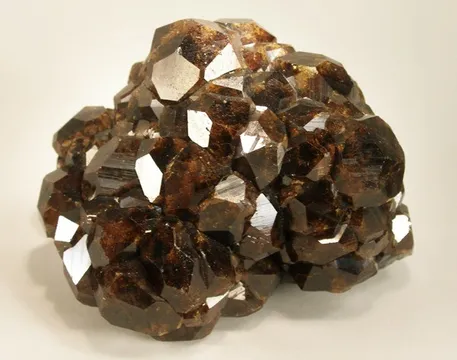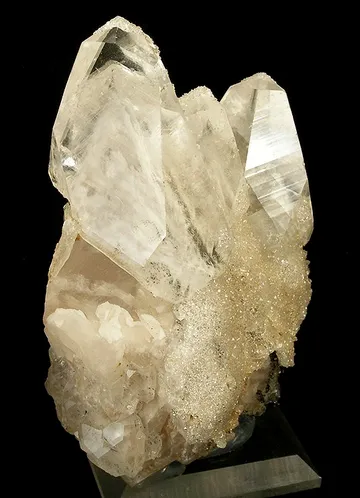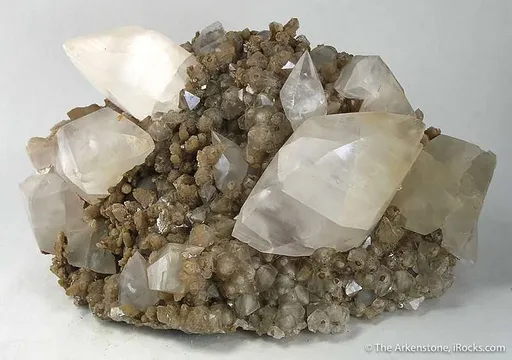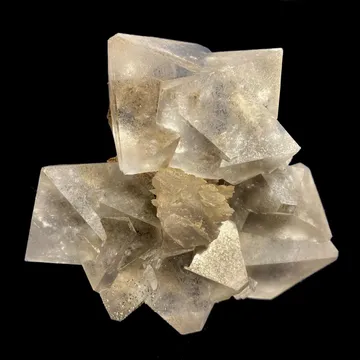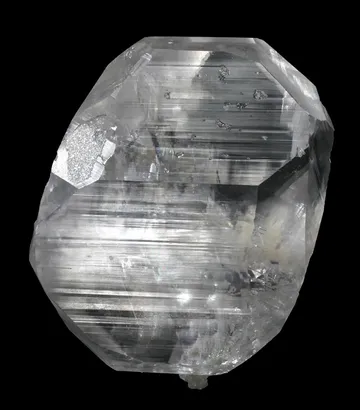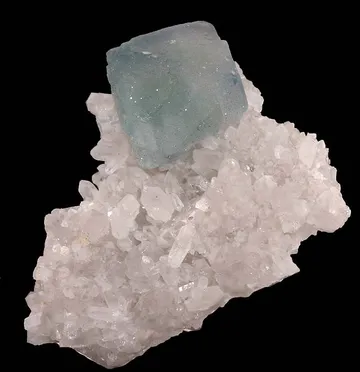
A collector's guide to 2nd Sovetskii Mine, Russia: its geology, mining history and notable minerals, illustrated with the 155 specimens documented from this locality on EarthWonders.
Key facts
The 2nd Sovetskii Mine is one of the essential Dalnegorsk names on a serious collector’s label: a working mine on the Partizanskoe Pb-Zn deposit, just outside the mining town of Dalnegorsk in Primorsky Krai, in the Russian Far East. Its significance is not a single spectacular species, but a complete skarn-polymetallic suite—calcite, quartz, sphalerite, galena, fluorite, ilvaite, chalcopyrite, pyrite, siderite, hematite, hedenbergite, and a silver-bismuth-sulfosalt micromineral world—formed where hydrothermal fluids worked through limestone blocks and mixed sedimentary rocks in the Sikhote-Alin margin. In hand specimen, the locality is immediately recognizable when it is at its best: colorless “invisible” fluorite on calcite and quartz; pale pink to colorless calcite plates and twins; red quartz from brief late-1990s finds; glossy black sphalerite and silver galena; and, more rarely, jet-black ilvaite perched among dipyramidal quartz on dark hedenbergite-rich matrix.
Regional View
Country View
The mine belongs to the Partizanskoe skarn system, a deposit built in a geologically complicated setting of olistostrome rocks: a silty terrigenous matrix carrying limestone, sandstone, siltstone, chert, and basaltic fragments. That geology matters to collectors because it explains why 2nd Sovetskii specimens can be so varied. The same deposit that produced lead-zinc ore also produced cavities, skarn zones, quartz-calcite bodies, late sulfosalt overprints, and open spaces where display-quality combinations grew. The best cabinet pieces are not merely “Dalnegorsk” in a generic sense; they carry a very specific 2nd Sovetskii look, especially when transparent fluorite, calcite, quartz, sphalerite, and galena are arranged in the crisp, high-contrast combinations that made the mine famous in post-Soviet mineral markets.
Search for specimens: View all specimens from 2nd Sovetskii Mine, Russia
The modern locality is best written as 2nd Sovetskii Mine, Partizanskoe Pb-Zn deposit, Dalnegorsk, Dalnegorsk Urban District, Primorsky Krai, Russia. Labels may also read Second Sovietsky, 2nd Sovietskiy, Vtoroi Sovietskiy, 2nd Sovietskii, or in Russian, Второй Советский рудник. Mindat places the mine at approximately 44.54817 N, 135.56421 E, only a few kilometers from Dalnegorsk, and the locality is tied to the Partizanskoe lead-zinc deposit rather than to the better-known Dalnegorsk boron skarn workings.
The deposit type is skarn-polymetallic, specifically a Zn-Pb skarn with silver, copper, cadmium, gold, bismuth, and related minor-metal enrichment in parts of the ore system. Dalpolimetall describes Partizanskoe as a skarn-type deposit whose mineralization follows contacts of displaced limestone plates lying within an olistostrome assemblage of mixed rocks including breccias, siltstones, and sandstones; volcanic rocks including tuffs, rhyolites, and andesites lie above the mixed sedimentary sequence. Published geological work places the deposit in the Dalnegorsk ore district of the Taukha terrane, a fragment of an Early Cretaceous accretionary prism in the Pacific ore belt. The host rocks include Lower Cretaceous sandstone, Triassic-Jurassic siltstone, and Middle to Upper Triassic limestone sheets, with some limestone sheets kilometers long and hundreds of meters thick.
The ore bodies are structurally controlled and occur as steeply dipping lodes, veins, lenses, and pipe-like bodies of skarn with sulfide mineralization. Scientific descriptions of the Partizanskoe deposit emphasize orebodies localized along contacts of a steep limestone olistolith with siltstone and sandstone, and in some cases at limestone contacts with overlying Late Cretaceous volcanic rocks. Underground workings have intersected orebodies at repeated intervals down to roughly 600 meters, with ore zones pinching out by about 800 meters. Dalpolimetall’s current description notes that many ore bodies dip steeply, commonly at 70–80 degrees toward the southeast, and tend to pass into pipe-like vertical ore columns with depth.
Mineralogically, the mine’s collector importance is tied to the same staged history that produced the ore. The earliest skarn-silicate assemblage includes hedenbergite, garnet, axinite, ilvaite, wollastonite, vesuvianite, fluorite, quartz, and calcite. That was followed by quartz-arsenopyrite mineralization, then the productive galena-sphalerite ore stage, and finally a pyrite-pyrrhotite-marcasite-chalcopyrite assemblage. A later silver-sulfosalt stage was superimposed on the upper parts of the system, separated from the main base-metal stage by basaltic dike emplacement and structural reworking. In collector terms, this is why a 2nd Sovetskii specimen can be a clean calcite-fluorite miniature, a dark sulfide-rich cabinet piece, a quartz-ilvaite skarn specimen, or a micromineralogically interesting ore specimen with silver and bismuth phases.
The mining history reaches back before the 2nd Sovetskii name. In 1912 the imperial mining department approved the Nininsky silver-lead mining allotment on the future area of the mine, though large-scale work did not begin then. In summer 1934, an ore body was discovered in the East Partizan area, and by winter 1936 the Upper adit had intersected rich ore. The Capital adit was started in 1948; by 1950 it had reached about 800 meters, and industrial development of Partizanskoe began around 1950–1951. Dalpolimetall sources record the 2nd Sovetskii Mine as having entered production in 1951 and later reaching a design capacity of about 300,000 tonnes of ore per year. A recent company retrospective states that since 1951 the mine has yielded about 15 million tonnes of ore and about 900,000 tonnes of lead and zinc.
Today the 2nd Sovetskii Mine is not an abandoned collecting locality in the casual field-collector sense. It is part of the operating structure of JSC MMC Dalpolimetall, whose production system includes the Nikolayevskiy and 2nd Sovetskii mines and several deposits in the Dalnegorsk and Kavalerovo areas. The company reports both open-pit and underground mining, a central processing plant, and selective flotation of lead and zinc concentrates, with silver, gold, and bismuth recovered into lead concentrate and cadmium and silver into zinc concentrate. Collecting access must therefore be treated as controlled industrial-mine access: specimens on the market are products of mining, old collections, mine contacts, and dealer networks, not of open recreational collecting.
The notable specimen finds are strongly episodic. The red quartz material from the late 1990s is one of the most distinctive: elongated, partly doubly terminated, crisscrossing crystals, often red from iron-oxide or hematite-related coloration and in some pieces partly coated by a later white quartz generation. Dealer records describe this find as brief and not repeated, which matches the rarity of convincing red quartz 2nd Sovetskii labels today. Fluorite finds include the colorless to faintly tinted “invisible” style, transparent cubes, cuboctahedra, and rounded aggregates of intergrown modified crystals, commonly with calcite, quartz, sphalerite, pyrite, and siderite. Calcite pockets have produced large pale pink and colorless crystals, including flattened “poker-chip” plates, twinned crystals, sharp hexagonal forms, and jackstraw groups. Ilvaite-quartz specimens, particularly mid-1990s material on hedenbergite-rich matrix, are far less common than calcite or fluorite but can be among the mine’s most dramatic skarn specimens.
Calcite from 2nd Sovetskii ranges from colorless, lustrous crystals to pale pink manganese-bearing calcite, and the best pieces are valued for form, transparency, and association rather than size alone. Documented habits include sharp hexagonal crystals to several centimeters, flattened plate or “poker-chip” crystals, twinned pale pink crystals on matrix, jackstraw clusters of doubly terminated transparent crystals, and calcite-rich matrix supporting fluorite, quartz, sphalerite, pyrite, hematite, and ilvaite. Cabinet specimens are well documented, including calcite-sphalerite combinations around 15 cm, manganese-bearing calcite in the 15–20 cm class, and older floater-like groups of lustrous colorless crystals. The most desirable pieces show undamaged edges, glassy to silky luster, clean pale color, and a compositionally balanced Dalnegorsk association—especially calcite with colorless fluorite, quartz, or dark sphalerite—while ordinary pieces tend to be massive, bruised, or visually crowded by dull sulfide matrix.
Quartz at 2nd Sovetskii is a collector species in its own right, not merely gangue: it occurs as glassy clear to translucent crystals, beta-style or Cumberland-like dipyramidal forms, slender elongated groups, greenish crystals included by hedenbergite or ilvaite, and the celebrated red quartz of about 1997–1998. The red quartz specimens are the signature pieces: elongated, commonly doubly terminated crystals in sculptural, crossing groups, sometimes on sphalerite matrix and sometimes overgrown in part by a second generation of white quartz. Other quartz combinations place dipyramidal crystals with ilvaite on dark hedenbergite-rich matrix, or clear quartz with sphalerite and fluorite. Miniatures and small cabinets are commonest, but large red-quartz groups and quartz-fluorite-sphalerite pieces reach cabinet size; the best examples show sharp terminations, an open sculptural arrangement, strong color or internal inclusions, and a documented mine-level label rather than a vague Dalnegorsk attribution.
Sphalerite from 2nd Sovetskii is the main zinc ore mineral and one of the great visual anchors of the locality’s specimens, typically appearing as black to deep red-brown, highly lustrous crystals, stepped or skeletal aggregates, and crystallized matrix beneath galena, calcite, fluorite, quartz, chalcopyrite, and pyrite. Geological work on the Partizanskoe deposit shows sphalerite is dominant in deeper root zones, locally forming pocket-like and massive aggregates in hedenbergite-, garnet-, and ilvaite-bearing skarn, while in collector specimens it is most prized when individual crystals are sharp, mirror-bright, complex, or stalactitic. A remarkable documented 2002 specimen was described as a slender healed “walking stick” of pseudo-octahedral stalactitic sphalerite crystals, only about 6.5 cm long, showing how unusual growth forms can elevate a small piece. Ordinary sphalerite here is abundant ore; top collector pieces have distinct crystal form, red internal flashes or black metallic luster, and crisp contrast with white calcite, clear fluorite, golden chalcopyrite, or silver galena.
Fluorite is one of 2nd Sovetskii’s most desirable display minerals, especially in the transparent to colorless “invisible” style for which Dalnegorsk is widely admired. The mine has produced cubes, cuboctahedra, modified cubes, octahedral-looking aggregates, rounded intergrowths of tightly grouped crystals, and crystals with internal phantoms or included quartz, commonly on calcite-quartz-sphalerite matrix. Documented specimens include small-cabinet fluorite with calcite and quartz, colorless cubes to about 1.4–2 cm, cabinet pieces with fluorite on crystallized sphalerite and calcite, and larger examples with individual cubes reported to several centimeters. The best pieces are water-clear enough to show internal included quartz or attractive dispersion, with undamaged cube corners and a matrix that makes the transparent crystals visible; weak pieces lose much of their appeal when bruised, dull, too colorless against a pale background, or confused by etched and rounded surfaces without strong crystal definition.
Galena from 2nd Sovetskii occurs as silver-gray cubes, cubo-octahedral crystals, skeletal-looking crystals, veinlets, and reticulate aggregates intergrown with sphalerite, calcite, chalcopyrite, quartz, fluorite, pyrite, and siderite. In the ore system, galena and sphalerite are the productive base-metal pair, with sphalerite beginning first and continuing together with galena in many zones; higher in the orebodies the lead/zinc ratio rises and galena becomes more important. Scientific studies also show that some deeper galena carries Ag and Bi enrichment or tight intergrowths with Ag-Pb-Bi sulfosalts, while upper-zone galena can be comparatively poor in those admixtures. For collectors, good 2nd Sovetskii galena means sharp, lustrous, damage-free cubes or cube groups, ideally contrasted by black to red-brown sphalerite, golden chalcopyrite, pale calcite, or quartz; ordinary pieces are heavy sulfide chunks with little crystal separation, rubbed cube edges, or ambiguous mine-level provenance.
Ilvaite from 2nd Sovetskii is a skarn mineral of much lower market availability than calcite, quartz, fluorite, sphalerite, or galena, and the best specimens are instantly appealing: jet-black, mirror-bright crystals with stepped prism faces and chisel-like terminations, most often on quartz and hedenbergite-rich matrix. The deposit geology places ilvaite in the skarn-silicate assemblage, particularly in lower skarn zones with hedenbergite, garnet, fluorite, quartz, and calcite, and collector specimens commonly pair ilvaite with dipyramidal quartz crystals, including quartz that is smoky-looking or greenish from inclusions. Mid-1990s discoveries produced some of the most impressive Dalnegorsk ilvaites, including repaired but striking matrix pieces with major crystals several centimeters long on dark hedenbergite coated with beta-style quartz. Fine 2nd Sovetskii ilvaite is judged by luster, termination quality, three-dimensional placement, and the absence of visually distracting repairs; damaged single crystals or crowded dark matrix pieces are far less compelling.
Chalcopyrite at 2nd Sovetskii is usually a partner mineral rather than the dominant showpiece, but it is an important part of the mine’s sulfide character. In the Partizanskoe ore sequence it appears both as minor chalcopyrite in the productive galena-sphalerite assemblage—commonly as fine emulsion-like inclusions or microveinlets in sphalerite—and as a major component of the later pyrite-pyrrhotite-marcasite-chalcopyrite assemblage and silver-sulfosalt overprint. Collector pieces show brassy to golden chalcopyrite on black sphalerite, with galena, calcite, and pyrite as frequent companions; the best examples use the color contrast beautifully, with sharp, bright crystals sprinkled over glossy sphalerite or associated with clean galena cubes. Because chalcopyrite is common in many Dalnegorsk sublocalities, mine-level provenance is especially important for 2nd Sovetskii specimens, and the most desirable pieces are those that show unmistakable skarn-polymetallic association rather than a generic “Dalnegorsk chalcopyrite” label.
Other documented minerals from the 2nd Sovetskii Mine and the broader Partizanskoe deposit include arsenopyrite, pyrite, pyrrhotite, marcasite, hematite, magnetite, hedenbergite, andradite-grossular garnet, axinite-group minerals, vesuvianite, wollastonite, fluorapophyllite-(K) or apophyllite-group minerals, siderite, aragonite, dolomite, pectolite, hisingerite, native bismuth, native silver, native gold, allargentum, acanthite, pyrargyrite, stephanite, luzonite, cosalite, matildite, hedleyite, joseite, heyrovskýite, wittite, and silver-bearing tetrahedrite/freibergite-group minerals. The most important rarities are not large display crystals but ore-microscope and analytical species tied to the Ag-Bi-Sb-Te-Ni-Co-As overprints of the Partizanskoe system. No verified source used for this guide identifies 2nd Sovetskii itself as the type locality for a valid mineral species, so the mine’s rarity profile is best understood as a combination of superb display minerals and a sophisticated micromineral assemblage rather than a type-locality fame.
The chief authenticity issue is locality precision. “Dalnegorsk” is a broad district label, and older specimens may be labelled Tetyukhe, Tetjuche, Tjetjuche, Primorskiy Kray, Far-Eastern Region, Kavalerovo mining district, Sovietsky Mine, or simply Russia. Some of those labels are historically meaningful, but they do not automatically prove 2nd Sovetskii origin. Serious collectors should favor specimens with old dealer labels, mine-level documentation, collection provenance, or a characteristic association matching the mine: red quartz from the late-1990s finds; colorless fluorite with calcite-quartz-sphalerite matrix; calcite on sphalerite; galena-sphalerite-chalcopyrite combinations; or ilvaite with beta-style quartz on dark hedenbergite-rich matrix.
No well-documented modern fake industry is specifically associated with 2nd Sovetskii in the verified sources used here, but mislabelling is a real concern because Dalnegorsk has several productive and visually overlapping sublocalities. Fluorite and calcite from Nikolaevskiy, Verkhnii, Bor Pit, 1st Sovetskii, and district-level Dalnegorsk material can be confused with 2nd Sovetskii pieces. The problem is not usually outright fabrication; it is insufficiently precise attribution after decades of mine production, export, relabelling, and collection dispersal.
Condition is critical. Fluorite corners, calcite edges, galena cube faces, and ilvaite terminations all bruise readily. Many 2nd Sovetskii cabinet pieces are heavy, irregular, and came from industrial mining rather than careful hand-collecting; minor contacts are common and should be evaluated in context. Ilvaite matrix specimens from major finds may be repaired, and reputable descriptions often state this openly. Red quartz should be checked for broken tips, reconstructed clusters, and later white quartz coatings that may hide contacts. Sphalerite and galena are dense sulfides, so seemingly small specimens can be heavy and vulnerable to edge abrasion in shipment.
Handling considerations are straightforward but important. Galena contains lead, and many ore specimens include fine sulfide intergrowths, so wash hands after handling, avoid making dust, and keep pieces away from children and food-preparation surfaces. Chalcopyrite, pyrite, marcasite, and pyrrhotite-bearing specimens should be stored dry and watched for oxidation; marcasite-rich material in particular can deteriorate under humid conditions. Fluorescence has been reported for some manganese-bearing calcite from the mine, including orange-pink responses in documented specimens, but fluorescence is not universal and should be considered a bonus rather than a primary proof of locality.
Market availability is moderate for calcite, quartz, fluorite, galena, and sphalerite, but truly fine 2nd Sovetskii pieces are much less common than the locality name may suggest. Ordinary miniatures and small cabinets appear periodically through dealers, auctions, and older collections. Red quartz, sharp colorless fluorite on attractive matrix, large clean pale pink manganese-bearing calcite, and high-quality ilvaite-quartz matrix pieces are significantly scarcer. The mine remains part of an operating industrial system, but great specimen pockets are episodic; many of the finest examples circulating today trace to finds from the 1990s, early 2000s, or older private collections.
In the company memory of Dalpolimetall, the birth of the 2nd Sovetskii Mine reads less like a neat engineering plan than a sequence of underground bets. The future mine ground had a formal paper life as early as 1912, when the imperial mining department approved the Nininsky silver-lead allotment, but Julius Brynner did not work it. The story resumed in the Soviet period: in 1936, miners drove the Upper adit into the East Partizan area and struck rich ore. In 1948, they began the Capital adit; by 1950 it had advanced roughly 800 meters, and the young mine was ready to become one of the long-lived producers of the Dalnegorsk district.
One of the most memorable recollections belongs to Viktor Dmitrievich Savvin, later a legendary director of Dalpolimetall, who began his working life at 2nd Sovetskii. Looking back to the late 1950s, he recalled a mine that was still crude and compressed: there was no modern administrative building, compressed air came from eight low-productivity mobile compressors, and in 1957 crews began driving the main haulage workings. The Capital adit, he remembered, had such a small section that a miner’s head almost touched the roof. Then the driving crew turned away from a fault and hit what he called “richest ore”—solid sphalerite and galena without impurities, grading above 30 percent. His laconic summary of the moment was miner’s understatement at its best: “There was much joy.”
The mine also has a machinery story that explains why 2nd Sovetskii was not merely a relic of hand drilling and timbering. In 1968, when Dalpolimetall was still operating under the Sikhali combine name, the 2nd Sovetskii Mine received one of the first load-haul-dump machines used in the Soviet Union. Decades later, the company placed an underground dump truck and a load-haul-dump machine on permanent display near its administration building in Dalnegorsk, explicitly presenting them as monuments to the technological line that had transformed underground mining in the district.
Even in the twenty-first century, the mine’s deeper levels continued to produce industrial milestones. In 2021, Dalpolimetall brought a Sandvik DL-321 production drill into service at 2nd Sovetskii, with the mine’s chief engineer Dmitry Lantsov stating that the machine was intended to drill 14,000 linear meters of holes and bring the Promezhutochnoe and Plastovoe ore bodies, as well as the Bolnichnaya ore lode, into production. In 2022, company news recorded the commissioning of chamber No. 3 of the Bolnichnaya ore lode, containing about 200,000 tonnes of mainly zinc ore. These are not mineral-show anecdotes, but they are exactly the kind of mine events that create specimen opportunities: new headings, new stopes, new cavities, and fresh ore faces in a deposit whose best pieces have always appeared unpredictably.
There is also a quieter collecting story in the red quartz. Dealer records describe the material as appearing between 1997 and 1998, with a habit so unlike ordinary Dalnegorsk quartz that it immediately stood out: red, elongated, intergrown crystals, many doubly terminated, arranged in sculptural groups and later dusted or partially coated by a second generation of white quartz. Collectors expected more; instead the style vanished almost as quickly as it appeared. That short-lived find is why convincing 2nd Sovetskii red quartz, especially large and undamaged cabinet material, still feels like a captured event rather than a routinely available product.
L. F. Simanenko, “Partizansky Base-Metal Skarn Deposit, Dal’negorsk Ore District, Russia: Stages of Ore Formation, Mineral Assemblages, and Typomorphism of Fahlore,” Geology of Ore Deposits, 48(4), 290–303, 2006. DOI: 10.1134/S1075701506040040. This is the key technical paper for the Partizanskoe deposit’s two-stage ore formation, vertical zoning, skarn-silicate assemblage, galena-sphalerite ore stage, and silver-sulfosalt overprint. PDF
L. F. Simanenko, “Modes of Trace Element Occurrence in Galena from the Partizansky Base Metal-Skarn Deposit, Primorye,” Russian Journal of Pacific Geology, 1(2), 144–152, 2007. DOI: 10.1134/S1819714007020042. Important for understanding Ag, Bi, and related trace-element behavior in Partizanskoe galena. Mindat reference page
Raymond W. Grant and Wendell E. Wilson, “Famous Mineral Localities: Dal’negorsk, Primorskiy Kray, Russia,” The Mineralogical Record, 32(1), 3–30, 2001. This is the major collector-oriented locality article for Dalnegorsk and is repeatedly cited in Mindat occurrence records for 2nd Sovetskii and other district sublocalities. Mindat reference entry
G. P. Vasilenko, “The Dalnegorsk Ore District,” in A. I. Khanchuk, G. A. Gonevchuk, and R. Seltmann, eds., Metallogeny of the Pacific Northwest (Russian Far East): Tectonics, Magmatism and Metallogeny of Active Continental Margins, IAGOD Guidebook Series 11, Dalnauka, Vladivostok, 2004, pp. 98–124. A regional metallogenic framework source for Dalnegorsk ore deposits. Mindat-cited regional reference context
L. F. Simanenko, V. V. Ratkin, V. A. Pakhomova, and O. A. Eliseeva, “Ni-Co Arsenides and Ag-Bi Tellurides in B-Pb-Zn Skarns of the Partizanskoe Deposit (Dalnegorsk Ore District, Sikhote-Alin, Russia),” Tikhookeanskaya Geologiya, 42(4), 61–75, 2023. DOI: 10.30911/0207-4028-2023-42-4-61-75. Documents rammelsbergite and hessite newly found at the deposit and places arsenide-telluride assemblages after the main skarn-sulfide stage. ResearchGate abstract
EarthWonders specimen record: Calcite on sphalerite, 15 cm, 2nd Sovetskii Mine, ex John Weir Collection, Jeff Scovil photo, published in Mineralogical Record “Mineral Collections in Australia,” p. 125. Specimen record
EarthWonders specimen record: Quartz with sphalerite on fluorite, 9.7 cm, 2nd Sovietsky Mine, published in Mineralogical Record “Mineral Collections in American Northeast,” p. 232. Specimen record
Amur regional museum exhibition note, 2022: records a collection of roughly fifty rare mineral specimens from Primorsky Krai, collected in 1988–1993 at the 2nd Sovetskii and Nikolayevskiy mines near Dalnegorsk; the note also states that 2nd Sovetskii entered operation in 1951, works the Partizanskoe deposit, and has a design capacity of 300,000 tonnes of ore per year. Amur.Life article
Mindat: 2nd Sovetskii Mine, Partizanskoe Pb-Zn deposit — Core mine-level locality page with coordinates, alternate names, photo gallery, and species links.
Mindat: Partizanskoe Pb-Zn deposit — Deposit-level page identifying Partizanskoe as a skarn base-metal and silver deposit and naming the Second Contact and Bolnichnaya ore bodies.
Simanenko 2006, Partizansky Base-Metal Skarn Deposit — The most useful technical paper for ore stages, mineral assemblages, zoning, and fahlore chemistry.
Dalpolimetall: Raw-material base and production — Company source for current deposits, Partizanskoe geology, and the role of the 2nd Sovetskii Mine.
Dalpolimetall: Production — Company overview of the active mining and processing system, including the 2nd Sovetskii and Nikolayevskiy mines.
Dalpolimetall: History — Company history from the late nineteenth-century Brynner period through processing-plant modernization and present operations.
Dalpolimetall: “Памятник труду” — Company article on underground mining machinery and the 1968 introduction of load-haul-dump equipment at 2nd Sovetskii.
Dalpolimetall: “Вклад в подготовку” — Company news item on the Sandvik DL-321 drill and development of the Promezhutochnoe, Plastovoe, and Bolnichnaya ore bodies.
Fabre Minerals: 2nd Sovetskii red quartz dealer records — Useful archived descriptions of the brief late-1990s red quartz find.
MineralAuctions: Ilvaite on quartz, ex Richard A. Kosnar Collection — Detailed market record for a major mid-1990s style 2nd Sovetskii ilvaite-quartz matrix specimen.
MineralAuctions: Fluorite with calcite and quartz — Good description of colorless “invisible” 2nd Sovetskii fluorite on calcite-quartz matrix.
MineralAuctions: Fluorite, calcite, and sphalerite, Maslansky Collection — A representative cabinet fluorite-calcite-sphalerite combination, probably post-2005 production.
Quebul Fine Minerals: Skeletal sphalerite, chalcopyrite, pyrite — Useful dealer reference for skeletal black sphalerite with chalcopyrite from 2nd Sovetskii.
M&W Minerals: Russian minerals gallery — Dealer archive showing 2nd Sovetskii red quartz, sphalerite, fluorite, and galena-sphalerite-chalcopyrite examples.
Wikimedia Commons: Galena-Sphalerite from 2nd Sovietskii Mine — Public image file for a galena-sphalerite specimen from the mine.