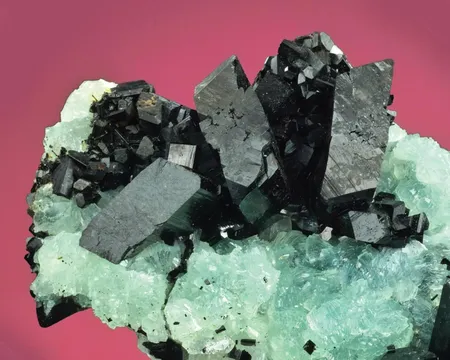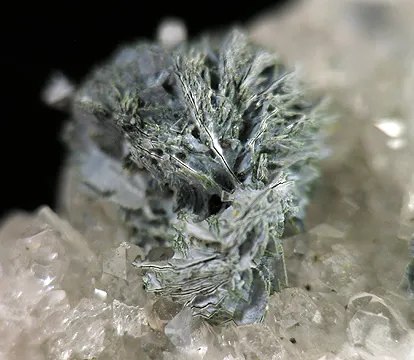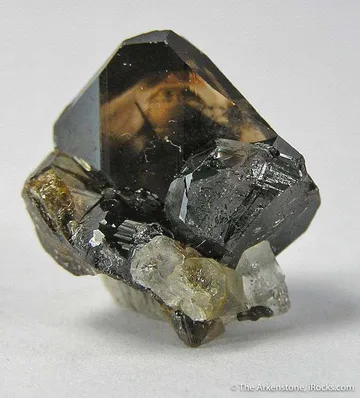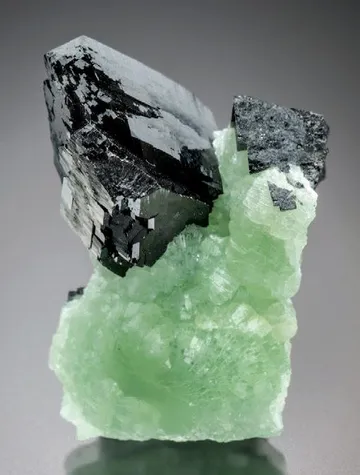
Babingtonite from Zhaotong is best understood as the Qiaojia County material: sharp, black, iron-rich silicate crystals set dramatically on pale green prehnite and, in many specimens, sparkling quartz. The finest examples are immediately recognizable. They have the graphic contrast collectors want in a display specimen—black, lustrous, striated babingtonite crystals rising from mint-green to pastel prehnite, sometimes with colorless quartz adding a bright architectural base.
Key facts
Babingtonite from Zhaotong is best understood as the Qiaojia County material: sharp, black, iron-rich silicate crystals set dramatically on pale green prehnite and, in many specimens, sparkling quartz. The finest examples are immediately recognizable. They have the graphic contrast collectors want in a display specimen—black, lustrous, striated babingtonite crystals rising from mint-green to pastel prehnite, sometimes with colorless quartz adding a bright architectural base.
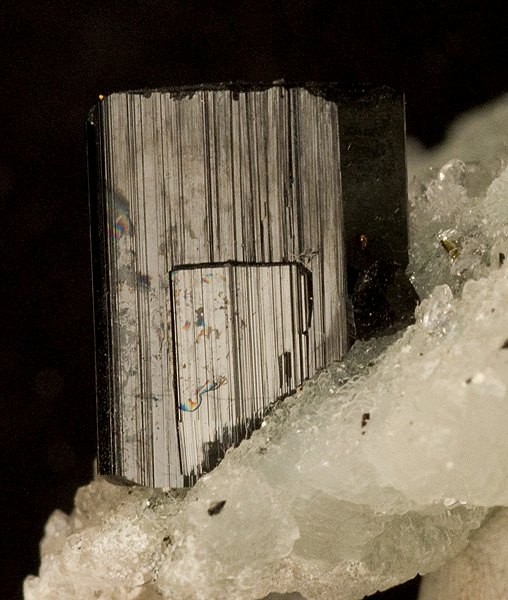
Photo: Wikimedia Commons
Mineralogically, these specimens are products of cavities in the Emeishan flood basalts of northeastern Yunnan and adjacent Sichuan. That setting matters. Babingtonite is not occurring here as a minor accessory lost in massive rock; it is a vug mineral, grown into open space with prehnite, quartz, calcite, and minor epidote. The best pieces preserve the cavity architecture: a plate or shell of prehnite and quartz, then black babingtonite perched along ridges, crests, or pocket walls where it could form crisp faces and terminations.
The locality’s historical importance is that it changed collector expectations for the species. Babingtonite had long been admired from classic traprock and basalt localities, but the Qiaojia finds brought larger, more sculptural, more contrasty specimens into the international market. Dealer and auction descriptions from the first major circulation of the material repeatedly emphasize the same qualities: unusually large crystals for the species, excellent sharpness, doubly terminated forms, and a striking prehnite-quartz association.
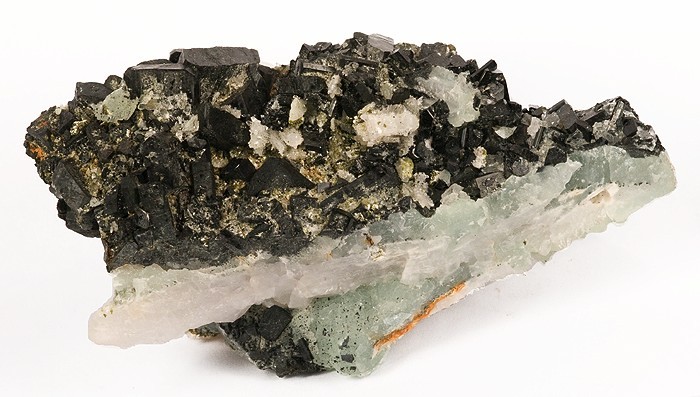
Photo: Wikimedia Commons
Collectors look first for intact terminations, strong luster, and clean contrast. The most desirable crystals are sharply defined, glossy to submetallic black, visibly striated, and either freestanding or well composed on pale prehnite. Matrix is not incidental here: a fine Qiaojia babingtonite without its green prehnite stage loses much of the locality’s charm. The strongest examples have rhythm—black crystals stepping across a pale vug surface, with enough open space to let each crystal read individually.
Search for specimens: View all babingtonite specimens from Zhaotong, Yunnan, China
The collector locality is a group of occurrences in Qiaojia County, Zhaotong, Yunnan, rather than a single named mine. The productive ground lies in basaltic rocks of the Emeishan flood-basalt province, a vast Permian volcanic province exposed across southwestern China. Within the Qiaojia area, the collectible minerals occur in open cavities and large vugs in the basalt. Those openings were later mineralized by calcium-, silica-, and iron-bearing fluids that deposited prehnite, quartz, babingtonite, calcite, and minor epidote.
The geographic setting is part of the upper Yangtze system, locally the Jinsha River reach, where steep basalt country and river-cut exposures helped reveal the vuggy zones. The important collector material is reported from a productive belt extending for many kilometers along the river in Qiaojia County, with comparable babingtonite-bearing occurrences continuing into neighboring Sichuan. This is why older labels may vary in precision: some say simply “Qiaojia, Yunnan,” some “Zhaotong Prefecture,” and some “Babingtonite occurrences, Qiaojia County.”
The locality is not known to collectors as a large commercial ore mine. The workings associated with the specimen finds are small excavations, many made by mineral collectors. That distinction is important for provenance: a good label should not invent a formal mine name where none is documented. “Babingtonite occurrences, Qiaojia County, Zhaotong, Yunnan, China” is the most defensible modern locality wording.
The production history appears in pulses. Important material was circulating internationally by 2005, when some specimens were offered under the name manganbabingtonite before analysis and X-ray diffraction supported babingtonite. Further strong production and market circulation followed around 2008–2010, when specimens appeared in European dealer stock, auctions, and mineral periodicals. Later examples have continued to appear sporadically, including documented 2023 material, but the best early pieces are now treated as modern classics and are not abundant on the market.
Notable finds include cabinet plates with babingtonite crystals around 2 cm, individual crystals above 2 cm, and exceptional specimens reporting crystals several centimeters across. One contemporary dealer listing describes a 12.5 x 9.5 x 6.3 cm specimen with a main babingtonite crystal measuring 4 x 3.2 x 1.5 cm on blue-green prehnite and quartz; another documented 2023 specimen measures 16.7 x 12.8 x 4 cm with a 2.2 x 1.3 cm main crystal.
The classic Zhaotong habit is thick tabular to prismatic babingtonite, often black to very deep green-black, with bright faces and strong longitudinal striations. Many crystals are flattened, wedge-like, or blocky, and doubly terminated crystals are a recurring feature of the better material. In hand specimens the crystals typically appear opaque black, but fine edges may show a greenish cast under strong light.
Size is one of the locality’s great strengths. Ordinary good specimens may carry crystals in the 5 mm to 15 mm range; strong cabinet pieces commonly show crystals around 1.5 to 2.5 cm; exceptional crystals can reach several centimeters. Reported top examples include main crystals around 4 cm, and locality summaries for the broader Chinese occurrences describe large crystals up to about 5.5 cm. For a species that commonly occurs as small dark crystals, that scale is a major reason Qiaojia material commands attention.
The matrix is usually prehnite, quartz, or both. Prehnite forms pale green, mint, water-green, botryoidal, spherical, stalactitic, or sparkling aggregate surfaces. Quartz may occur as clear to milky drusy crystals, layered plates, or larger transparent crystals beneath or beside the babingtonite. Calcite is a known associated mineral, and epidote occurs as olive-green microcrystals. Analcime has also been reported in specimen descriptions, particularly as small white trapezohedral crystals in complex babingtonite-prehnite-quartz pieces.
The best Zhaotong specimens balance mineralogical quality and composition. A single large crystal is valuable if it is complete, lustrous, and well terminated, but a more modest crystal group can be more desirable if it sits elegantly on prehnite and quartz. Collectors tend to prize the following features:
Condition is especially important because babingtonite has perfect cleavage in one direction and good cleavage in others. Large flat crystals can be cleaved, contacted, or edge-bruised; some otherwise excellent plates show terminated fronts but contacted backs or pocket-contacted crystal ends. Those are not automatically disqualifying—vug minerals often grew against pocket walls—but disclosure matters.
Authenticity questions for this locality center less on artificial treatment and more on correct species identification. Early material from the 2005 wave was sometimes offered as manganbabingtonite. Subsequent dealer testing, including X-ray diffraction, supported babingtonite for analyzed examples, and the manganbabingtonite rumor is not supported by the available locality record. Mindat also notes that similar babingtonites from basalt outcrops in neighboring Sichuan showed only minor manganese contents, on the order of 2–3% MnO, rather than supporting a manganese-dominant species identity.
No well-documented treatment or fabrication problem appears to be specific to Qiaojia babingtonite. The normal collector cautions still apply: inspect for repaired major crystals, glued prehnite fragments, oiled-looking surfaces, and matrix trimming that disguises damage. Because black babingtonite can hide bruises in photographs, strong side lighting is useful; cleaved or abraded terminations often show duller patches or planar interruptions against otherwise lustrous faces.
Common condition issues include chipped terminations, contacted crystal backs, edge wear on tabular crystals, and fragile prehnite crusts. Quartz points on the matrix may also be chipped. A pristine thumbnail or miniature with one sharp, floating, doubly terminated crystal can be more collectible than a larger cabinet specimen with multiple repaired or contacted crystals.
Rarity is quality-dependent. Small to mid-grade Qiaojia specimens appear with some regularity in auctions and dealer inventories, but the best early examples—sharp, large, undamaged babingtonite on elegant prehnite-quartz matrix—are increasingly difficult to replace. Public auction records and dealer listings show strong demand from species collectors, Chinese-locality specialists, and aesthetic collectors alike. Recent market data include cabinet specimens selling in the hundreds to low thousands of dollars, with exceptional large display pieces priced higher.
When the first important Qiaojia specimens reached the European market in 2005, they did not arrive with the quiet confidence of an already-understood classic. Some were offered as manganbabingtonite, a plausible-sounding identification given babingtonite’s chemical relationship to manganese-bearing analogs. Fabre Minerals recorded the episode plainly: at Munich 2005, Chinese samples were offered under that name, but the identification raised doubts. The response was not to repeat the label but to test it. Simple analysis and X-ray diffraction were carried out, and the conclusion was unambiguous: the specimens were babingtonite.
That small identification drama matters because it shaped how serious collectors viewed the find. Once the name was settled, the material’s importance became obvious. The specimens were not just chemically interesting; they were visually superior. Fabre described them as exceptional for size, association with prehnite and quartz, and overall aesthetics. One specimen from that 2005 generation, later documented as published in Lapis in June 2008, carried a larger doubly terminated crystal standing out from a crowd of smaller babingtonites on prehnite.
The 2008–2009 market wave gave collectors a clearer picture of the locality’s range. Auction and dealer descriptions from that period read like variations on a theme: jet-black lustrous crystals, botryoidal prehnite, quartz, pristine crystal fronts, and doubly terminated forms. One January 2010 auction specimen, a 12.9 x 9.3 x 3.5 cm cabinet plate from 2008–2009 finds, was described as having two generations of babingtonite: first-generation jet-black crystals to 1.8 cm, followed by microcrystals scattered over babingtonite, prehnite, and quartz. That kind of paragenetic detail is exactly what makes the locality rewarding under magnification.
The locality has continued to surprise collectors. A Fabre Minerals video specimen from an April 2023 find measured 16.7 x 12.8 x 4 cm and carried prismatic, flattened, very lustrous babingtonite crystals, many doubly terminated, on light green botryoidal prehnite and quartz. That single documented piece complicates the simple story that the locality is purely exhausted: production is better described as sporadic, with the finest early material scarce, but later pockets still capable of producing important specimens.