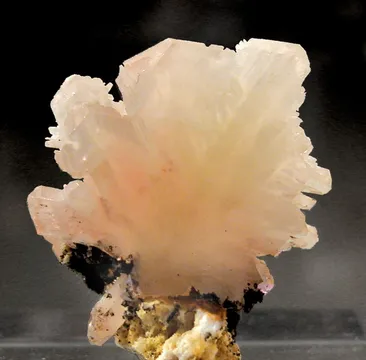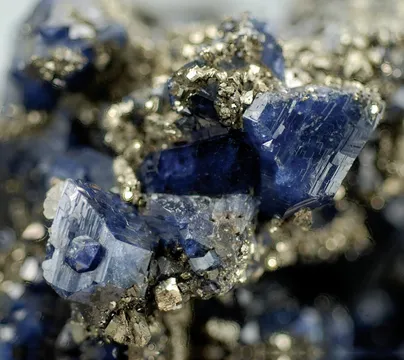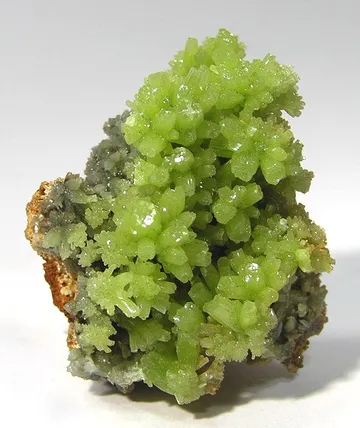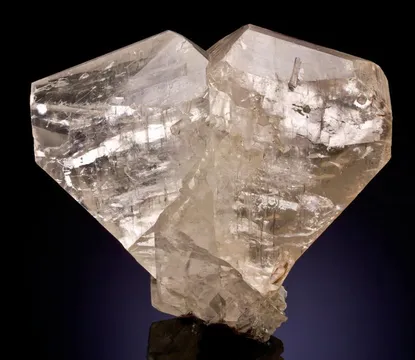
Yangshuo Mine, China — renowned for vivid pyromorphite hues and blue plumbogummite films, a significant Guangxi locality prized by serious collectors.
Key facts
Yangshuo Mine is one of the key names in the modern Chinese lead-mineral boom: a hydrothermal lead-zinc deposit in northeastern Yangshuo County, Guilin, Guangxi, tied underground and historically in the specimen trade to the neighboring Daoping workings across the county boundary. Its collector reputation rests on secondary minerals formed in the oxidized lead zone, especially yellow-green to apple-green pyromorphite on quartz-rich and iron-stained matrix, and the famous blue plumbogummite-coated or pseudomorphed material long sold under Yangshuo and Daoping labels. The best specimens have a saturated, almost tropical color contrast: lime or yellow pyromorphite barrels and hoppered hexagonal crystals, powder-blue to turquoise plumbogummite films and botryoids, white to glassy quartz, and dark gossanous matrix that makes the phosphates glow.
Regional View
Country View
The locality’s importance is also partly historical: Yangshuo and Daoping brought Guangxi pyromorphite to the front rank of world localities around the turn of the millennium, and later label research turned the district into a cautionary case study in Chinese mineral provenance. The same names—Yangshuo, Daoping, Laohu, Laohuan, “near Guilin,” and “Guilin area”—have appeared on labels for specimens that are visually similar but not always from the same exact workings. For serious collectors, Yangshuo is therefore both a source of superb lead-phosphate aesthetics and a locality where a good label, old invoice, analysis, or publication pedigree matters.

Photo: Wikimedia Commons
Search for specimens: View all specimens from Yangshuo Mine, China
Yangshuo Mine is a hydrothermal Pb-Zn deposit hosted in Devonian Wuzhishan Formation limestone, sandstone, and shale. The district lithologies are locally intruded by granite and lamprophyre dikes, and the ore system straddles the boundary between Yangshuo County and Gongcheng County. In specimen terms, “Yangshuo” and “Daoping” are not cleanly separable after a certain point: the mines exploit the same broader mineralized system, and their underground workings have been reported as interconnected since 2003. That connection explains why later specimens, especially pyromorphites, can be honestly but imprecisely labelled from the Yangshuo-Daoping mine complex rather than from a single isolated adit.
The primary ore minerals are galena and sphalerite, with quartz, baryte, calcite, dolomite, hematite, chalcopyrite, and other gangue or accessory minerals documented from the locality. Collector minerals formed mainly through supergene alteration of the lead-zinc ore: galena supplied lead, oxidizing conditions mobilized phosphate, arsenate, carbonate, and silica, and open fractures and vugs in the host rocks allowed pyromorphite, cerussite, mimetite, plumbogummite coatings, and related secondary species to crystallize. Quartz is more than background here; many desirable pieces rely on a pale quartz framework that holds sprays or clusters of pyromorphite and gives the blue plumbogummite material its sharpest color contrast.
Industrial mining in the Yangshuo Pb-Zn district goes back to the 1950s. A small flotation plant was established near the pit head in 1958, and environmental studies of the Sidi River watershed record a storm-related tailings-dam failure in the 1970s and an abandoned tailings pond dating to 1996. A later corporate filing identifies Yangshuo County Xing Yuan Lead-Zinc Mine Co. Ltd. as a company connected with Yangshuo lead-zinc mining business activity, while the specimen literature focuses less on formal operators and more on local miners, dealers, and the practical geography of the Yangshuo-Daoping workings.
The specimen story begins with pyromorphite. Material from the Guangxi mines entered the international market in the late 1990s and early 2000s and immediately changed collector expectations for Chinese pyromorphite: lustrous green crystals, often barrel-shaped or hexagonal, on vuggy quartz or pale carbonate-bearing matrix. Older reports distinguish yellowish to light green Yangshuo material from darker, more saturated Daoping material, but that distinction is not always reliable because of the shared orebody and connected workings. The best early Yangshuo-Daoping pieces show freestanding, doubly terminated, or hoppered crystals, good transparency, strong luster, and limited bruising on the terminations.
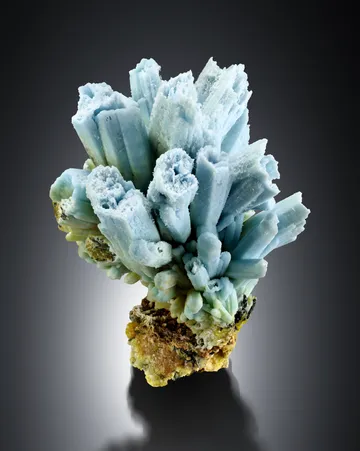
The blue plumbogummite story is more complicated. Many specimens sold for years as Yangshuo or Daoping plumbogummite—especially blue coatings, botryoidal crusts, and pseudomorphs after pyromorphite or mimetite—have since been reassessed in the collector literature and on Mindat as coming from the Laohu/Laohuan area rather than from Yangshuo proper. For EarthWonders and the specimen trade, the Yangshuo label remains historically meaningful because many pieces entered collections that way; for scientific locality accuracy, the collector should treat blue plumbogummite-bearing “Yangshuo” labels as provisional unless supported by unusually strong provenance.
Collecting access today should be regarded as closed to casual field collecting. The mine is an industrial and environmentally sensitive Pb-Zn district, not a public collecting site, and recent academic work in the area deals with heavy-metal pollution, tailings restoration, and watershed impacts rather than hobby collecting. Most specimens available to collectors come through old collections, dealer inventories, auction dispersals, and occasional modern Chinese-market parcels. Labels, not field access, are the practical collecting frontier.
Plumbogummite under the Yangshuo name is prized for pale sky-blue to deeper turquoise-blue coatings, hemispherical botryoids, and pseudomorphic or perimorphic shells preserving the hexagonal shape of pyromorphite or, more rarely, mimetite; specimen sizes range from thumbnails with one or two coated crystals to large cabinet pieces over 10 cm, including published examples with quartz matrix and pieces showing yellow-green pyromorphite remnants at crystal tips. The crucial locality issue is that much of the celebrated material historically sold as Yangshuo or Daoping has been reassigned by specialists to the Laohu/Laohuan workings, so the best “Yangshuo” plumbogummites are best understood as classic Guangxi trade-locality specimens unless their exact source is independently documented. Good pieces have intact pseudomorph shapes, even blue coverage, visible crystal architecture rather than amorphous crust, strong contrast with pyromorphite or quartz, and minimal edge bruising on the fragile coated terminations.
Pyromorphite is the legitimate heart of Yangshuo’s collector fame: crystals occur as yellow-green to lime-green and apple-green hexagonal prisms, barrels, hoppered crystals, acicular sprays, and dense sparkling druses on quartz, carbonate, limonitic matrix, and locally with cerussite, galena, mimetite, or blue plumbogummite coatings. Yangshuo material is often described as lighter and more yellowish than classic darker Daoping material, though post-2003 pieces from the connected workings may be better called Yangshuo-Daoping. Miniatures and small cabinet plates with crystals around 5 mm are common enough in the market, while top examples show larger, bright, translucent crystals approaching the centimeter scale or more, freestanding tips, wet luster, and balanced coverage without the crushed or abraded terminations that plague many pocket-cleaned specimens.
Quartz from Yangshuo is usually important as matrix and architecture rather than as the headline species: white, milky, or glassy quartz crystals and drusy quartz vugs provide the scaffold on which pyromorphite grew and the pale contrast that makes blue plumbogummite coatings look so vivid. The best quartz-associated pieces are not simply “quartz with a dusting” but well-composed combinations where a sharp quartz point or vug is partly wrapped by botryoidal plumbogummite or spotted with bright pyromorphite; small cabinet examples around 4–7 cm are especially appealing when the quartz is clean, lustrous, undamaged, and not overwhelmed by iron oxide or broken matrix. In the Yangshuo-Daoping context, quartz also helps separate some specimen styles: drusy quartz-lined cavities with yellow-green pyromorphite have a very different visual character from solid masses of coated phosphate.
Mimetite is a minor but intriguing Yangshuo-associated species because of its position in the pyromorphite-mimetite solid-solution series and its role in some blue plumbogummite pseudomorph labels; published and photographed specimens include yellow mimetite or pyromorphite-mimetite material partly coated or replaced by plumbogummite, sometimes forming slender “finger” structures and light, hollow-feeling pseudomorphs. Fine examples are uncommon compared with ordinary pyromorphite: collectors should look for obvious yellow arsenate-rich cores or remnants, sharp inherited hexagonal form, clear association with plumbogummite or pyromorphite, and old labels or publication history, because visually similar yellow-green apatite-group crystals from the Yangshuo-Daoping-Laohuan district can be difficult to separate without analysis.
Other documented minerals from Yangshuo Mine include baryte, calcite, cerussite, chalcopyrite, chrysocolla, descloizite, dolomite, galena, hematite, malachite, sphalerite, and willemite. No verified type-locality mineral is established for Yangshuo itself in the standard locality records consulted; the notable rarities here are instead secondary species and uncommon associations from the oxidized Pb-Zn system, especially willemite and descloizite as locality-list species, and cerussite or galena when found in attractive association with pyromorphite.
The major authenticity concern for Yangshuo is not a well-documented wave of manufactured fakes; it is locality accuracy. Blue plumbogummite specimens labelled Yangshuo or Daoping should be handled as a special case. Modern literature and Mindat commentary have shifted much of that material to the Laohu/Laohuan source, while many old labels and dealer archives still say Yangshuo. A collector-grade label should therefore preserve the historical name but also note the reassessment where appropriate: “Yangshuo label; likely Laohuan/Laohu area according to Ottens/Mineralogical Record reassessment” is often more honest than silently replacing or ignoring the old provenance.
For pyromorphite, the Yangshuo-Daoping distinction is genuinely difficult because the workings are connected and because material was moved through the same regional dealer network. “Yangshuo-Daoping mine complex” is a disciplined label for later or uncertain pieces. Older labels reading only “Guilin,” “Yangshuo,” “Daoping,” “Tangping,” or “Gongcheng” are not automatically wrong, but they should be evaluated against specimen style, date, and provenance.
Condition matters enormously. Pyromorphite has good luster but exposed hexagonal terminations bruise readily; check crystal tips under magnification, especially on protruding barrels and sprays. Plumbogummite coatings can conceal older damage or soften crystal outlines, and pseudomorphs may have thin walls, rough contacts, or missing terminations where the original pyromorphite was only partly replaced. Blue botryoidal plumbogummite on quartz can look pristine at first glance while hiding rubs on the highest domes. Mimetite and pyromorphite-mimetite pieces deserve the same scrutiny, with additional caution around hollow or lightweight pseudomorphs.
Fluorescence can be useful but should not be overinterpreted. Fluorescent Mineral Society records document green fluorescence from plumbogummite under UV, best under midwave in one large Yangshuo-labelled specimen, with orange responses from residual unaltered pyromorphite. That response can make a specimen more interesting, but fluorescence is not a substitute for chemical identification or exact locality proof.
Handling is straightforward but should be respectful: pyromorphite, mimetite, galena, cerussite, and plumbogummite are lead-bearing minerals, and mimetite also contains arsenic. They are safe as display specimens when left intact and handled normally, but do not cut, grind, soak, acid-clean, or ultrasonic-clean them; wash hands after handling and keep dust away from children, pets, and food areas. Avoid prolonged high humidity for mixed matrix pieces and avoid aggressive cleaning because many specimens owe their value to delicate coatings and fragile vug architecture.
Market availability remains active but uneven. Ordinary Yangshuo-Daoping pyromorphite is still obtainable, while large, saturated, undamaged, old-find pyromorphites with strong luster are much scarcer and command major premiums. Plumbogummite-bearing pieces are plentiful enough to appear in dealer stock and online auctions, but the finest examples—large, sharply pseudomorphic, richly blue, and well documented—are already treated as modern Chinese classics. Buyers should pay for condition, aesthetics, and provenance, not just the word “Yangshuo” on a label.
The most memorable Yangshuo story is a story of names moving under the feet of the specimens. In the early years, a collector could buy a blue plumbogummite-coated pyromorphite as Yangshuo, Daoping, or simply “near Guilin,” and all three labels might have felt plausible because the mines and the dealer routes were so tightly entangled. Then the debate sharpened. In 2015, Vik Vanrusselt opened a Mindat discussion pointing to Berthold Ottens’ 2014 Lapis article and arguing that Chinese plumbogummites then on the open market—often on white quartz, on yellow pyromorphite, or as pseudomorphs—came not from Yangshuo or Daoping at all but from an unnamed baryte mine on Laohu Hill. Other experienced collectors pushed back, noting the older literature and dealer testimony. Knut Edvard Larsen, after reading the Ottens article, confirmed that Ottens had compared older “Daoping” material with newer 2012–2013 finds and with information gathered during locality visits and from local dealers, especially a Mr. Zhou. The debate did not end instantly, but it changed how serious collectors label these specimens.
The 2022 Mineralogical Record treatment of Laohuan gave the story its sharper geography. The source of the famous sky-blue plumbogummite pseudomorphs was described as artisanal workings on the slope of Laohuan, “Old Tiger Hill,” at Haiyang Mountain east of Guilin City, nearly 40 km north of the famous Yangshuo-Daoping pyromorphite occurrences. That distance is large enough to matter on a label and small enough to explain how the confusion persisted within the Guilin trade. The irony is that the mislabelled plumbogummites became classics before their correct locality did. For many collectors, “Yangshuo plumbogummite” is now both a visual category and a historical label problem.
There is also a quieter economic story behind the specimens. Laohuan was originally worked for lead, zinc, silver, and baryte, but the ore was low grade; once miners realized that specimen-quality pyromorphite and plumbogummite could bring better money than ore, crystal mining became its own activity. The same pattern helps explain Yangshuo-Daoping: green pyromorphite that had little industrial meaning suddenly became the valuable product. In a district of tunnels, adits, ropeways, tailings, and oxidized ore, the collector market altered what miners looked for underground.
A small but telling episode survives from the show world. In April 2015, Jordi Fabre added the blue-green plumbogummite-coated Yangshuo material to a “New Standards of Excellence” discussion, posting specimens listed as mined in February 2014 and in 2014. The examples were only a few centimeters across, yet their impact was disproportionate: curved yellow-green pyromorphite forms under bluish plumbogummite, the older crystal shape still legible beneath a new mineral skin. That is the essence of the Yangshuo-labelled plumbogummite aesthetic—a mineralogical before-and-after preserved in one small object.