Wagholi Quarries, India — famed cavansite and pentagonite with electric-blue rosettes and sprays on Deccan basalt; a premier collecting locality.
Key facts
Wagholi Quarries is the locality that made cavansite and pentagonite household names among serious mineral collectors. The quarries lie near Wagholi, east of Pune in Maharashtra, where construction-stone workings cut Deccan Volcanic Province basalt flows and exposed altered, red-brown, highly porous flow-top breccias. These were not ore bodies in the mining sense; they were secondary cavity-mineral zones in flood basalt, opened incidentally while quarrymen were extracting dense black basalt for aggregate and building stone. The specimen minerals formed in vugs, fractures, breccia voids, and interconnected open spaces where low-temperature hydrothermal fluids deposited heulandite, stilbite-Ca, cavansite, pentagonite, mordenite, calcite, chalcedony, quartz, and rarer species.
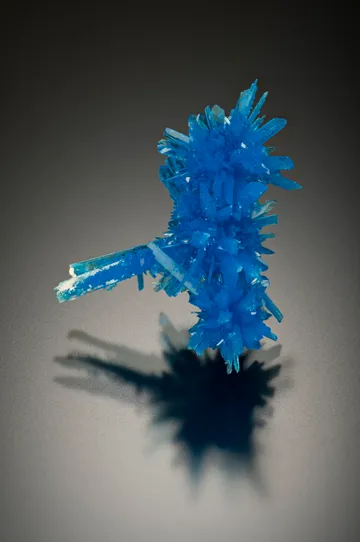
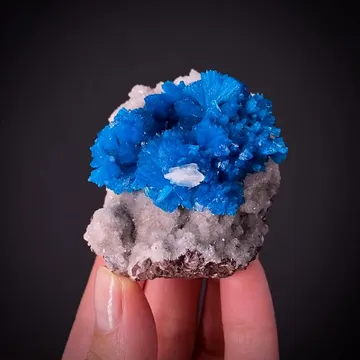
What made Wagholi famous was not merely that cavansite occurred there, but that it occurred as superb specimens: electric-blue spherical rosettes, hemispheres, sprays, and rare bladed or stalactitic forms perched on pale stilbite or heulandite. Pentagonite, the dimorph with the same formula, Ca(VO)Si4O10 · 4H2O, added a sharper and more crystalline blue expression—slender sprays, twinned clusters, and fiveling-looking aggregates that can look almost impossibly delicate. Good Wagholi pieces have the classic Deccan-Trap contrast: saturated vanadium blue on white, cream, or peach zeolite, with red-brown basalt matrix giving depth and context.
Historically, Wagholi stands at the center of the modern cavansite story. Cavansite and pentagonite were first described from Oregon, but the Oregon material was small and scarce. The Indian finds, especially after the 1988 Dhoot Quarry discovery and the flood of late-1980s and 1990s specimens, transformed cavansite from a mineralogical rarity into a classic display species. The best Wagholi cavansites and pentagonites still define the market standard for the species.
Regional View
Country View
The geology is now better understood than it was in the early collecting literature. Older descriptions often used “andesite” or “tuffaceous andesite” for the red altered host; recent work places the cavansite–pentagonite mineralization in altered basaltic breccia related to stacked lava flows. The productive rock is the permeable, brecciated, vesicular material—not the massive black basalt that the quarrymen actually wanted. That contrast between industrial waste rock and museum-grade specimens is central to Wagholi’s character.


Search for specimens: View all specimens from Wagholi Quarries, India
The Wagholi Quarries form a quarry complex near Wagholi village in Pune District, Maharashtra, in the western Deccan Volcanic Province. The district is part of the classic Indian “Deccan Traps” zeolite country, where flood-basalt lava flows and their vesicular and brecciated tops provided spaces for later secondary minerals. At Wagholi, recent field-based interpretation recognizes two principal lava flows in the exposed quarry sections. The lower flow is massive but carries the flow-top breccia that hosts the cavansite–pentagonite mineralization; the upper flow is a core-dominated rubbly lava flow welded to the breccia in places.
The deposit type is best described as a low-temperature secondary cavity-mineral occurrence in altered tholeiitic basalt, not as an ore deposit. The quarry product was construction stone. The mineralized zones were valuable to collectors but troublesome to quarry operators because the red, altered, vesicular, brecciated material was weak and unsuitable for the best road-metal or building-stone use. Cavansite and pentagonite occupy interconnected open spaces in the breccia; isolated vesicles are much more restricted mineralogically and commonly carry heulandite as the principal lining.
The mineralization is vertically and laterally zoned rather than continuous. In the upper parts of the breccia system, heulandite and stilbite dominate. Cavansite is strongest in an intermediate zone, especially where vanadium-bearing fluids moved through open breccia spaces already lined by heulandite. Pentagonite becomes more important deeper in the system and in some northeastward or lower portions of the quarry complex, commonly with mordenite and calcite. Mordenite and silica minerals are part of later-stage fluid events, and chalcedony and quartz occur in deeper or more evolved parageneses. Calcite is unusually instructive at Wagholi because it appears in several generations: before or with cavansite, on cavansite, on or partly enclosing pentagonite, and as later transparent pale yellow crystals on mordenite or directly on pentagonite.
There are no conventional ore bodies here. The “bodies” that mattered to collectors were pockets, sinuous cavities, breccia seams, and localized mineralized columns or ramps exposed by blasting and quarry-floor excavation. The famous Dhoot Quarry occurrence involved a conspicuous altered breccia column or pipe-like mass left standing as quarrying removed the better basalt around it. Older collector accounts treated it as a vent-like or pipe-like feature; newer geological interpretation prefers a mineralized breccia mound, ramp, or intensely altered zone rather than a true feeder pipe. Whatever its exact geometry, its removal exposed the material that launched Wagholi into the international mineral trade.
Important sublocalities include Dhoot Quarry, Chavan quarry, Bhawadi Quarry, Para Plateau Quarry, and Quarry no. 4. Dhoot Quarry is the name most closely attached to the first great cavansite finds and was a former trap-rock quarry associated with Mr. Balakrishna Dhoot of Poona; Mindat records it as first worked in the 1960s and now flooded. The broader Wagholi quarry belt has been described as a multi-quarry complex several kilometers long, with many small workings opened, exhausted, abandoned, flooded, or overtaken by development at different times.
Basalt quarrying in the Wagholi area began before the cavansite boom, but the famous specimen-producing era began in 1988, when abundant cavansite was recognized in a recently opened quarrying zone. The specimens reached the international show circuit almost immediately afterward. Large quantities were reported from the late 1980s into the mid-1990s, and good production continued irregularly through later pockets in the 1990s and early 2000s. By the 2010s and 2020s, production had become much more sporadic. Urban expansion around Pune, environmental and quarrying restrictions, flooding, exhaustion of productive horizons, and the simple fact that many pockets were localized and finite have all reduced the likelihood of new classic finds.
Collecting access today should be treated as closed or effectively unavailable to casual visitors. Wagholi is an industrial quarry district, not a public collecting area. Historically, collecting depended on permission, timing, relationships with quarry owners and workers, and the luck of being present when blasting or excavation opened a pocket. Modern access is further complicated by private land, safety hazards, active or abandoned pits, water, development, and regulation. For collectors, Wagholi is best approached as a classic market locality: provenance, old labels, dealer history, and specimen quality matter more than any expectation of field collecting.
Wagholi cavansite is the locality’s signature mineral and occurs chiefly as vivid blue to blue-green rosettes, hemispherical “balls,” spherical aggregates of acicular crystals, parallel aggregates, occasional bladed-tabular individuals, and rare sculptural forms on pale zeolite matrix. Modern study describes cavansite mainly in the interconnected open spaces of zone II, commonly on heulandite and very often intergrown with or followed by stilbite; associations with calcite, mordenite, chalcedony, quartz, and rare pentagonite are also documented. Individual aggregates and parallel groups reach about 2 cm, with long-prismatic crystals to about 1 cm and a later generation of smaller crystals to about 1 mm perched on earlier crystals. The finest collector pieces show saturated royal to electric blue color, lustrous undamaged tips, three-dimensional placement on white or cream stilbite or heulandite, and little or no distracting brown staining, glue, bruising, or mordenite overgrowth; ordinary pieces tend to be isolated, abraded blue balls on flat trimmed matrix.
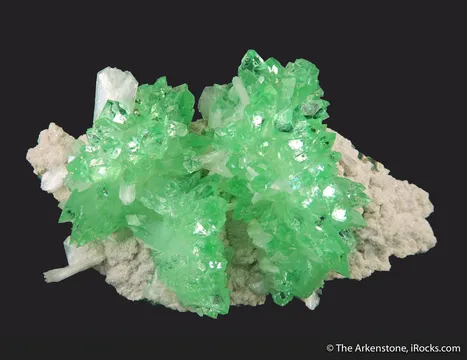
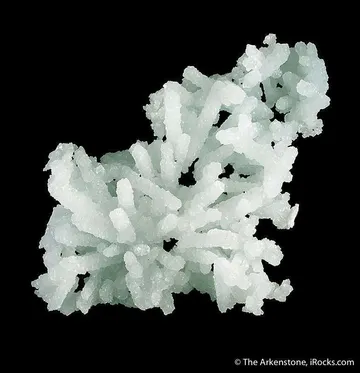
Stilbite-Ca is the classic pale stage on which Wagholi cavansite performs. It occurs in the interconnected breccia spaces rather than as a uniform filling through the massive basalt, with small early crystals on heulandite and later, larger lustrous blades, sheaves, bow-ties, and compact mats that are frequently intergrown with cavansite. Documented early stilbite reaches about 5 mm, while later crystals in the cavansite association reach roughly 3 cm; in rarer pentagonite-stilbite associations, highly lustrous crystals to about 20 mm have been described, with stilbite crystallizing after pentagonite. The best Wagholi stilbite specimens are not necessarily the largest but the cleanest: pearly white, cream, ivory, peach, or salmon blades with sharp terminations, open fan geometry, and strong contrast with blue cavansite or pentagonite. Dull, chalky, broken, or heavily contacted stilbite reduces both aesthetic and specimen value, especially when it obscures the blue species.
Pentagonite from Wagholi is rarer than cavansite in the market but can be more spectacular crystallographically: sharp blue sprays, radial clusters of elongated crystals, and characteristic twinned forms that give the mineral its fivefold-looking habit. At Wagholi it occurs in zones II and III and in the subzone, but is most frequent in the deeper zone III, commonly on heulandite or heulandite with chalcedony and commonly associated with mordenite, calcite, and locally stilbite. Cavansite and pentagonite can occur together, with cavansite generally earlier, but true combination specimens are scarce. First-generation pentagonite crystals at Wagholi can reach 70 mm, while a later generation commonly remains under about 5 mm and may sit without uniform orientation on earlier crystals. Fine examples show glassy luster, transparency, vivid blue color, undamaged terminations, and exposed twinned sprays; mordenite or chalcedony overgrowth can dull the surfaces and make the crystals less legible.
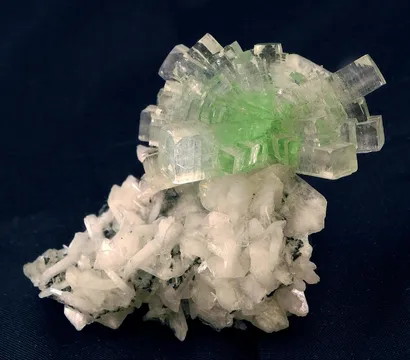
Calcite is widespread at Wagholi and occurs in all mineralized zones, but it is most important to collectors when it adds a sharp second architecture to blue cavansite or pentagonite. Four generations have been described: early flat rhombohedral calcite before or simultaneous with cavansite, calcite on cavansite, calcite on or partly enclosing pentagonite, and late generally transparent pale yellow calcite on mordenite or directly on pentagonite where mordenite is also present. On collector specimens, calcite may appear as clear to pale yellow rhombs, flat rhombohedra, or smaller crystals sprinkled on blue aggregates. Top pieces show clean, lustrous, transparent calcite that frames rather than buries the blue vanadium silicate; pieces where calcite partly encloses cavansite or pentagonite can be scientifically interesting but may be less visually dramatic unless the blue is still well exposed.
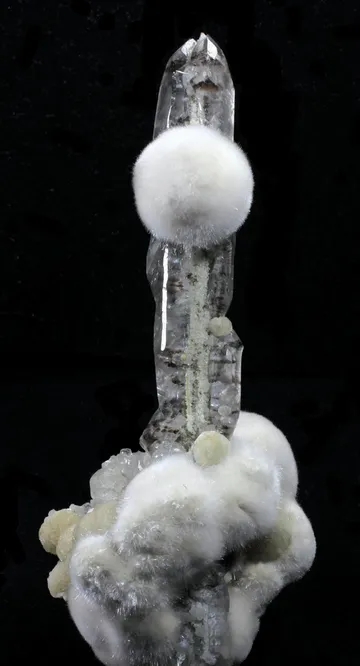
Mordenite is a later-stage zeolite at Wagholi and is especially associated with deeper, pentagonite-rich or silica-bearing parageneses. It appears as white fibrous sprays, hair-like coatings, radiating tufts, spherical aggregates, and soft-looking layers that may partly or completely overgrow cavansite or pentagonite. In the modern mineralization model, mordenite belongs chiefly to later ascending fluids and may follow cavansite, pentagonite, chalcedony, or heulandite depending on the pocket. The best Wagholi mordenite specimens for collectors are not just white fuzz on basalt; they are balanced combinations where the mordenite provides contrast and texture while leaving blue cavansite or pentagonite exposed and undamaged. Heavy mordenite overgrowth can be scientifically revealing but commercially frustrating because it masks luster, transparency, and terminations of the blue species beneath.
Quartz at Wagholi is a later silica-phase mineral, documented with cavansite and pentagonite but far less central to the locality’s fame than stilbite, heulandite, calcite, or mordenite. It occurs with chalcedony in paragenetic sequences such as heulandite to cavansite or pentagonite, then chalcedony, then quartz, and in more complex deeper-stage sequences involving pentagonite, chalcedony, mordenite, later chalcedony, and quartz. Collector pieces may show drusy quartz, chalcedony crusts, or quartz-lined surfaces acting as a pale sparkling base for isolated blue rosettes or sprays. The best Wagholi quartz combinations are those where the quartz provides clean sparkle and contrast without being misrepresented as a primary classic matrix; ordinary pieces are often small, late-stage, and valued mostly because they carry good cavansite or pentagonite rather than because of the quartz itself.
Other documented minerals and rock types from Wagholi include heulandite-Ca, the heulandite subgroup, fluorapophyllite-(K), chalcedony, opal, cristobalite, celadonite, smectite-group minerals, prehnite, okenite, native copper, djurleite, basalt, breccia, and andesitic tuff as used in older locality descriptions. Heulandite is fundamental to the deposit because it lines both isolated vesicles and interconnected open spaces before many of the later species; fluorapophyllite-(K) is rare at Wagholi and only occasionally found with cavansite; djurleite is a notable late-stage rarity recorded with the blue vanadium silicates and silica-carbonate assemblages. Wagholi is not the type locality for cavansite or pentagonite—the original type material is from Oregon—but it is the world standard locality for display-quality specimens of both species.
Wagholi material is easy to recognize in broad style but not always easy to label precisely. The most common identification problem is cavansite versus pentagonite. Color alone is unsafe because both can be vivid blue to blue-green. Cavansite generally forms compact rosettes, balls, hemispheres, sprays, and short radiating aggregates; pentagonite more often forms sharper, longer, glassier prismatic sprays and twinned clusters. There is overlap, and some trade labels have been wrong. Important pentagonite specimens, unusual habits, and high-value cavansite–pentagonite combinations deserve analytical confirmation or at least provenance from a dealer who understands the distinction.
The second concern is repair, stabilization, and assembly. Wagholi pockets were opened in hard industrial quarry conditions, often by blasting or heavy tools, and the blue aggregates can detach from their zeolite matrix. Cyanoacrylate stabilization has been documented in the collecting literature, including use during extraction to keep delicate pieces intact. That does not automatically condemn a specimen—many classic Indian zeolites required careful recovery—but undisclosed glue, reattached blue balls, transplanted cavansite onto unrelated zeolite, and over-trimmed or sawn matrix all affect value. Examine the contact between the blue mineral and the matrix under magnification. Look for glue shine, unnatural gaps, blue aggregates sitting on broken rather than crystallized surfaces, and multiple rosettes with suspiciously similar attachment style.
Condition is crucial. Cavansite rosettes are built of fine acicular to prismatic crystals; bruised tips quickly turn a fine specimen into an average one. Pentagonite is even less forgiving: broken terminations, missing spray tips, and dulled surfaces are common. Stilbite matrix may be chipped, rubbed, or cleaved, and mordenite can collect dust or obscure damage. A little matrix contact on the back is normal for quarry-extracted pieces, but damage on the display face should be priced accordingly.
Wagholi specimens are often small but visually powerful. Miniatures with one sharp, intense blue rosette on clean stilbite can be more desirable than larger pieces with scattered or damaged balls. Cabinet specimens with multiple undamaged blue clusters, strong three-dimensional composition, and clean pale matrix are increasingly hard to replace. Large pentagonite sprays and cavansite–pentagonite combinations are especially scarce.
Market availability remains better for cavansite than for pentagonite, but the flow of fresh classic material is much reduced compared with the 1990s and early 2000s. Current offerings include old-stock dealer pieces, recycled collection specimens, small new or recent finds, and occasional high-end pieces from older pockets. Reports on whether any part of Wagholi is still producing are inconsistent, but the overall trend is clear: urban expansion, quarry closures, flooding, development pressure, and exhaustion of the best breccia zones have moved Wagholi from active modern locality toward classic status.
For handling, keep Wagholi cavansite and pentagonite dry, clean, and protected from abrasion. Do not wash fibrous mordenite-rich pieces aggressively. Avoid ultrasonic cleaners. Dust with a soft blower or very soft brush only when necessary. The strong blue color is natural and not a dye, but the minerals are hydrated calcium vanadium silicates, and good specimens deserve stable indoor storage rather than heat, soaking, or rough handling.
The Wagholi story begins with a quarryman seeing blue where no one was looking for blue. The quarry target was dark basalt, not mineral specimens. One day in 1988, a worker in the Wagholi stone quarries noticed radiant blue pieces among the broken rock and contacted Pune geologist Arvind Bhale. Bhale came with hammer and chisel, collected samples, and had the material identified outside India at a time when the necessary analytical facilities were not readily available locally. His wife, Jyoti Bhale, later recalled that the quarry owner happened to be Bhale’s school friend and allowed him to extract specimens. Among collectors, Bhale became known simply as the “Cavansite man.”
The Dhoot Quarry discovery has one of the great practical details in modern specimen history. Early quarrying left a roughly cylindrical mass of altered breccia standing as the better basalt around it was removed. The rock was not useful construction stone, so it remained in the pit. In collector retellings, that column became a convenient observation point for tax officials who came to measure the progress of quarrying and calculate royalties. The quarry owner, not eager to provide them with such a useful perch, had the column removed. Near its base, the blue mineralization improved dramatically. Once the column was gone, work continued below the floor in search of more blue pockets, and the quarry that had been a source of black rock became a source of the world’s most recognizable cavansite.
The specimens moved quickly from Pune to the world. By 1989, Wagholi cavansite was appearing on the international show circuit, where its color made an immediate impression. Contemporary accounts compared the blue to copper sulfate and to liroconite. That comparison was apt: collectors were seeing a color associated with rare copper minerals, but here it appeared as round, lustrous, almost floral aggregates on pale Indian zeolite matrix. For many buyers, the color looked too saturated to be real until they saw several flats of specimens side by side.
Recovering the pieces was a physical craft. Muhammad F. Makki described Wagholi cavansite cavities as irregular, twisting, sinuous openings rather than neat rooms. Some held only scattered blue balls; richer ones carried clustered rosettes across heulandite and stilbite. The tools were heavy: experienced collectors used a large sledgehammer and a long, thick chisel, not because the work was crude but because a firm, controlled blow could push the rock apart. A light hammer could make the chisel jump and vibrate, sending shock through the pocket and popping blue spherules off the matrix.
There was also a strange quarry-floor economy. A few good blue specimens could be worth more than many days of ordinary stone work, so when a vug appeared it changed the rhythm of the quarry. Workers, collectors, runners, and owners all had different incentives. The quarry needed to produce basalt; collectors wanted time and delicacy; a pocket could be destroyed by haste or by one careless blow. Many Wagholi specimens still carry that history in their form: sharply trimmed backs, protected display faces, repaired contacts, or matrix edges that show they were saved from an industrial process never designed for mineral preservation.
Pune itself changed around the locality. Wagholi was once outside the city, in a landscape of quarries, agricultural land, and village traffic. As Pune expanded, construction demanded more stone, helping drive quarrying outward. Later, the same expansion made the quarry zone valuable for real estate and infrastructure. The mineral existed in a brief window: exposed because the city needed basalt, made scarce because the city kept growing.
One of the most memorable modern local-history moments comes not from a quarry but from London. Pune blogger Ranjit Ghatge visited the Natural History Museum and saw a dazzling turquoise-blue crystalline rock displayed near the entrance with a label identifying it as “Beautiful Cavansite from Wagholi quarry of Pune, India.” He had grown up in Pune without knowing that a world-famous rare mineral came from near his own city. That reaction captures Wagholi’s odd status perfectly: a global mineral classic, but also a local Pune story hidden in plain sight.