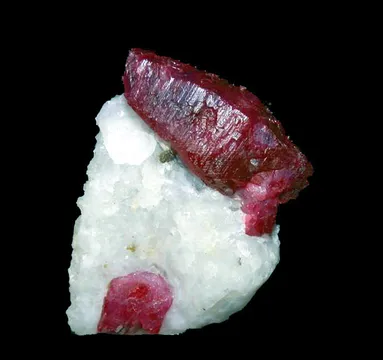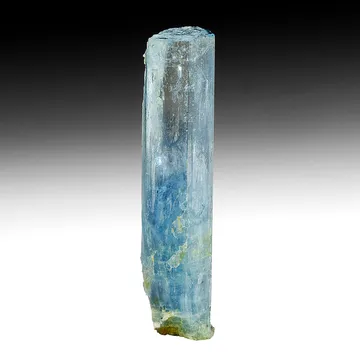
Vietnam, diverse gem provinces from Luc Yen’s ruby, spinel, and sea-blue aquamarine from Xuan Le; prized for high-contrast specimens and pegmatite origins.
Key facts
Vietnam is not a single mineral locality in the tidy sense of a quarry or mine; it is a compact mineral province whose best specimens come from several sharply different geological settings. For collectors, the country’s reputation rests on two great specimen families. The first is the marble-hosted gem suite of northern Vietnam—ruby, sapphire, spinel, pargasite, humite-group minerals, danburite, and tourmaline—best known from the Luc Yen district of Yen Bai Province and from related occurrences in Nghe An. The second is the beryl-bearing pegmatite suite, especially the aquamarine of Xuan Le in Thuong Xuan District, Thanh Hoa Province, with additional beryl occurrences recorded from Nghe An, Phu Tho, Ha Giang, Lam Dong, Binh Thuan, and Ninh Thuan.
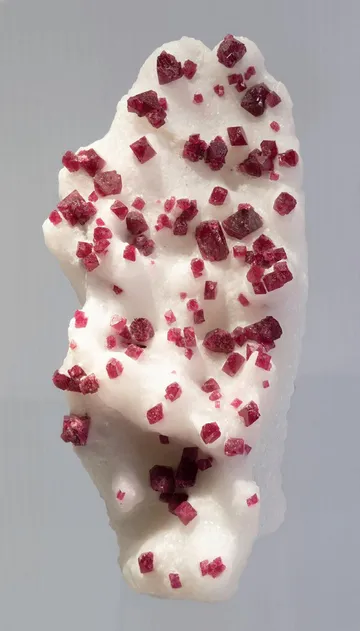
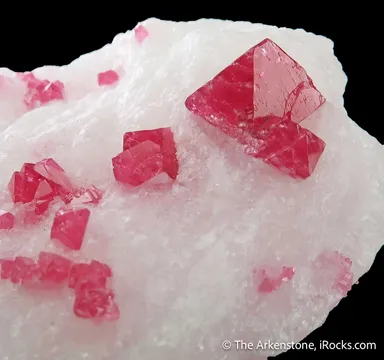
The contrast between these settings is part of Vietnam’s collecting appeal. In Luc Yen, gem minerals formed in and around metamorphosed carbonate rocks within the Lo Gam zone, a belt affected by major regional deformation related to the Red River shear system and the India–Eurasia collision. There, white marble can carry ruby, spinel, pargasite, phlogopite, humite-group minerals, and calcite in dramatic high-contrast specimens. In Thanh Hoa, by contrast, aquamarine is tied to granitic pegmatites and their eluvial weathering products, where blue beryl is associated with quartz, feldspar, muscovite, schorl, topaz, fluorite, and rare zircon.
Historically, Vietnam entered the modern gem and mineral market quickly. Aquamarine and topaz were first recognized in the Xuan Le area in 1985 during government geological mapping. Luc Yen’s gem boom followed in late 1987, when farmers recovered ruby from placer deposits; by 1988 state-supported gem mining had begun, and during the 1990s Luc Yen became the country’s most important gemstone-trading center. For specimen collectors, the most memorable Vietnamese pieces have a distinctive look: sea-blue aquamarine prisms, sometimes singly terminated and sometimes doubly terminated, commonly etched or frosted from weathering; saturated cobalt-blue spinel or ruby-red spinel set in snow-white marble; and rare honey-yellow danburite from Luc Yen placers.
Regional View
Country View
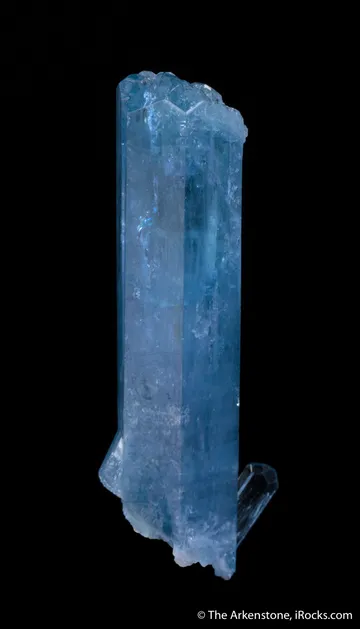
Vietnamese aquamarine has become especially recognizable in the specimen trade because good crystals are often unusually saturated for their size. The best examples from Thanh Hoa and Nghe An are not the pale, watery aquamarines that make up much of the world’s pegmatite production; they can show strong blue to blue-green color, glassy transparency, clean prism faces, and attractive etched terminations. Matrix pieces are scarcer than loose crystals because the host pegmatites are deeply weathered, so well-composed aquamarine on smoky quartz or with schorl carries a premium beyond color alone.
Search for specimens: View all specimens from Vietnam
Vietnam’s specimen-producing gem localities fall into two main geological families. The first is the marble-hosted metamorphic gem association of northern Vietnam, especially Luc Yen in Yen Bai Province and the Quy Chau–Quy Hop area of Nghe An Province. These deposits occur in metamorphic belts near major shear zones. At Luc Yen, the important gem workings lie in the Lo Gam zone, where Proterozoic to Cambrian metasedimentary rocks include calcitic and dolomitic marble, schist, gneiss, calc-silicate rocks, and amphibolite. Ruby and spinel occur in primary marble and in secondary placer deposits derived from erosion of that marble. The second family is the granitic pegmatite association, best represented by the beryl and topaz deposits of Xuan Le in Thuong Xuan District, Thanh Hoa Province, and by rare-element pegmatites in the Luc Yen district.
The Xuan Le aquamarine deposits lie west of Thanh Hoa City and are hosted by pegmatites distributed mainly within the Ban Chieng and Ban Muong granite complexes. The pegmatites occur as lenses and veins, from small bodies only tens of centimeters thick to bodies several meters thick and tens of meters long. Their typical mineralogy is quartz, K-feldspar, plagioclase, muscovite, subordinate biotite, and accessory gem minerals. Miarolitic cavities and weathered pegmatite bodies have yielded aquamarine, topaz, tourmaline, fluorite, and rare zircon. Although topaz is part of the broader Xuan Le gem district, the better gem topaz and the better aquamarine are not necessarily from the same pegmatite bodies.
The productive mining style at Xuan Le is important for collectors to understand. Much of the attractive aquamarine has been recovered from eluvial deposits rather than from fresh hard-rock pockets. Weathering releases crystals from pegmatite into the residual soil, preserving loose prisms but making intact matrix pieces uncommon. This is why many Vietnamese aquamarines on the market are single crystals or parallel-growth clusters rather than large pegmatite plates. The best crystals are hexagonal prisms, commonly sea-blue to blue-green, transparent to translucent, and in good cases several centimeters long. Older Vietnamese reports describe high-quality Xuan Le aquamarine crystals from about 5 to 20 cm long and 1 to 6 cm in diameter, while more recent market and museum examples show both thumbnail-sized etched crystals and cabinet specimens.
Production has been episodic. Aquamarine and topaz were discovered at Xuan Le in 1985. By the 2000s local people were recovering gem material annually, and gemological reporting from 2011 recorded dealer estimates of roughly 100–150 kg of gem material per year during the preceding decade, rising to about 300–400 kg in 2010. The adjacent Que Phong and Quy Chau districts in Nghe An Province have also produced aquamarine, generally in smaller quantities, including loose crystals and rare attractive aquamarine with smoky quartz. Thach Khoan in Phu Tho Province and the Song Chay massif of Ha Giang Province are documented beryl-bearing areas; Song Chay is notable for green beryl found in quartz–mica–tourmaline and mica–feldspar–quartz pegmatites near Na Chi and Tan Nam villages.
Luc Yen’s mining history is better documented and more dramatic. The first high-quality rubies were discovered there in late 1987 by farmers working placer deposits. In June 1988, the Vietnam Gemstones Company, known as VINAGEMCO, was established as a state-owned company for exploration, mining, processing, and trading. Mining began that September through a joint venture between VINAGEMCO and B.H. Mining Company of Thailand at the Khoan Thong Valley placer. From November 1989 to March 1990, the Khoan Thong operation produced 244 kg of gem-quality ruby and sapphire, most of which entered the Bangkok cutting trade. Thousands of independent miners moved into the district from 1990 to 1994, and new primary and placer discoveries followed. In 1995, management passed to the Vietnam National Gems and Gold Corporation, VIGEGO; a 2003 merger formed the Vietnam Minerals Corporation, VIMICO. Today, Luc Yen gemstone production is largely small-scale and local rather than state-controlled.
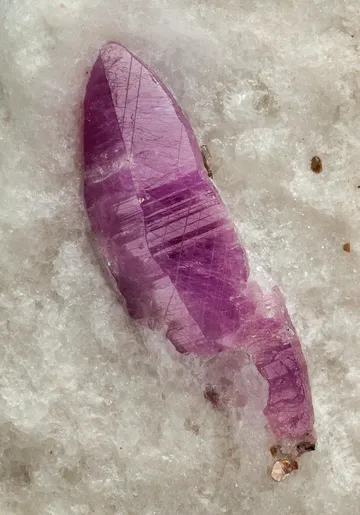
Luc Yen’s primary ruby workings include marble deposits such as May Ha and May Thuong, where miners follow ruby-bearing bands parallel to metamorphic foliation. Ruby-bearing marble blocks may contain many crystals and can range from hand-sized pieces to large decorative blocks. Spinel and pargasite specimens are especially associated with Cong Troi, the “Sky Gate” area, where spinel occurs in bands within marble and where attractive red to pink spinel in white marble has long been trimmed, carved, or sold as specimens. Blue spinel deposits in the district include May Trung, Bai Son, Bah Linh Mot, Khe Khi, Bai Gou, and related sites; some are primary marble deposits and others are secondary placer deposits.
Luc Yen also has a pegmatite story separate from its marble-hosted ruby and spinel. Tourmaline-bearing pegmatites were recognized around Minh Tien, Khai Trung, Tan Lap, and An Phu. The first body containing colored tourmaline and green feldspar was found at Minh Tien and mined in 2004–2005; later bodies were discovered at Khai Trung in 2008–2009, Tan Lap in 2009–2010, and An Phu in 2011. These pegmatites have produced elbaite, liddicoatite, possible rossmanite, lepidolite, amazonite or green feldspar, smoky quartz, and danburite-related associations. Vietnamese academic work classifies some Luc Yen gem pegmatites as LCT rare-element pegmatites of the rare-element class, lithium subclass, complex type, elbaite subtype.
Collecting access today should be considered restricted and local. Active gem workings are not casual public collecting sites, and in Luc Yen local authorities have banned mining at the pegmatite bodies even though placer mining has continued in places. In the marble areas, mining is small-scale, physically demanding, and often tied to local landholders, farmers, or licensed marble activity. For most collectors, the practical route to Vietnamese specimens is through established dealers, old collections, or the gem markets of Luc Yen, Hanoi, and Ho Chi Minh City rather than field collecting.
Vietnamese aquamarine is most strongly associated with Xuan Le in Thuong Xuan District, Thanh Hoa Province, where it occurs in granitic pegmatites and eluvial deposits with quartz, feldspar, muscovite, schorl, topaz, fluorite, and rare zircon; additional aquamarine is documented from Nghe An, Phu Tho, Lam Dong, and other localities. Xuan Le crystals are typically hexagonal prisms, sea-blue to blue-green, and transparent to translucent, with classic reports giving fine crystals in the 5–20 cm range and 1–6 cm in diameter, while specimen-market examples often show etched surfaces, longitudinal striations, pinacoid terminations, and occasional association with smoky quartz or black tourmaline. The best pieces are distinguished by saturated blue color, intact terminations, transparency down the c-axis, and balanced form; ordinary pieces tend to be paler, more fractured, more heavily etched, or isolated loose prisms without aesthetic matrix.
Beyond aquamarine, Vietnam has a broader beryl record in pegmatites from Thanh Hoa, Nghe An, Phu Tho, and Ha Giang. At Xuan Le, beryl is disseminated in pegmatite bodies related to biotite granite, granosyenite, granophyric granite, and quartz syenite; older Vietnamese research describes small beryl crystals in the primary ore, while commercial aquamarine-quality material is best known from placers and eluvial deposits. At Deo Sen in the Quy Chau district of Nghe An, beryl occurs in pegmatite bodies a few meters thick and tens of meters long, and at Thach Khoan in Phu Tho it is recorded with white mica, tourmaline, feldspar, and quartz. The most interesting non-aquamarine beryl report is from the Song Chay granite-gneiss massif in Ha Giang, where large green beryl crystals were found in quartz–mica–tourmaline and mica–feldspar–quartz pegmatites near Na Chi and Tan Nam; for collectors, the best “beryl” rather than “aquamarine” specimens are sharp, well-formed prisms with credible locality data, because many Vietnamese-market beryls are sold simply by color variety and may lack mine-level provenance.
Vietnamese heliodor requires more caution than Vietnamese aquamarine. Yellow beryl and heliodor-labeled crystals are documented from the Vietnamese market and from localities including Thanh Hoa, Binh Thuan, and Ninh Thuan, and Mindat records several yellow beryl specimens from Binh Thuan and Ninh Thuan; however, gemological literature has also cautioned that pale Vietnamese aquamarine has reportedly been irradiated in Laos and returned to the domestic market as natural heliodor. Fine Vietnamese heliodor-type specimens are generally small, lustrous, transparent yellow to golden-yellow prisms or parallel-growth clusters, sometimes with etched or striated faces; the best pieces combine strong natural-looking color, high clarity, undamaged terminations, and trustworthy documentation, while ordinary or suspect pieces are pale, overly uniform in color, poorly documented, or offered without treatment disclosure.
Other Vietnamese minerals of collector importance include ruby and sapphire from Luc Yen, Yen Binh, Quy Chau, Quy Hop, Dak Lak, Lam Dong, Dong Nai, and Binh Thuan; cobalt-bearing blue spinel and red to pink spinel in marble from Luc Yen; elbaite, liddicoatite, possible rossmanite, schorl, lepidolite, and green feldspar from Luc Yen pegmatites; gem peridot and zircon from the Central Highlands; almandine garnet from Phu Tho; honey-yellow danburite from the Bai Cat placer in Luc Yen; and green orthoclase from the Minh Tien area. A cautionary note belongs with the amphibole once sold from Luc Yen as “fluor-cannilloite”: analyzed material from the district has been reclassified by specialists as pargasite rather than true fluoro-cannilloite, making old labels worth checking carefully.
Vietnamese specimens reward provenance discipline. “Vietnam” labels are common, but mine-level or district-level labels are far more meaningful. A Thanh Hoa aquamarine from Xuan Le is a different collecting object from a Nghe An aquamarine, a Lam Dong aquamarine, or a yellow beryl from Binh Thuan. Likewise, stones bought in Luc Yen’s market are not automatically from Luc Yen. GIA field reporting specifically notes that the Yen The market has sold gems from Vietnam and elsewhere, including beryl, aquamarine, peridot, quartz, chalcedony, jade, and fluorite. Treat a market label as a starting point, not a proof of origin.
The chief beryl concern is treatment and variety mislabelling. Vietnamese aquamarine may be natural-color blue, heated, or used as starting material for yellow stones sold as heliodor. Reports that pale Vietnamese aquamarine was irradiated in Laos and sold back into Vietnam as natural heliodor are important enough that any high-value yellow beryl should be bought with laboratory support or clear treatment disclosure. Research on aquamarines and yellow beryls from Thanh Hoa also shows that heating can change color and clarity and that high-temperature treatment can produce cracks, fissures, milkiness, and opacity through dehydration effects in the beryl structure.
Condition is the other major issue. Much Vietnamese aquamarine comes from weathered pegmatite or eluvial deposits, so crystals often show etched faces, rounded edges, missing terminations, internal tubes, healed fractures, or frosted surfaces. Some etching is natural and attractive; severe corrosion or bruised terminations are not. Good matrix specimens are less common than loose crystals because the pegmatites are weathered, so a well-balanced aquamarine on smoky quartz or with schorl should be examined closely for repairs, reattachments, or artificial assembly.
For Luc Yen marble specimens, trimming is normal but should be disclosed when it affects aesthetics. Spinel, ruby, pargasite, and humite in marble are commonly cut, carved, or polished for the local decorative and feng shui market. This does not make them fake, but collectors should distinguish a natural specimen from a shaped decorative object. Old “fluor-cannilloite” labels from Luc Yen should be viewed skeptically because analyzed examples from the district have turned out to be pargasite.
Synthetic and treated gems occur in Vietnamese markets, even when the surrounding mining district is genuine. Ruby and sapphire may be heated or otherwise treated in the broader trade; synthetic gems are documented in Luc Yen markets; and cobalt-blue spinel has become valuable enough worldwide that any vivid blue spinel should be tested for natural origin and treatment when price warrants it. For specimens rather than cut stones, the strongest buying position is a piece with known district, host rock, no suspicious glue line, no undisclosed carving, and a label history predating recent fashion spikes in Vietnamese material.
Fluorescence is not generally a key buying feature for Vietnamese beryl, but it matters for some associated species. Luc Yen danburite is reported as inert under short-wave ultraviolet and blue-luminescent under long-wave ultraviolet, with the blue luminescence related to rare-earth impurities. Handle all etched beryl, danburite, topaz, and spinel-in-marble specimens as display minerals rather than rough: loose crystals can have stressed terminations and internal fractures, and marble specimens can chip along trimmed edges.
The modern Vietnamese gem story begins in a landscape of rice fields, karst towers, and weathered marble. In late 1987, farmers in the Luc Yen district recovered rubies from placer ground in Yen Bai Province. Within months, a local agricultural district had become the focus of a state-backed gem rush. VINAGEMCO was created in June 1988, and by September a joint venture with B.H. Mining Company of Thailand was working the Khoan Thong Valley placer. Between November 1989 and March 1990, that valley yielded 244 kg of gem-quality ruby and sapphire. Much of the material went to Bangkok to be cut, and thousands of independent miners followed into Luc Yen between 1990 and 1994.
The physical stage was extraordinary. Luc Yen is a mountain district of jungle-covered karsts separated by narrow valleys, villages, and paddy fields. It is bordered by Thac Ba Lake, an 80 km-long reservoir created in 1970 for Vietnam’s first hydroelectric power plant. The lake has more than a thousand islands, and it drowned ground between Tan Huong and the Luc Yen peninsula that geologists consider potentially gem-rich. In the spring of 2005, when water levels fell, local miners dug for ruby along the lake margin—working briefly exposed ground that for much of the year lies beneath the reservoir.
Luc Yen’s gem market became a daily ritual. During the 1990s, the market covered more than 1,000 square meters, and hundreds of farmers arrived with gems from 5:30 to 7:30 each morning. After the market closed, they went back to the mountains to mine. Buyers came from Hanoi, Ho Chi Minh City, Thailand, and elsewhere. The modern market is smaller—about a tenth of its former size—but it still carries the atmosphere of a field economy: women at small tables with parcels of rough and cut stones, local traders with mobile phones, and better stones often moving privately before they ever reach a public stall.
One of the great Vietnamese specimen stories is the Luc Yen tourmaline find of 1994. A particolor tourmaline crystal weighing 1400 g and measuring about 9.5 × 9.0 × 8.0 cm was taken from a placer and later held by the Hoi An Gemstone Art Museum. That single crystal represents the oddity of Luc Yen pegmatites: gem tourmaline had been found with ruby, sapphire, and spinel in placers since the late 1980s, but the first pegmatite body containing colored tourmaline and green feldspar was not discovered until 2004 at Minh Tien. Other pegmatite discoveries followed at Khai Trung, Tan Lap, and An Phu, but official restrictions later stopped mining at the pegmatite bodies even as placer recovery continued.
The marble workings produced their own vignettes. At May Thuong, the “Upper Cloud” ruby mine, a small crew worked a white marble exposure with a generator, drills, crowbars, and blasting. Miners watched for ruby and phlogopite—the mica often treated as a ruby indicator—then drilled and broke out marble blocks. Some ruby-bearing blocks were small enough to carry; others were large decorative masses. The ruby crystals were generally opaque to translucent, but the visual impact of red corundum in white marble made them desirable for carving and collecting even when not suitable as transparent gems.
At Cong Troi, the “Sky Gate,” pink and red spinel in white marble created another local economy. Around 2012, roughly 20 miners were working the area, many of them young men in their late teens to thirties. The marble cliff yielded spinel in colors from brownish red and reddish brown to purple, black, pink, and purplish pink, with crystals from millimeter size to several centimeters. In Vietnam, such blocks are not merely specimens; they may be trimmed and carved for decorative and phong thuy use, linking the specimen trade to local ideas of display, luck, and landscape.
A smaller but scientifically memorable episode came in the summer of 2015, when researchers investigating metamorphosed carbonate rocks in Luc Yen found honey-yellow danburite at Bai Cat, an active placer deposit in An Phu commune. The first pieces were modest—crystals up to 2.5 cm from mining dumps—but the team followed the clue and found more small transparent crystals along streams within 2 km of Bai Cat. One rough crystal weighing 26.3 ct cut a clean 4.6 ct oval. For collectors, the find added a new species to Luc Yen’s already rich marble-and-pegmatite story: not large by world standards, but unusually transparent, yellow, and enriched in rare-earth elements.