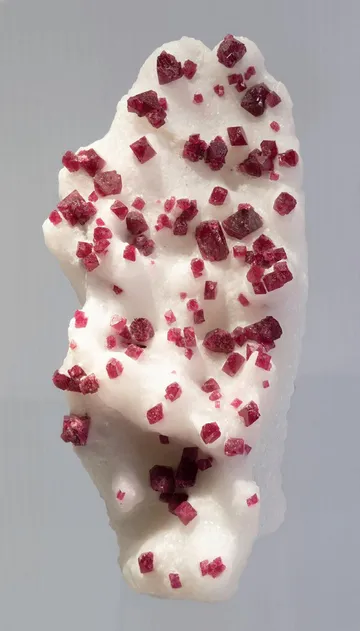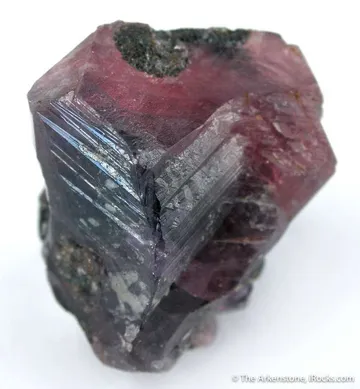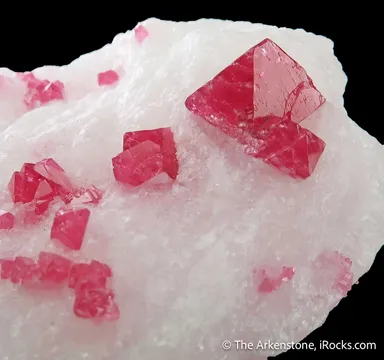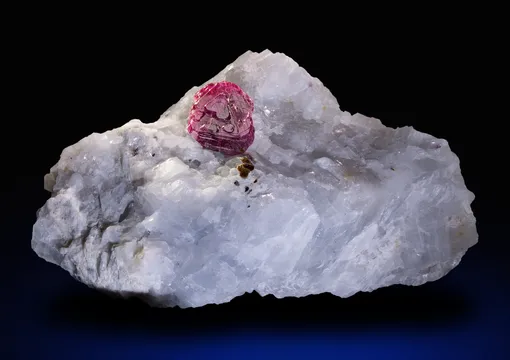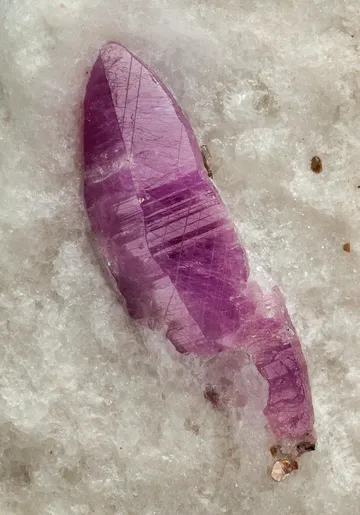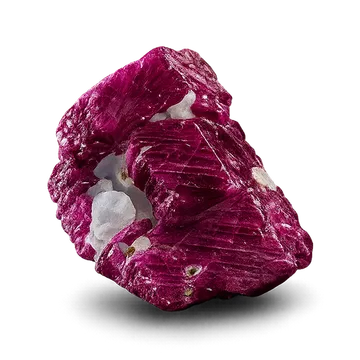
Luc Yen ruby, Vietnam — marble-hosted pink-red to purplish corundum in white marble, famed for crystal form, luster, and matrix prized by collectors.
Key facts
Luc Yen ruby belongs to the great marble-hosted ruby belt of Central and Southeast Asia, but it has its own unmistakable collector personality: saturated pink-red to purplish red corundum set against white marble, often with a waxy to vitreous luster and sharply visible hexagonal or bipyramidal crystal forms. The finest crystals have the lively fluorescence and low-iron brightness collectors expect from marble-hosted ruby, while many matrix pieces preserve the geologic contrast that makes Luc Yen specimens so immediately recognizable: red corundum embedded in pale carbonate rock, commonly with mica, amphibole, spinel, graphite, pyrite, or other metamorphic associates.

Photo: Géry Parent, Wikimedia Commons
The district lies in northern Vietnam’s Yen Bai Province, in the Lo Gam tectonic zone on the eastern side of the Red River shear-zone system. There the ruby occurs in recrystallized carbonate rocks—marbles of Upper Proterozoic to Lower Cambrian age—within a metamorphic terrane that also hosts spinel, sapphire, tourmaline, pargasite, humite-group minerals, and other collector minerals. Luc Yen is therefore not simply a gemstone source; it is a specimen locality where ruby must be understood as part of a larger marble mineral assemblage.
The modern fame of Luc Yen began with the late-1980s gem discoveries that put Vietnamese ruby into the international trade. In the early 1990s, stones from Luc Yen and nearby northern Vietnamese deposits were already being compared with marble-hosted rubies from Mogok, Myanmar, though the Vietnamese material often shows a more purplish cast and distinctive internal features. For specimen collectors, the most desirable pieces are not merely red; they combine form, color, luster, and matrix. A small, lustrous ruby crystal cleanly perched in white marble can be more compelling than a larger, opaque mass. Likewise, clusters with multiple crystals, strong color, and minimal damage command a strong premium because so much Luc Yen production is worn placer material, opaque carving-grade corundum, or ruby-bearing marble blocks that require trimming.

Photo: Rob Lavinsky, iRocks.com, Wikimedia Commons
Luc Yen also occupies a special place in collector culture because it has produced both cabinet-grade ruby-in-marble specimens and gem rough entering the cutting trade. That dual identity matters. A fine Luc Yen specimen is judged as mineral art—crystal architecture, matrix contrast, and surface preservation—while a fine Luc Yen gem is judged for transparency, color distribution, treatment status, and laboratory-confirmed origin. The best locality material brings those worlds close together: bright ruby with enough crystal quality to satisfy the mineral collector and enough chromatic intensity to remind the gemologist why the district changed Vietnam’s gemstone history.
Search for specimens: View all ruby specimens from Luc Yen, Vietnam
Luc Yen is a mountainous district in northern Yen Bai Province, northwest of Hanoi. The town most associated with the gem trade is Yen The, commonly referred to in the trade as Luc Yen. The landscape is classic karst country: limestone and marble hills, narrow valleys, paddy fields, caves, sinkholes, and alluvial pockets where resistant gem minerals concentrate after weathering out of the surrounding marble.
The ruby deposits are both primary and secondary. In the primary occurrences, ruby is hosted by recrystallized marble, commonly as disseminated crystals, bands, veinlets, or fissure-related concentrations. Reported primary ruby associations include calcite, dolomite, phlogopite, dravite, margarite, pyrite, rutile, spinel, edenite, graphite, and related marble minerals. In the secondary deposits, ruby and sapphire occur as placer concentrations in karst pockets, alluvial fans, stream gravels, and valley sediments. These placers are particularly important because they supplied much of the early gem production and continue to furnish small parcels of ruby, sapphire, spinel, and associated gem minerals.
Modern exploitation began after the late-1987 discovery of high-quality rubies by local farmers in colluvial and alluvial sediments. Government-backed exploration and mining followed in 1988 through VINAGEMCO, and a joint venture with B.H. Mining Company of Thailand worked the Khoan Thong Valley placer. From November 1989 to March 1990, that operation produced 244 kg of gem-quality ruby and sapphire from Khoan Thong, much of which entered the cutting trade through Bangkok. The discovery rapidly transformed Luc Yen from an agricultural district into Vietnam’s best-known northern gemstone center.
The early 1990s were the boom years. Thousands of independent miners moved through the district, and new primary and placer occurrences were found. The Luc Yen market became the morning clearinghouse for rough and cut stones, with farmers, local traders, Vietnamese buyers from Hanoi and Ho Chi Minh City, and foreign dealers all participating. State control later passed through VIGEGO and VIMICO, but large-scale mining proved poorly suited to the district’s geology: ruby-bearing gravels are distributed through karst pockets, caves, narrow valleys, and paddy-field settings where mechanized mining can miss material between marble pinnacles. By 2000, organized state control had largely given way again to small-scale artisanal mining.
Primary ruby has been documented at places including May Ha and May Thuong—names translated as the Lower and Upper Cloud mines—where ruby-bearing white marble is quarried by small teams. In May Thuong, ruby crystals occur in bands parallel to the foliation of the metamorphic rocks. Miners look for ruby itself or phlogopite, a local indicator mineral, then drill and blast marble blocks. Ruby-bearing blocks reported from these workings range from small hand specimens to hundreds of kilograms, and some blocks contain many crystals.
Secondary mining remains highly local and seasonal. Farmers and small mining groups work gravels with basic tools, water hoses, rattan baskets, pumps, small sluices, and hand sorting. Activity fluctuates with agricultural cycles. At Bai Chuoi near Khoan Thong, miners have worked pits with a water reservoir and pump-fed sluice; the area has produced ruby, including trapiche ruby, as well as tourmaline, rutile, quartz, blue sapphire, and light blue spinel. Old mechanized workings are still revisited because heavy equipment often removed only the easiest ground, leaving gem-rich material in awkward karst pockets and between marble pinnacles.
Collecting access should be approached as commercial-field access, not casual rockhounding. These are active or formerly active mining areas, many on private, village, agricultural, or licensed ground. Outsiders should not assume permission to dig, enter pits, or collect from mine dumps. Serious collectors generally acquire Luc Yen ruby through reputable dealers, established local contacts, or documented market channels rather than by self-collecting. Provenance is especially important because Yen The’s market handles not only Luc Yen gems but also stones from elsewhere in Vietnam and abroad.
Luc Yen ruby occurs in several collector-relevant forms. Primary matrix pieces show crystals embedded in white to off-white marble, often as bipyramidal hexagonal crystals, short prisms, irregular but lustrous crystal clusters, or bands of corundum following foliation. Some crystals are sharply formed; others are rounded, resorbed, flattened, or lumpy. Placer crystals tend to be more worn, but some preserve surprisingly sharp faces, suggesting limited transport from their marble source.
Color ranges from pink and medium pink-red through purplish red, dark red, dark purple-red, and pinkish purple. Fine crystals may show a vivid, glowing red to raspberry-red color on white marble. Many pieces are more purplish than classic Mogok ruby, and some gem material carries blue zoning or uneven color patches. The finest collector specimens avoid a muddy brownish tone and retain brightness even where the crystals are translucent rather than transparent.
Size depends heavily on whether one is discussing gem rough, cut stones, or specimen crystals. Early gemological study described much gem-quality Luc Yen rough as small, commonly 2–6 mm long, with large pieces of rough rare but known above 20 ct. Faceted research stones from early studies were mostly under 2 ct, and much of the commercial material was better suited to cabochons or carvings than clean faceting. In primary marble, crystals can be far larger as specimens: documented crystals from May Thuong commonly range from about 3 mm to 1.5 cm in diameter and 2–10 cm in length, though much of this material is opaque to translucent and specimen-grade rather than facet-grade.
The most characteristic specimen matrix is white marble with ruby. Associated and neighboring minerals in the Luc Yen marble environment include calcite, dolomite, spinel, phlogopite, pargasite, dravite, margarite, edenite, rutile, pyrite, pyrrhotite, graphite, humite-group minerals, and tourmaline-group minerals. For collectors, the most attractive associations are ruby in bright marble, ruby with green amphibole or mica contrast, and pieces that preserve the district’s broader gem assemblage without visual confusion between ruby and red spinel.
Under the microscope, Vietnamese rubies from the Luc Yen–Quy Chau suite are known for a complex inclusion scene. Reported internal features include blue color zones, swirled or “treacle” growth features, angular or wedge-shaped growth, laminated twinning planes, bluish clouds of minute particles, orange-stained fractures, and solid inclusions of calcite, apatite, pyrrhotite, phlogopite, rutile, and nordstrandite. Rod-like calcite and pyrrhotite inclusions, orange prismatic rutile clusters, and bluish clouds are especially notable in the gemological literature on Vietnamese ruby.
On specimens, the decisive quality factors are color saturation, crystal definition, luster, contrast, and condition. A deep red crystal with a bright surface on clean white marble is preferable to a larger but dull, bruised, or iron-stained mass. Sharp crystal edges are uncommon enough to matter. Complete terminations, visible hexagonal geometry, and natural contacts with marble add value. Detached crystals are judged more severely for abrasion and repair; matrix specimens are judged for trimming, balance, and whether the ruby is naturally exposed or artificially carved out.
Authenticity concerns for Luc Yen ruby fall into three overlapping categories: species identity, locality identity, and treatment or repair.
Species identity is not trivial in this district. Luc Yen is also famous for red, pink, purple, and blue spinel, and red spinel may be visually confused with ruby by non-specialists. The broader Yen The market also handles garnet, sapphire, tourmaline, beryl, peridot, quartz, chalcedony, jade, fluorite, and synthetic gems, not all of them local. A red crystal or cabochon bought in Luc Yen is not automatically Luc Yen ruby. For valuable cut stones, laboratory testing is essential; for specimens, a reliable dealer, old label, analytical confirmation, or strong mineralogical context is desirable.
Synthetic and misrepresented material has been documented in the Vietnamese ruby trade since the early years. In a GIA study of 124 faceted samples represented as Vietnamese ruby and fancy sapphire, testing found one flame-fusion synthetic ruby, two almandine garnets, and nine natural spinels among the submitted stones. The authors also noted that flame-fusion synthetic rubies had been seen represented as natural Vietnamese stones. That warning remains relevant: a “Vietnam ruby” label, by itself, is not proof of natural origin.
Treatment concerns are most important for faceted or cabochon rubies, but specimen collectors should still be alert. Heat-treated Vietnamese ruby has been reported in the trade, and ruby from nearly every commercial source may be heated to improve color or clarity. General ruby treatments such as heat, fracture filling, dyeing, and glass filling should be considered when buying polished stones or carving-grade material. For specimen crystals in marble, the more common practical concerns are trimming, polishing, oiling or coating, glued repairs, and artificially improved exposure of crystals. One early GIA study even documented a Vietnamese ruby whose broken pavilion had been glued back after faceting; in specimen form, analogous repairs may appear as glued crystals, reattached fragments, filled cracks, or marble reconstruction.
Condition is a major issue. Luc Yen ruby in marble is hard relative to its carbonate host, so cleaning and trimming can undercut the matrix or leave bruised contact areas. The ruby itself may show natural fractures, orange iron staining, internal clouds, color zoning, and parting along twinning. Placer crystals often show abrasion. Matrix specimens may be carved or trimmed to expose ruby, a practice with a long local tradition because ruby-bearing marble blocks are also used for ornamental and feng shui objects in Vietnam. Such preparation is not automatically a defect, but collectors should distinguish a naturally exposed crystal from a sculpted block with polished or carved marble.
Fine Luc Yen ruby specimens are available, but truly top examples are not common. The market contains many small crystals, pink-to-purple corundum pieces, carved matrix objects, and opaque ruby-bearing marble specimens. The rare prizes are lustrous, saturated red crystals with good form and minimal damage on clean marble, especially if accompanied by provenance or old collection history. Facet-grade unheated Luc Yen ruby above modest sizes is scarce, and specimen-grade crystals with both gemminess and strong morphology are correspondingly sought after.
The Luc Yen story begins not in a corporate mine office but in fields and valleys. Farmers recovered the first high-quality rubies from placer sediments in late 1987, and within months the district’s quiet agricultural rhythm was altered. VINAGEMCO was established in June 1988, mining began that September, and by November 1989 the Khoan Thong Valley placer was producing at a pace that made the trade pay attention. In only five months, through March 1990, the joint venture recovered 244 kg of gem-quality ruby and sapphire. Most of that production was sold and cut in Bangkok, linking a remote Vietnamese karst district directly to the international colored-stone trade.
The landscape itself shaped the mining. Thac Ba Lake, created in 1970 for Vietnam’s first hydroelectric power plant, borders the district to the west, south, and east. It is about 80 km long, as much as 10 km wide, and dotted with more than a thousand islands. It also submerged ground considered potentially gem-rich. In spring 2005, when the water level was low, local miners took advantage of the exposed lake margins and dug for rubies where the water had retreated.
At May Thuong in May 2011, the mine scene was intimate and stark: only a handful of men worked daily in white marble, living halfway up the mountain in a canvas-covered shack. Their toolkit was practical rather than romantic—a power generator, drilling machines, crowbars, and blasting. They watched the marble for signs of ruby or phlogopite; when the indicator appeared, they drilled, blasted, and removed blocks along the foliation plane. Some ruby-bearing blocks were small enough for a specimen shelf, but others were immense, reported up to 700 kg and as much as 1.2 m across, with hundreds of crystals scattered through the marble.
Getting those blocks down the hill was another part of the economy. Miners hired local Man or Tay carriers, who were paid 2,000 to 3,000 Vietnamese dong per kilogram—about US$0.10 to $0.15 at the time reported. One man or woman could usually carry 50–80 kg over difficult terrain. The image is hard to forget: ruby-bearing marble, pried from a mountain by a few miners with drills and crowbars, then shouldered down the slope by local carriers for a few cents per kilogram.
The old Luc Yen market had its own rhythm. During the 1990s, the exhibition area covered more than 1,000 square meters, and hundreds of local farmers arrived from 5:30 to 7:30 each morning to sell gems before returning to the mountains. The market is much smaller now, about a tenth of its former size, but the morning trade persists. Sellers, often women, display parcels of rough and cut stones on small tables. Dealers no longer need the market as they once did; mobile phones allow buyers to intercept miners near the foothills. Yet the old market remains a living symbol of the discovery that remade the district.
Luc Yen also developed a distinctly Vietnamese afterlife for its smaller and lower-grade gem material. Cutters became traders; traders kept cutting machines at home; some family operations grew into small factories. Others shifted toward carving ruby- and spinel-bearing marble into ornamental objects—trees, animals, and feng shui pieces. Gemstone paintings became another local specialty. Red ruby, garnet, and spinel; blue sapphire; green pargasite, peridot, or chalcedony; purple fluorite or amethyst; and pink rose quartz could be left as grains or crushed to powder and glued onto a prepared acrylic base. A worker could complete a 40 × 60 cm painting in a day, and about 10 manufacturers were reported distributing such paintings from Hanoi to Ho Chi Minh City. For miners, that steady decorative market helped pay daily costs while they waited for the occasional exceptional stone.
Robert E. Kane, Shane F. McClure, Robert C. Kammerling, Nguyen Dang Khoa, Carlo Mora, Saverio Repetto, Nguyen Duc Khai and John I. Koivula, “Rubies and Fancy Sapphires from Vietnam,” Gems & Gemology, Fall 1991, Vol. 27, No. 3 — Foundational gemological study of more than 100 Vietnamese rubies and fancy sapphires, including Luc Yen material, with internal features, inclusions, and early trade context.
Pham Van Long, Vincent Pardieu and Gaston Giuliani, “Update on Gemstone Mining in Luc Yen, Vietnam,” Gems & Gemology, Winter 2013, Vol. 49, No. 4 — The best field-based overview of Luc Yen mining, geology, market activity, primary and placer deposits, and the post-boom artisanal mining scene.
Gaston Giuliani, Jean Dubessy, David Banks, Hoàng Quang Vinh, Thérèse Lhomme, Jacques Pironon, Virginie Garnier, Phan Trong Trinh, Pham Van Long, Daniel Ohnenstetter and Dietmar Schwarz, “CO2–H2S–COS–S8–AlO(OH)-bearing fluid inclusions in ruby from marble-hosted deposits in Luc Yen area, North Vietnam,” Chemical Geology, 194, 167–185, 2003 — Detailed fluid-inclusion study central to understanding the marble-hosted genesis of Luc Yen ruby.
Virginie Garnier, Gaston Giuliani, Henri Maluski, Daniel Ohnenstetter and coauthors, “Ar–Ar ages in phlogopites from marble-hosted ruby deposits in northern Vietnam: evidence for Cenozoic ruby formation,” Chemical Geology, 188, 33–49, 2002 — Geochronological work on phlogopite associated with northern Vietnamese ruby deposits, including Luc Yen.
Virginie Garnier, Daniel Ohnenstetter, Gaston Giuliani, Henri Maluski, Etienne Deloule, Phan Trong Trinh, Pham Van Long and Hoàng Quang Vinh, “Age and significance of ruby-bearing marble from the Red River Shear Zone, northern Vietnam,” The Canadian Mineralogist, 43, 1315–1329, 2005 — U-Pb zircon study linking ruby-bearing marble to the tectonometamorphic history of the Red River shear-zone region.
Virginie Garnier, Gaston Giuliani, Daniel Ohnenstetter, Anthony E. Fallick, Jean Dubessy, David Banks and coauthors, “Marble-hosted ruby deposits from Central and Southeast Asia: Towards a new genetic model,” Ore Geology Reviews, 34, 169–191, 2008 — Regional genetic model placing Luc Yen within the broader Central and Southeast Asian marble-hosted ruby province.
Mindat: Luc Yen Mine, Lục Yên District, Yên Bái Province, Vietnam — Mineral list, locality coordinates, references, and specimen-photo gateway for the Luc Yen ruby and spinel locality.
Mindat: Ruby occurrence record for Luc Yen Mine — Dedicated occurrence entry for ruby at Luc Yen with formula, locality hierarchy, references, and photo listings.
Mindat photo record: Corundum var. Ruby, Lục Yên District, Yên Bái Province, Vietnam, ex Steve Smale Collection — Notable photographed thumbnail ruby cluster from Luc Yen, useful for comparison of high-color collector crystals.
“GIA Field Gemologists Seek Gems in Luc Yen, Vietnam,” GIA Staff — Field video following Vincent Pardieu and the GIA team through Luc Yen’s limestone mountains, markets, mining areas, and gemstone-painting workshops.
“Market for gemstones,” VietNamNet — Photo essay of the Luc Yen gemstone market, including morning trading, ruby testing, bamboo baskets, and crushed ruby used for gemstone paintings.
GIA: Update on Gemstone Mining in Luc Yen, Vietnam — Essential field report for mining history, deposit types, primary and placer workings, and the Luc Yen market.
GIA: Rubies and Fancy Sapphires from Vietnam — Classic early gemological paper documenting Vietnamese ruby characteristics, inclusions, synthetics encountered in the trade, and early production.
GIA Field Report: GIA Field Gemologists Seek Gems in Luc Yen, Vietnam — Accessible video and field summary showing the terrain, market, and field-gemology purpose of collecting reference samples.
Mindat: Luc Yen Mine locality page — Locality hierarchy, coordinates, mineral list, references, and specimen photos.
Mindat: Ruby from Luc Yen Mine occurrence page — Focused ruby occurrence record for the locality.
Wikimedia Commons: Rubis, calcite 14.jpg — High-resolution photograph of a 27 mm ruby crystal on calcite from Luc Yen.
Wikimedia Commons: Corundum-Marble-104086.jpg — Photograph of ruby crystals in white marble from Luc Yen, credited to Rob Lavinsky, iRocks.com.
Chemical Geology PDF: Fluid inclusions in ruby from marble-hosted deposits in the Luc Yen area — Technical paper on the fluid system involved in Luc Yen marble-hosted ruby formation.
EPA HERO record: Age and significance of ruby-bearing marble from the Red River Shear Zone, northern Vietnam — Bibliographic and abstract record for the Canadian Mineralogist geochronology paper.
Mindat reference: Marble-hosted ruby deposits from Central and Southeast Asia — Citation details for the Ore Geology Reviews genetic model paper.