Thuong Xuan, Vietnam — notable aquamarine locality with sharp blue beryl crystals from pegmatites; collectible specimens, vivid color, and solid background.
Key facts
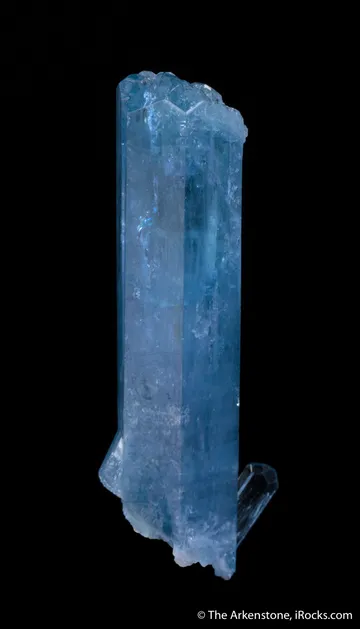
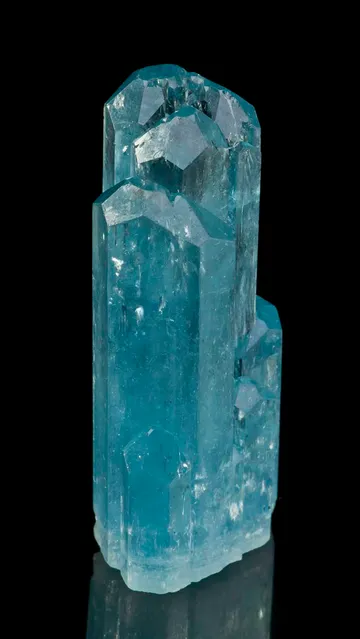
Thuong Xuan is the name collectors most often use for Vietnam’s finest aquamarine-producing district: the pegmatite fields around Xuan Le in western Thanh Hoa Province, roughly 70 km west of Thanh Hoa City and not far, in regional terms, from the Lao border. For the mineral collector it is a compact but important locality because it put Vietnam on the aquamarine map with sharp, naturally blue beryl crystals from granitic pegmatites and eluvial diggings rather than the more familiar marble-hosted ruby and spinel deposits of northern Vietnam. The best specimens are slender to moderately stout hexagonal prisms, typically light to medium blue, sometimes strongly saturated for their size, with glassy faces, bright internal gemminess, and the occasional association with smoky quartz, feldspar, schorl, or topaz.
Regional View
Country View
The significance of Thuong Xuan is not merely that it produced cuttable aquamarine. It produced recognizable specimen aquamarine: crystals that can stand in a thumbnail box with the best small gem crystals from classic pegmatite districts. The locality’s strongest pieces are not the largest aquamarines in the world, but they have a collector-friendly combination of narrow prismatic form, fine luster, color that remains visible even in small crystals, and a freshness that reflects their relatively recent arrival on the international specimen market. Scientific work on the material has also made Thuong Xuan aquamarine one of the better characterized Vietnamese gem minerals, with published data on chemistry, fluid inclusions, Raman and infrared spectra, and heat-treatment response.
Historically, the deposit sits at an interesting moment in Vietnamese gem mining. Aquamarine and topaz were reported from Xuan Le in 1985 during government geological mapping, shortly before Vietnam’s modern gem trade accelerated after the late-1980s ruby discoveries farther north. By the 2000s and early 2010s, local people were recovering meaningful quantities of gem material from weathered pegmatites and nearby eluvial concentrations, while fine individual crystals began to circulate among specialist dealers and beryl collectors outside Vietnam.
Search for specimens: View all specimens from Thuong Xuan, Vietnam
The collectible material comes principally from the Xuan Le area of Thuong Xuan District, Thanh Hoa Province. In geological terms, this is a granitic pegmatite occurrence with both primary pockets and secondary eluvial concentrations. The aquamarine-bearing pegmatites are associated with the Ban Chieng and Ban Muong granite complexes, and the district is cut by a set of mostly northwest-trending faults. Published descriptions place the pegmatites as lenses and veins, from decimeter-scale bodies only a few meters long to much larger bodies several meters thick and tens of meters long. The host pegmatites are dominated by quartz, K-feldspar, plagioclase, and muscovite, with lesser biotite; miarolitic cavities have yielded aquamarine with quartz, feldspar, topaz, tourmaline, fluorite, and rare zircon.
The principal productive eluvial occurrences named in the literature are Ban Pang, Lang Ben, Non Na Ca, and Ban Tuc, all derived from pegmatites intruding the Ban Chieng granite. The eluvial workings were important because weathering freed crystals from the pegmatite, making them recoverable with hand tools. This mode of preservation explains both the beauty and the limitations of Thuong Xuan specimens: individual aquamarine crystals can be gemmy and sharply formed, but matrix specimens are uncommon because the pegmatite host is often deeply decomposed. When matrix pieces do survive, they are especially desirable, particularly aquamarine on smoky quartz or feldspar, or with black tourmaline.
Mining has been largely artisanal. Published field observations describe crystals being gathered by hand from eluvial deposits or recovered from shallow workings in pegmatite using rudimentary tools, with no organized industrial mining at the time of those reports. Local production was significant enough by the 2000s to supply gem rough, but not sufficiently regular to make fine specimen crystals abundant. GIA’s 2011 study reported local-dealer estimates of roughly 100–150 kg of gem material recovered annually during the preceding decade, with an unusually strong year in 2010 estimated at 300–400 kg. Those figures refer to gem material broadly, not to intact collector crystals; fine complete prisms were only a fraction of the output.
The most memorable published field account is from May 2011, when Dudley Blauwet visited the Thanh Hoa aquamarine deposits. From Hanoi the route ran south to Thanh Hoa City, then through rice fields and karst country toward the remote mountains. From Xuan Le, motorbikes covered the last 7–8 km along a narrow dirt track with stream crossings on one-meter-wide wooden bridges. Above Lang Ben village, a steep footpath led to scattered aquamarine pits in dense jungle. The workings covered roughly 400 m horizontally, from about 592 m to 621 m elevation, with decomposed, near-vertical pegmatites and shafts reportedly as deep as 15 m. Higher on the mountain, around 811 m elevation, active workings in more quartz-rich pegmatites were producing aquamarine and occasional colorless topaz; miners offered small parcels of broken gem fragments and a few complete blue crystals up to about 7 cm long.
Collector labels may vary. The most precise and useful labels are “Xuan Le, Thuong Xuan District, Thanh Hoa Province, Vietnam” or “Xuan Le, Thường Xuân District, Thanh Hóa Province, Vietnam.” Some market labels simplify this to “Thuong Xuan, Vietnam” or “Thanh Hoa, Vietnam.” The name “Doi Ty” or “Doi Ty Mountain” also appears on some specimen labels in the trade, but buyers should treat such labels carefully and prefer pieces accompanied by older dealer documentation or a clear chain of provenance.
Collecting access today should be regarded as uncertain and not comparable to casual fee collecting in North America or Europe. The known workings are remote, small-scale, and locally worked; access involves local permission, land-use and mining regulations, and difficult terrain. For most collectors, reputable dealers and documented older material are the practical route to acquiring specimens from the locality.
Thuong Xuan beryl is best known as aquamarine: light to medium blue, blue-green to blue, transparent to translucent hexagonal prisms that commonly show longitudinal striations, growth zoning, internal tubes, and two-phase or multiphase inclusions. Published crystal sizes from the locality are typically 5–20 cm long and 1–6 cm in diameter for mined crystals, though the finest specimen-market pieces are often smaller thumbnails and miniatures where color saturation, glassy luster, completeness, and clean terminations matter more than size alone. The most desirable specimens are sharp, lustrous, minimally etched crystals with saturated blue color, visible internal gemminess, and little damage; matrix examples with smoky quartz, feldspar, or schorl are distinctly scarcer than single crystals because the pegmatites are commonly weathered and decomposed.
Other minerals documented from the Xuan Le–Thuong Xuan pegmatites include topaz, quartz including smoky quartz, feldspar, muscovite, biotite, tourmaline commonly represented by schorl, fluorite, and rare zircon; cassiterite is reported with the productive eluvial assemblage. Topaz is the locality’s other important gem mineral, generally colorless to faintly yellowish, transparent, and commonly recovered from placers or weathered pegmatites. Published inclusion studies on Thuong Xuan aquamarine also document growth tubes, H2O-CO2 fluid inclusions, calcite and albite in multiphase inclusions, and hematite and biotite as solid inclusions. The locality is not known for a type-mineral species; its rarity value lies instead in fine Vietnamese aquamarine crystals, scarce aquamarine matrix pieces, and well-formed topaz from the same gem-bearing district.
Thuong Xuan aquamarine has several authenticity issues worth taking seriously. The first is locality precision. Much material is sold simply as “Vietnam aquamarine,” “Thanh Hoa aquamarine,” or “Thuong Xuan aquamarine,” and fine crystals from nearby or neighboring provinces can be conflated in the trade. Published reports distinguish the Thanh Hoa deposits in Thuong Xuan District from smaller aquamarine production in Que Phong District, Nghe An Province. Good labels should ideally specify Xuan Le or Thuong Xuan District, Thanh Hoa Province.
The second issue is color and treatment. Aquamarine in general is often heated to reduce greenish or yellowish components, and Vietnamese beryls from Thanh Hoa Province have been specifically studied under heating experiments. Heating up to about 700 °C produced optical changes without major crystal-structure change in the studied material, while higher temperatures of 900–1,100 °C produced cracks and fissures related to dehydration. For faceted stones, treatment disclosure is the jeweler’s problem; for mineral specimens, the collector’s concern is whether an unusually saturated blue crystal is natural color and whether any heating, irradiation, oiling, or repair has occurred. Most serious specimen dealers sell Thuong Xuan aquamarine as natural and untreated, but the buyer should still ask directly when color is unusually intense.
The third issue is condition. The best Thuong Xuan crystals are slender and gemmy, which means they are vulnerable to chips on terminations and prism edges. Etching is common enough that smooth, glassy faces command a premium. Internal fractures are also frequent; they may add sparkle or iridescence, but they limit cutting value and can weaken specimens. Growth tubes, veils, liquid-gas inclusions, and multiphase inclusions are normal for the locality and should not be mistaken for damage, but open fractures, glued breaks, or polished bases should be disclosed.
Fluorescence is not a selling point for typical Thuong Xuan aquamarine. GIA’s study found the examined samples inert to both long-wave and short-wave ultraviolet radiation. Care is straightforward but conservative: avoid thermal shock, hydrofluoric acid, aggressive ultrasonic cleaning on fractured material, and rough handling of thin prisms. A well-cut base or custom acrylic mount is often preferable to repeated handling, especially for long narrow crystals.
Market availability is real but limited. Fine Thuong Xuan aquamarines appeared internationally in the 2010s and have continued to show up as thumbnails, miniatures, small gem crystals, and occasional matrix pieces. Small saturated crystals can be more visually impressive than their measurements suggest, and clean, sharply terminated, dark blue thumbnails often sell quickly. Matrix specimens, doubly terminated crystals, parallel-growth groups, and aquamarine with smoky quartz or schorl are much less common than single loose prisms.
The best field story from Thuong Xuan begins not at the mine but on the road from Hanoi. In May 2011, Dudley Blauwet set out with Mr. Lai Duy, his friend and guide, driving south for about five hours to Thanh Hoa City before leaving the main highway for narrower roads. The route passed rice fields and karst hills before reaching the mountains that hold the aquamarine-bearing pegmatites. From Xuan Le, the last 7–8 km could not be done comfortably by car. Motorbikes were used instead, following a narrow dirt track over streams crossed by “rickety 1-m-wide wooden bridges.”
At Lang Ben village the vehicle travel ended and the climbing began. The trail was steep, slippery, and hot, rising through tropical vegetation. After about one hour and forty minutes on foot, and after passing a place reportedly mined for topaz, the path came out of the jungle into the aquamarine workings. They were not grand mines. They were dozens of small pits scattered through dense growth over about 400 m, at elevations from 592 m to 621 m. The pegmatites were nearly vertical and so weathered that hand tools were enough. Shafts went down as much as 15 m, and some had horizontal tunnels at the bottom. There were no pumps, no mechanized equipment, and no timber supports.
A local miner told Blauwet that this Lang Ben area had been worked for about four years and was yielding an estimated 50–60 kg per year of mixed-grade aquamarine. Higher up, at about 811 m elevation, another working was active. There the tunnels were larger, entering the hillside at shallow angles and reaching perhaps 15–20 m. The pegmatite dumps showed more quartz, including opaque white to light smoky fragments up to about 20 cm. Around a dozen miners were active, and their parcels told the collector’s story of the deposit in miniature: mostly broken blue fragments of 1–3 g, plus a few complete crystals up to about 7 cm long. The color was attractive, but the crystals commonly carried lengthwise fractures, meaning that even gemmy rough would cut only modest clean stones.
The contrast is part of Thuong Xuan’s charm. It is a locality capable of producing elegant, world-class little aquamarine crystals, but it does so from jungle pits, weathered pegmatite, hand-dug tunnels, and parcels where a complete undamaged prism is the exception rather than the rule.