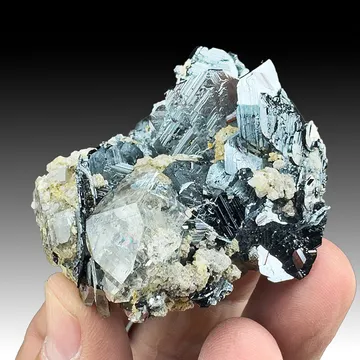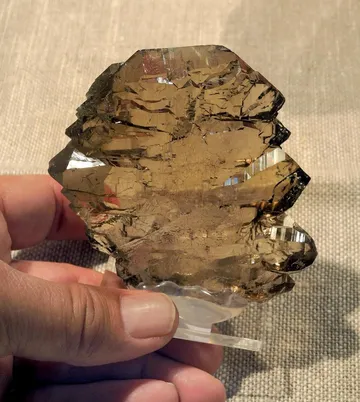
Val Nalps, Switzerland - Alpine locality famed for sharp quartz on schist, phantoms and rutile needles, with historic Pb-Ag-Zn mines, prized by collectors.
Key facts
Val Nalps is one of the quieter but deeply rewarding mineral valleys of the Tujetsch district in Graubünden, lying just west of the celebrated Cavradi–Val Curnera collecting country and within the crystalline basement of the Gotthard nappe. For collectors, its importance rests on two overlapping traditions. The first is the Alpine cleft tradition: quartz fissures in gneisses, schists, amphibolitic rocks, and related basement units have produced rock crystal, smoky quartz, gwindels, sagenitic rutile, anatase, adularia, calcite, chlorite, monazite-(Ce), titanite, and a distinctive suite of rare-earth and titanium-bearing accessories. The second is an older mining tradition: the Ruosna da Palits workings on the Tgom side of the valley mark a small but historically significant lead-silver-zinc occurrence, with surviving underground workings, dated mine timber, and archival references reaching back to medieval mining rights.
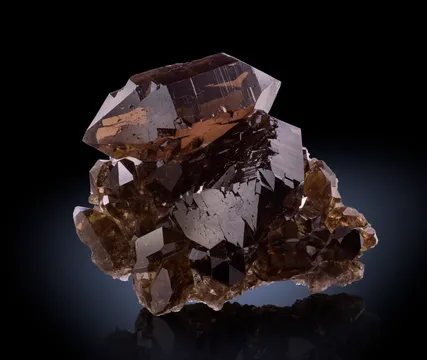
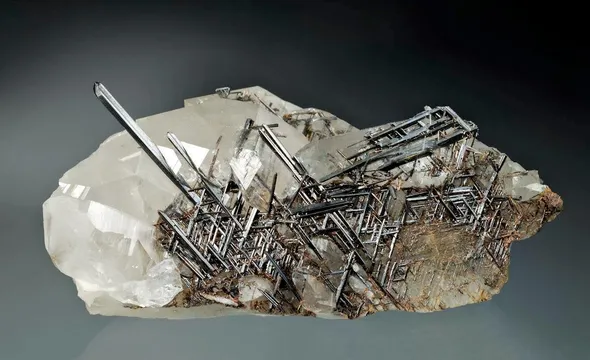
The finest cabinet specimens from Val Nalps are unmistakably Alpine in style: bright, sharply faced quartz on schistose matrix; smoky or water-clear crystals with chlorite dusting or phantoms; and, most memorably, quartz shot through with golden, straw-like rutile needles. Pardatsch, Piz Blas, Claus Valley, Muotta Naira at Piz Lai Blau, Piz Rondadura, and Piz Vatgira recur on good labels, and those sublocality names matter. A specimen simply labelled “Val Nalps” may be perfectly legitimate, but the strongest pieces are often traceable to a particular slope, cleft zone, or peak.
Regional View
Country View
Geologically, Val Nalps sits in terrain whose rock names are familiar from Central Alpine basement literature: Val Nalps gneiss complex, Prato series, Tavetsch/Tujetsch crystalline units, and the Gotthard nappe. Modern mapping and tunnel studies describe these rocks as pre- to early-Variscan gneisses, schists, amphibolites, and related high-grade basement units, with mafic and locally eclogitic components recording a long pre-Alpine history later overprinted by Alpine deformation and fluid movement. For the collector, that translates into the mineral language of fissures: open spaces along fractures and cleavages where silica-rich and carbonate-bearing fluids deposited quartz, feldspar, chlorite, carbonates, TiO2 polymorphs, and rare accessory minerals.

Photo: Wikimedia Commons
The valley has never had the public fame of Cavradi Gorge, yet serious Swiss Alpine collectors know it as a source of unusually attractive quartz-rutile combinations and as part of the broader Tavetsch mineral province. In this district, labels can carry several historical spellings: Tujetsch, Tavetsch, Grisons, Graubünden, Grischun, Nalps Valley, Val Nalpes, Pardatsch, and occasionally older or imperfect forms such as “Peodatsch.” Preserving those labels is important, because they document a collecting geography that is more precise than a modern political locality alone.
Search for specimens: View all specimens from Val Nalps, Switzerland
Val Nalps is best understood not as a single pit or quarry but as a mountain-valley collecting district in the municipality of Tujetsch, Surselva Region, Canton Graubünden. The Mindat locality is a regional entry that includes sublocalities such as Claus Valley, Clavau, Pardatsch, Piz Blas, Piz Fuorcla, Piz Gannaretsch, Piz Lai Blau with Muotta Naira, Piz Rondadura, Piz Uffiern, Piz Vatgira, Tgom with the Ruosna da Palits Mine, and Tuors Paradis. That broad coverage explains why the Val Nalps mineral list combines classic Alpine cleft minerals with ore minerals from the old mine and rarer accessories from high-level fissures.
The specimen-producing deposit type is principally Alpine fissure or Alpine cleft mineralization developed in Central Alpine crystalline basement rocks. The country rocks belong to the eastern Gotthard nappe and related Tavetsch-area basement units, including gneisses, schists, amphibolites, and local mafic rocks. During Alpine deformation and uplift, fractures opened repeatedly; hydrothermal fluids then deposited quartz, adularia and albite, chlorite, calcite and other carbonates, rutile, anatase, titanite, monazite-(Ce), xenotime-(Y), synchysite-(Ce), synchysite-(Y), gadolinite-(Y), and other accessories. The best collector pockets are therefore not “ore shoots” in the mining sense but clefts: narrow open cavities, often irregular and partly crushed, where crystals grew freely into space.
Pardatsch is one of the most important specimen names on Val Nalps labels. Published locality compilations and dealer records emphasize Pardatsch for quartz, rutile, anatase, brookite, apatite, calcite, ilmenite, monazite, pyrite, pyrrhotite, siderite, tourmaline, hematite, and native gold in tiny grains. The west slopes above Pardatsch and toward Plaun Palits are noted especially for rutile, including fine golden material, and quartz crystals reported up to exceptional lengths. Across the lower valley, the Uaut Siaras/Uaul Siaras area is recorded for anatase, violet apatite, aragonite, small white tabular baryte, calcite, muscovite, phantom quartz, and rare orange-yellow monazite crystals of outstanding quality, some enclosed in quartz.
Piz Blas is the other name that immediately raises a collector’s expectations. It is a 3019 m peak, and its Val Nalps mineral list is particularly rich in rare-earth and Ti-bearing species: aeschynite-(Y), anatase, fluorite, gadolinite-(Y), ilmenite, adularia, monazite-(Ce), quartz, rutile, synchysite-(Ce), synchysite-(Y), and xenotime-(Y). Piz Rondadura is also important for gadolinite-(Y), aeschynite-(Y), hingganite-(Y), and associated Alpine fissure minerals. Muotta Naira at Piz Lai Blau adds another distinct sublocality suite, including quartz, rutile, calcite, monazite-(Ce), grossular, titanite, epidote, bavenite, prehnite, albite var. pericline, adularia, chlorite, stilbite-subgroup minerals, tourmaline, and apatite-group material.
The historic ore occurrence is Ruosna da Palits, also written Ruosna da Paliz and known locally as the Palitserloch. It lies on the Tgom side of Val Nalps above Pardatsch da Stiarls, at about 1875 to 1880 m elevation. Bergbauforschung Graubünden records the site as an underground lead-silver-zinc mine. The entry route from Sedrun follows the road into Val Nalps, then a climb toward Plaun Palits and a departure from the path near point 1834 toward a rocky gully. The workings are small, cramped, and hazardous. After about 14 m the adit divides; the right branch is just under 10 m long and the left branch about 25 m long. The mining was not systematic bench-and-stope work but followed the ore vein.
The mine’s documentary history is unusually long for so small a site. In 1366, Abbot Jakob von Planaterra granted mining rights to interested parties from central Switzerland. In 1643 and 1648 disputes arose over the mines between the monastery and the Disentis district. In 1658 the monastery leased the Tavetsch ore mines to banner-bearer Duri Soliva for annual payments and for a term of 101 years. Inside the Ruosna da Palits adit, the date 1697 is carved into the wall near the entrance, while mine-timber samples have been dated to 1530, 1587, and 1613; another timber date of 1648 is cited in the Bergknappe account. Those dates make the site more than a curiosity: it is a physical remnant of early-modern Alpine ore searching and extraction in the upper Rhine headwater region.
Collecting access today is regulated by the municipality of Tujetsch. Since the municipal law revised in 2026, mineral and crystal collecting with tools anywhere in Tujetsch requires a permit, regardless of land ownership. A collector must be at least 18 and have liability insurance; the permit must be carried, together with identification, and shown to municipal or cantonal officers when requested. Collecting is prohibited on Sundays and on specified federal, cantonal, and municipal holidays. Day permits require the exact place for that day to be declared, and blasting or drilling is not allowed under a day permit. Explosives and drilling machines require additional authorization restricted to persons with civil residence in Tujetsch who are at least 20 and hold the required Swiss blasting certificate. Worked clefts can be reserved for up to two years if correctly marked with tools, but a collector may reserve no more than three clefts in the municipality and may not claim entire rock walls. Material depots must be marked and their coordinates reported to the municipal administration. Important finds of rare beauty or scientific significance must be reported to the municipal board, which has first right to acquire them for appropriate compensation.
Practical collecting in Val Nalps is alpine work, not casual roadside collecting. The productive ground includes steep slopes, gullies, clefted bedrock, loose talus, old workings, and high sublocalities around named peaks. The Ruosna da Palits adit is explicitly described as narrow and dangerous and should not be entered casually. Serious field collectors should check the current Tujetsch permit rules before entering the district, avoid protected woods, reforestation areas, dam and road embankments, and grazing damage, and treat marked clefts and stored tools as active claims under local custom and law.
Quartz is the visual backbone of Val Nalps collecting: rock crystal and smoky quartz occur as Alpine cleft crystals, clusters, gwindels, skeletal forms, phantom pieces, and rutilated crystals from pockets in gneissic and schistose country rock, with documented sublocalities including Val Nalps broadly, Pardatsch, Piz Blas, Piz Vatgira, and Muotta Naira. Ordinary pieces are slender, clear to pale smoky single crystals with chlorite dusting, small contacts, or internal stress fractures; better pieces show glassy lustre, crisp terminations, three-dimensional matrix balance, floating or recrystallized backs, good smoky colour, visible chlorite or hematite phantoms, adularia or calcite association, or dense golden rutile sprays enclosed within the quartz. Dealer records show Val Nalps quartz ranging from small affordable singles of roughly 5–10 cm to substantial cabinet clusters, while published locality compilations for the Pardatsch–Plaun Palits area record exceptional quartz lengths up to 50 cm.
Rutile is the mineral that gives Val Nalps its most distinctive specimen personality. It occurs both as free crystals and, more famously, as sagenitic golden to orange-gold needles in quartz, with important records from Pardatsch, Claus Valley, and Muotta Naira at Piz Lai Blau. The Pardatsch–Plaun Palits slopes are repeatedly singled out for notable rutile finds, including fine golden material, and older locality summaries mention rutile to about 5 cm, thickly acicular, sometimes hairy, and occurring with quartz and pyrite. The most desirable specimens are not merely “included quartz” but bright, transparent quartz in which the rutile is dense, well oriented, metallic, richly coloured, and visible through clean faces; external rutile on contrasting calcite or quartz matrix is rarer, and pieces with attractive sagenite sprays, undamaged terminations, and credible Pardatsch or Claus Valley sublocality labels command special interest.
Anatase from Val Nalps belongs to the broader Tujetsch tradition of Alpine TiO2 cleft minerals, where old literature already noted the species in the district and modern records place Val Nalps among the better Tujetsch anatase localities, alongside Val Curnera, Cavradi Gorge, and Druntobel. Within Val Nalps it is documented from Piz Blas, Claus Valley, Pardatsch, and Piz Rondadura, commonly as small but lustrous crystals associated with quartz, adularia, calcite, chlorite, rutile, ilmenite, and other Alpine fissure minerals. Most Tujetsch anatase is small, often only a few millimetres, and the finest Val Nalps pieces are judged by sharp bipyramidal or tabular form, lustre, freedom from damage, contrast on pale quartz or feldspar, and a good, specific sublocality rather than by sheer size alone.
Other documented Val Nalps minerals give the valley its advanced-collector appeal. The district list includes aeschynite-(Ce), aeschynite-(Y), albite var. pericline, ankerite, aragonite, bavenite, boulangerite, calcite, chlorite-group minerals, epidote, fluorite, gadolinite-(Y), galena, grossular, hematite, hingganite-(Y), ilmenite, jamesonite, kainosite-(Y), adularia, monazite-(Ce), muscovite, prehnite, pyrite, stilbite-subgroup minerals, synchysite-(Ce), synchysite-(Y), titanite, tourmaline, xenotime-(Y), and zircon. The rare-earth assemblage around Piz Blas, Piz Rondadura, Claus Valley, and Muotta Naira is especially significant: gadolinite-(Y) from Val Nalps was included in a Canadian Mineralogist crystal-chemical study of Alpine gadolinite, and Val Nalps is indexed in Mineralogical Record coverage of Alpine rare-earth mineral localities. For micromount specialists, orange-yellow monazite-(Ce), xenotime-(Y), synchysite species, gadolinite-(Y), and aeschynite-(Y) are every bit as locality-defining as the more visible quartz and rutile.
No well-documented, locality-specific fake industry is known for Val Nalps, but mislabelling and over-broad labelling are real issues. Older specimens may be labelled Tavetsch, Tujetsch, Nalps Valley, Val Nalpes, Graubünden, Grisons, Pardatsch, Peodatsch, Piz Blas, or Piz Vatgira. These variants should not be dismissed automatically; several reflect older language, spelling, or dealer usage. The greater risk is imprecision: specimens from the adjacent Cavradi–Val Curnera and broader Tujetsch district can resemble Val Nalps material closely, especially rutile in quartz, anatase on quartz or adularia, and chloritized smoky quartz. When a piece is sold as Val Nalps, a credible old label, sublocality, collector provenance, or field note adds real value.
Rutilated quartz deserves particular caution. Brazilian and other non-Alpine rutilated quartz is abundant on the market, and a vague “Swiss rutilated quartz” label is not enough. Val Nalps material tends to have an Alpine quartz habit, commonly with natural contacts, cleft growth surfaces, chlorite, hematite staining, schist or gneiss matrix, or associated adularia/calcite rather than the polished, sawn, or lapidary presentation common in commercial rutilated quartz. Dense golden rutile in transparent quartz from Val Nalps is genuinely scarce; strong colour, rich orientation, and an old Swiss label should be evaluated together.
Condition is critical. Many quartz crystals from Alpine clefts were detached from pocket walls, shifted during late-stage movement, or later extracted from tight fissures, so contacts on the base or back, small bruises on terminations, etched or rehealed patches, and chlorite-coated faces are common. These are not automatically defects, but they must be priced honestly. A “full floater” or a matrix cluster with recrystallized bottom, sharp lustre, no distracting repairs, and visible internal rutile is in a different class from a broken-back single crystal.
Rutile itself is easily damaged when exposed. Fine needles can be bent or snapped; sagenitic sprays on matrix should be handled only by the matrix, never by the needles. Anatase, monazite, xenotime, synchysite, and gadolinite specimens are often micromount scale and should be kept in boxes where abrasion and loose grit cannot dull the faces. Some rare-earth minerals may be metamict or contain minor radioactive elements; for normal specimen handling this is generally a storage and labelling consideration rather than a hazard, but avoid grinding, trimming, or cleaning dust from unidentified REE-rich material without proper precautions.
Fluorescence is not a major selling feature for Val Nalps quartz-rutile-anatase specimens. The collector value lies instead in Alpine aesthetics, locality precision, crystal sharpness, and association. Market availability is steady but not plentiful. Small Val Nalps quartz singles and smoky quartz points appear periodically from Swiss strahlers and alpine-mineral dealers at modest prices; attractive matrix quartz, gwindels, and quartz-rutile pieces are much less common; and top specimens with dense golden rutile, strong transparency, major size, or rare-earth associations are scarce enough that provenance and condition can dominate price.
The old Palitserloch has the atmosphere of a place that never became a large mine but kept drawing people back. From Sedrun the route turns into Val Nalps, then before Pardatsch da Stiarls climbs toward Plaun Palits. Near point 1834 the path is left behind and the route rises toward a rocky gully. The entrance appears around 1880 m above sea level, high on the Tgom side of the valley, and the first metres of the adit carry a carved date: 1697. Inside, the passage is tight enough that modern mining researchers describe the inspection as very narrow and dangerous. About 14 m in, the adit splits: the right-hand branch runs just under 10 m; the left-hand branch continues about 25 m. There was no elaborate mining geometry here. The miners simply followed the vein.
The timber tells an older story than the inscription. Three pieces of spruce mine wood from Ruosna da Palits have been dated to 1530, 1587, and 1613, and another piece is cited as dated to 1648. Those dates sit alongside the paper trail: in 1366 Abbot Jakob von Planaterra granted mining rights to men from central Switzerland; in 1643 and 1648 quarrels over the Tavetsch mines flared between the monastery and the Disentis district; in 1658 the monastery leased the Tavetsch ore mines to Duri Soliva for annual rent and a term of 101 years. The place feels small on the mountain, but the documents make it part of a centuries-long search for metal in the upper Rhine country.
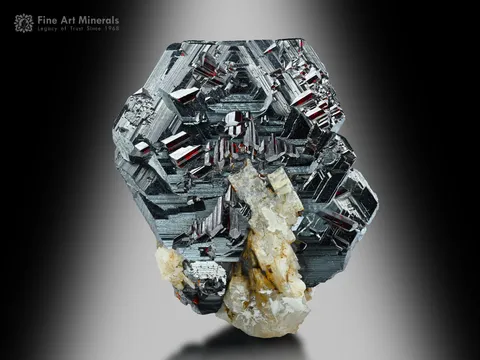
The modern collecting stories are very different: not ore, but pockets. Ueli Eggenberger, a Chur-born strahler who has looked after the mineralogy collections of the Bündner Naturmuseum since 2001, lists his finest finds with the calm selectivity of someone who has seen a great many crystals. He mentions iron roses from Lukmanier in 1982, rare large axinite from an exposed couloir at Piz Vallatscha in 1986, and gold crystals on quartz from the Lukmanier Gorge in 1991. Then comes Val Nalps: from Piz Blas he carried out smoky quartz points weighing up to 35 kg. In a valley better known to many collectors for elegant miniatures and rutile needles, that number is startling—a reminder that Val Nalps has also produced quartz with true alpine mass.