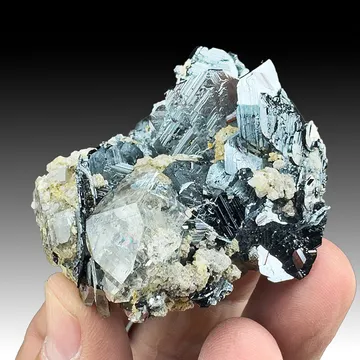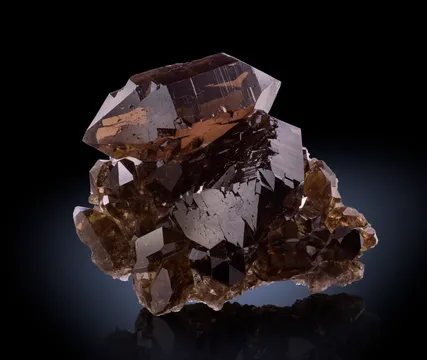
A collector's guide to Val Giuv, Switzerland: its geology, mining history and notable minerals, illustrated with the 55 specimens documented from this locality on EarthWonders.
Key facts
Val Giuv is one of the great names in Alpine quartz collecting: a high glacial valley above the Tujetsch in Graubünden where smoky quartz, quartz gwindels, adularia, and rare beryllium minerals come together in a setting that is as demanding as it is productive. Its finest specimens are not mine products in the ordinary sense, but cleft minerals won from Alpine-type fissures by generations of Strahler working steep, cold, broken ground near the head of the valley. For collectors, Val Giuv matters because its best smoky quartz has the combination that made Swiss Alpine quartz famous: glassy luster, crisp form, internal transparency, rich brown to dark smoky color, and—at its most iconic—the twisted architecture of the gwindel.
The geological key is the upper valley. Val Giuv cuts the southeastern Aar Massif, and the most celebrated quartz is tied closely to the Giuv syenite, a weakly metamorphosed quartz-monzonite to quartz-syenite body with conspicuous pale K-feldspar, actinolite, biotite, and a naturally elevated uranium-thorium background. The same cleft system also intersects aplite dikes, and those aplites are critical to the locality’s rarer identity: this is the type locality for milarite, and the beryllium-bearing association has produced Alpine specimens of the species that are significant far beyond Switzerland.
Visually, the best Val Giuv pieces are unmistakably Alpine. Dark, transparent smoky quartz rises from white to colorless adularia; chlorite may add green veils or a silky dusting; calcite, zeolites, titanite, pyrite, fluorapatite, and rarer species complete the paragenesis. A normal smoky quartz crystal from the valley can be excellent, but a fine Val Giuv gwindel is in a different collecting category: compact, flattened, lustrous, subtly or strongly twisted, with bright rhombohedral faces and the surface sparkle that turns a technical growth form into a display specimen.
Regional View
Country View
Historically, Val Giuv belongs to the living collecting culture of the Tujetsch. The valley has been worked for crystals for roughly two centuries, and its modern reputation was strengthened by major smoky-quartz finds in the Giuv syenite during the late twentieth century and by important milarite discoveries around the turn of the twenty-first. It remains a place where old labels matter. Specimens may be encountered as Val Giuv, Val Giuf, Giuv Valley, Tavetsch, Tujetsch, Graubünden, Grisons, or Grischun; more precise sublocality information—Secunda Muotta, Emprema Muotta, Tiarza Muotta, Kalkspat-Lücke, Rotwichel, Giuvstöckli, Piz Giuv south slope, or Giuv glacier—adds real interest and often real value.

Photo: Wikimedia Commons
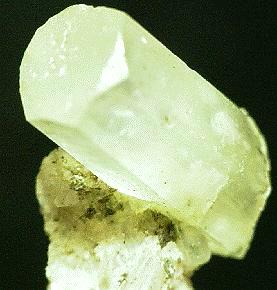
Photo: Wikimedia Commons
Search for specimens: View all specimens from Val Giuv, Switzerland
Val Giuv is a glacial trough valley in the municipality of Tujetsch, Surselva Region, Canton Graubünden, Switzerland. It rises from the Sedrun–Camischolas side of the Vorderrhein valley toward the high boundary with Uri, with the mineralogically important ground concentrated in the upper valley around the Giuv syenite and its surrounding alpine-cleft zones. The mapped locality sits near 46° 41' 32" N, 8° 42' 5" E, but collectors should think of Val Giuv less as a point on a map than as a high-alpine mineral district made up of named knobs, passes, glacier margins, slopes, and cleft-bearing walls.
The deposit type is Alpine-type fissure mineralization. These fissures are tension openings formed during Alpine deformation and later mineralized by hydrothermal fluids moving through metamorphosed and tectonized crystalline rocks. In the lower southern part of the valley, the rocks include the Tavetscher Zwischenmassiv, older crystalline rocks, and the southern Aar granite. Toward the northern upper valley, the Giuv syenite becomes the defining rock: an elongated quartz-monzonite to quartz-syenite body extending beyond Val Giuv into neighboring high valleys. The syenite is cut by aplite dikes, some substantial, and by schistose zones that helped localize fissures.
There is no conventional mine, orebody, operator, or industrial production history here. “Production” at Val Giuv means Strahler work: individual crystal hunters or small teams reading quartz bands, old cleft signs, wall-rock texture, and subtle structural cues, then opening pockets in a landscape where loose rock, snow, weather, exposure, and distance are part of the cost of every specimen. Mineralization is uneven. The most productive fissures are concentrated especially along the southern boundary of the Giuv syenite and in or near aplite dikes. That explains why the valley can be both legendary and frustrating: fine pieces exist, but they came from particular pockets, not from a uniformly mineralized hillside.
The best-known mineral assemblage is smoky quartz with adularia and chlorite, but the locality is richer than that phrase suggests. Quartz occurs as normal prismatic crystals, rock crystal, smoky quartz, amethyst-tipped scepters, faden-like aggregates, and gwindels. Associated species include K-feldspar as adularia, calcite, chabazite, heulandite-Ca, laumontite, scolecite, stilbite-subgroup zeolites, clinochlore, actinolite or byssolite, pyrite, chalcopyrite, malachite, hematite, rutile, titanite, fluorapatite, apatite, fluorite, galena, scheelite, datolite, phenakite, muscovite, prehnite, and milarite. The beryllium-bearing species are tied particularly to the aplites and their cleft systems.
Several sublocalities recur on serious labels. Secunda Muotta is familiar for smoky quartz and gwindels and lies close to the southern boundary of the Giuv syenite intrusion. Emprema Muotta has produced pale amethyst-tipped scepter quartz. Kalkspat-Lücke—literally pointing to its calcite reputation—is known for calcite, quartz, smoky quartz, adularia, chabazite, and limonitized pyrite. Giuvstöckli is a historic datolite occurrence and also appears in records of smoky quartz, scheelite, calcite, and gwindels. Rotwichel and the Piz Giuv south-slope area are important in the broader syenite association and in records of large smoky quartz, adularia, amiant-like amphibole, and related Alpine minerals.
The historical thread is long. Crystal collecting in the Tujetsch is documented back centuries, and Val Giuv itself has been searched by Strahler for about 200 years. Early collectors worked what could be reached and recognized; later, as the obvious clefts were emptied, work shifted to harder ground, more technical openings, and deeper knowledge of the syenite and aplite zones. Among the outstanding modern finds, the 1996 Curschellas brothers’ smoky-quartz find in the Giuv syenite stands out. Reports describe a large cleft at Piz Giuv that yielded about 2,000 kg of crystals, including many gwindels and a massive smoky-quartz group of roughly 350–360 kg. A separate museum record documents a 180 cm long Giuv syenite specimen with smoky quartz, adularia, and amiant from between Rot Wichel and Péz Giuv, accessioned in 1999 by the Museum Regiunal Surselva.
Access today is regulated. Collecting with tools in the municipality of Tujetsch requires a Strahlerpatent from the commune, and the revised municipal law that came into force on April 1, 2026 applies across the whole municipal territory regardless of land ownership. A permit is required for crystal and mineral searching with tools; permit holders must be natural persons at least 18 years old and must carry liability insurance. Use of explosives and drilling equipment requires additional authorization and is restricted to persons with civil residence in Tujetsch who meet stricter legal requirements. Sundays and specified federal, cantonal, and municipal holidays are closed to Strahler work, and there are additional rules concerning protected areas, pasture damage, cleft marking, material depots, helicopter transport, reporting important finds, and penalties. For a collector, the practical point is simple: Val Giuv is not a casual “pick-up-a-crystal” locality. It is a regulated Alpine field locality, and permission, competence, weather judgment, and restraint are part of the collecting ethics.
Quartz from Val Giuv ranges from clear rock crystal to pale amethyst-tipped scepters, faden-like aggregates, macromosaic crystals, gwindels, and smoky quartz, with the finest material concentrated in Alpine fissures of the Giuv syenite and related aplite zones. Normal-habit quartz may show sharp pyramidal terminations, strong luster, and trapezohedral x-faces; rock crystal from Kalkspat-Lücke has been reported as limonite-encrusted clear crystals with adularia, chabazite, and limonitized pyrite, while Emprema Muotta is noted for pale purple scepter tips. Good Val Giuv quartz is not merely transparent: it has Alpine tension, with crisp form, natural contacts or matrix, readable growth history, and associations such as white adularia, chlorite, calcite, zeolites, or pyrite that place it unmistakably in the Tujetsch cleft environment.
Smoky quartz is the emblem of Val Giuv, occurring as lustrous prismatic crystals, clusters, skeletal forms, double-terminated pieces, and especially gwindels from sublocalities such as Secunda Muotta, Giuvstöckli, Rotwichel, Kalkspat-Lücke, and the broader upper Giuv syenite zone. Colors range from light cinnamon and cognac through rich warm brown to very dark smoky tones, often with a quality collectors prize highly: the crystal may look nearly black in reflected light yet open to transparent brown when backlit. Fine specimens are judged by sharpness, internal clarity, luster, clean terminations, attractive matrix, and the absence of distracting chips; for gwindels, value rises sharply with a strong readable twist, intact crests and edges, bright parquet-like faces, good transparency, and the classic contrast of smoky quartz against snow-white adularia or green chlorite.
Val Giuv’s rarities give the locality much of its depth. Milarite is the headline species: Val Giuv is recognized as the type locality, and the species occurs as hexagonal crystals, smaller ones clear and larger ones translucent, colorless to greenish or yellowish, associated with the beryllium-bearing aplite environment. Phenakite and datolite add further interest for systematic collectors, while fluorapatite is recorded as small, usually colorless, clear, well-developed crystals of good luster. Scheelite, although not a display staple here, is important in the broader Aar-syenite context and may fluoresce bluish white. Scolecite and stilbite from the Skolezitkehle area, titanite from the syenite-aplite association, adularia in sharp glassy crystals, and the zeolite suite complete a locality that rewards both aesthetic quartz collectors and serious Alpine-systematic specialists.
The principal concern with Val Giuv specimens is not a famous flood of locality-specific fakes, but a combination of label discipline, condition, and the general problem of treated smoky quartz. Because smoky quartz can be darkened artificially by irradiation, a Val Giuv attribution should rest on more than dark color. Look for Alpine cleft character: natural growth surfaces, plausible contacts, macromosaic textures, associated adularia or chlorite, and a label history that fits the Tujetsch/Graubünden naming conventions. A loose, perfectly uniform, commercial-looking smoky point with no old label, no matrix, and no Alpine morphology should not be valued as Val Giuv simply because it is brown.
Darkness itself is not suspicious at this locality. The Giuv syenite environment is exactly the setting in which natural smoky quartz belongs, and the best crystals may be strongly saturated. The test is quality and context: rich smoky color should be paired with transparency, luster, sharp faces, and a believable Alpine presentation. Backlighting is especially useful. Fine Val Giuv quartz often changes from blackish brown to internally luminous smoke; dead opacity, glassy polish, sawed bases, or unnatural uniformity deserve closer scrutiny.
Condition matters enormously. Alpine cleft quartz grows in tight openings, and many otherwise fine pieces have bruised edges, minor chips, rehealed contacts, broken backs, or repaired sections. On gwindels, inspect the crest, side edges, and rhombohedral steps first, because even small breaks can interrupt the visual rhythm of the twist. A recrystallized contact on the back may be natural and acceptable; a fresh break, trimmed base, hidden glue line, or undisclosed repair is a different matter. Chlorite coatings can hide abrasions, and white adularia can make chips difficult to read in photographs, so good lighting and multiple angles are important.
For associated minerals, handling should be thoughtful. Laumontite and some zeolitic coatings can be less forgiving than quartz; friable cleft clay, chlorite dusting, and delicate scolecite or stilbite aggregates should not be overcleaned. Scheelite-bearing pieces, when identified, are of systematic interest and may show diagnostic fluorescence, but most Val Giuv market specimens are bought for quartz aesthetics rather than ultraviolet response. As always with Alpine specimens, avoid aggressive acid cleaning unless the species suite is known and the goal is worth the risk.
Market availability is uneven. Small smoky quartz crystals and modest groups appear regularly enough through Alpine dealers, older European collections, and online marketplaces. Good Val Giuv gwindels are much scarcer, and top examples with clean twist, glassy transparency, strong smoky color, and adularia association can be fiercely contested. Large historical groups, especially those connected to the 1990s finds or to named Strahler, seldom circulate. Milarite from the true Giuv association is in a separate rarity class: even small well-crystallized examples are significant, and matrix pieces with strong provenance are important locality specimens.
In Val Giuv, the stories are inseparable from the word fuorn—the Romansh collector’s word for a productive cleft. For Luis and Damian Curschellas of Sedrun, the decisive one came in August 1996. They had already spent decades going into the mountains together, and over the years their major clefts formed a kind of private map: Val Val in 1986, the great Val Giuv find in 1996, further Val Giuv finds in 2003/04 and 2010, and Val Cavradi in 2017. But the 1996 pocket was the one that became local legend.
The scale is still startling. Reports describe the 1996 Val Giuv cleft as yielding about 2,000 kg of crystals. The largest smoky-quartz group weighed over 300 kg—often cited around 350 to 360 kg—and was displayed in the Curschellas sports shop in Sedrun rather than disappearing into an anonymous distant collection. The logistics were as impressive as the mineralogy: the brothers had to remove the pieces intact, set them onto boards, load them onto pallets, and bring them down by helicopter in five flights. A cabinet specimen can make a collector forget the mountain; this story restores it immediately. Every giant smoky group from Val Giuv represents not only a pocket, but extraction, judgment, timing, transport, and nerve.
Another account of the same collecting tradition emphasizes how deceptive modern tools can be. Dynamite, drills, hammers, chisels, pocketknives, and crowbars may sound forceful, but Val Giuv does not become easy because a Strahler has better equipment. The accessible clefts at the foot of the walls were worked long ago. Later collectors had to read quartz veins higher in the cliffs and follow hints in the rock, sometimes finding that one opened space showed a further hole behind it—perhaps nothing, perhaps the next chamber. That suspense is central to Alpine collecting: a pocket may end at a blank wall, or it may continue into the kind of chamber that changes a collector’s life.
Patrick Reith’s field account gives the valley a strong physical presence. The approach begins gently above Camischolas and Milez, with the path crossing wide meadows beside a small mountain stream. After roughly twenty minutes, old cleft signs and earlier workings begin to appear. Farther in, the route becomes steeper, meadows give way to boulders, and early-season snow may still lie in the upper ground. After about two hours, the lower end of the upper valley is reached; beyond that, the work becomes fully Alpine. There are no reliable paths, the terrain demands orientation in bad weather, and a camp near Emprema Muotta sits at about 2600 m—high enough that a tent is not a romantic accessory but a serious piece of survival equipment. Reith’s warning is memorable: more than one collector has had a tent torn apart by the wind up there.
The same account captures why the valley draws people back despite that severity. The Muottas toward the Giuvfirn are cut by thick aplite bands, and those bands carry the minerals that make Val Giuv more than a smoky-quartz locality: amethyst, adularia, apatite, epidote, datolite, baryte, pyrite, calcite, and the famous milarite found by Conrad Berther. Reith singles out the upper Val Giuv smoky quartz as among the most beautiful in the world for luster, color, and form, and he gives the collector’s perfect image: dark smoky quartz set with snow-white adularia, an Alpine contrast that can be almost impossible to improve upon.
Val Giuv’s milarite story has its own folklore. The mineral’s name points historically toward Val Milà, but the better-known collecting tradition holds that the first material actually came from Val Giuf/Val Giuv and was deliberately labelled as Val Milà to mislead competing Strahler. Whether encountered as a scholarly correction or a collector’s anecdote, the story is very Alpine: secrecy, locality knowledge, rivalry, and labels that matter. Later, Val Giuv was recognized for what it was—the true classic source—and a 2000 find by Conrad Berther produced a remarkably large Alpine milarite crystal, recorded around 4.3–4.5 cm, a giant for a species collectors more often expect as small hexagonal crystals.