






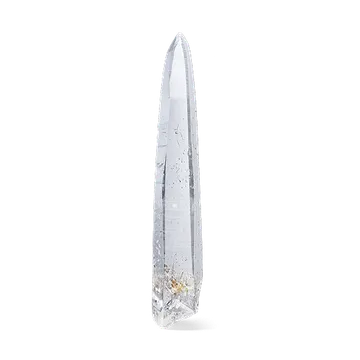
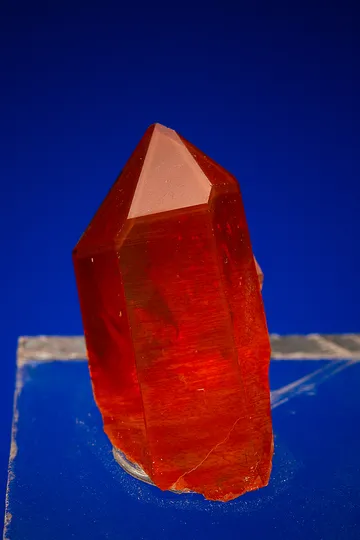
Cavradi Gorge quartz, Switzerland - clear, glassy crystals with hematite and red rutile on gneiss, a famed Alpine locality prized by serious collectors.
Key facts
Cavradi quartz belongs to the great Alpine-cleft tradition of Switzerland, but it has a personality very much its own. The finest pieces are limpid rock crystal to pale cognac smoky quartz, often sharply terminated, glassy, striated, and attractively poised on gneiss or feldspar matrix. What sets the locality apart for serious collectors is not just quartz alone, but quartz in the Cavradi language: clear crystals carrying mirror-bright tabular hematite, red rutile, adularia, calcite, siderite, and, more rarely, gwindel or amethyst forms. A cabinet of Swiss Alpine quartz can look geographically anonymous until a good Cavradi piece appears; the combination of water-clear quartz, dark metallic hematite, and red rutile has a crisp, high-contrast look that is instantly memorable.

Photo: Wikimedia Commons / James St. John
The gorge lies in Val Curnera in Tujetsch, in the Surselva region of Graubünden. Mineralogically, Cavradi is an Alpine-type fissure locality: crystals grew in open tension fissures in high-grade metamorphic rocks, where hot fluids had space to feed slow crystal growth. The central gorge cuts Permian and Carboniferous rocks of the Urseren-Gavera zone of the Gotthard massif, chiefly mica schists and gneisses with a dense concentration of Alpine clefts. Northward, the gorge enters gneisses of the Tavetscher Zwischenmassiv, an area with a different, anatase-rich style of mineralization. Southward toward Lai da Curnera, paragneisses of the Gotthard massif are comparatively poorer in pockets and specimen production.
Historically, Cavradi is best known as a hematite locality, and quartz is the stage on which many of those hematites perform. The locality has been worked by Swiss Strahler—professional or semi-professional mountain crystal collectors—for generations, and modern accounts describe nearly two centuries of Alpine-cleft collecting in the ravines around the gorge. The 2013 bilingual monograph Cavradi gave the locality the kind of focused treatment usually reserved for world-class mining districts, emphasizing not only the specimens but also the people who worked the clefts.

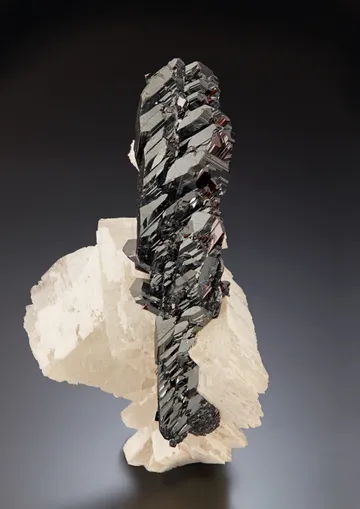
Photo: Wikimedia Commons / Rob Lavinsky, iRocks.com
Collectors look for clarity first: transparent to near-transparent quartz, ideally with high luster and sharp edges. The most desirable examples show the locality’s classic associations—tabular hematite perched on or partly enclosed by quartz, oriented rutile on hematite, snowy adularia, or delicate calcite and siderite. Gwindels from Cavradi are much scarcer than ordinary rock crystal and smoky quartz from the gorge, and matrix examples with good transparency and visible twist are especially sought after. Large single quartz crystals are not the norm; many clefts are narrow, so Cavradi’s finest quartz tends to be valued for aesthetics, perfection, and association rather than sheer size.
Search for specimens: View all quartz specimens from Cavradi Gorge, Switzerland
Cavradi Gorge, also known locally as Cavradischlucht, forms the northern exit of Val Curnera below Tschamut, in the municipality of Tujetsch, canton Graubünden. The locality is centered around 46° 38' 39" N, 8° 42' 33" E, but the name covers a collecting area of ravines, side gullies, cleft zones, old workings, and quartz-bearing slopes rather than a single mine. The best-known sublocality names encountered on specimen labels include Val Aulta, Val dils Cavengs, Val da Cristallas, and front Val Curnera.
The deposit type is Alpine-type fissure mineralization. These clefts formed in metamorphic rocks during Alpine deformation and fluid movement, and they served as open cavities in which quartz and associated minerals crystallized. In the central gorge the host rocks belong to the Urseren-Gavera zone of the Gotthard massif; the mineral-bearing mica schists and gneisses here are the source of the classic Cavradi hematite, rutile, quartz, and copper-sulfide associations. North of this zone, the Tavetscher Zwischenmassiv contributes a different cleft suite, notably including anatase. Near the Curnera reservoir to the south, the rocks are more pocket-poor, and collecting quality drops off.
Cavradi is not a conventional quartz mine. It is a working Strahler locality, and the “production” has come from hand-worked clefts, small rock cuts, and, in parts of the gorge, blasting by local collectors. Modern locality accounts describe decades of activity by Tujetsch-area Strahler, with small quarries and long heaps visible in the lower and central gorge. The Curnera dam, completed in the 1960s, and the service road associated with it also enter the locality’s collecting history: one photographed intergrowth of thick tabular hematite from Cavradi is specifically recorded as having been found during construction of the service road to the Curnera dam.
Access is alpine, awkward, and not casual. A commonly described approach begins near the golf course at Tschamut and takes about 45 minutes to reach the more interesting collecting ground. The path follows the eastern side of the gorge, in places only a few meters above the creek and in other places far above it. Warnings in the area are not ornamental: active Strahler work, falling rock, and occasional blasting are part of the locality. The lower and central gorge are not suitable for casual collecting, and current locality guidance emphasizes avoiding active workings, staying visible, and not lingering near other collectors’ overburden or work areas.
Legally and practically, collectors must treat Cavradi as a working alpine locality, not a public dump. Blasting and drilling are reported as restricted to residents of the community of Tujetsch. Even where collecting is possible, rope work, rockfall awareness, and good judgment are essential. Much of the productive ground is below 2000 meters and southwest-facing, so it can sometimes be accessible relatively early in the season, but spring brings loosened plates and rockfall, and summer heat in the gorge can be severe.
Notable finds include quartz with hematite “iron roses,” rutile on hematite, clear to cognac smoky quartz groups, rare gwindels, rare amethyst, quartz with calcite, quartz with siderite, and unusual healed or skeletal forms. Cavradi’s reputation rests on the whole paragenesis, but quartz is the unifying mineral: it is the transparent support, the smoky sculptural form, the cleft-filling mass, and sometimes the rare twisted prize.
Cavradi quartz is most often seen as rock crystal to pale smoky quartz, with the most admired color falling between colorless, very light grey, and warm cognac. Deep smoky pieces occur, but the locality’s signature is frequently a light, bright, transparent smoky tone rather than the blackish Morion style familiar from other Alpine regions. Fine examples are glassy, sharp, and striated, with the clean faces and high reflectivity that collectors expect from Alpine cleft quartz.
Crystal habits are diverse. Single crystals can be slender and doubly terminated, especially from Val Aulta-type material, and may sit exposed on gneiss or feldspar matrix. Groups of parallel or slightly divergent crystals are common in display specimens. Skeletal and stepped-growth crystals are documented, including unusual matrix pieces with dramatically different front and back faces. Cavradi also produces gwindels—twisted quartz crystals grown with rotation along an a-axis—though they are far scarcer than ordinary quartz. Closed or “sucre” gwindels, smoky gwindels, and gwindels on adularia matrix are the most coveted expressions.
Amethyst is rare but real from the gorge. Recorded examples include scepter amethyst associated with quartz, adularia, and small hematite. These are not the commercial purple amethyst clusters familiar from volcanic geodes; they are Alpine-cleft oddities, usually modest in size and prized for locality significance. Scepter growth, healed fractures, and distorted quartz forms are all part of the Cavradi vocabulary, especially where crystals grew, broke, and re-healed inside active fissures.
Size varies widely, but Cavradi quartz is usually admired as miniature to cabinet material. Documented examples include a 48 x 33 x 25 mm doubly terminated Val Aulta quartz, a 6.5 x 6 cm quartz cluster, a 13 x 11 cm aesthetic quartz specimen, a 14 cm pale smoky quartz with hematite, and a 19.5 x 4.5 cm quartz crystal with scalenohedral calcite on matrix. Gwindels are commonly a few centimeters across; market examples include pieces around 5.1 cm and 5.5 cm, while an exceptional smoky gwindel-bearing matrix group measured 9.6 x 8.7 x 7.2 cm and carried a gwindel over 4 cm.
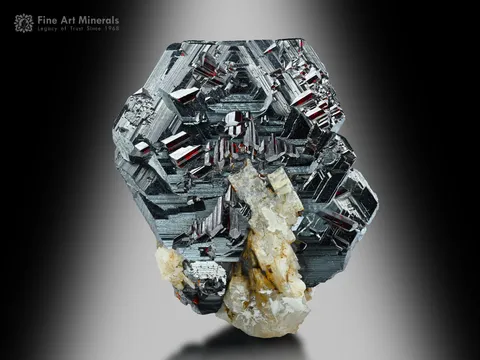
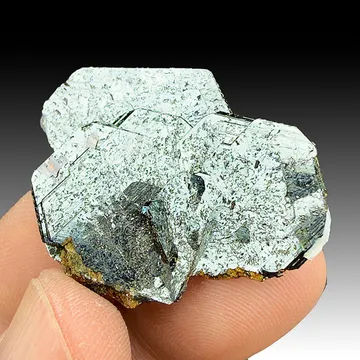
The classic associated minerals are hematite and rutile. Cavradi hematite occurs as lustrous tabular crystals, thick blades, rosettes, and complex multi-faced forms, often perched on quartz or feldspar. Rutile may appear as red crystals on hematite, sometimes epitactic and sometimes visually dramatic under magnification. Adularia provides the white feldspar contrast prized in smoky quartz groups. Calcite, siderite, strontianite, anatase, schorl, monazite, pyrite, malachite, gold, silver, and several copper sulfides are recorded from the locality, though not all are common or normally associated with collectible quartz specimens.
Quality factors are locality-specific. The best Cavradi quartz has high transparency, bright luster, clean termination, minimal edge wear, and a convincing alpine matrix. Hematite-on-quartz specimens rise sharply in desirability when the hematite is undamaged, lustrous, well centered, and accompanied by red rutile. Smoky quartz is judged on color balance: overly dark material can lose the luminous Cavradi look, while a pale cognac tone with water-clear interiors is highly attractive. For gwindels, collectors want visible twist, clean terminations, sharp form, glassy faces, and preferably matrix or association with adularia; matrix gwindels are much rarer than loose crystals.
The main authenticity issue with Cavradi quartz is locality precision. “Swiss smoky quartz,” “Graubünden quartz,” “Val Curnera quartz,” and “Cavradi” are not interchangeable labels. Cavradi has a distinctive style, but there are other excellent Alpine quartz localities in Graubünden, Uri, Valais, and the broader central Alps. For important purchases, especially gwindels and hematite-on-quartz specimens, old labels, Strahler provenance, dealer documentation, or a chain of collection history matter.
No locality-specific quartz treatment problem is prominent in the published and dealer sources for Cavradi. The concern is not usually dyeing, coating, or irradiation; it is attribution, repair, and condition. Generic smoky quartz, ordinary Alpine gwindels, and quartz-hematite associations from other Swiss localities can be made to sound more desirable if loosely labeled. A credible Cavradi label should ideally include Cavradi Gorge or Cavradischlucht, Val Curnera, Tujetsch, Surselva, Graubünden/Grisons, Switzerland, and, when known, a sublocality such as Val Aulta.
Repairs deserve close inspection. Cavradi matrix specimens can be difficult to extract because the pockets occur in steep, fractured, weathered rock. Dealer descriptions of top hematite-on-quartz pieces explicitly note that repairs are common in this material, particularly where hematite and quartz sit on decayed granite or gneiss matrix. Inspect joins between quartz and matrix, hematite-to-quartz contacts, and the bases of standing crystals. A repaired Cavradi specimen can still be collectible if disclosed, stable, and aesthetic, but undisclosed reconstruction materially affects value.
Condition issues include edge wear on quartz terminations, bruising on high points, chipped gwindel margins, contacted back sides, broken rutile needles, and loosened hematite blades. With gwindels, some surface irregularities, sutures, and stepped growth may be natural features of the growth habit rather than damage; however, peripheral chipping is common and should be separated from true gwindel morphology. For hematite-on-quartz, check whether the hematite is complete around its beveled edges and whether the quartz base is freshly broken, naturally healed, or trimmed.
Rarity depends strongly on habit. Ordinary small quartz, especially with some contacts, is obtainable. Fine gemmy quartz on matrix is much scarcer. Cavradi quartz with balanced, undamaged hematite and rutile is a classic European cabinet specimen and commands a premium. Gwindels from Cavradi are rarer still, and good matrix examples are seldom encountered. A few recent market references show the spread clearly: modest loose or small matrix quartz can appear in the low hundreds of dollars or euros, while fine smoky gwindels and major matrix pieces can reach four figures; exceptional gwindel or hematite-rutile-quartz specimens have been offered or sold for several thousand dollars.
The approach to Cavradi is part of the specimen’s meaning. From Tschamut, the collector walks toward Val Curnera, following the eastern side of the gorge on a narrow path that may sit only 5 meters above the creek in one stretch and as much as 100 meters above it in another. After roughly 45 minutes the warning appears: “Avoid walks in the Cavradi area.” In many localities such a sign would be an administrative formality. Here it is literal. The lower and central gorge are active Strahler ground, with blasting in the working areas and small quarries cut into the slopes.
The local advice is unusually concrete: if you cross the lower gorge, do it quickly, and not in a group larger than two or three people. Make yourself visible. Do not poke through another Strahler’s tempting overburden, because it distracts the person working and puts both of you at risk. The old, partly overgrown clefts away from active work may still reward patience, but the best ground has never been easy. Cavradi’s treasure sits in a ravine of loose, tough rock where even a promising wall may require days of work.
The rope-work cautions read like field notes written by someone who has heard stones pass too close. In spring, sharp plates protrude from the wall and can fall easily. A rope can be cut by a sharp falling rock. Trees, roots, rock heads, and bolts are possible anchors, but bolts are suspect if the rock sounds hollow. Nuts and friends, so useful on clean climbing cracks, are nearly useless here because the cracks are poor and the footing can be slippery. The image is not of a romantic collector casually opening a pocket, but of a Strahler standing in a steep, hot, unstable gorge, working slowly because haste breaks both crystals and people.
Above the gorge, the Curnera dam adds an unexpected modern layer to the locality. The dam was built in 1966, and the road to the reservoir cut into the mineralized landscape. One recorded Cavradi specimen—a 6.6 x 3.5 cm intergrowth of thick tabular hematite—was found during construction of the service road to the Curnera dam. The same road and reservoir landscape later acquired a passing pop-culture footnote: the dam was used in the 2014 film Edge of Tomorrow as a supposed alien hiding place. For mineral people, however, the real drama is across the valley on the rocky slopes, where Graubünden tourism material bluntly calls the ground the “Eldorado of the local prospectors” and warns hikers not to be alarmed by weekday blasts.
One of the most revealing modern specimen stories concerns a major Cavradi hematite-on-quartz piece handled by The Arkenstone. The specimen measured 10.0 x 8.0 x 8.0 cm after trimming, with a full 4 cm hematite crystal standing over clear, sparkling quartz. Rob Lavinsky recalled first seeing it around 2002 in the Marc Weill collection in Connecticut; it had reportedly come from the Marcus Budil collection. At that time it was roughly the size and weight of a bowling ball, impressive but unwieldy, and he assumed it had been repaired. Years later, after the specimen resurfaced in another collection, he acquired it and trimmed it down in two stages over several years. The surprise was that it was not repaired after all. The final form preserved enough granite matrix to remain natural and balanced, but opened the view so the hematite and quartz could be read from all sides.
A separate Cavradi specimen that passed through Heritage Auctions carries a note from Rock H. Currier. It was a hematite and oriented rutile on quartz, a flaring cluster with flattened hematite crystals up to about 4 cm and red rutile lying on the hematite over clear quartz. Currier recorded that he obtained it in a large trade with the Santa Barbara Museum of Natural History, from the Ed Harrison collection. The specimen sold on February 7, 2022 for $4,125, a reminder that the finest Cavradi pieces are not simply Alpine souvenirs; they are established mineral classics with provenance, published comparisons, and auction history.
The photographic record from the Cavradi circle gives a sense of how varied the quartz can be when the clefts cooperate. One Val Aulta piece is described simply as a “Cavradi classic,” an aesthetic quartz specimen measuring 13 x 11 cm. Another is a perfect quartz cluster on matrix, 6.5 x 6 cm. A 3.7 cm fractured and rehealed quartz crystal shows the active life of a cleft, where growth can stop, break, and seal again. A 6 x 5 cm scepter amethyst with quartz, adularia, and small hematite is called unique in the caption. A long 19.5 x 4.5 cm quartz crystal carries scalenohedral calcite on matrix. A pale smoky quartz with hematite reaches 14 cm. These are not repetitive production pieces; they are individual Alpine-cleft episodes, each preserving a slightly different moment of pressure, fluid, fracture, and patience.
_2.jpg)
