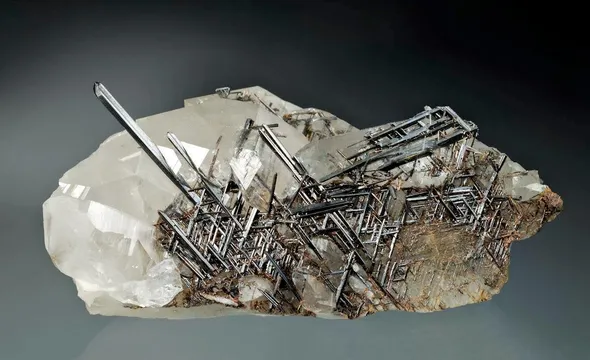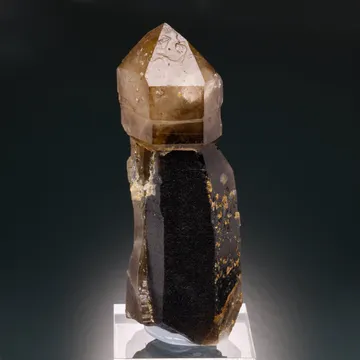
Val Giuv, Switzerland - Smoky Quartz from a premier Alpine locality famed for glassy, deep smoky color and iconic twisted gwindel crystals prized by collectors.
Key facts
Val Giuv is one of the great Alpine smoky-quartz localities: a high, severe, mineral-rich valley above Sedrun in the Tujetsch district of Graubünden, famous above all for smoky quartz of exceptional glassiness and for gwindels—twisted quartz crystals whose faces seem to climb in a slow spiral. The best Val Giuv pieces combine the virtues collectors associate with the Swiss Alps at their finest: sharp form, watery internal clarity, high vitreous luster, and a restrained but powerful smoky color ranging from warm cognac and clove-brown through dark morion-like tones.

Photo: Wikimedia Commons
What gives Val Giuv its particular mineralogical identity is the relationship between Alpine-type fissures and the so-called Giuv syenite, a weakly metamorphosed quartz-monzonite to quartz-syenite body exposed in the upper valley. This rock is conspicuous for large, pale K-feldspar crystals, greenish actinolite, dark biotite, and a naturally elevated uranium-thorium background. In smoky quartz, the color is produced by irradiation-related color centers in aluminum-bearing quartz; in Val Giuv the dark smoky tone is tied to that radioactive host-rock environment. The result is not merely “brown quartz,” but quartz with a deep, internally luminous smoke that can look nearly black until held to the light.

Photo: Wikimedia Commons
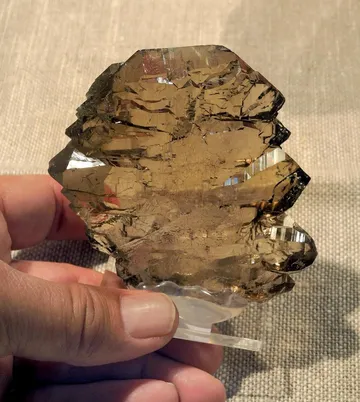
The locality’s most celebrated crystals are gwindels. These are not ordinary quartz prisms bent after growth; they are growth forms in which quartz appears to have developed laterally while twisting around an axis. Val Giuv is especially admired for both open and closed smoky gwindels, many with a parquet-like surface sparkle, fine internal transparency, and crisp rhombohedral faces. Serious collectors look for a clearly expressed twist, clean terminations, original luster, and the absence of distracting bruising along the crest or edges. A good Val Giuv smoky gwindel is instantly recognizable: compact, architectural, glassy, and often surprisingly bright for its depth of color.
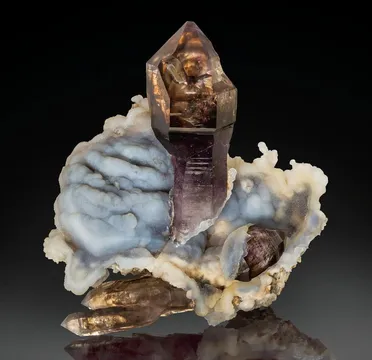
The aesthetic peak of the locality is smoky quartz with snow-white adularia. The contrast is classic Alpine mineralogy at its most elegant: dark transparent quartz against white feldspar, sometimes touched by chlorite, calcite, zeolites, or other fissure minerals. Val Giuv specimens can be miniature, cabinet-sized, or much larger, but the best are not judged by mass alone. They are judged by the balance between transparency, sculptural form, luster, color, and the unmistakable tension of crystals grown in a narrow, high-pressure Alpine cleft.

Photo: Wikimedia Commons
Historically, Val Giuv belongs to the living tradition of the Swiss Strahler—the Alpine crystal hunters who work fissures with patience, tools, permits, ropes, local knowledge, and a strong tolerance for exposure. The valley has been searched for crystals for roughly two centuries, and yet it still produces notable finds. That is part of its allure: Val Giuv is neither an abandoned mine nor a casual roadside collecting site, but a difficult high-Alpine mineral field where experience, endurance, geology, and luck still matter.
Search for specimens: View all smoky-quartz specimens from Val Giuv, Switzerland
Val Giuv is a glacial trough valley in the southeastern Aar Massif, in the municipality of Tujetsch, Surselva Region, Canton Graubünden. The valley trends up from the Sedrun–Camischolas area toward the high boundary with Uri, with important collecting ground in the upper valley around localities such as Emprema Muotta, Secunda Muotta, Tiarza Muotta, Rotwichel, Giuvstöckli, the Piz Giuv south slope, Kalkspat-Lücke, and the Giuv glacier area.
The deposit type is Alpine-type fissure mineralization. These are tension clefts and related openings formed during Alpine tectonism and later filled by hydrothermal fluids. In Val Giuv, the lower valley crosses several structural units, but the finest smoky-quartz and gwindel reputation is closely associated with the upper valley and the Giuv syenite. The Giuv syenite body is cut by numerous aplite dikes, some several meters wide and traceable for long distances. The aplites matter because they introduce a slightly different paragenesis, including beryllium-bearing minerals; milarite, one of Val Giuv’s most important mineralogical claims to fame, is associated with these aplitic zones.
Fissures are not evenly distributed. They are concentrated particularly along the southern boundary of the Giuv syenite body and within or near the aplite dikes. This patchiness explains why the valley can be simultaneously famous and frustrating: great crystals have come from it, but the productive clefts are not simply scattered everywhere across the slopes. The obvious fissures have mostly been worked, and present-day success commonly demands long familiarity with quartz veins, wall-rock structures, old workings, and subtle signs of unopened cavities.
Val Giuv has no conventional smoky-quartz “mine” in the industrial sense. Its production history is the history of Alpine Strahler work: individuals and small teams prospecting, opening clefts, extracting crystals, and transporting specimens down from difficult ground. The region has been searched for about 200 years. Finds continue, but the collecting situation has changed. Easily reached clefts near the base of the cliffs have long been emptied, and important modern work is often higher, steeper, and more technically demanding.
Access is regulated. Collecting crystals and minerals with tools in the municipality of Tujetsch requires a Strahler permit. The current municipal law applies across the whole municipality regardless of land ownership. A standard Strahler permit is issued to natural persons who are at least 18 years old and carry liability insurance; the permit is valid for the calendar year. Drill and explosive use requires an additional authorization and is restricted to eligible Tujetsch residents who meet stricter age and legal requirements. Collecting is prohibited on Sundays and on specified public and church holidays, and there are also rules for protected areas, pasture damage, cleft marking, material storage, helicopter transport, reporting exceptional finds, and penalties for violations.
For collectors reading labels, “Val Giuv” may refer broadly to the valley, but more precise sublocality information adds value. Secunda Muotta is especially familiar on gwindel labels, while Kalkspat-Lücke is noted for calcite and quartz finds, and Rotwichel–Piz Giuv material appears in records of large smoky quartz, adularia, and amiant-bearing specimens. Old labels may use variants such as Giuv Valley, Val Giuf, Tavetsch, Tujetsch, Graubünden, Grisons, or Grischun.
Notable finds include major smoky-quartz clefts in the Giuv syenite, the 1996 large smoky-quartz find reported in Schweizer Strahler, and the Curschellas brothers’ celebrated 360-kilogram crystal group from 1996. Val Giuv is also the type locality for milarite, and a 4.5 cm Alpine milarite crystal found there in 2000 is recorded as the largest Alpine specimen of the species. The Museum Regiunal Surselva holds a remarkable 180 cm long specimen of Giuv syenite with smoky quartz, adularia, and amiant from between Rot Wichel and Piz Giuv, entered in 1999 after helicopter-transport compensation.
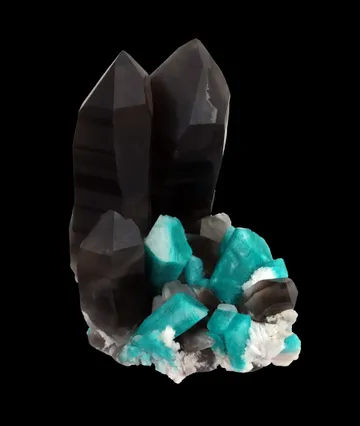
The signature Val Giuv smoky quartz is lustrous, transparent to gemmy, and sharply formed. Colors range from pale smoky and cinnamon-brown to rich clove-brown and very dark smoky morion tones. Fine examples can look nearly black in reflected light but open into transparent brown when backlit. This transparency-through-darkness is a key quality factor: the most desirable pieces are not merely dark, but internally alive.
Crystal habits include normal prismatic quartz, macromosaic quartz, gwindels, double-terminated crystals, skeletal or etched forms, faden-like aggregates, scepters in associated quartz varieties, and groups on matrix. Large trapezohedral x-faces are not uncommon, and these faces can be slightly roughened or textured. On gwindels, the faces may have a faceted, parquet-like surface that catches light differently from ordinary prism faces.
Val Giuv gwindels occur in both open and closed styles. In open gwindels, stacked subindividuals and rhombohedral faces are more visibly separated, giving the crystal a stepped, sparkling architecture. Closed gwindels appear more compact and slab-like, with the twist expressed through the whole body rather than through obvious open gaps. Some pieces show a strong torsion angle; others are subtler, with only a few degrees of rotation across the crystal. In fine Val Giuv examples, even a modest twist can be very elegant because of the luster and clarity.
Typical specimen sizes range from thumbnails and miniatures through small cabinet and cabinet specimens. Documented and commercial examples include individual gwindels around 5–9 cm, cabinet specimens around 13 cm across, and much larger groups. Truly large Val Giuv crystal groups are exceptional and usually remain in local collections, institutions, or long-held private collections rather than circulating freely on the market.
Associated minerals are an important part of Val Giuv’s identity. The classic association is smoky quartz with adularia, the white K-feldspar making a crisp contrast to the smoky crystals. Chlorite is common as inclusions, coatings, or greenish surface accents; in some gwindels it contributes to silky luster or internal veils. Other associated species include calcite, heulandite, stilbite, laumontite, scolecite, pyrite, fluorapatite, apatite, epidote, titanite, actinolite or byssolite, scheelite, fluorite, baryte, rutile, hematite, albite, datolite, phenakite, and the locality-defining milarite.
Quality is judged by several interacting factors. For a normal smoky quartz crystal, collectors want sharp termination, luster, transparency, attractive smoky saturation, undamaged display faces, and preferably some matrix or companion minerals. For a gwindel, the criteria become more specialized: strength and readability of the twist, completeness of the edges, whether it is open or closed, surface sparkle, absence of broken crests, clean transparency, and overall sculptural stance. A small but perfect Val Giuv gwindel can outrank a larger ordinary smoky cluster.
Adularia association can significantly improve desirability when the feldspar is bright, well-formed, and naturally positioned rather than visually competing with the quartz. Chlorite can be positive or negative depending on presentation: fine green inclusions and tasteful coatings are highly Alpine and can enhance contrast, while dull overgrowths that obscure faces may reduce appeal. Recrystallized contacts are common in cleft minerals and are not automatically flaws, but collectors should distinguish a natural rehealed back or contact from breakage, trimming, or repair.
The main authenticity concern with Val Giuv smoky quartz is not a widely documented, locality-specific fake industry, but rather label accuracy, undisclosed treatment in smoky quartz generally, and condition. Because smoky quartz can be produced or darkened by artificial irradiation of suitable quartz, buyers should favor specimens with credible Alpine morphology, old or documented provenance, dealer transparency, and labels that make sense geologically and stylistically. Val Giuv material should not look like mass-produced commercial smoky quartz points; fine pieces normally show Alpine cleft character—growth textures, natural contacts, companion minerals, and the high luster associated with Swiss fissure quartz.
The dark color of Val Giuv smoky quartz is expected and natural for the locality, especially in material from the Giuv syenite environment. That means darkness alone is not a red flag here. The better question is whether the crystal has the right total character: natural terminations, coherent growth surfaces, plausible contacts, appropriate associations such as adularia or chlorite, and a label history that does not appear invented after the fact. A suspiciously uniform, glassy-black quartz object with no Alpine context, no locality history, and commercial carving or polishing should be treated differently from a sharp cleft specimen on matrix.
Condition is crucial. Alpine quartz often emerges from tight pockets, and contact damage, bruised edges, minor chips, repaired clusters, trimmed bases, and broken-away matrix are common issues. On gwindels, the outer edges and crest are the first places to inspect. Even a small chip can interrupt the visual flow of the twist. Look carefully at the back: a natural recrystallized contact can be acceptable and even interesting, but a freshly broken back, saw cut, glue line, or undisclosed repair changes the specimen’s value.
Chlorite coatings and pocket clay can obscure damage, so examine photographs from multiple angles and, when possible, under both reflected and transmitted light. Fine Val Giuv smoky quartz should reward backlighting: the color should open, zoning and inclusions should become legible, and the crystal should show life rather than dead opacity. For adularia-associated pieces, inspect feldspar edges as well; white adularia can hide small chips in photographs.
Market availability is steady but uneven. Small smoky crystals and modest gwindels appear periodically from dealers and older collections. Fine gwindels with strong twist, excellent transparency, and minimal damage are much scarcer and draw competition from both quartz specialists and Alpine-mineral collectors. Large historic groups, especially those with adularia or significant provenance, are rarely offered and can remain off the market for decades. The strongest Val Giuv pieces occupy the same collector tier as classic Swiss Alpine material from Grimsel, Furka, Cavradi, and related high-Alpine fissure localities, but with the distinct cachet of the Giuv syenite and the valley’s world-class gwindels.
In August 2013, visitors to the Disentis mineral fair stopped in front of a new Val Giuv find by the Sedrun brothers Damian and Luis Curschellas. The attraction was not simply smoky quartz, but a pocket full of gwindels—the twisted crystals that make quartz collectors lean closer. The tools behind the story were as blunt and Alpine as the crystals were refined: dynamite, hammer, chisel, pocketknife, and crowbar. The brothers had opened a cleft in the rough rock walls of Val Giuv and brought out crystals whose spiral growth made the display one of the fair’s talking points.
Damian Curschellas called such stones “wirklich eine Rarität,” and the French collector Grégoire Saussus, who came yearly to the Disentis fair because of gwindels, confirmed the pull of the material. He described the Val Giuv smoky quartz as “fast schwarz und lupenrein” when held to the light: almost black, yet loupe-clean. The brothers did not even bring their best crystals to sell. Damian’s explanation was simple and familiar to anyone who knows local Alpine collecting culture: the best ones are kept.
Their largest trophy was not on a table at the fair. It was in Luis Curschellas’s sports shop in Sedrun: a 360-kilogram crystal group found in 1996. The reported value was around 100,000 Swiss francs, but for the brothers it was not for sale. Damian was grateful that such masses could be flown out by helicopter, because the old way was human backs and long descents. His remark cuts to the practical reality behind every large Val Giuv specimen in a display case: without modern transport, the biggest pieces would have been almost impossible to save intact from the mountain.
The same article captured a shift in Val Giuv collecting. Better tools had not made the work easy; in some ways the work had become more dangerous because the easy clefts were gone. The readily reached fissures at the foot of the cliffs had been emptied, pushing Strahler higher and into the rock walls themselves. Quartz veins still acted as guides, and sometimes one cleft led toward another. In the brothers’ new cleft, they had seen a hole behind the opened space—perhaps nothing, perhaps the next chamber.
Patrick Reith’s field description of Val Giuv gives the same story from the landscape’s point of view. The valley begins gently, with wide meadows and a small mountain stream, and within about twenty minutes the first cleft signs and old workings can be seen. Farther in, the ground steepens, grass gives way to rubble and early-season old snow, and after roughly two hours the lower end of the upper valley is reached. From there, the valley becomes properly Alpine. Paths disappear. Orientation matters in bad weather. Above the steep scree toward the Giuv glacier, near Emprema Muotta, a tent can be pitched at about 2600 meters—but the wind is not romantic. Reith warns that more than one collector has had a tent torn apart up there, converting the dream of a high camp into a long and miserable night.
His account also explains why Val Giuv is loved beyond its specimens. The Muottas toward the Giuvfirn are cut by thick aplite bands and carry not only smoky quartz but amethyst, adularia, apatite, epidote, datolite, baryte, pyrite, calcite, and the famous large milarite found by Conrad Berther. The upper valley, continuously above about 2600 meters in the Giuv syenite zone, has an unusually high density of clefts, and the smoky quartz from that ground is praised for the union of luster, color, and form. When snow-white adularia appears with smoky quartz on the same specimen, the contrast can be nearly unsurpassable.
Yet Reith is equally clear that Val Giuv gives nothing away. Good Strahler have searched the valley for decades, some spending more than thirty days a year looking for new clefts. The route to the summit regions of Schattig Wichel and other three-thousand-meter ground is long, and anyone without sure footing and high-Alpine experience will quickly meet the limit of wishful thinking. His closing image is not a crystal but an evening: no signposted tourist highway, the dark valleys below, and glaciers to the south glowing orange at sunset from nearly 3000 meters.