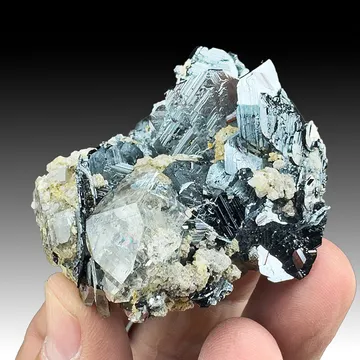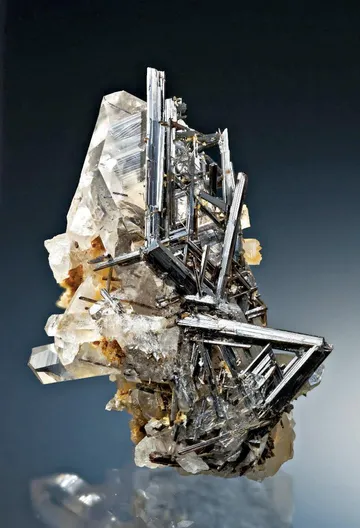
Grisons, Switzerland: Alpine quartz varieties, milarite from Val Giuv, and manganese arsenates—classic localities prized by collectors for rarity and beauty.
Key facts
Grisons—Graubünden in German, Grischun in Romansh, and Grigioni in Italian—is not a single mine locality so much as one of Europe’s great mineral provinces. For collectors it matters because several very different Alpine environments meet within one canton: high fissure systems in the Aar and Gotthard realms around Tujetsch and the Vorderrhein; the celebrated Cavradi Gorge in Val Curnera; beryllium-bearing aplite and “Giuv syenite” associations in Val Giuv; and metamorphosed manganese deposits at Falotta, Parsettens, Fianel, Starlera, and related Alpine ore bodies. The collector’s mental image of Grisons is usually quartz first: glassy rock crystal, cognac to dark smoky quartz, compact and twisted gwindels, double-terminated crystals, skeletal forms, and matrix groups with white adularia, chlorite, calcite, hematite, rutile, zeolites, or rare accessory minerals. But the canton’s importance runs deeper than display quartz. It includes classic type-locality and first-described minerals, among them milarite from Val Giuv and a suite of rare manganese arsenates, vanadates, and silicates from the Oberhalbstein and Val Ferrera districts.
Regional View
Country View
The best Grisons specimens have a distinctly Alpine restraint. They are not gaudy in the way of oxidized silver camps or pegmatite pockets; their beauty lies in architecture, transparency, surface texture, and mineral contrast. A first-rate Val Giuv smoky gwindel can be the color of tea, cognac, or dark clove, yet still flash internally when backlit. Cavradi hematite may form lustrous black metallic “iron roses” and blades accented by red rutile and small quartz. Rock-crystal groups from Tujetsch, Heinzenberg, Val Medel, Val Strem, Val Nalps, and neighboring valleys can be water-clear, chlorite-dusted, phantom-bearing, or delicately perched on adularia. In the manganese districts, the specimens are often smaller and more systematic than decorative, but they carry enormous mineralogical weight because of their unusual chemistry and type-locality status.

Photo: Wikimedia Commons
The canton’s collecting history is inseparable from the Swiss Strahler tradition. “Strahler” are Alpine crystal hunters, and in the Surselva the Romansh term “cava cristallas” carries the same practical meaning: people who read cliffs, quartz veins, cleft clay, iron staining, and mountain weather as fluently as others read a map. Grisons has produced museum specimens, scientific type material, local legends, and hard-earned commercial classics through that tradition. Many important finds were not industrial mine production at all, but the work of individual collectors opening narrow Alpine clefts with hammer, chisel, drill, rope, patience, and a trained eye.

Photo: Wikimedia Commons
Search for specimens: View all specimens from Grisons, Switzerland
Grisons is best understood as a regional collecting field rather than a single deposit. Its collector-grade quartz comes chiefly from Alpine-type fissures: open tension clefts and related cavities formed during Alpine deformation and later lined by hydrothermal minerals. In the Tujetsch–Surselva district, fissures cut gneisses, schists, granitoids, aplite bands, and the famous Giuv syenite body. These cavities supplied silica-rich fluids and open space for euhedral quartz, adularia, chlorite, calcite, zeolites, rutile, hematite, titanite, epidote, apatite, baryte, and rare Be-bearing species. The color of the finest smoky quartz is linked to irradiation-related color centers in aluminum-bearing quartz, and the naturally radioactive background of certain granitic and syenitic rocks in the central Alps is one reason the region yields such characterful smoky crystals.
The most famous Grisons quartz district is Tujetsch, especially Val Giuv, Val Strem, Val Val, Val Nalps, Val Curnera, Cavradi Gorge, Drun Tobel, and the country around Sedrun, Rueras, Camischolas, Tschamut, and the upper Vorderrhein. Val Giuv rises above Camischolas toward the Uri–Graubünden boundary and the Piz Giuv area. The upper valley, especially around the Muottas and the Giuv syenite, is known for high cleft density, smoky quartz gwindels, large smoky quartz groups, adularia contrasts, skeletal quartz, titanite on chloritized adularia, zeolite associations, and important rare minerals. Productive zones are localized rather than evenly distributed; aplite bands and structural boundaries are especially important. Old labels may read Val Giuv, Val Giuf, Giuv Valley, Tavetsch, Tujetsch, Vorderrhein, Graubünden, Grisons, or Grischun.
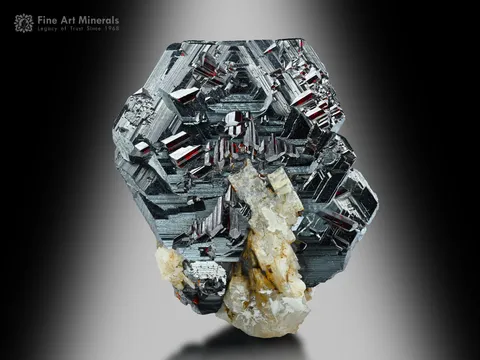
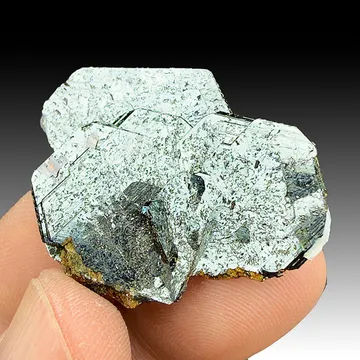
Cavradi Gorge, at the northern outlet of Val Curnera in the municipality of Tujetsch, is another essential name on Grisons labels. It is best known for hematite and rutile, but quartz is the structural backbone of many Cavradi specimens. Its fissures in metamorphic rocks of the Gotthard realm and the Urseren-Gavera zone yielded bright quartz, pale to cognac smoky quartz, scarce gwindels, hematite blades and iron roses, red rutile, adularia, albite, calcite, siderite, strontianite, baryte, malachite, copper sulfides, monazite-(Ce), xenotime-(Y), and other accessories. Some material is tied to sublocalities and working zones such as Val Aulta, Val dils Cavengs, and Val da Cristallas. Cavradi should not be treated as a casual roadside locality: it has active Strahler workings, steep ground, falling rock, and a long history of technically demanding extraction.
The canton’s ore-mineral history is equally important. The Oberhalbstein manganese deposits at Falotta, Parsettens, Alp digl Plaz, and nearby localities are among Switzerland’s largest radiolarite-hosted manganese ore occurrences. The manganese bodies were metamorphosed and recrystallized, producing braunite-, rhodonite-, spessartine-, tinzenite-, sursassite-, parsettensite-, piemontite-, and rhodochrosite-bearing assemblages, with late clefts and alteration zones carrying rare arsenates and vanadates. Falotta is an abandoned manganese mine about 14 km south-southeast of Tiefencastel, above the Tinizong–Rona area; workings included several small open pits and were operated only seasonally because of altitude and snow.
Mining at the Tinizong manganese deposits was modest but strategically significant. Early references to mining in the wider area go back to the medieval and early modern period, while the mines around Tinizong enter the record clearly in the nineteenth century. Initial manganese exploitation in the nineteenth century was poor and ended by the 1890s. Wartime supply pressure made the deposits important again: during the First World War, Falotta, Parsettens, and Alp digl Plaz supplied roughly 2,500 tonnes of manganese ore to Swiss industry, and during the Second World War Falotta and Parsettens were worked again. Falotta yielded about 1,800 tonnes in the mid-1940s, while Parsettens supplied about 2,500 tonnes during the 1942–1945 interval. Ore transport involved cableways, rollways, trucks, and rail movement toward processing and steel-making centers. Today these mines are of interest mainly to mineral collectors, mining historians, and systematic mineralogists.
Val Ferrera, particularly Fianel and Starlera near Ausserferrera and Ferrera, adds another chemical dimension. These are Fe-Mn deposits in the Eastern Swiss Alps, with hematite-quartz-carbonate ores and quartz-dolomite veinlets carrying unusual W-Mo-As-Y-Be-REE-bearing minerals. Fianel is the type locality for fianelite and ansermetite and is a key locality for scheelite-powellite, paraniite-(Y), chernovite-(Y), vanadium minerals, beryl, phenakite, monazite-(Ce), fluorapatite, and related rare species. Starlera, likewise, has produced rare manganese and antimony-bearing species and is tied to the type-locality record of fluorcalcioroméite.
Collecting access varies by municipality, land ownership, protected zones, season, and method. In Tujetsch, current municipal rules require a permit for crystal and mineral collecting with tools anywhere in the municipality, regardless of land ownership. A standard Strahler permit is for natural persons who are at least eighteen and carry liability insurance; the use of explosives or drilling machines requires additional authorization and is restricted to eligible residents meeting stricter legal requirements. Collecting is prohibited on Sundays and specified holidays, and the law includes rules on cleft marking, protected work sites, reporting exceptional finds, storage of material, and penalties. Serious collectors should treat Grisons localities as regulated Alpine workplaces rather than public dumps. Even where access is legal, the productive ground is often steep, loose, exposed, snowy into summer, or subject to rockfall.
Notable specimen finds are scattered through the record. Val Giuv is the type locality for milarite and has yielded smoky quartz gwindels of international standing, large smoky quartz groups, rare amethyst-colored scepter quartz, baryte crystals, faden quartz aggregates, and a 4.5 cm Alpine milarite crystal recorded as the largest Alpine specimen of the species. In 1996, Damian and Luis Curschellas recovered a 360 kg smoky quartz group from the Giuv syenite; another major Val Giuv specimen, a 180 cm long Giuv syenite piece with smoky quartz, adularia, and amiant from between Rot Wichel and Piz Giuv, entered the Museum Regiunal Surselva after helicopter-transport compensation. Cavradi is famous for hematite-rutile-quartz associations, including pristine metallic hematite blades with embedded wine-red rutile and quartz accents. Falotta, Parsettens, and Fianel are less about large display crystals and more about rare, type-locality, and chemically sophisticated species.
Quartz from Grisons ranges from classic Alpine rock crystal to smoky quartz, amethyst-colored scepters, gwindels, skeletal crystals, faden quartz, and matrix groups with adularia, chlorite, hematite, rutile, calcite, zeolites, and rare accessories. The finest colorless quartz is prized for water clarity, high luster, sharp terminations, and natural cleft contacts; the best smoky examples show transparency through color rather than dead opacity. In Val Giuv, quartz is closely tied to the Giuv syenite and aplite-bearing fissure systems, where normal prisms, double-terminated crystals, gwindels, and skeletal forms occur with adularia, chlorite, calcite, heulandite, stilbite, apatite, titanite, epidote, baryte, and milarite. Cavradi quartz tends to be valued not only as quartz itself but as the stage for hematite and rutile: bright quartz crystals carrying metallic hematite or red rutile can be much more desirable than isolated quartz points from the same district. Ordinary Grisons quartz may be cloudy, bruised, clay-coated, or heavily contacted; superior pieces have clean display faces, undamaged terminations, lively internal reflections, convincing Alpine growth textures, and precise sublocality labels such as Val Giuv, Secunda Muotta, Piz Gendusas, Val Strem, Cavradi Gorge, Val Aulta, or Kalkspat-Lücke.
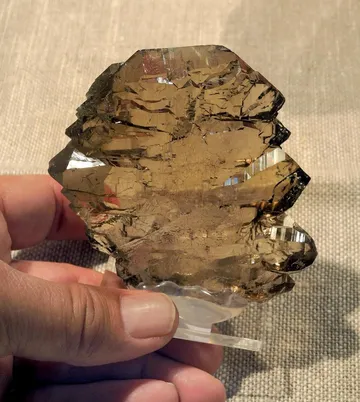
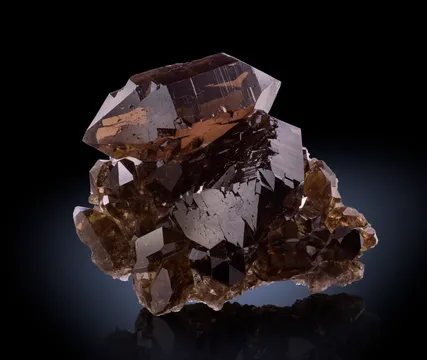
Smoky quartz is the collector emblem of Grisons, especially from Val Giuv and the surrounding Tujetsch high valleys. Val Giuv material is admired for glassy luster, sharp Alpine form, and color that ranges from pale honey-smoke through cognac and clove-brown to dark morion-like tones; many fine crystals look almost black in reflected light but open into warm transparent brown when held to light. The premier habit is the gwindel, a twisted quartz growth form in both open and closed styles, commonly compact, architectural, and sparkling on the surface; good examples are judged by the strength and readability of the twist, completeness of the crest and edges, transparency, luster, and absence of chips. Smoky quartz groups with white adularia from Val Giuv are among the most aesthetic Grisons specimens because the dark transparent quartz and bright feldspar make a classic Alpine contrast, sometimes with chlorite, calcite, zeolites, fluorapatite, or actinolite. Cavradi smoky quartz is generally less abundant as a market category than Val Giuv smoky quartz but becomes important when paired with hematite, rutile, or adularia. The best pieces are not merely large or dark; they have Alpine cleft character, natural contacts, growth complexity, and a label that places them within the correct Grisons valley or gorge.
Beyond quartz, Grisons is one of Switzerland’s richest systematic-mineral regions. Val Giuv is the type locality for milarite, K(◻H2O)Ca2(Be2Al)[Si12O30], a Be-bearing cyclosilicate whose history is famously entangled with a false early locality attribution to Val Milà. Cavradi Gorge is a benchmark Alpine locality for hematite and rutile, with iron roses, lustrous blades, rutile needles, and quartz-adularia associations. The Falotta manganese mine at Tinizong is the type locality for falottaite, geigerite, grischunite, and vaniniite, and it also produced important assemblages with sarkinite, tilasite, manganberzeliite, rhodochrosite, rhodonite, spessartine, sursassite, tinzenite, parsettensite, kutnohorite, piemontite, and wallkilldellite-group minerals. Parsettens Alp is tied to parsettensite, sursassite, and tinzenite, while Fianel in Val Ferrera is essential for fianelite, ansermetite, scheelite-powellite, paraniite-(Y), chernovite-(Y), palenzonaite, pyrobelonite, beryl, phenakite, monazite-(Ce), and fluorapatite. For collectors who prize rare Alpine chemistry, these small, often unattractive-looking manganese and Fe-Mn specimens can be as significant as any smoky quartz gwindel.
The first collector issue with Grisons material is locality precision. “Grisons,” “Graubünden,” and “Swiss Alps” are broad labels, not specimen-grade locality data. A smoky quartz labelled simply “Grisons” may be perfectly legitimate, but it is worth less scientifically and usually less commercially than one traceable to Val Giuv, Secunda Muotta, Piz Gendusas, Val Strem, Cavradi Gorge, Val Curnera, Val Aulta, or another specific valley or cleft zone. Older labels may use historical, German, Romansh, or French-influenced spellings—Tavetsch for Tujetsch, Giuf for Giuv, Grischun for Grisons, or Cavradischlucht for Cavradi Gorge. These variants are normal, but vague modern relabelling should be treated carefully.
There is no famous, locality-specific fake industry for Grisons quartz on the scale seen in some commercial gem-mineral sources. The risks are subtler: generic Swiss smoky quartz sold as Val Giuv, Val Giuv-style gwindels relabelled from other Alpine districts, ordinary quartz darkened by artificial irradiation, repaired gwindels, trimmed backs, and incomplete old labels inflated into more desirable sublocalities. Because smoky quartz can be artificially darkened in general, a very uniform black color without Alpine surface character should not be accepted on color alone. Genuine Grisons smoky quartz should have a coherent total personality: natural terminations, cleft contacts or matrix, Alpine growth textures, plausible associations, and a label history that makes sense.
Condition matters greatly. Alpine fissure crystals grew in narrow cavities and were removed from hard, fractured rock, so contacts, bruised edges, small chips, repaired groups, and broken-away matrix are common. On gwindels, inspect the crest and outer edges first; a small chip in the wrong place can interrupt the entire visual line of the twist. On quartz groups, look for crushed contacts hidden by chlorite or pocket clay, repaired terminations, and unnatural trimming. A natural recrystallized contact or healed fracture is not necessarily a defect, but fresh breaks, glue lines, saw marks, or undisclosed restorations are.
Cleaning should be conservative. Chlorite, limonite, clay, and carbonate films are part of many Grisons cleft environments, and aggressive cleaning can remove context as well as dirt. Cavradi hematite and rutile combinations deserve special care: thin hematite blades and rutile needles can be brittle, and vigorous ultrasonic cleaning is risky. White adularia can hide edge bruising in photographs, so inspect it under side lighting. Smoky quartz color is generally stable under normal display, but prolonged high heat is inappropriate, and strong light exposure should be avoided for any delicate or unusually colored quartz variety.
Market availability is steady but uneven. Modest Grisons quartz and smoky quartz appear regularly from Swiss, German, Austrian, and international dealers, often as older collection material. Fine Val Giuv gwindels, especially with strong twist, glassy transparency, undamaged edges, and adularia, are much scarcer and can be expensive even in miniature sizes. Cavradi hematite-rutile-quartz pieces have a strong specialist following; top examples with high metallic luster, bright red rutile, and clean quartz or adularia matrix are not common. Type-locality milarite and rare manganese species from Falotta, Parsettens, and Fianel are generally specialist specimens: small, sometimes microscopic, and often traded through systematic collections rather than broad decorative markets.
Milarite begins with one of the best locality stories in Alpine mineralogy. In 1868, Giachen Fidel Cavegn of Rueras showed the scholarly world an unfamiliar mineral, almost certainly found at Secunda Muotta in Val Giuv. To keep other Strahler away from the source, Cavegn shifted the locality eastward and said it came from Val Milà. Gustav Adolf Kenngott later named the new mineral after that supposed locality, and the name milarite entered mineralogy even though “giuvite” would have been the geographically honest choice. Cavegn did not live long enough to see the later scientific career of the species; he died four years later in a rock avalanche in Val Giuv.
The deception had consequences that lasted for generations of labels. Val Milà became attached to the name, while Val Giuv held the true type-locality claim. Large milarite crystals remained exceptional. A 3.2 cm crystal found in 1930 by Ambrosi Cavegn was valued by the British mineralogist Frederick Ashcroft at 500 Swiss francs, a formidable sum for the time. Much later, Conrad Berther found a milarite crystal from Val Giuv exceeding 4 cm, a specimen recorded as the largest Alpine example of the species. In a region where most people think first of quartz, milarite gives Val Giuv a second identity: not just a smoky-quartz valley, but a type locality whose naming story is pure Strahler psychology.
Another great Grisons story came from Piz Giuv in August 1986, when Rudolf Giossi and Conrad Berther returned to an old fissure below the first Motta. The rock was hard, light, coarse-grained granitic gneiss—hard enough that an earlier unknown Strahler had abandoned the attempt. Giossi and Berther persisted. Over two years they opened one small cavity after another, typically about 50 cm long and 10–15 cm high, until the work joined into a horizontal cleft system roughly 6 m long, 4.5 m deep, and 1.5 m high. The prize was not ordinary quartz but amethyst-colored scepter quartz, accompanied by large baryte crystals and faden quartz aggregates.
The mineralogy of that cleft was as memorable as its size. Some scepters grew to 4–5 cm in diameter and 6–8 cm total length, sitting on thin early quartz stems so overgrown that they could look like thick double-terminated crystals placed directly on the cleft lining. The younger rhombohedral growth zones were purple, while older prism zones were milky or lightly smoky. Some crystals had healed scars and window-like depressions caused by bursting fluid inclusions before growth was complete. Then the same internal pressure asserted itself after collecting: when the Strahler placed the haul in the sun outside the cleft, liquid CO2 in inclusions caused some crystals to burst explosively. Warm washing water at home repeated the lesson. The pocket also yielded slightly violet baryte crystals up to about 4 x 2 x 2 cm, tabular apatite crystals about 6 mm across, oxidized cubic pyrite, chlorite, limonite, and faden quartz with curved aggregates and dark green chlorite phantoms.
The modern Val Giuv story is also a story of mass, helicopters, and restraint. In 2013, visitors at the Disentis mineral fair gathered around a new find by the Sedrun brothers Damian and Luis Curschellas: a cleft of smoky quartz gwindels from Val Giuv. The working tools behind those elegant twisted crystals were dynamite, hammer, chisel, pocketknife, and crowbar. Damian Curschellas called such pieces “wirklich eine Rarität,” and a French collector, Grégoire Saussus, described the appeal of Val Giuv smoky quartz as “fast schwarz und lupenrein”—almost black and loupe-clean—when held to light. The brothers did not bring their best pieces to sell. The best, Damian explained, were kept.
Their largest trophy was not at the fair table at all. It stood in Luis Curschellas’s sports shop in Sedrun: a 360 kg smoky quartz group found in 1996 and reported at a value of about 100,000 Swiss francs. The practical fact behind such a specimen is as important as the price. Without helicopter transport, many of the largest Alpine groups could not be removed intact. Older Strahler carried crystals down on their backs; modern aircraft changed what could be saved from the mountain, but did not make the discovery itself any easier.
Remigi Cavegn’s life shows the human side of the same tradition. Born in Sedrun on February 6, 1944, the youngest son in a family of seven children, he learned Strahler craft as a boy from his uncle Ambrosi Cavegn, one of the well-known Surselva crystal hunters. He trained as a mechanic in Solothurn, worked for decades at the military airfield in Emmen, and spent free days and holidays returning to the Tujetsch mountains. On Saturdays, if the weather allowed, he went back to his home district and often returned in the evening with a rucksack full of crystals. He later took guests, beginners, children, and club members into the field, explaining the signs of clefts and the logic of the terrain.
After early retirement he returned to Sedrun and devoted himself fully to collecting. His own words capture the attraction better than any market description: “In der Natur ist Ruhe, Freiheit, sind andere Gesetze.” In one summer he went 28 times to the Stremhörner; in 2006 he spent 131 days searching for crystals. His main localities included Cavradi Gorge, the Rhine banks near Sedrun, Drun Tobel, Val Strem, Val Nalps, Val Val, and other Tujetsch side valleys. From his workings in Val d’Arschella in Cavradi he recovered quartz, hematite, rutile, strontianite, baryte, “floater” quartz specimens, and smoky gwindels. He did not leave many written notes, but his collection became a compact portrait of Tujetsch mineralogy: rock crystal, smoky quartz, gwindels, amethyst, milarite, green fluorite, prehnite, strontianite, baryte, galena, titanite, boulangerite, and more. On April 23, 2007, he did not return from a spring tour to the Cavradi Gorge; he died at his collecting site in Val d’Arschella.
The physical realities of Grisons collecting are visible in field diaries as well as museum cases. In May 2020, a Strahler returned early in the season to Cavradi with a heavy pack of gear. He checked his stance, installed new ropes, and had to overcome the fear of lowering himself over a vertical drop. Hanging in the rope, he probed promising signs with a grübler and found that several clefts had already been partly broken by erosion, most of their crystals gone into the depths below. The reward was modest—some beautiful crystals, a numb leg, and severe muscle soreness—but the diary called it a successful first Strahler day in Tujetsch.
A few days later, the same diary moved to the Vorderrhein between Rueras and Tschamut. A likely digging spot promised mud, and after some work a small pocket opened. Crystals of decent size crumbled during extraction, but one small point showed countless rutile needles, changing the day’s balance. Then the practical cost appeared: a badly pinched middle finger, blood, and the worry that the fingernail might fall off. That is the true scale of much Alpine collecting—small pockets, difficult body positions, broken crystals, one good inclusion, and a finger throbbing while the next day’s plan is still being made.