A collector's guide to Cavradi gorge, Switzerland: its geology, mining history and notable minerals, illustrated with the 135 specimens documented from this locality on EarthWonders.
Key facts
Cavradi gorge is one of the great Alpine-cleft names in Switzerland: a steep, worked ravine at the northern exit of Val Curnera, below Tschamut in the municipality of Tujetsch, Graubünden. Its reputation rests on an unusually vivid mineralogical signature—mirror-black hematite “iron roses” and tabular blades, wine-red rutile growing in oriented epitaxy on those hematite faces, clear to faintly smoky quartz, white adularia, calcite, siderite, strontianite, and a suite of uncommon copper and accessory minerals. For collectors, Cavradi is not just another Swiss quartz locality; it is the classic place where black metallic hematite, red TiO2, and Alpine rock crystal meet in a recognizable visual language.
Geologically, the gorge crosses several distinct basement units rather than a single mine or vein system. The central and most famous part cuts Permian and Carboniferous rocks of the Urseren-Garvera zone within the Gotthard massif, chiefly mica schists and gneisses containing dense systems of Alpine-type fissures. These open clefts were the growth chambers for the world-famous hematite-rutile specimens. Northward, the gorge enters gneisses of the Tavetscher Zwischenmassiv, where the mineralization changes into an anatase-rich style; southward toward the Lai da Curnera reservoir, the paragneisses are comparatively poor in pockets.
Historically, Cavradi belongs to the Swiss Strahler tradition: generations of local crystal hunters working exposed clefts by hand, and in some permitted local cases with drilling and blasting. The locality has no conventional mine-operator history, no formal ore production schedule, and no industrial ore body in the specimen-collector sense. Its “production” is the episodic opening of Alpine fissures—small quarries, dumps, old pockets, freshly exposed rock, and precarious work sites on both sides of the gorge.
Regional View
Country View
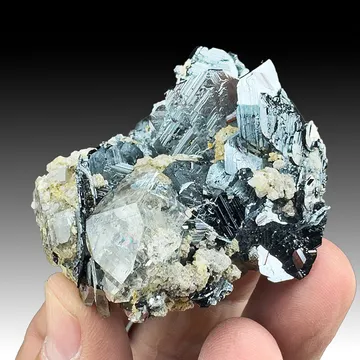
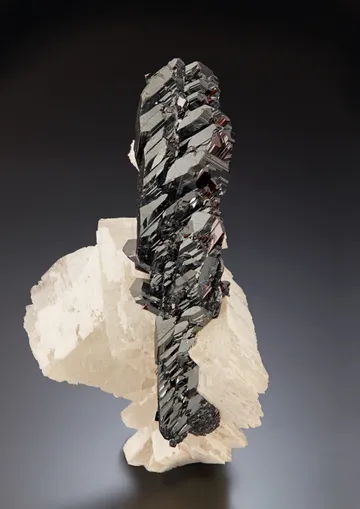
The best Cavradi specimens are small to cabinet-sized objects of precision rather than brute size. A fine piece may be only a few centimeters across, but it will carry intense metallic luster, sharp beveled hematite edges, geometric growth striations, and red rutile crystals placed like sparks across the black surfaces. Quartz pieces are prized when the crystals are transparent, lustrous, and elegantly set on gneiss or feldspar matrix, especially when they support hematite or show smoky color, rehealing, scepter growth, or the rare gwindel habit.

Photo: Wikimedia Commons
Search for specimens: View all specimens from Cavradi gorge, Switzerland
Cavradi gorge, also written Cavradischlucht, lies in Val Curnera in Tujetsch, Surselva Region, Graubünden, Switzerland, near 46°38′39″ N, 8°42′33″ E. The name is best understood as a collecting district in a gorge rather than a single mine. Specimen labels may use Cavradi, Cavradischlucht, Val Curnera, Tujetsch or Tavetsch, Sedrun, Grisons, Graubünden, or more precise local names such as Val Aulta, Val d’Arschella, Crest Lad, Crep dil Tschess, Igl Iert, Prait Aulta, Las Vals, and the lower Cavradi gorge.
The deposit type is Alpine-type fissure mineralization. Open clefts in metamorphic rocks acted as cavities into which mineralizing fluids introduced silica, iron, titanium, barium, strontium, copper, and minor rare-earth and precious-metal components. In the central hematite zone, feldspar-rich psammitic to psephitic gneisses and hematite-bearing conglomeratic gneisses are the mother rocks for the famous hematite-rutile clefts. This central belt is commonly described as roughly 400 meters wide within a larger sequence of steeply schistose rocks. North of it, the gorge changes into two-mica gneisses of the Tavetscher Zwischenmassiv and the so-called anatase zone; south of it, toward the Curnera dam and reservoir, the paragneisses are much less productive.
Cavradi’s mineralization is not an ore body in the mine-geology sense, although ore minerals and copper sulfides are an important part of the locality’s scientific interest. The economically named “ore” species occur in clefts, small impregnations, masses, coatings, and microscopic associations rather than in a worked mine. The most important collector mineralization consists of hematite, rutile, quartz, adularia, calcite, siderite, strontianite, barite/celestobarite, anatase, brookite, tourmaline, monazite-(Ce), xenotime-(Y), malachite, digenite, djurleite, tennantite, native silver, native gold, and other rare sulfides and sulfosalts.
The classic hematite-rutile specimens come especially from the middle part of the gorge, in the hematite zone. Published and collector accounts separate this from the anatase zone at the gorge entrance and from the less productive reservoir-side paragneisses. Within the old local nomenclature, the east side of the gorge opposite Alp Cavradi includes steep gullies known by names such as Adlerfels, Crest Lad, Cugn Graischel, Cugn Lad, Grep dil Tschess, Iert, Val Aulta, and Val d’Arschella. These names matter on older Swiss labels because Cavradi specimens with precise sublocality information are more desirable and more scientifically useful than pieces labeled simply “Switzerland.”
Mining history here is really Strahler history. Local crystal hunters have worked Cavradi for decades, developing small quarry-like cuts and long dumps in the productive zone. Some work is seasonal and exposed, requiring rope technique and a practiced eye for clefts in steep Alpine ground. Cavradi specimens entered classic European collections well before the modern boom in online mineral dealing; older examples are recorded from mid-20th-century collections, and the locality was already prominent enough to appear in Swiss mineralogical literature long before the 2013 monograph devoted to the gorge.
Access today is regulated by the municipality of Tujetsch. A Strahler permit is required for crystal and mineral collecting with tools anywhere in the municipality, regardless of land ownership. Under the 2026 revised municipal rules, ordinary collecting permits include day, week, and year options; drilling and blasting require an additional permit restricted to qualified residents of Tujetsch. Collecting is forbidden on Sundays and designated federal, cantonal, and municipal holidays. Closed forests, reforestation and dam areas, road and trail embankments, and certain protected zones are off limits or restricted. A working cleft may be reserved for two years if properly marked with tools, and no collector may reserve more than three clefts or an entire rock wall.
For visiting collectors, the practical caution is as important as the legal one. The approach often described from the Tschamut side takes about 45 minutes to the more interesting collecting ground, but the lower and central gorge include active or historically active Strahler workings. Signs warn against walking in parts of the Cavradi area, and in the lower central workings permitted local collectors may use explosives. Old dumps can be tempting, but crossing active work areas, taking material from marked clefts, or disturbing another Strahler’s overburden is both unsafe and unacceptable.
Notable finds from Cavradi include lustrous hematite roses and plates several centimeters across, rutile crystals to several centimeters in exceptional cases, quartz crystals generally under 10 cm but occasionally larger, smoky quartz to around 15 cm or more, gwindels exceeding 10 cm in rare cases, amethyst scepters up to about 10 cm and specimen groups to about 20 cm, strontianite aggregates to several centimeters, celestobarite crystals and aggregates reported to substantial weight near Igl Iert, and rare copper-mineral masses carrying digenite, djurleite, tennantite, malachite, and microscopic sulfosalts. The finest pockets are remembered not only for size but for the balance of associations: hematite on clear quartz, red rutile on hematite, white adularia contrast, and clean undamaged crystal surfaces.
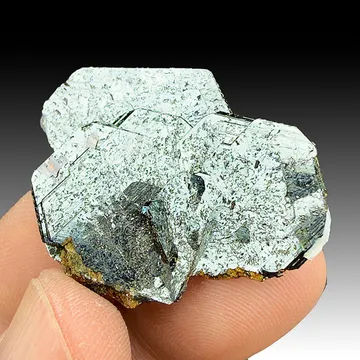
Hematite is Cavradi’s defining species, occurring as high-luster black to silvery-black tabular crystals, blades, rosettes, and complex iron-rose aggregates in the central hematite zone of the gorge. Ordinary pieces may show small, bright plates on quartz or gneiss, but the better specimens have mirror luster, crisp beveled edges, visible striated growth, and a sculptural arrangement rather than a flat smear of plates. Documented material commonly falls in the 3–5 cm range for individual crystal groups, with exceptional crystals and roses approaching or exceeding that scale; older locality summaries cite hematite up to about 10 cm as exceptional. The classic associations are rutile, quartz, adularia, calcite, siderite, malachite-bearing copper sulfides, strontianite, and barite/celestobarite. Top Cavradi hematite is separated from ordinary Alpine hematite by its polish-black surfaces, sharpness, and—above all—the red rutile epitaxy that can decorate both faces of a plate.
Rutile from Cavradi is most famous not as isolated crystals but as red to wine-red epitaxial crystals on hematite, where its orientation to the hematite substrate creates one of the locality’s most recognizable signatures. It may occur as tiny bright needles, short prismatic crystals, more robust red blades, hairlike crystals, and sagenitic aggregates, and older locality compilations record individual crystals to about 3 cm in exceptional cases. The richest and most collectible rutile belongs to the hematite-bearing central cleft zone, particularly where black hematite plates are accompanied by clear quartz, adularia, calcite, siderite, and occasional copper minerals. A good Cavradi rutile specimen needs contrast and preservation: transparent to gemmy red crystals standing clearly on glossy hematite, ideally without broken tips, dull cleaning residue, or confusion with merely iron-stained cracks. The rutile may be small, but when it is well placed on a sharp hematite rose it can make the specimen.
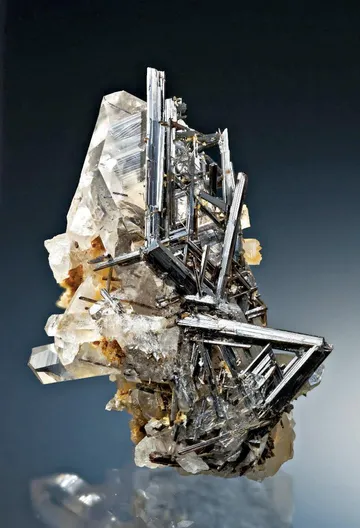
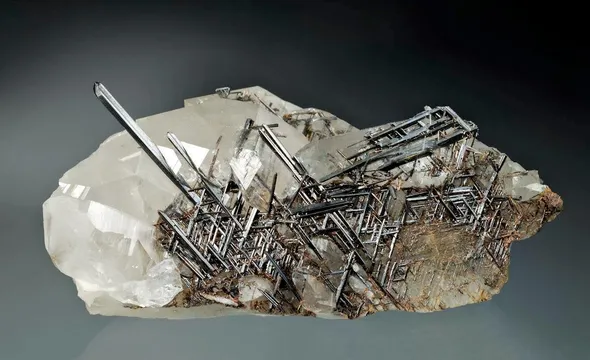
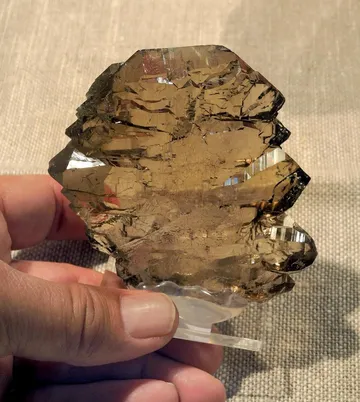
Quartz at Cavradi ranges from water-clear rock crystal to pale cognac and smoky quartz, with crystals typically less than 10 cm but documented exceptional examples to around 20 cm. Many clefts in the gorge are narrow, so Cavradi quartz is usually valued for clarity, luster, association, and alpine character rather than huge size. The best pieces show glassy transparent crystals on gneiss or adularia-rich matrix, often with hematite perched on or partly included in the quartz, red rutile on associated hematite, calcite or siderite, and occasionally amethyst scepter growth, rehealed crystals, faden quartz, phantom quartz, or rare gwindel forms. Cavradi quartz is at its most desirable when the crystal is bright and undamaged and the locality association is unmistakable: black hematite, red rutile, white feldspar, and clean Alpine cleft growth in a balanced miniature or cabinet specimen.
Beyond hematite, rutile, and quartz, Cavradi is a surprisingly rich rare-species locality. It is better described as a classic occurrence than as a type locality, but it has produced noteworthy Swiss and Alpine records: bergslagite was found there in the late 1970s before being widely recognized in the literature, arsenpolybasite was reported as a first Swiss occurrence from a Cavradi copper mineralization, and cervelleite was noted as a very rare microscopic occurrence. The broader suite includes anatase, brookite, adularia, albite, amethyst, anhydrite inclusions or hollow needles in quartz, barite and celestobarite, calcite, strontianite, siderite, monazite-(Ce), xenotime-(Y), fluorite, pyrite, chalcopyrite, bornite, digenite, djurleite, geerite, anilite, tennantite, covellite, native silver, native gold, malachite, brochantite, tourmaline, magnetite, and several microscopic sulfides and sulfosalts that make the gorge important well beyond its display-quality specimens.
The main authenticity concern with Cavradi specimens is locality precision. “Swiss Alpine hematite,” “Graubünden quartz,” “Val Curnera,” and “Cavradi” should not be treated as interchangeable labels. Cavradi pieces have a distinctive style—mirror-bright tabular hematite, red rutile epitaxy, clear quartz, adularia, calcite, siderite, and gneissic Alpine matrix—but comparable species occur elsewhere in the Central Alps. For important specimens, especially hematite-rutile plates, hematite-on-quartz, gwindels, and old collection pieces, value rises sharply when the label records Cavradischlucht or Cavradi gorge, Val Curnera, Tujetsch, Graubünden/Grisons, and preferably a credible sublocality or Strahler provenance.
No strong locality-specific tradition of dyeing, heating, irradiation, or artificial coating is documented for Cavradi material. The collector problems are more practical: repair, trimming, cleaning, and optimistic labeling. Hematite plates from Alpine clefts are heavy, sharp, and brittle at their edges; quartz matrix can be fractured or rehealed naturally, but it can also be repaired. Rutile crystals on hematite are easily snapped, rubbed, or lost during cleaning. Old glue, modern acrylic mounts, and trimmed matrix are common enough in the trade that they should be inspected without prejudice but with care.
Condition is critical. On hematite, look for bruised beveled edges, missing crystal corners, dull abrasion on formerly mirror-bright faces, and broken rutile needles. On quartz, inspect the termination, prism edges, and the junctions where hematite or adularia meets matrix. Natural contacts are common in tight Alpine clefts, but fresh chips, glue lines, and unnatural breaks affect value. Some matrix hematite-quartz specimens have been reduced from larger, awkward blocks; good trimming can greatly improve display, but it should not be confused with an untouched pocket group.
Cavradi is not a fluorescence locality of major collector importance. Handling concerns are mostly mechanical: hematite edges can scratch neighboring specimens, rutile is delicate, calcite and strontianite associations are softer and more easily etched or bruised, and malachite-bearing copper mineralization should be kept dry and stable. Avoid aggressive acids unless the specimen has been evaluated carefully; calcite, strontianite, barite/celestobarite associations, and delicate secondary copper minerals may be part of what makes the piece important.
Market availability is steady but not abundant at the high end. Small hematite-rutile and quartz pieces appear regularly from Swiss and European dealers, but exceptional Cavradi specimens with old provenance, strong rutile epitaxy, perfect hematite roses, matrix quartz, or precise sublocality data are much scarcer. The best examples sit comfortably among classic Alpine minerals rather than inexpensive locality curiosities. A small flawless thumbnail with brilliant rutile may be more desirable than a larger, dull, abraded plate.
A visit to Cavradi begins deceptively gently. From near the golf course at Tschamut, the usual approach follows the east side of the gorge toward the collecting ground. The trail runs above the creek, first climbing more strongly, then easing, and the walker may be only a few meters above the water in one place and as much as a hundred meters above it in another. Then comes the warning sign telling visitors to avoid walks in the Cavradi area. It is not theater. In the lower, central part of the gorge, local Strahler have long worked the rock with enough seriousness that explosives may be used by those permitted to do so.
That practical detail explains much about Cavradi specimens. The polished iron roses in a collector’s case look refined, almost architectural, but their birthplace is a steep ravine of loose rock, old dumps, marked clefts, and working faces. Local collectors have made small quarries over decades, with long heaps of overburden that can look inviting to an outsider. The local advice is plain: do not linger in active ground, be visible if crossing, and do not root through another Strahler’s work. Cavradi’s etiquette is not only about courtesy; it is about falling stones, blasts, reserved clefts, and the reality that a collector’s “interesting dump” may be someone else’s labor in progress.
The gorge also has an instructive collecting-room story. A major Cavradi hematite-on-quartz specimen filmed by The Arkenstone measured 10.0 x 8.0 x 8.0 cm after preparation, with a 4 cm hematite crystal standing above clear quartz. Rob Lavinsky recalled first seeing it around 2002 in the Marc Weill collection in Connecticut, reportedly after it had passed through the Marcus Budil collection. At that time it was much larger—remembered as roughly the size and weight of a bowling ball—and he assumed it had been repaired. Years later, when he finally acquired it, the specimen was trimmed down in two stages over several years. The surprise was that it was not repaired after all. What looked like a risky reconstruction turned out to be a natural but unwieldy Alpine matrix piece, reduced until the hematite, quartz, and granite matrix could be seen in balance from all sides.
Cavradi stories are often stories of scale turned upside down. A pocket may yield a hematite rose only a few centimeters across and still produce a world-class specimen if the faces are sharp, the luster is black and metallic, and the rutile is intact. Conversely, a large block can require years of nerve and judgment before it becomes a displayable specimen. The locality rewards the collector who understands that Alpine cleft minerals are not judged by size alone. At Cavradi, a wine-red rutile needle on the right hematite face can be the decisive detail.