A collector's guide to Trepča complex, Kosovo: its geology, mining history and notable minerals, illustrated with the 123 specimens documented from this locality on EarthWonders.
Key facts
Trepča is one of the great names in European mineral collecting: a vast Pb-Zn-Ag polymetallic system in northern Kosovo whose finest specimens look unmistakably “Trepča” even before the label is read. The heart of the complex is the Trepča/Stari Trg, or Stan Terg, mine near Stantërg in the Trepča Valley northeast of Mitrovica. Geologically it is a carbonate-replacement and skarn system developed where mineralizing fluids exploited a folded carbonate sequence, schists, quartzites, and an Oligo-Miocene volcanic conduit with associated brecciation. That combination—reactive limestones, structural preparation, magmatic-hydrothermal fluids, and open cavities—made both ore and specimens on a scale few European localities can match.
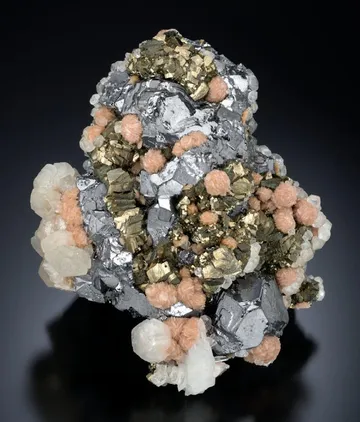
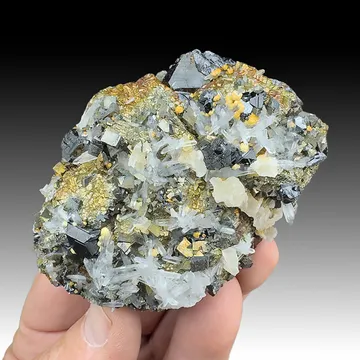
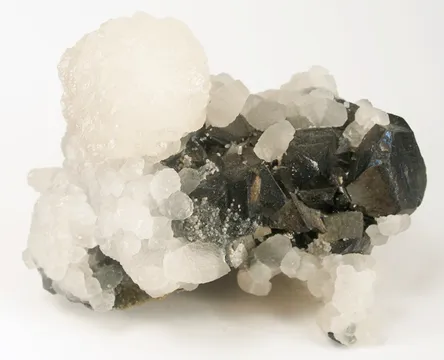
The collector’s Trepča is a world of black, brilliant sphalerite; steel-gray galena; brassy pyrite and bronze pyrrhotite; tin-white arsenopyrite; white to translucent calcite; pink rhodochrosite; curved dolomite; slender quartz; and local showings of boulangerite, bournonite, vivianite, ludlamite, siderite, and rare Bi-, Ag-, Sb-, and Sn-bearing phases. The best pieces are not single-species miniatures but built specimens: sharp dark sphalerite crystals partly dusted with white calcite, rhodochrosite rosettes tucked among sulfides, pyrite glittering over pyrrhotite forms, galena cubes and cubo-octahedra set into quartz and carbonate, and delicate gray-black needles of boulangerite or jamesonite lying in protected pockets.
The mine’s historical importance is just as large as its mineralogical one. Mining in the district is documented from the Middle Ages and probably draws on much older activity; modern industrial mining began in the late 1920s and entered production in 1930 under British capital. In the Yugoslav period the Trepča combine became an industrial giant, with mines, concentrators, smelting, refining, chemical plants, and a workforce that made the name Trepča as much an economic and political symbol as a geological one. For collectors, that scale mattered: decades of underground production constantly opened new cavities, new levels, and new mineralized faces, sending Trepča specimens into museums and private collections across Europe and beyond.
Regional View
Country View
Trepča specimens reward close looking. Many were found in ore cavities rather than in clean alpine-style vugs, so a great specimen may have dense sulfide mass on the back, matrix of breccia or skarn, and multiple generations of carbonate and sulfide growth on the display face. The locality is especially strong in contrast: black sphalerite against white calcite, pink rhodochrosite against galena, bright arsenopyrite on creamy dolomite, and bronze pyrrhotite modified or replaced by pyrite. Old labels may read Trepca, Trepča, Stari Trg, Stan Trg, Stan Terg, Kosovska Mitrovica, Serbia, Yugoslavia, or Kosovo; all can be historically legitimate, but the most precise modern label for the main classic mine is Trepča Mine, Trepča complex, Mitrovica, Mitrovica District, Kosovo.
Search for specimens: View all specimens from Trepča complex, Kosovo
The Trepča complex occupies the central part of a broader Kosovo Pb-Zn-Ag belt that extends for roughly 80 km, with the Stari Trg/Stan Terg mine as its best-known and most productive deposit. The main mine lies in the Trepča Valley, near Stari Trg or Stantërg, about 8–9 km northeast of Mitrovica. Historically, the district has included northern deposits such as Črnac and Belo Brdo, central Trepča/Stari Trg, and southern deposits including Artana/Novo Brdo, Hajvalija, and Kišnica-Badovac, though the collector locality “Trepča” most often means the Stari Trg mine and its immediate complex.
The deposit is best understood as a skarn and carbonate-replacement Pb-Zn-Ag system with strong hydrothermal overprinting. The host sequence includes thick marmorized limestones at the footwall, schists at the hanging wall, local quartzite and quartz-micaschist, and Oligo-Miocene volcanic rocks. The key structural feature is an asymmetric anticline whose axis plunges toward the northwest; along this hinge, a volcanic conduit and explosion breccia localized much of the ore. The ore bodies are often described as mantos and mineralized skarns arranged in a hose-shaped envelope at the contact between carbonate rocks and the volcanic pipe.
Eleven principal columnar to manto-like ore bodies have been described in the mine, coalescing downward and occupying the contact zone between limestones and schists. Close to the volcanic conduit, skarn replacement affected the footwall limestones, locally over tens of meters, producing calc-silicate assemblages with hedenbergite, ilvaite, actinolite, garnet, magnetite, and the principal ore sulfides. More broadly, the hydrothermal assemblage includes pyrrhotite, pyrite, arsenopyrite, argentiferous galena, sphalerite, and boulangerite, with lesser bournonite, chalcopyrite, tetrahedrite-group minerals, stibnite, stannite, enargite, and a gangue dominated by calcite, rhodochrosite, dolomite, ankerite, siderite, and quartz.
The specimen-producing character of Trepča comes from the same structural openness that made the mine rich. Cavities developed in replacement ore, skarn, carbonate bodies, and sulfide masses, and these cavities could preserve later generations of sharply crystallized sulfides and carbonates. Collectors commonly see a paragenetic layering in Trepča specimens: massive or early sulfides, then black sphalerite and galena, then rhodochrosite, dolomite, quartz, arsenopyrite, pyrite, boulangerite, and final white to translucent calcite in crusts, rhombs, rosettes, and “snowflake” coatings. In some pieces, the late carbonate cover is so heavy that the real quality of the specimen is judged from edges, windows, and underside views where the sulfide crystals emerge.
Modern industrial development began after exploration by Selection Trust in the mid-1920s. Trepča Mines Limited was established in London in 1927, mine development began the same year, and production started in 1930. The Zvečan flotation plant came into service in 1930, followed by smelting and refining infrastructure, and after World War II the complex continued under state ownership. During the second half of the twentieth century Trepča became one of Yugoslavia’s most important Pb-Zn-Ag producers and one of the most significant polymetallic mining-industrial systems in the Balkans.
Production declined sharply in the 1990s and the mine was forced into closure around the Kosovo war period. Stari Trg reopened under Kosovo Trust Agency/UNMIK administration in 2005, with renewed concentrate production and later periods of continued activity, limited output, and restructuring. Today Trepča remains a working industrial and heritage landscape rather than an open collecting site. Underground access requires permission, safety clearance, and local authorization; collectors should not treat the locality as an ordinary field-collecting destination. Most specimens reaching the market come through older collections, miners and local contacts, mine-permitted recovery, dealers with Kosovo sources, and occasional post-reopening material.
Notable specimen production spans many periods. Older collections contain superb pyrrhotite, galena, sphalerite, arsenopyrite, vivianite, ludlamite, and carbonate combinations from deep mine work and mid-century collecting. Material from the late twentieth century includes pyrite after pyrrhotite, black twinned sphalerite, galena with quartz and carbonate, and complex multi-mineral sulfide plates. Since the 2005 reopening, newer specimens have appeared from active lower levels, including sphalerite partly coated with rhodochrosite, boulangerite and bournonite-bearing pockets, calcite-rich combinations, and sulfide specimens from freshly blasted faces. Recent field accounts from the 10th and 11th levels describe working areas more than 700–800 m below surface, pockets in ceilings, warm water on the lower level, decomposing sulfide zones with green melanterite stalactites, and fresh ore rich enough to yield small but highly characteristic Trepča specimens.
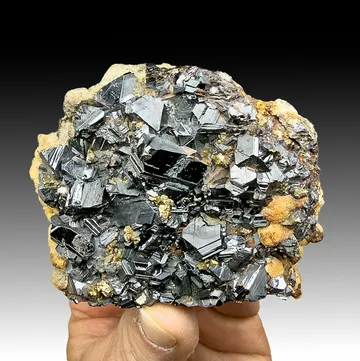
Sphalerite is the visual anchor of Trepča collecting: usually iron-rich, black to silvery black, highly lustrous, and commonly developed as modified tetrahedra, spinel-law twins, cyclic twins, blocky compound crystals, and complex striated groups. Individual crystals on collector pieces commonly fall in the 1–3 cm range, with better cabinet specimens showing larger, sharply twinned crystals several centimeters across on sulfide or carbonate matrix. The classic associations are white or translucent calcite, brassy pyrite, gray galena, pyrrhotite, arsenopyrite, quartz, rhodochrosite, siderite, dolomite, and locally boulangerite or bournonite. The best Trepča sphalerites are bright rather than merely black: sharp-edged, reflective, well separated enough to read as crystals, and balanced against pale carbonate or pink rhodochrosite; ordinary examples are dense, bruised ore masses with calcite crusts obscuring broken or incomplete sphalerite faces.
Calcite at Trepča is usually late in the specimen sequence and therefore often acts as the bright, snowy cap over earlier sulfides and carbonates. It occurs as white, creamy, translucent, colorless, and locally manganese-bearing pinkish material in rhombohedra, flattened rhombs, scalenohedral to nail-head forms, rosette-like aggregates, curved crusts, “snowflake” coatings, and stalactitic underground growths. Good crystals may be small sparkling druses or individual crystals to centimeter scale, and fine specimens show calcite resting on black sphalerite, galena, pyrite, rhodochrosite, quartz, dolomite, siderite, and arsenopyrite. The best pieces use calcite as contrast rather than camouflage: clean, lustrous crystals that frame or partially coat the sulfides while leaving the important black sphalerite, galena, pyrite, or rhodochrosite visible; common pieces have chalky calcite blankets over damaged ore.
Quartz from Trepča is generally a subordinate but important cavity mineral, appearing as colorless to milky prisms, slender needles, drusy linings, and small transparent crystals intergrown with galena, sphalerite, pyrite, arsenopyrite, siderite, dolomite, and calcite. It is especially attractive when it forms clean sprays or needle fields against heavy metallic sulfides, or when later siderite/ankerite and calcite have dusted the quartz without burying it. In the complex’s specimen language, quartz gives openness and architecture to otherwise dense sulfide pieces: a fine example has intact terminations, clear separation from the matrix, and contrast with galena, sphalerite, or rhodochrosite, while ordinary quartz-rich Trepča pieces are usually small drusy crusts or bruised white quartz hidden among ore minerals.
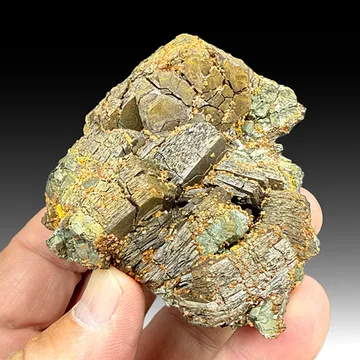
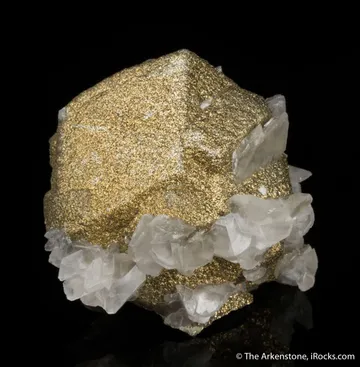
Pyrite is abundant at Trepča and ranges from massive ore and small brassy crystals to highly collectible glittering coatings on carbonate and sulfide specimens. Its most distinctive collector expression is pyrite replacing or coating pyrrhotite, preserving the pseudohexagonal, platy, or bladed outlines of the earlier pyrrhotite while adding a brassy pyrite sparkle; specimens from twentieth-century finds, including material associated with level 6, made this habit a Trepča classic. Pyrite also occurs with black sphalerite, galena, calcite, quartz, arsenopyrite, rhodochrosite, and dolomite. The best examples are sharp, lustrous, sculptural, and visually coherent—especially pyrite-after-pyrrhotite groups with intact outlines and attractive calcite or sphalerite accents—whereas lesser pieces are merely brassy granular ore with damaged sulfide surfaces.
Boulangerite is one of the locality’s important Pb-Sb sulfosalts and appears at Trepča as gray to black, silky, fibrous, acicular, felted, or plumose aggregates in cavities and on sulfide-carbonate specimens. It is commonly associated with galena, sphalerite, calcite, pyrite, quartz, arsenopyrite, and other sulfosalts; older literature and museum material also record plumose boulangerite, historically referred to as plumosite in collector usage. Fine Trepča boulangerite specimens are judged by delicacy and preservation: protected sprays or velvety patches visibly sitting on matrix, preferably with contrasting white calcite or dark sphalerite, are far better than smeared gray fibrous coatings that cannot be confidently appreciated without magnification. Because the needles and hairs are fragile and easily crushed, intact examples from protected cavities are much scarcer than the mineral’s presence in the ore would suggest.
Galena is the principal lead mineral of Trepča and is classic here as bright steel-gray cubes, cubo-octahedra, modified crystals, cleavage masses, and complex intergrowths with sphalerite, quartz, pyrite, calcite, arsenopyrite, rhodochrosite, siderite, and boulangerite. Some specimens show sharp galena perched on quartz or carbonate, others show cubic cleavage surfaces within ore, and especially interesting examples include galena with oriented or star-like growths on pyrrhotite or with arsenopyrite and rhodochrosite accents. The best collector pieces have undamaged, reflective crystal faces, well-defined cubic or cubo-octahedral form, and enough matrix contrast to avoid looking like a broken ore chunk; common examples are heavy, cleaved galena masses with scattered calcite and little crystal definition.
Pyrrhotite is a signature Trepča sulfide and one of the minerals that lifted the locality into the top rank of European specimen sources. It occurs as bronze to brownish metallic pseudohexagonal plates, blades, rosettes, and aggregates, often with quartz, sphalerite, arsenopyrite, galena, pyrite, and calcite. Many pyrrhotite specimens are partly coated or replaced by pyrite, producing the famous pyrite-after-pyrrhotite look that preserves the pyrrhotite habit while adding bright brassy surfaces. Fine examples show sharp form, bronze luster or clean pseudomorphic definition, minimal oxidation, and good contrast with white quartz or calcite; lesser pieces are dull, altered, friable, or so covered by later minerals that the pyrrhotite habit is no longer legible.
Arsenopyrite from Trepča is bright tin-white to steel-gray and commonly forms sharp prismatic to wedge-shaped crystals, striated crystals, sprays, and metallic accents on carbonate-sulfide matrix. It is a major part of the mine’s hydrothermal assemblage and occurs with sphalerite, pyrrhotite, pyrite, galena, quartz, calcite, dolomite, siderite, rhodochrosite, boulangerite, and bournonite. Fine specimens use arsenopyrite as a crisp metallic highlight: sharp lustrous crystals rising from white dolomite or calcite, or bristling among black sphalerite and pink rhodochrosite, are much more desirable than massive arsenopyrite-rich ore. At Trepča, good arsenopyrite often separates itself by geometry—the hard, bright, striated faces stand out against softer carbonate textures and darker sulfides.
Rhodochrosite gives Trepča specimens their most appealing color, though it is usually not the transparent raspberry rhodochrosite of classic silver veins. Here it most often appears as pale to stronger pink rhombohedra, botryoidal or ball-like aggregates, rosettes, crusts, and drusy bands between dark sulfides and later white calcite. It is especially prized with black sphalerite, galena, pyrite, arsenopyrite, quartz, and calcite, where even small pink areas transform the specimen visually. Better pieces show clean, distinct pink carbonate in protected pockets or as rounded aggregates that are not buried under calcite; ordinary examples may contain rhodochrosite only as a dull pinkish coating, ambiguous Mn-carbonate, or small hidden patches.
Siderite is part of Trepča’s complex Fe-Mn-Ca-Mg carbonate gangue and occurs as brown, tan, honey-brown, reddish-brown, or buff rhombohedra, discs, crusts, and small crystals on quartz, sphalerite, galena, pyrite, calcite, and locally vivianite. It can be difficult to distinguish by eye from ankerite or other intermediate carbonates in the Trepča carbonate series, so well-documented labels or analytical confidence add value. Collectible siderite is best when it forms crisp, visible crystals or contrasting brown discs rather than an indistinct earthy film; the most attractive specimens use siderite to add warm color to black sphalerite, white quartz, and calcite, while ordinary siderite-bearing pieces are often visually muted and mineralogically uncertain without testing.
Dolomite from Trepča is a major carbonate collector mineral, typically appearing as white, cream, tan, pale pink, or flesh-colored rhombohedra, curved rhombs, saddle-like forms, and architectural clusters, often later coated by calcite or dotted with pyrite and arsenopyrite. It occurs with quartz, sphalerite, galena, calcite, rhodochrosite, siderite, and other carbonates, and some older pieces show large rhombohedral dolomite crystals several centimeters across. The best dolomite specimens from Trepča have large, lustrous, well-spaced curved crystals and a clean relationship to sulfide accents; less interesting examples are flat carbonate crusts, dull rhombs, or specimens in which late calcite obscures the dolomite shape.
Beyond these collector staples, Trepča is important for bournonite, chalcopyrite, tetrahedrite- and tennantite-group minerals, stannite, enargite, stibnite, jamesonite, cosalite, native bismuth, bismuthinite, pyrargyrite, stephanite, freibergite, freieslebenite, marcasite, baryte, aragonite, cerussite, anglesite, smithsonite, scheelite, magnetite, ilvaite, hedenbergite, actinolite, garnet, wollastonite, vivianite, ludlamite, childrenite, crandallite, struvite, gypsum, and melanterite. Modern microanalytical work has made the locality even richer, documenting rare Bi- and Te-bearing minerals such as ikunolite, babkinite, joséite-A, izoklakeite, cannizzarite, lillianite-gustavite, heyrovskýite, aleksite, ingodite, and related phases. Trepča is therefore both a cabinet-specimen locality and a research locality: the same mine that produced display-sized sulfide-carbonate combinations also preserves subtle trace-metal and sulfosalt assemblages that continue to reward analytical mineralogy.
Trepča specimens are widely available compared with many classic European localities, but quality varies enormously. Common market pieces are sulfide-carbonate miniatures and small cabinet specimens with black sphalerite, calcite, pyrite, quartz, and sometimes galena or rhodochrosite. Fine pieces—large twinned sphalerite groups, crisp pyrite-after-pyrrhotite, bright galena with quartz, rich arsenopyrite combinations, undamaged rhodochrosite-bearing sulfide plates, and preserved boulangerite sprays—are much less common and should be judged as classic locality specimens rather than ordinary ore.
Mislabelling is a real concern, mostly because of history rather than fraud. Labels may use Yugoslavia, Serbia, Kosovo, Trepca, Trepča, Stari Trg, Stan Trg, Stan Terg, or Kosovska Mitrovica. Those variants can all point to legitimate historical material, but vague “Trepca, Balkans” labels, unlabeled black-sphalerite/calcite pieces, and specimens said only to be from “Kosovo mines” deserve caution. Trepča-style sulfide assemblages can resemble material from Madan in Bulgaria, Cavnic and Baia Sprie in Romania, and other Balkan or Carpathian Pb-Zn districts, so provenance matters. A good label should ideally specify Trepča Mine or Stari Trg/Stan Terg within the Trepča complex.
Documented large-scale faking is not a defining problem for Trepča, but repairs, trimming, recementing of heavy sulfide pieces, and selective acid cleaning should always be considered. Calcite, dolomite, and siderite can be etched or dulled by careless cleaning; pyrite coatings may be brightened by aggressive preparation; and fragile boulangerite or jamesonite hairs can be brushed away in seconds. On older pieces, examine contact points between crystals and matrix, look for glue in sulfide fractures, and be alert to artificially assembled “combination” specimens, especially where heavy galena, calcite, and sphalerite masses meet along suspicious seams.
Condition is the major issue. Sphalerite chips easily along edges and high points; galena is soft and cleaves; calcite bruises and dissolves; rhodochrosite can be scuffed; pyrrhotite may tarnish or oxidize; and pyrite-after-pyrrhotite specimens can be vulnerable if the replacement is incomplete or the matrix is damp. Avoid storing Trepča sulfides in humid conditions. Pyrrhotite-rich material and decomposing iron sulfides should be kept dry, watched for acid products or sulfate bloom, and isolated from delicate carbonates and labels. Melanterite and other soluble secondary sulfates seen underground are not durable cabinet minerals.
Fluorescence is not the principal reason to collect Trepča, but calcite from the locality may show fluorescence, including pale pink responses in manganese-bearing calcite and minor fluorescence noted on some dolomite/calcite specimens. Use UV as a supplementary observation, not an identification shortcut, because the carbonate series at Trepča is chemically complex and visual identification between calcite, dolomite, siderite, ankerite, kutnohorite-related material, and mixed carbonates can be uncertain.
For value, prioritize form, contrast, and locality character. A top Trepča piece should announce the mine: brilliant black sphalerite or bright galena, white calcite or quartz, pink rhodochrosite or warm siderite/dolomite if present, and sharp metallic accents of pyrite, arsenopyrite, or pyrrhotite. Specimens with old provenance, mid-century labels, mine-worker provenance, Zagreb/Croatian or European collection history, or clear post-reopening pocket information are especially desirable. Because the mine has produced specimens over many decades and is still represented on the market, rarity is not simply “Trepča versus not Trepča”; it is the rarity of an undamaged, well-composed, sharply crystallized specimen from a locality where ordinary material is abundant.
In the summer of 1959, a British geology undergraduate named Peter Perkins arrived at Stari Trg through IAESTE, the International Association for the Exchange of Students for Technical Experience. He was not specializing in mineralogy, yet he found himself assigned to one of Europe’s great mineral localities alongside three other students from Norway, Poland, and Germany. The memorable part came at the end of an underground visit: returning to the surface, the students were allowed to gather specimens from ledges where miners had set aside “clusters of special crystals.” More than half a century later, those pieces still told the mine’s story in miniature: nail-head calcite built on pyrite, calcite on rhodochrosite, galena with slender quartz, arsenopyrite on dolomite, and black sphalerite carrying pale calcite.
One of the most revealing old details is the name itself. In the countryside, Stari Trg means “Old Market,” but old mine documents preserve the variants Stan Trg and Stan Terg. A modern explanation, repeated in locality literature, is wonderfully mundane: the adjacent letters “r” and “i” in Stari may have been misread as an “n,” and the misprint survived because changing it after the launch of mining in 1930 might have created legal or administrative problems. Thus a collector can hold a perfectly legitimate specimen whose label reads Stari Trg, Stan Trg, Stan Terg, Trepca, Trepča, Yugoslavia, Serbia, or Kosovo, each name recording a different layer of the mine’s tangled political and administrative history.
The mine also carries a political memory far beyond mineral collecting. In February 1989, Trepča miners began an underground hunger strike against the dismantling of Kosovo’s autonomy. Accounts from Kosovo’s oral-history work remember not only the constitutional demands but the mine as a living presence in the town. One witness recalled the alarm siren at Trepča, describing its sound as if “somebody was crying,” and how families would gather at the pit when it sounded. For collectors, that history matters because Trepča specimens are not anonymous geology: they came from a working mine whose shafts, change rooms, workshops, and ore chutes were embedded in the lives of thousands of families.
Recent underground visits show that Trepča is still not a museum piece frozen in the past. In May 2025, Jolyon Ralph visited the mine with local mineral dealer Enis Hajdini and permission to go underground. The party waited for the lift to the 10th level, more than 700 m below surface, then moved toward level 11, the lowest part of the mine. The descriptions are pure Trepča: calcite stalactites, luminous green melanterite stalactites dripping acidic water from decomposing sulfides, hand drilling and blasting in active ore, and freshly broken sulfide material rich enough to yield small specimens. A wall pocket produced sphalerite crystals partly coated with rhodochrosite; a ceiling pocket required the help of miners and even a ride in a digger bucket; a small bournonite with calcite and galena was picked up before its identity was fully appreciated.
A 2026 mineral trip added new scenes from the 11th level, roughly 800 m down: warm thermal water entering the tunnels and warming boots, the south section yielding boulangerite, an exceptional ceiling pocket of cosalite, and miners helping by probing overhead cavities and catching the specimens that fell. The same trip visited the long-abandoned Trepča open cut, where there was little to find compared with the active underground mine, but small single quartz crystals still turned up in the dump. That contrast—world-class sulfides deep below, modest quartz in old surface waste—captures the locality perfectly. Trepča’s best specimens were never casual roadside finds; they were gifts of depth, industry, and permission.