






A collector's guide to Kosovo: its geology, mining history and notable minerals, illustrated with the 25 specimens documented from this locality on EarthWonders.
Key facts
Kosovo’s mineral-collecting reputation rests above all on the Trepça mining district, and within it the classic Trepça Stari Trg or Stan Terg mine near Mitrovica. For collectors, this is not a country known primarily for broad hobby field collecting; it is a great European ore-field locality, the kind of place whose specimens entered museums and old collections because industrial mining cut deeply through rich Pb-Zn-Ag mineralization for generations. The Trepça assemblage is instantly recognizable: black iron-rich sphalerite, bright galena, pyrite and pyrrhotite, arsenopyrite, quartz, calcite, dolomite, rhodochrosite, siderite, boulangerite, bournonite, vivianite and ludlamite, commonly arranged as dense sulfide-carbonate-quartz combinations rather than isolated single-species display pieces.
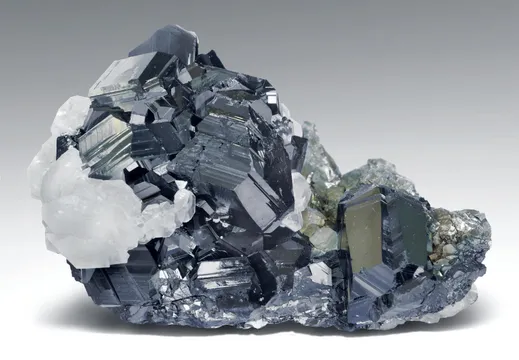
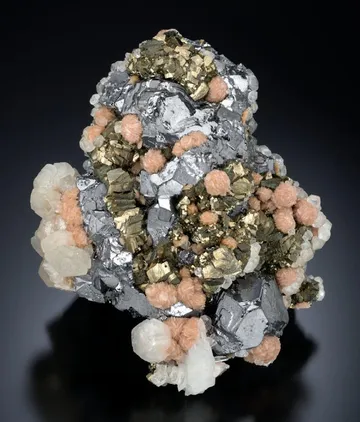
Geologically, the classic material comes from a polymetallic carbonate-replacement and skarn system in the Vardar Zone, where hydrothermal fluids associated with Oligocene-Miocene magmatism mineralized carbonate rocks and related structures. At Stari Trg the ore was localized around a volcanic breccia pipe and along the contact between marblized limestone and schist; in collector terms, that structure produced both massive ore and the open cavities needed for lustrous crystals. The best Kosovo pieces have a heavy, architectural look: black sphalerite twins against white calcite, quartz points peeking through sulfides, pyrite replacing pyrrhotite, steel-gray galena cubes, pink rhodochrosite accents, and occasionally delicate sprays or inclusions of boulangerite.
Regional View
Country View
The locality names on old labels can look confusing but usually tell a coherent story. “Trepča,” “Trepca,” “Stari Trg,” “Stan Trg,” “Stan Terg,” “Kosovska Mitrovica,” “Mitrovica,” “Yugoslavia,” “Serbia,” and “Kosovo” all appear in the collector record. The modern, most useful label for the classic source is Trepça Stari Trg Mine, Trepça complex, Mitrovica District, Kosovo. “Stan Trg” and “Stan Terg” are historically entrenched variants, not separate specimen localities in the usual collector sense.

Photo: Wikimedia Commons / James St. John
Search for specimens: View all specimens from Kosovo
For the mineral collector, Kosovo effectively means the Trepça Mineral Belt, a north-northwest to south-southeast belt of Pb-Zn-Ag deposits extending for more than 80 km through the Vardar Zone. The mines and deposits commonly cited in the belt include Stan Terg/Stari Trg, Belo Brdo, Crnac, Hajvalia, Kizhnica, Artana/Novo Brdo and Drazhnje. Trepça Stari Trg is the central classic: an underground lead-zinc-silver mine near the village of Stari Trg, roughly 8 to 9 km northeast or east of Mitrovica depending on the reference point used.
The Stari Trg deposit is best understood as a carbonate-replacement and skarn system with a strong structural and magmatic control. The host sequence includes marblized limestones, schists, quartzites and nearby volcanic rocks; the ore is tied to a volcanic breccia pipe and to the hinge of a plunging antiform. Principal orebodies form manto-like and columnar replacement bodies along favorable contacts, especially where limestone could be replaced below less permeable schist. Skarn minerals such as garnet, pyroxene, amphibole and magnetite belong to the earlier high-temperature story; the collector specimens that made the locality famous largely came from later sulfide-carbonate-quartz cavities within and around the ore.
The main ore minerals are galena and iron-rich sphalerite, accompanied by pyrite, pyrrhotite, arsenopyrite and minor chalcopyrite. The collector suite owes its character to the gangue and late cavity minerals: quartz, calcite, dolomite, siderite, rhodochrosite, boulangerite, bournonite, vivianite, ludlamite and rarer phosphate and sulfosalt species. Stari Trg specimens are typically not light, airy plates; many are dense ore-cavity pieces in which the visual impact comes from contrast—black sphalerite, silvery galena, brassy pyrite, white calcite, clear to milky quartz and pink manganese carbonates.
Mining in the region reaches back to medieval and probably earlier lead-silver exploitation. Modern industrial mining began after British interests investigated the old workings in the 1920s: Trepča Mines Limited was formed in London in 1927, and production began in 1930. The mine then became one of the principal lead-zinc producers of Yugoslavia, with decades of underground development exposing deep, specimen-bearing zones. Production continued through the German-Italian occupation during the Second World War and later under Yugoslav state ownership. The late twentieth century brought decline, war and flooding; the mine was shut during the 1998–1999 Kosovo War, and later accounts describe destroyed smelters and flooded workings. Stan Terg production resumed in 2005, and current official and commercial references still treat the Stan Terg mine and flotation unit as an active part of the Trepça enterprise.
Historically, specimen recovery was closely tied to mining access. The great pieces came from underground pockets, stopes and ore faces rather than from open collecting ground. Older accounts describe crystals set aside by miners on ledges, museum material accumulated at the mine, and specimens leaving through miners, engineers, visiting geologists and later dealer channels. Modern collectors should assume the mine is a regulated industrial site, not a casual collecting locality. Legitimate specimens on the market are normally old Yugoslav-era pieces, post-reopening material obtained through local mining channels, or specimens from established dealers and collections; underground access or collection requires permission and should not be inferred from tourist or museum visitation.
Notable collector finds span many decades. Older Trepča pieces include black sphalerite twins with calcite and pyrite, galena with quartz and arsenopyrite, rhodochrosite with sphalerite, quartz and calcite, deep green vivianite, apple-green ludlamite, plumosite-like boulangerite and rare phosphate assemblages. More recent dealer-documented specimens show the same vocabulary: 2000s to 2020s sphalerite with calcite, quartz and pyrite after pyrrhotite; 2012 sphalerite with chalcopyrite, boulangerite, calcite and quartz; and classic large rhodochrosite-sphalerite-quartz-calcite pieces from early postwar and post-reopening circulation. The mine’s best pieces are locality specimens in the fullest sense: they record a specific paragenesis, not merely a species name.
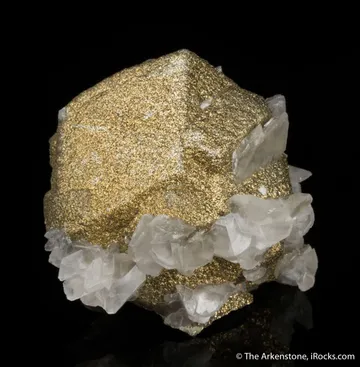
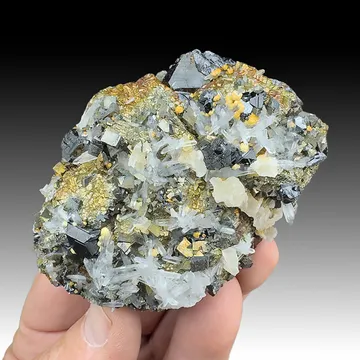
Calcite from Kosovo, especially Trepça Stari Trg, is one of the visual binders of the locality’s ore-cavity specimens: white to cream, translucent, gray when included by boulangerite, and locally pale pink where manganese is present. It occurs as rhombohedral, trigonal, compressed, scalenohedral, drusy and curved aggregate forms, commonly sitting on or among black sphalerite, galena, pyrite, pyrrhotite, quartz, arsenopyrite and rhodochrosite. Fine pieces are judged less by calcite alone than by composition: sharp undamaged carbonate crystals rising cleanly above dark sulfides, pale manganoan color, strong contrast with quartz or sphalerite, and, in the more unusual examples, fibrous boulangerite inclusions or spherical to rope-like calcite aggregates that give the specimen a texture immediately associated with Trepča.
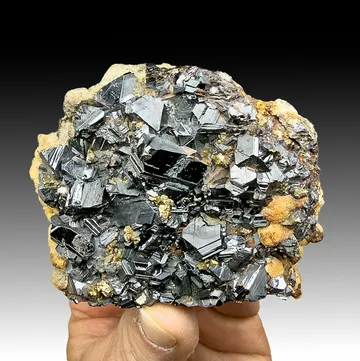
Sphalerite is the black signature mineral of Trepça: iron-rich, commonly referred to in older collector language as marmatite, and prized for sharp spinel-law twinning, lustrous faces and complex cyclic twin groups. Documented Kosovo specimens show jet-black octahedral and modified crystals from millimetric groups to crystals around 2–3 cm on small-cabinet pieces, with older and larger cabinet combinations adding galena, pyrite, pyrrhotite, arsenopyrite, quartz, calcite, dolomite, rhodochrosite, chalcopyrite and boulangerite. The best sphalerites from here are not dull black masses but bright, sculptural crystals with crisp edges and lively reflections, ideally set off by white calcite or quartz and, on premier association pieces, by pink rhodochrosite or metallic galena.
Quartz from Kosovo is usually a supporting mineral rather than the headline, but at Trepça it is essential to the look of the best combinations. It occurs as clear, colorless, milky or grayish prismatic crystals and drusy coatings, sometimes as sharper small crystals under calcite or sulfides, and older descriptions note white to hyaline quartz and occasional sceptre-like crystals up to about 7 cm. Good Kosovo quartz specimens have clean terminations and an open arrangement with black sphalerite, pyrite, galena, arsenopyrite, calcite or rhodochrosite; ordinary pieces are massive or crowded, while the better ones let quartz act as a bright framework that lifts the dark sulfide assemblage.
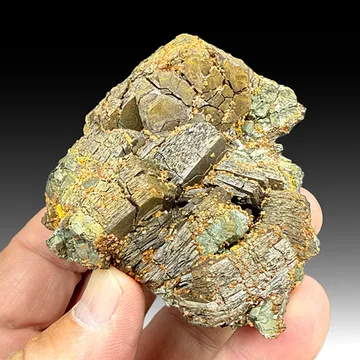
Beyond calcite, sphalerite and quartz, Kosovo’s collector importance lies in the breadth of Trepča’s sulfide, sulfosalt, carbonate and phosphate suite. Galena, pyrite, pyrrhotite, arsenopyrite, rhodochrosite, dolomite, siderite, boulangerite, bournonite, chalcopyrite, vivianite and ludlamite are all central to the classic assemblage. Vivianite from Trepça is especially valued as a deep green late-stage cavity mineral, while ludlamite is rarer and highly sought. Boulangerite may appear as silky plumosite-like masses, fine fibers, inclusions in calcite, or on mixed sulfide pieces. Childrenite and its alteration product crandallite were studied from Stari Trg and remain important rarities for systematic collectors. Kosovo also has a true type-locality mineral outside the Trepça ore suite: synchysite-(Nd), CaNd(CO3)2F, described from the Grebnik karstic bauxite deposit near Klina, where the type material occurs as microscopic bladed crystals and radial to platy aggregates.
Kosovo specimens are most often misread through labels, not through species. A piece labeled “Trepca, Yugoslavia” may be perfectly old and legitimate, while “Trepça, Serbia” can reflect pre-independence or older geopolitical usage rather than a mineralogical error. For modern cataloguing, separate the historical label from the updated locality line; do not discard old labels simply because the country name has changed. The clearest present-day locality wording for the classic material is Trepça Stari Trg Mine, Trepça complex, Mitrovica District, Kosovo.
The most common commercial ambiguity is over-broad labeling. “Trepça” may refer specifically to Stari Trg/Stan Terg, but it can also be used loosely for the wider Trepça complex or mineral belt. For high-value sphalerite, rhodochrosite, vivianite, ludlamite, bournonite or unusual sulfosalt pieces, a label that names Stari Trg, Stan Terg, Stan Trg or the Trepça Mine is preferable to a generic Kosovo label. Conversely, not every Kosovo Pb-Zn specimen should automatically be forced into Stari Trg; the belt includes other deposits such as Belo Brdo, Crnac, Hajvalia, Kizhnica, Artana/Novo Brdo and Drazhnje.
Condition matters greatly. Calcite is easily bruised, and the white to translucent crystals show edge wear quickly. Quartz tips can be chipped but are usually less vulnerable than calcite. Sphalerite, although showy, is brittle; check twinned crystals for missing corners and repaired points. Galena may show cleavage bruising, and pyrite/pyrrhotite-rich matrix can be heavy and awkwardly balanced. Boulangerite fibers and plumosite-like surfaces are extremely delicate and should never be brushed aggressively. Vivianite and ludlamite require cautious handling and stable storage; vivianite in particular is best kept away from strong light and unnecessary display heat.
Manganoan calcite from Trepça can show pale pink response under ultraviolet light, but fluorescence should be treated as an added observation rather than a primary authenticity test. The most convincing Kosovo specimens are identified by a whole assemblage: iron-rich black sphalerite, galena, pyrite or pyrrhotite, quartz, calcite, rhodochrosite, dolomite, arsenopyrite and, on rarer pieces, boulangerite or bournonite. Freshly washed but unprepared material may look less glossy than old dealer-polished specimens; over-cleaning can remove iron staining or clay but may also expose damage and weaken fibrous or friable associations.
Availability is steady but stratified. Small to modest calcite, pyrite, sphalerite and mixed sulfide-carbonate pieces appear regularly, including post-reopening material. Fine old combination specimens, large rhodochrosite plates, excellent sphalerite twins, deep green vivianite, ludlamite and unusual phosphate or sulfosalt specimens are much scarcer and command a premium when accompanied by credible provenance. The strongest Trepča specimens are rarely bought as “a calcite” or “a quartz”; they are bought as Trepča compositions.
In the summer of 1959, British undergraduate Peter Perkins arrived at Stari Trg through IAESTE, the International Association for the Exchange of Students for Technical Experience. He was not there as a mineral specialist. He had been assigned to the mine with three other students from Norway, Poland and Germany, and on returning to the surface after an underground visit they were allowed to collect from ledges where miners had placed clusters of special crystals. That small detail explains how many old Trepča specimens began their collector lives: not in formal field-collecting trips, but as crystals recognized underground by miners, set aside from the ore stream, and handed to the few people lucky enough to be present.
The name “Stan Terg,” so familiar on labels, may owe its permanence to a clerical accident. Stari Trg means “old market” or “old place,” but early British mining paperwork used “Stan Trg,” apparently because the adjacent letters “r” and “i” in handwritten text were read as an “n.” Once the mining documents were launched under that form in 1930, the error became institutional. Later writers suggested that correcting it might have risked legal confusion over official claims and certificates. Collectors inherited the result: a locality where the typo itself became part of the tradition.
Trepča’s mining history is far older than the boxed labels in our cabinets. Lead-silver exploitation is recorded in the medieval period, with intense activity beginning in 1303, and the silver helped finance fortifications along the Ibar valley. Control of the mines mattered enough that empires and rulers cared deeply about them: Roman, Ottoman, medieval Serbian, British, Yugoslav and postwar Kosovo histories all pass through the same mineralized ground. The specimens carry that weight. A black sphalerite on calcite from Stari Trg is not merely a pretty skarn-cavity piece; it is a fragment of one of the Balkans’ longest mining landscapes.
Trepça also became a stage for political resistance. From February 20 to February 28, 1989, miners at the Stan Tërg mine undertook a major strike underground. Later commemorations described horizons 8 and 9 of the mine shaft as “trenches of resistance.” For collectors, it is a reminder that the mine’s mineralogical history cannot be separated from the lives of the people who worked the stopes, kept the pumps running, sorted ore, saved crystals and endured the region’s upheavals.
The most painful collecting story is the museum loss after the Kosovo War. On September 18, 1999, the mineralogical museum at the mine—where important specimens had been accumulated since 1966—was plundered amid the postwar confusion. Reports cited the disappearance of the museum’s most important vivianite specimen, more than 1,500 crystals collected inside the mine since 1927, and 150 specimens donated by 30 countries. That theft is why old Trepča museum-style specimens with vague post-1999 histories deserve careful provenance questions. It also explains the urgency behind later efforts to preserve and rebuild the Trepça crystal and mineral heritage.

.jpeg)