Amethyst
 Quartz
 Fluorite
 Tourmaline
 Malachite
 Azurite
 Rhodochrosite
Regional View
Country View
Madagascar is famous for tourmalines that display vivid polychrome color zoning, especially from the Anjanabonoina area in the central highlands. In the mid-20th century, the pegmatites of Anjanabonoina produced large crystals of what was eventually identified as the species liddicoatite (a calcium-rich tourmaline) with jaw-dropping internal color patterns. When sliced crosswise, these crystals reveal concentric and sector-zoned patterns: triangles of pink, green, brown, and other hues in kaleidoscopic arrangements. Such slices, often resembling abstract stained-glass windows, became highly sought after by collectors and jewelers. Liddicoatite was defined as a distinct mineral in 1977, and Madagascar remains its type locality.
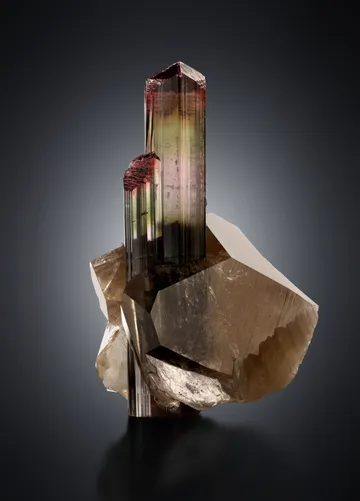
For collectors of mineral specimens (as opposed to just slices), Anjanabonoina tourmalines are notable for their multicolor gem segments and intricate terminations. A single crystal might show a pink core, grading to green, then to a colorless zone, capped by a dark termination – essentially a natural “watermelon” or even “rainbow” in one crystal. These crystals tend to be stout and often highly striated or even etched on the prism faces. Though not known for high clarity (many have internal cracks or inclusions), they compensate with rich color and complexity. Complete crystals from Madagascar often have a drusy or etched surface and rarely are found on matrix (they typically broke out of the pocket walls). Many ended up in alluvial gravels, which is why polished slices became common. Still, a fine terminated Madagascar tourmaline is a prized collectible – usually exhibiting colors or color combinations seen nowhere else. For instance, you might find a crystal with a unique neon peach or vermilion shade that shifts to olive-green at one end, reflecting minor element changes during growth. The most remarkable pieces show triangular color zoning when viewed down the crystal’s cross-section, a hallmark of liddicoatite. Such “remarkable polychrome tourmalines with varied geometric patterns” are essentially natural art. They may not have the sheer size or transparency of Brazilian or Afghan tourmalines, but their aesthetic appeal is undeniable. Collectors often include a Madagascar tourmaline slice or crystal in their suite to showcase the wild color possibilities of this mineral. As many would agree, “tourmalines from Madagascar are valued for their striking color combinations” that truly stand out in any display.