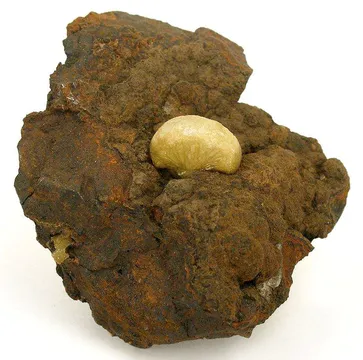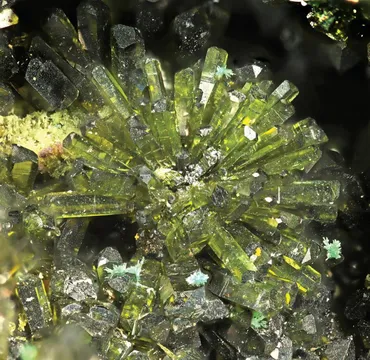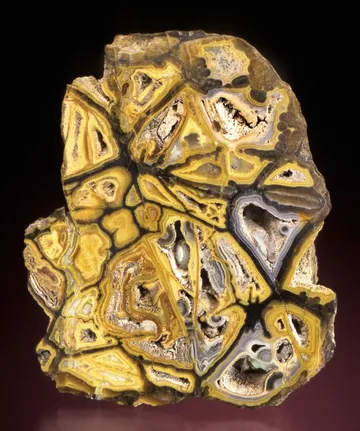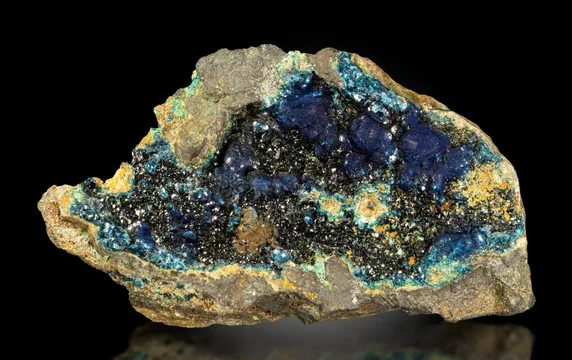
Topaz Mountain, Utah — vuggy Miocene-topaz locality yielding warm, glassy topaz prisms in pale rhyolite, with bixbyite and rare red beryl, highly prized by col…
Key facts
Topaz Mountain is the collector’s landmark of Utah’s western desert: a pale rhyolite mountain at the south end of the Thomas Range where transparent topaz crystals weather from a Miocene volcanic pile and flash in the washes like broken glass. Its fame rests on a classic topaz-rhyolite environment. Fluorine-rich, silica-rich lavas and tuffs erupted roughly six to seven million years ago along faults and fault intersections; as the rock cooled, vapor-rich cavities and lithophysae became miniature chambers for topaz, bixbyite-(Mn), hematite, pseudobrookite, quartz, red beryl, garnet-group minerals, fluorite, calcite, sanidine, opal, and other species. For collectors, this is not a conventional vein mine but a vuggy volcanic locality: the specimen is won by reading flow-banded rhyolite, finding pockets, and preserving fragile crystals that often grew out from cavity walls.
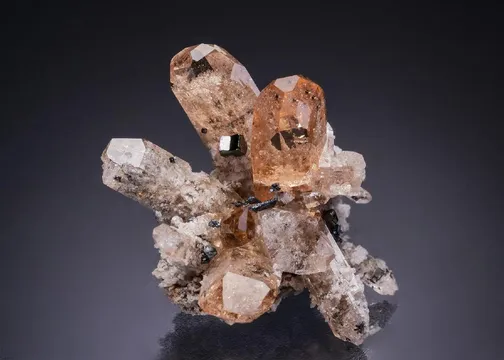
The best Topaz Mountain pieces have an unmistakable look. Sherry, amber, honey, or champagne topaz prisms rise from cream-gray rhyolite, commonly with bright glassy luster and clean orthorhombic terminations. Many loose crystals found in the washes are water-white because sunlight bleaches the natural color; fresh pocket crystals can be warm brown to orange when first opened, and specimens that retain that natural color are especially desirable. The locality’s finest cabinet appeal comes from associations: black, mirror-bright bixbyite cubes on or beside topaz; hematite plates or specks accenting sherry crystals; pseudobrookite needles in small metallic sprays; or, very rarely, red beryl on pale matrix.
Historically, Topaz Mountain is more than a field-trip stop. The Thomas Range attracted scientific attention in the nineteenth century, and the topaz there was already important enough for early American mineralogists to describe its crystal forms. Maynard Bixby’s collecting in the range supplied the material for bixbyite, a mineral named in his honor, and the area later yielded important work on red beryl, pseudobrookite, and the vapor-phase mineral assemblage of topaz rhyolites. Topaz became Utah’s official state gem in 1969, and Topaz Mountain remains the best-known public-facing locality for that state-gem identity.
Regional View
Country View

Photo: Wikimedia Commons

Photo: Wikimedia Commons
Search for specimens: View all specimens from Topaz Mountain, USA
Topaz Mountain lies in Juab County, Utah, in the southern Thomas Range, reached from the Delta–Lynndyl side of the west desert. The collecting area is remote, dry, and largely without services, but it is unusually accessible for a world-famous mineral locality because part of the ground is managed by the Bureau of Land Management as the Topaz Mountain Rockhound Recreation Area. The BLM describes the area as one of the productive and diverse rockhound areas of the West, with dispersed camping permitted but no developed facilities. The practical collecting reality is mixed land status: BLM public land, Utah School Trust land, private parcels, active mining claims, and gemstone leases all occur in the broader Thomas Range. Marked claims are not public collecting ground, and collectors should verify current status before entering or digging.
Geologically, the specimen-producing rock is the Topaz Mountain Rhyolite. It is a topaz-bearing alkali rhyolite complex of coalescing flows, domes, breccias, vitrophyres, and stratified tuffs. Older descriptions separated the younger volcanic rocks into several overlapping flow units, each with a sequence of vitric tuff, breccia, and rhyolite, with rhyolite making up the great bulk of the unit. The cavities that matter to collectors are lithophysae and small vugs: rounded to lenticular gas cavities, shell-like cavities, and small open spaces formed as the lava and ash cooled. In Topaz Valley especially, the rhyolite may show a honeycombed texture, with topaz, quartz, sanidine, hematite, bixbyite, garnet, pseudobrookite, fluorite, red beryl, and related species projecting into the hollow centers or growing along fissures.
The mineralization is best thought of as vapor-phase and late-magmatic, not as a mineable ore shoot in the metallic sense. Topaz crystals occur in all rhyolite flows of the younger volcanic group, but productive concentrations are quite local. Older USGS descriptions note that individual topaz-bearing areas commonly cover only several hundred square feet, and that areas with larger crystals are far scarcer than areas with small crystals. The “ore body” for the collector is therefore a favorable patch of vuggy rhyolite: pale, altered, flow-banded rock with open cavities, clayey pocket fill, or lithophysal shells. Loose topaz in dry washes represents crystals weathered from those pockets, while matrix specimens require opening unweathered rhyolite and trimming the rock without cleaving the topaz.
Topaz Valley, also called The Cove or Topaz Cove, is the classic public collecting focus. It has produced countless loose, sun-bleached crystals over more than a century, but the easy surface crystals are much less abundant than in earlier decades. The old advice still holds: loose colorless crystals may be found in washes and on slopes by watching for bright flashes in low sun, while larger or colored crystals are more likely to come from breaking fresh white to gray rhyolite and finding unopened cavities. Most casual wash crystals are under an inch long. Literature and field reports document better crystals of several centimeters from productive pockets, and a historic clear crystal from near the center of Topaz Valley was recorded at about 2 inches long.
The collecting history is deep. Henry Engelmann, geologist for Captain J. H. Simpson’s 1859 expedition across the Great Basin, briefly discussed topaz from the Thomas Range; later nineteenth-century geologists and mineralogists added observations on the volcanic rocks and crystal forms. Maynard Bixby, who moved to Utah in the early 1890s after work in mining districts elsewhere in the West, spent considerable time prospecting the Thomas Range and staked multiple claims. His material led to the naming of bixbyite in 1897, and pink to red beryl from the district was known by 1905. The Maynard Claim, near Pismire Knolls, remains one of the storied names attached to fine topaz, bixbyite, red beryl, and association specimens from the broader Thomas Range.
Commercial-style specimen recovery has been intermittent and claim-specific rather than a continuous mine industry. Collector’s Edge Minerals conducted a documented specimen-mining project at the Maynard Claim from October 1, 2009 into mid-December 2009, using drilling and blasting to expose rhyolite flows and pockets. Their account describes fresh pocket recovery, careful wrapping of specimens, sherry to colorless topaz, and no future plans at that time for continued mining there. Modern fee collecting is represented by Topaz Mountain Adventures, which offers guided public and private access to fresh blasted or excavated material at designated private sites, including Topaz Dome and a pink-topaz-and-bixbyite area, with tool kits available for tours and higher-clearance vehicles recommended.
The broader Topaz Mountain–Thomas Range area also includes scientifically important uranium and rare-mineral occurrences. The Autunite No. 8 claim, on the southeast side of the range, is a small uranium prospect with two pits and no recorded ore production in the USGS description, but it is mineralogically important as the type locality for weeksite. Starvation Canyon and nearby pits are important for holfertite, a uranium-titanium hydrated oxide associated with hematite, sanidine, quartz, calcite, topaz, and red beryl. These occurrences are part of the same regional mineral story, but they are not all public collecting targets; many are on claims or in restricted claim areas.
Topaz from Topaz Mountain is prized as sharp orthorhombic prisms in lithophysal cavities and small vugs of pale Topaz Mountain Rhyolite, ranging from loose, sun-bleached colorless wash crystals to sherry, amber, champagne, and pale wine-colored pocket crystals on matrix. Many crystals are small, commonly under an inch for casual finds, but good pockets have produced crystals in the several-centimeter range, with historic and modern reports of crystals and groups around 5 cm from favored Thomas Range localities. The best specimens show glassy luster, transparent terminations, minimal cleavage, and natural attachment to rhyolite; crystals with bixbyite, hematite, quartz, red beryl, pseudobrookite, fluorite, or garnet carry the strongest locality character. Ordinary pieces are loose, water-clear singles with bruised terminations or cleavage damage, while superior examples preserve sherry color, matrix, and a balanced pocket composition.
Bixbyite-(Mn) is one of Topaz Mountain’s defining collector minerals and a historic topotype species from the Thomas Range, occurring as lustrous black to iron-black cubic crystals and modified cubes in rhyolite cavities. Typical crystals are small, from millimeter scale to a few millimeters, but better examples from the range reach around a centimeter and exceptional rumored or claim specimens are larger. The classic association is bixbyite on pale rhyolite with sherry topaz, quartz, hematite, pseudobrookite, red beryl, or garnet; a sharp black cube perched on a topaz crystal is among the most desirable combinations from the locality. Good pieces have complete cubic form, high luster, exposed placement, and clean contrast against light matrix, while ordinary specimens are tiny, partly embedded, or visually lost in dark pocket coating.
Hematite at Topaz Mountain is chiefly a specimen accent rather than the headline species, but it is important in the paragenesis and aesthetics of the cavities. It occurs as tiny metallic plates, specularite, and black to steel-gray crystals attached to cavity walls or to earlier minerals, and it may also appear as hematite replacing or pseudomorphing garnet in the Thomas Range suite. Palache described hematite plates attached by an edge in the rhyolite cavities, and modern collectors value pieces where hematite inclusions or plates add dark metallic sparkle to sherry topaz, or where hematite accompanies quartz, pseudobrookite, bixbyite, or red beryl. The best hematite-bearing specimens are clean association pieces with visible, well-formed metallic plates and intact topaz, not merely iron-stained rhyolite or dull black crusts.
Other documented Topaz Mountain and Thomas Range minerals give the locality its exceptional depth. Red beryl, historically called bixbite but best labelled as red beryl to avoid confusion with bixbyite, occurs as very small rose-red to raspberry tabular crystals attached to cavity walls or topaz, rarely reaching several millimeters in older descriptions and rumored larger in select pockets. Pseudobrookite is a classic black, metallic, needlelike to prismatic species here, with some of the best Thomas Range specimens coming from localities such as Solar Wind and The Cove; small sprays in rhyolite are typical, but crystals over a centimeter are known from special finds. Quartz is common as drusy crystals lining cavities and as inclusions in topaz and beryl. Garnet-group minerals, including spessartine- to almandine-rich compositions reported in the range, occur as reddish brown crystals and clusters. Fluorite, calcite, sanidine, opal, chalcedony, amethyst, ilmenite, cassiterite, durangite, ferrocolumbite, carnotite, uranophane, schroeckingerite, weeksite, and holfertite round out a suite that reaches from field-collecting classics to radioactive micro-rarities and type-locality minerals.
The first authenticity issue with Topaz Mountain material is color. Fresh crystals can be sherry, amber, or pale wine-colored, but sunlight may bleach them to colorless. Natural retained color is desirable, but it must be treated skeptically if a specimen has no old label, no clear provenance, or an implausibly intense color for the matrix and association. Radiation can restore or induce color in topaz, so “sherry” alone is not proof of an untouched specimen. Good provenance matters most for expensive colored topaz, especially matrix pieces and specimens sold as Maynard Claim or named-claim material.
The second concern is assembly. The locality naturally produces topaz with bixbyite, hematite, pseudobrookite, red beryl, quartz, and other associates, but the very desirability of those combinations invites glued or enhanced specimens. Examine any dramatic topaz-bixbyite or topaz-red beryl association under magnification. Natural crystals should emerge from consistent pocket surfaces, share undisturbed clay or rhyolite contact, and show no glossy adhesive meniscus, mismatched dust, or unnatural seating. Loose topaz can be wedged into rhyolite, and red beryl fragments can be placed on matrix; careful inspection is essential for high-value pieces.
Condition is a major grading factor. Topaz is hard, but it has perfect basal cleavage and is less forgiving than its Mohs hardness suggests. Many Topaz Mountain crystals show bruised terminations, cleaved bases, edge nicks, or internal fractures from hammer extraction. Matrix specimens are scarcer because the host rhyolite is tough and pockets are small; removing a crystal without snapping it from its base takes patience and luck. Loose wash crystals are abundant enough that chipped or frosted pieces remain modest, while clean, lustrous, complete crystals on original matrix command much stronger collector interest.
Handling and display should be conservative. Keep colored topaz out of direct sunlight and strong display lighting if color retention matters. Store sherry specimens in closed drawers, boxes, or low-light cases, and document their color with photographs when acquired. Rinse loose crystals gently; avoid aggressive mechanical cleaning near terminations and cleavage planes. For radioactive species such as weeksite, holfertite, carnotite, uranophane, and schroeckingerite, use normal radioactive-mineral precautions: keep specimens labeled, boxed, dust-free, away from children, and do not grind or soak friable material without understanding the risk.
Market availability is broad but stratified. Loose colorless topaz from Topaz Mountain remains common, and small specimens appear frequently from field collectors and dealers. Attractive sherry matrix topaz is scarcer; old pieces, Maynard Claim material, and crystals with undamaged terminations bring a premium. Bixbyite is regularly available in small sizes, but sharp, isolated, lustrous crystals on contrasting rhyolite or directly associated with topaz are much more selective. Hematite association pieces are affordable unless they are part of a high-quality topaz composition. Red beryl from Topaz Mountain is rare and often tiny; fine red beryl association specimens from the Thomas Range should be bought only with careful provenance and magnification.
In the spring of 1933, Harvard sent Edwin Over, Jr. into the Thomas Range to collect for the Harvard Mineralogical Museum. He spent most of his time at Topaz Mountain and came away with a suite that Charles Palache later described as “very fine.” The trip mattered because it was not merely another haul of sherry topaz. Over’s material added pseudobrookite, beryl, fluorite, and calcite to the recorded paragenesis. Palache’s best topaz from the trip was a doubly terminated crystal of beautiful quality about 3 cm long. The cavities told the story of growth: minute quartz lined the walls and continued crystallizing throughout the pocket history, so that quartz appeared included inside both topaz and beryl. Calcite, when present, could fill the cavities as snow-white masses, while pale purple fluorite lay intermingled without obvious crystal form. The red beryl was rarer still: blasting produced only a small number of specimens, tabular pink crystals on cavity walls or topaz, rarely as much as 5 mm across and 3 mm high.
The Maynard Bixby story still hovers over every good black cube from the Thomas Range. Bixby was not a casual visitor; he was a prospector and mineral collector who worked the range hard, staked claims, and supplied material that became part of American mineralogical literature. The mineral named for him was described in 1897 by Samuel L. Penfield and H. W. Foote in the American Journal of Science. Later collectors continued to use the name Maynard Claim with a kind of reverence, because it tied the specimen in hand to the early era of Utah mineral collecting. The label “bixbite” later attached to red beryl created a durable confusion, because red beryl and bixbyite are both connected to Bixby and both occur in the same rhyolite district. Serious labels now avoid that trap: bixbyite is the black Mn-Fe oxide; red beryl is the red Be-Al silicate.
Modern specimen mining brought a very different rhythm. Collector’s Edge Minerals began work at the Maynard Claim on October 1, 2009 and continued into mid-December. The operation was not romantic pick-and-shovel collecting in a wash; it involved drilling, blasting, removing overburden, exposing rhyolite flow, and then slowing down when pockets appeared. Their field photographs and captions read like the stages of a specimen mine: drilling in preparation for blasting, clearing overburden, an exposed pocket containing topaz, removing crystals from pockets, clusters just extracted, specimens carefully wrapped and carried to camp, and finally winter settling in over the excavation. The same account records the central collector’s paradox of the place: good sherry crystals are best recovered fresh from light gray rhyolite, but if they are not protected from sunlight they can bleach rapidly from sherry to clear.
Topaz Valley has its own quieter story, written in absence as much as abundance. Older accounts describe countless loose crystals picked from the ground and specimen-rich boulders that could be broken with heavy sledgehammers. A century of collectors reduced the easy material, and yet the valley still earns its name. The modern collector sees fewer glittering crystals lying openly in the washes, fewer convenient boulders left untouched, and more competition from old pits, claim posts, and sun-baked rubble. But the pockets were always local and irregular. The collector who slows down, reads the rhyolite, and works beyond the most obvious scars can still find the small flash of a prism, the black face of a bixbyite cube, or a clay-lined cavity that opens into a miniature Thomas Range world.
Samuel L. Penfield and H. W. Foote, “On Bixbyite, a New Mineral, and Notes on the Associated Topaz,” American Journal of Science, series 4, vol. 4, no. 20, 1897, pp. 105–108 — Original description of bixbyite, based on material supplied from the Thomas Range, with notes on associated topaz.
Charles Palache, “Minerals from Topaz Mt., Utah,” American Mineralogist, vol. 19, 1934, pp. 14–15 — Short but important paper on Edwin Over, Jr.’s 1933 collecting for Harvard, recording pale wine-colored topaz and adding pseudobrookite, beryl, fluorite, and calcite to the documented Topaz Mountain paragenesis.
Mortimer H. Staatz and Wilfred J. Carr, “Geology and Mineral Deposits of the Thomas and Dugway Ranges, Juab and Tooele Counties, Utah,” U.S. Geological Survey Professional Paper 415, 1964 — The foundational USGS monograph for the range, including volcanic stratigraphy, mineral deposits, Topaz Mountain Rhyolite, and the cavity minerals of the Thomas Range.
M. H. Staatz and H. L. Bauer, Jr., “Preliminary Report on Tertiary Volcanism and Uranium Mineralization in the Thomas Range and Northern Drum Mountains, Juab County, Utah,” U.S. Geological Survey Open-File Report 78-434, 1978 — Useful regional context for the Thomas caldera, Topaz Mountain Rhyolite, uranium prospects, and fluorine-rich alkali rhyolite mineralization.
Klaus Fuhrberger and Patrick Haynes, “Minerals from the Thomas Range, Juab County, Utah,” New Mexico Mineral Symposium abstract, 2010 — Collector-focused locality summary with detailed notes on Maynard’s Claim, Topaz Valley, Starvation Canyon, Solar Wind, pseudobrookite, bixbyite, red beryl, weeksite, and holfertite.
Carl Ege, “New Utah Minerals: Holfertite & Nukundamite,” Utah Geological Survey, Survey Notes — Concise account of holfertite from Starvation Canyon and other Thomas Range areas, including its naming for John Holfert and its association with hematite, sanidine, quartz, calcite, topaz, and red beryl.
Utah Geological Survey, “Rockhound Guide to Selected Rock & Mineral Localities in Utah,” Public Information Series 62 — Practical collecting guide listing Topaz Mountain minerals, maps, directions, land ownership, and claim cautions.
Utah Geological Survey, “Minerals and Mineral Localities of Utah,” Bulletin 117 — Statewide locality reference documenting the Topaz Mountain and Thomas Range mineral assemblage, including rare uranium species and classic vapor-phase minerals.
Smithsonian Contributions to the Earth Sciences, no. 18, “Type Specimens in the National Museum of Natural History,” 1977 — Includes weeksite type material from the Autunite No. 8 Claim, Thomas Range, Juab County, Utah.
“Finding Topaz Crystals and Bixbyite on a Private Mining Claim Near Topaz Mountain, UT” — The Rugged Rockhound — Field-collecting video showing topaz and bixbyite recovery on a private claim near Topaz Mountain.
“Rare Pink Topaz Crystals Found in Utah!” — The Crystal Collector — Recent field video focused on pink topaz and associated minerals in the Thomas Range/Topaz Mountain collecting scene.
Mindat: Topaz Mountain, Thomas Range, Juab County, Utah, USA — Species list, sublocalities, photographs, and reference trail for the main locality.
Utah Geological Survey: The Rockhounder — Topaz and other minerals found at Topaz Mountain, Juab County — Concise official collecting guide with geology, directions, land status, and safety notes.
Bureau of Land Management: Topaz Mountain Rockhound Recreation Area — Official access page for the recreation area, including directions, contacts, facilities note, and activity information.
Bureau of Land Management: Rockhounding on Public Lands — Current BLM overview of noncommercial collecting rules, restrictions, and listed rockhounding areas.
USGS: Topaz Mountain Rhyolite photographs and notes — Geological photo resource summarizing Topaz Mountain Rhyolite as coalescing flows and domes with vapor-phase mineral cavities.
USGS Professional Paper 415: Geology and Mineral Deposits of the Thomas and Dugway Ranges — Essential technical foundation for the Thomas Range geology and mineral deposits.
Collector’s Edge Minerals: Maynard Topaz Claim, Thomas Range, Juab County, Utah — Detailed modern specimen-mining history and geology of the Maynard Claim, including the 2009 recovery project.
Wikimedia Commons: Minerals of Topaz Mountain — Open image category with topaz, bixbyite, hematite, pseudobrookite, and related Topaz Mountain specimens.
Topaz Mountain Adventures: Tours & Passes — Current fee-collecting information for guided access to fresh blasted or excavated material on private sites.
Natural History Museum of Utah: What Is Utah’s State Gemstone? — Accessible museum overview of Utah topaz, its state-gem status, color behavior, and Thomas Range context.