Tantara Mine, DR Congo — compact Haut-Katanga locality yielding emerald to blue-green dioptase with plancheite and shattuckite; copper-silicate pseudomorphs al…
Key facts
Tantara is one of the deceptively small Katangan copper localities whose specimen importance is far larger than its mining footprint. It lies in the Shinkolobwe–Kambove area of Haut-Katanga, within the Katanga Copper Crescent, and is best understood as a compact oxidized copper occurrence developed in dolomitic and calcareous beds of the Kakontwe Formation. In collector terms, Tantara means deep green dioptase, blue copper silicates, cobalt-tinted carbonates, and some of the most intriguing copper-silicate pseudomorphs from Africa.
The great Tantara look is unmistakable: emerald to blue-green dioptase crystals, often blocky to rhombohedral, set against powder-blue to sky-blue plancheite, darker shattuckite, white to off-white calcite, and patches of malachite. The most historically important specimens are not simply pretty combinations; they are mineralogical puzzles. Calcite crystals were replaced by dioptase, and in some specimens that dioptase was later partly replaced by plancheite and shattuckite while preserving the scalenohedral form of the original calcite. That sequence—carbonate crystal, green copper silicate, blue copper silicate—gives Tantara specimens their particular fascination.
Regional View
Country View
Tantara’s best dioptase pieces do not usually compete with Tsumeb for glassy transparency, but the finest have a dense, saturated green color and a distinctly Congolese personality: thick crusts, pockets, replacement textures, and associations with pale blue plancheite or darker shattuckite. Older pieces can carry labels from the Belgian Congo, Katanga, Shaba, or Zaïre periods, and the locality may also appear as Tantara near Shinkolobwe, Kakonde or Kakounde, or simply “Tantara, Katanga.”
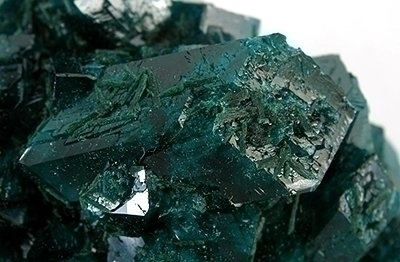
Photo: Wikimedia Commons

Photo: Wikimedia Commons

Photo: Wikimedia Commons
Search for specimens: View all specimens from Tantara Mine, DR Congo
Tantara is recorded as a copper and specimen locality in the Shinkolobwe area of Kambove Territory, Haut-Katanga, roughly within the classic central Katangan copper-mineral province. It is a small oxidized copper deposit rather than a great industrial copper mine. The host is part of the calcareous to dolomitic Kakontwe Formation, and the collectible assemblage comes from oxidized copper mineralization in carbonate rock: dioptase, plancheite, shattuckite, malachite, chrysocolla, cuprite, calcite, cobalt-bearing calcite and dolomite, goethite, hematite, quartz, and strontianite.
The deposit is famous for pockets and vugs rather than large-scale ore production. Belgian geologists reportedly nicknamed it a “rabbit hole,” a telling phrase for a small but specimen-rich occurrence whose openings yielded minerals out of proportion to the deposit’s physical size. Typical Tantara specimens include dioptase-lined cavities, pink cobalt-bearing calcite in dioptase vugs, and pseudomorphs preserving calcite forms after replacement by dioptase and later by plancheite or shattuckite.
Historically, Tantara belongs to the early Belgian Congo mineralogical record. Specimens were entering European and institutional collections by the early 1920s, and the Royal Museum for Central Africa preserves numerous Tantara samples donated or recorded in that period, including dioptase crystals, plancheite nodules, pseudomorphs after calcite, cuprite-rich nodules, malachite, and minor azurite. Archival records also connect the Shinkolobwe–Tantara area with early 20th-century geological work by the Comité Spécial du Katanga and Union Minière du Haut-Katanga, followed later by documentation under Gécamines and regional geological surveys.
The locality continued to matter to collectors long after formal mining declined. Around 2002, local mineral diggers recovered a small run of attractive dioptase specimens from the abandoned mine; Belgian accounts describe about a hundred good pieces, later seen on the international market, including at Tucson. A second modern wave came in 2010–2011, when limited pockets of pseudomorphs—blue shattuckite and plancheite with dioptase and malachite after earlier calcite forms—reintroduced Tantara as one of the world’s elite localities for complex copper-silicate replacements. Later specimen material, including fine shattuckite and mixed dioptase–plancheite combinations, continued to appear sporadically from artisanal recovery.
Access today should be regarded as mining access, not casual field collecting. The original open-cast working is abandoned or depleted, and modern specimens have generally reached the market through local artisanal recovery rather than through organized collector visits. Provenance is therefore especially important: good Tantara labels may mention old Belgian collections, the 1920s historical finds, Shaba-era material, the circa-2002 dioptase recovery, or the 2011 pseudomorph pocket.
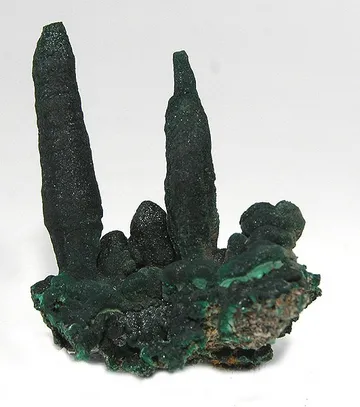
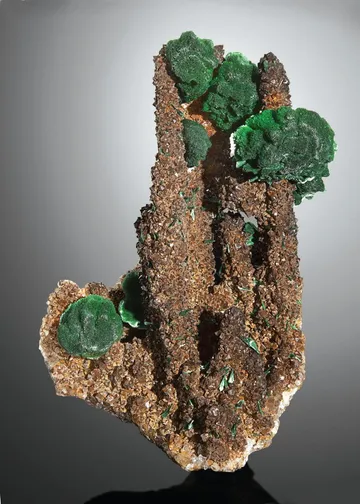
At Tantara, malachite is usually not the dominant show species but is crucial to the locality’s color and paragenesis: it appears as grass-green to deep green crystals, tufts, coatings, and pseudomorphic material with dioptase, plancheite, shattuckite, quartz, calcite, cuprite, and chrysocolla. Historic museum records include fine acicular malachite with chalcocite and dark green prismatic malachite crystals associated with dioptase, while later collector pieces show malachite perched on quartz over shattuckite or present as part of multi-stage replacements after calcite and possibly earlier azurite. The strongest Tantara malachites are not massive green lumps; they are specimens where malachite adds sharp, saturated green accents to blue copper silicates, preserves an earlier crystal form, or appears as discrete crystals on quartz, dioptase, or shattuckite without smearing the specimen’s delicate texture.
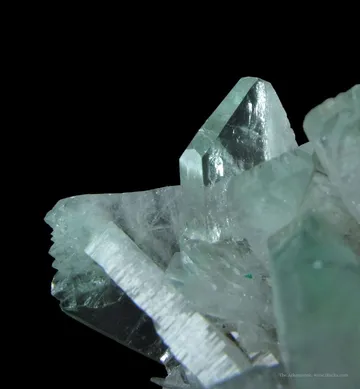
Dioptase is Tantara’s signature mineral and occurs as deep emerald-green to blue-green crystals lining vugs, crusting gossanous matrix, forming solid clusters, and replacing calcite in scalenohedral pseudomorphs. Individual crystals commonly range from a few millimetres to about 1 cm, with exceptional pieces showing crystals around 1.2 cm and rare old specimens carrying much larger isolated crystals approaching 2 cm or more; one notable old-label specimen has been described with a main crystal about 2.8 x 1.7 cm. Tantara dioptase is typically less glassy than the finest Tsumeb material, but its best pieces compensate with dense color, strong form, and associations with pale blue plancheite, dark shattuckite, cobalt-bearing calcite, malachite, quartz, and chrysocolla. Elite specimens show undamaged, lustrous crystals in three-dimensional pockets or on contrasting blue copper-silicate matrix; ordinary pieces tend to be flatter, bruised, massive, or dulled by iron oxides.
Quartz at Tantara is valued less as a stand-alone species than as a sparkling architectural and color modifier in copper-silicate specimens. It occurs as snow-white to clear drusy coatings, spherical crystallized clusters, and blue quartz colored by inclusions of plancheite or related copper silicates; documented pieces include quartz over shattuckite, quartz with plancheite and malachite, and quartz-covered dioptase or blue-silicate matrix. Fine Tantara quartz specimens have a frosty, glittering contrast against emerald dioptase or deep green malachite, with rounded quartz aggregates reported to about 2 cm across on some combination pieces. The most desirable examples are airy and sculptural, preserving the blue-green contrast rather than burying the copper minerals under featureless white druse.
Tantara shattuckite is among the locality’s great modern collector minerals, appearing as sky-blue to darker royal-blue radial sprays, velvet botryoidal crusts, spherical groups, acicular aggregates, and pseudomorphs involved in the calcite-to-dioptase-to-blue-silicate replacement sequence. The 2011 pocket produced especially coveted sculptural specimens, including shattuckite replacing earlier dioptase pseudomorphs after calcite and in some cases carrying later green dioptase crystals on the blue replacement surface. Cabinet-quality pieces may show radial balls, chatoyant fibrous luster, and strong association with dioptase, malachite, quartz, chrysocolla, plancheite, and calcite. The finest examples have clean blue color, velvety texture, visible replacement form, and minimal crushing on the exposed sprays; lesser pieces are chalky, rubbed, or simply massive blue material without the locality’s characteristic paragenetic drama.
Chrysocolla from Tantara appears as light blue to aqua coatings, crusts, replacement material, and occasional pseudomorphous masses associated with dioptase, calcite, malachite, shattuckite, quartz, and plancheite. It is easy to confuse with plancheite or shattuckite when seen only by color, and older labels sometimes used “chrysocolla” for rich blue material that later observers considered more likely plancheite. Verified Tantara specimens include light blue chrysocolla with calcite and dioptase, shattuckite-dioptase-calcite-chrysocolla combinations, and complex chrysocolla epimorphs or replacements after malachite after azurite. Good chrysocolla pieces from Tantara are those with convincing texture and paragenesis—silky or botryoidal blue-green material in context with identifiable dioptase, calcite, quartz, or malachite—rather than isolated blue crusts whose identity rests only on a dealer label.
Azurite is a minor and much less visible Tantara species, important chiefly as part of the locality’s copper-carbonate alteration history rather than as the large display crystals collectors associate with Milpillas, Tsumeb, or Bisbee. A 1923 Royal Museum for Central Africa specimen records azurite as a minor component in a large zoned nodule with a cuprite core, major dioptase, and minor calcite and malachite, while some modern replacement specimens from Tantara are described as chrysocolla after malachite after azurite, implying earlier bladed azurite forms now largely transformed. Collectible azurite from Tantara should therefore be judged conservatively: the best “azurite” interest is likely in preserved morphology and verified multi-stage pseudomorphs, not in free-standing blue azurite crystals.
Calcite is the quiet structural mineral behind many of Tantara’s most famous specimens. It occurs as white, off-white, waxy, translucent, and cobalt-bearing pink calcite in vugs and on matrix, but its greatest role is as the original crystal form in scalenohedral pseudomorphs later replaced by dioptase and then partly by plancheite or shattuckite. Museum and dealer records show calcite with dioptase, plancheite, shattuckite, chrysocolla, malachite, quartz, and cuprite, and some pockets include calcite occupying the center of geodes lined by blue plancheite. Fine Tantara calcite specimens are those where calcite provides contrast, paragenetic clarity, or preserved form; common broken white calcite on matrix is far less desirable unless accompanied by sharp dioptase or blue copper-silicate replacements.
Plancheite is one of Tantara’s defining blue minerals, occurring as pale to sky-blue fibro-radial nodules, tufts, acicular aggregates, stalactitic or botryoidal forms, crusts, and pseudomorphs after dioptase after calcite. Historic records describe plancheite nodules around 2 cm, large blue plancheite scalenohedrons to about 2 cm, and rare radiating clusters reported up to roughly 2.8 cm; modern descriptions also note isolated plancheite balls on dioptase, a style that is especially prized when the spheres are separate, undamaged, and internally vivid blue. It commonly occurs with dioptase, calcite, malachite, quartz, shattuckite, chrysocolla, cuprite, and cobalt-bearing calcite, and it is central to the long-running Tantara pseudomorph discussion. The finest pieces show a clear contrast between deep green dioptase and soft blue plancheite, with recognizable replacement forms or discrete fibrous balls; dull massive blue crusts and ambiguous “blue copper silicate” pieces need careful confirmation.
Other documented Tantara minerals include cuprite, goethite, hematite, dolomite, cobalt-bearing dolomite, cobalt-bearing calcite, strontianite, tenorite, chalcocite, and historical “katangite.” The last name is especially important to old labels: katangite was described from Katanga material associated with Tantara and was later discredited, with authors treating it as plancheite or a plancheite-like/chrysocolla-like microcrystalline copper silicate rather than a valid species. The locality is therefore significant not because it is a modern type locality for a valid mineral species, but because it preserves an early 20th-century chapter in the naming, misnaming, and analytical clarification of blue copper silicates from central Africa.
Tantara specimens reward close looking and careful labeling. The most common identification problem is the blue material: plancheite, shattuckite, chrysocolla, and historically “katangite” can be visually similar, especially when fibrous, botryoidal, or microcrystalline. Old labels may say chrysocolla where later observers would suspect plancheite, or may preserve obsolete names. For better pieces, especially blue pseudomorphs or expensive dioptase-on-blue-silicate combinations, a provenance chain or analytical history is worth a premium.
Mislabelling is a real issue. Some older or dealer-attributed pieces have been confused with material from the Republic of the Congo, the “Star of the Congo” label tradition, or vague “Katanga” and “Congo” designations. Tantara dioptase is also sometimes casually grouped with Renéville or Mindouli dioptase in the broader Congo market, even though those are different countries and different geological districts. A correct label should place Tantara in the Shinkolobwe–Kambove area of Haut-Katanga, Democratic Republic of the Congo.
Condition is often the difference between a merely colorful specimen and a serious one. Dioptase is brittle and bruises easily on crystal edges. Plancheite and shattuckite can be fibrous and delicate, with exposed balls or sprays prone to rubbing, chipping, and dust abrasion. Calcite is soft and acid-reactive, so avoid acid cleaning. Malachite and chrysocolla replacements may have thin, fragile surfaces. Many attractive Tantara specimens have natural contacts from pocket extraction; this is acceptable when the display face remains crisp, but heavy edge grinding, oiled-looking surfaces, glued repairs, or unexplained glossy coatings should be examined carefully.
A specific treatment concern applies mainly to lapidary shattuckite/bisbeeite material attributed to Tantara: stabilized rough, slabs, and cabochons from the DRC have been documented in gemological literature, including material sold under the trade name Lunazul. Stabilization is not inherently deceptive when disclosed for lapidary goods, but it is a serious problem if a treated cabochon or polished piece is represented as an untreated crystallized specimen. For display specimens, watch for unnatural resin gloss in porous blue material, especially on massive shattuckite/chrysocolla mixtures.
In the market, Tantara is available but not abundant. Small shattuckite balls, quartz-coated blue pieces, and modest dioptase clusters appear regularly enough for patient collectors. Fine old dioptase, large intact plancheite balls on dioptase, and 2011-style multi-stage pseudomorphs are much scarcer and can command strong prices, especially with old Belgian, Shaba-era, or named-collection provenance. The best Tantara pieces have three virtues at once: color contrast, visible paragenesis, and condition.
The earliest great Tantara story begins in 1920, when unusual pseudomorphs were recovered from what was then the Belgian Congo. They looked like calcite scalenohedrons, but they were not calcite anymore. The green portions were dioptase, and the blue portions raised a problem that would occupy mineralogists for decades: was the blue mineral plancheite, shattuckite, “katangite,” or a mixture? By 1925–1926, Belgian authors were already disagreeing about the mineralogy. The specimens were attractive enough to collect, but their real value was the sequence frozen inside them: calcite form, dioptase substance, blue copper-silicate alteration.
That 1920s material did not disappear into legend. It entered museums and old collections, and some of the very specimens later became the basis for a modern reinvestigation. The Royal Museum for Central Africa preserves Tantara samples donated in 1923 by Nève de Mévergnies, including a large zoned nodule with a cuprite core, dioptase, azurite, calcite, and malachite; blue plancheite scalenohedrons to 2 cm with green dioptase crystals after calcite; and dark green dioptase scalenohedrons preserving calcite morphology. These are not just cabinet curiosities—they are the physical record of how early Katangan copper minerals were named, argued over, and reinterpreted.
Then came the long silence. Collectors knew Tantara mostly through old labels and older literature, until local diggers revisited the abandoned copper mine around 2002. The find was small: about a hundred attractive dioptase specimens, described from a locality roughly 10 km southwest of Shinkolobwe. The matrix was white dolomite, sometimes carrying blue chrysocolla and small shattuckite balls. Roger Van Dooren later offered material from that recovery on the international market, including at Tucson in 2004, reintroducing Tantara dioptase to collectors who had previously known it mainly as an old Belgian Congo name.
The most dramatic modern episode arrived in 2010–2011. A very small find in 2010 was followed by a larger hit in the first half of 2011: new pseudomorphs, some preserving the familiar scalenohedral calcite habit and others showing a new style that collectors debated intensely. Belgian collector Valère Berlage recognized their significance early. By the 2011 Munich Show, the material had become one of the surprises of the event. A few dozen specimens had passed through South Africa to Kalahari Classics and Paul Balayer; analyses suggested shattuckite in material that earlier expectations might have called plancheite. Many specimens also carried dioptase and malachite, making the replacements not a simple one-mineral-after-one-mineral story but a layered copper-silicate history.
The quantities from that 2011 pocket were small. One show report estimated perhaps only 60–70 specimens from the limited find. That number matters: it explains why good examples have remained so intensely pursued. The best specimens can show shattuckite or plancheite after dioptase after calcite, partly covered by a second generation of dioptase. One particularly admired example discussed by collectors measured about 15 x 15 x 10 cm—a large, sculptural survival from a find otherwise dominated by much smaller pieces.
The debate did not end at the show table. Collectors examined broken crystals, replacement fronts, blue octahedral-looking microforms, and the way shattuckite seemed to “eat” earlier dioptase from the outside inward. Some pieces showed enough of the replacement sequence for the naked eye to follow the mineralogical argument: calcite first, dioptase next, then blue copper silicates advancing through or over the green. That is the essence of Tantara’s appeal. It is not a locality of endless production; it is a locality where a small number of pockets captured mineral change in three dimensions.