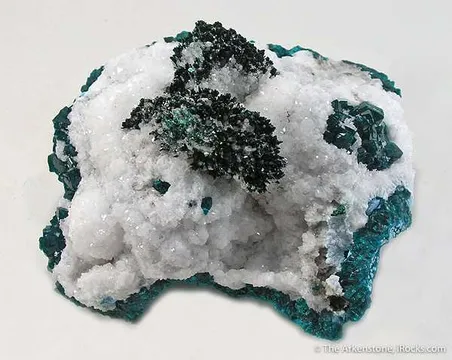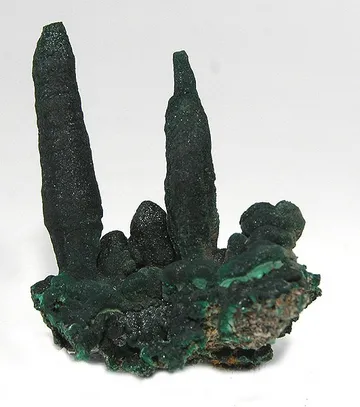
Shangulowé Mine, DR Congo — a distinctive collector locality with baryte on malachite and plancheite, prized for texture, color contrast, and associations.
Key facts
Shangulowé is one of the more distinctive collector localities of the Kambove copper district: not simply another Katangan copper mine, but a breccia-hosted Cu-(Pb-Zn) deposit whose best specimens preserve the whole drama of an oxidized copper system in miniature. The mine lies in the central part of the Lufilian arc, within the Congolese Copperbelt, where Neoproterozoic rocks of the Katanga Supergroup were folded, faulted, brecciated, mineralized, and then deeply weathered. Geologically, Shangulowé is important because its copper mineralization is hosted not in the classic Roan Mines Subgroup ore shale alone, but in sedimentary breccias and adjacent Kundelungu Group rocks along the M’sesa fault system. For collectors, that geology matters because the dissolution cavities, fractures, and porous breccia matrices created the spaces in which malachite, chrysocolla, baryte/barite, plancheite, shattuckite, azurite, brochantite, and related secondary minerals could form as highly aesthetic specimen associations.
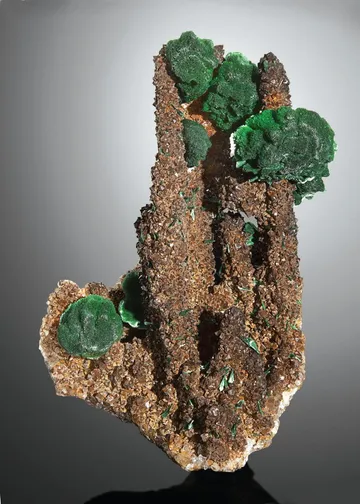
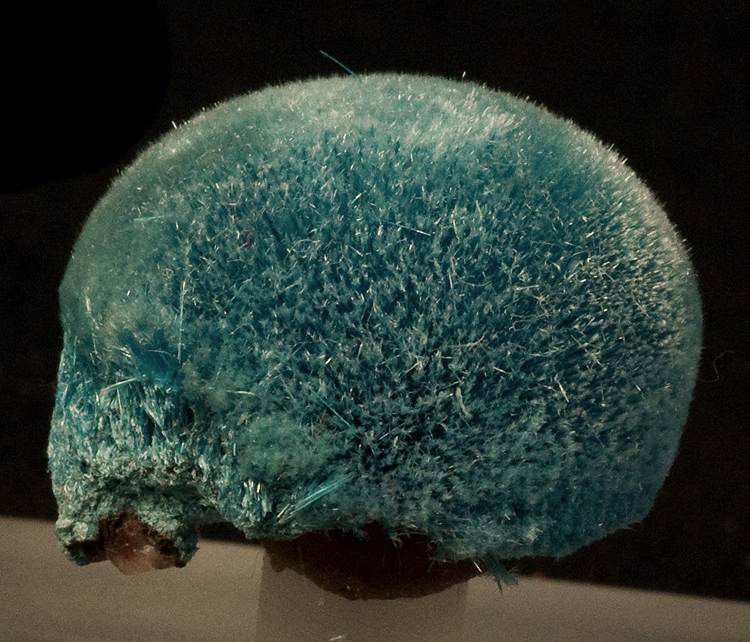
The locality is most famous for its baryte on malachite: pale, glassy to milky-white bladed crystals, often subtly green from malachite inclusions, perched on deep green botryoidal or velvety malachite. The best pieces have a sculptural contrast that is immediately recognizable—transparent or translucent baryte blades standing proud of a rounded malachite substrate, sometimes with tiny malachite balls caught inside the baryte. Shangulowé also produced powder-blue plancheite in soft, fibrous, hemispherical, botryoidal, and acicular aggregates, locally in association with baryte, calcite, quartz, malachite, chrysocolla, and shattuckite. The result is a locality suite with a very different personality from the cuprite-rich Kolwezi mines or the uranium-bearing classics of Shinkolobwe: Shangulowé specimens are about texture, inclusion, pseudomorph, and color contrast.
Regional View
Country View
Historically, the deposit was discovered by Union Minière du Haut-Katanga in 1931 and was mined between 1933 and 1943 by both open-pit and underground methods. That short, high-grade production life—over one million tonnes of ore averaging more than 9% copper—left a locality that is much better known today to mineral collectors than to the broader public. In museum and old-collection records, Shangulowé appears under older spellings and political geography—Katanga, Shaba, Zaire, Congo Belge, Congo (RDC)—so older labels should be read carefully rather than dismissed. Some of the finest baryte-malachite material circulated in the late twentieth century, while new pockets and recirculated old specimens have kept the locality visible on the market.

Search for specimens: View all specimens from Shangulowé Mine, DR Congo
Shangulowé is in the Kambove mining district of Haut-Katanga, part of the central Congolese Copperbelt. The mine is usually placed near Kambove and Kamfundwa, in the same regional cluster as Kambove, Kamoya, Kamfundwa, M’sesa, Kakanda, and related sediment-hosted copper-cobalt deposits. The accepted mineral-locality name in collector usage is Shangulowé Mine, Kambove, Kambove Territory, Haut-Katanga, DR Congo; older labels may say Shangulowe, Shangoluwe, Katanga, Shaba, Zaire, or Belgian Congo.
Geologically, Shangulowé is a stratabound Cu-(Pb-Zn) deposit hosted in breccias and surrounding Kundelungu Group rocks. It lies along the northwest-southeast M’sesa fault, which cuts the Kambove synform. Modern work divides the deposit structurally into North, Central, and South zones separated by transverse sinistral faults. The North and Central sectors expose the Kanianga Formation, while the South sector is associated with the Mongwe Formation; both belong to the Kundelungu succession. This is one reason Shangulowé has received attention in the literature: the deposit sits outside the simple collector’s shorthand of “Katangan copper oxides” and instead records a complicated history of sedimentary brecciation, dissolution, later brittle deformation, and supergene enrichment.
The Shangulowé breccia package has been described as three principal layers: a lower ferruginous breccia, a middle dolomitic breccia, and an upper siliceous breccia. The ferruginous breccias are roughly 60 m thick and contain angular to very angular dolomite fragments in an iron-rich sandy clay matrix, with hematite and goethite giving the rock its reddish-brown cast. The dolomitic breccias are about 50 m thick, with millimetric to centimetric dolomite fragments, locally up to 50 cm, in a siliceous matrix. The siliceous breccias, about 25–50 m thick, are younger and post-orogenic in character. Those breccias, together with smaller mud-flow horizons and faulted Kundelungu rocks, supplied the broken, porous, carbonate-rich architecture in which copper-bearing fluids could move.
The primary ore suite includes pyrite, chalcopyrite, bornite, chalcocite, and locally sphalerite and galena. The collector minerals belong mainly to the oxidized and supergene stages: malachite, chrysocolla, azurite, covellite, brochantite, shattuckite, plancheite, and baryte. In the ferruginous breccias, azurite, chalcocite, chrysocolla, covellite, and malachite are common supergene minerals. In the dolomitic breccias, azurite, malachite, chrysocolla, chalcocite, covellite, sphalerite, and galena occur in matrix and fractures, while malachite and barite are specifically documented in dissolution cavities and pores of altered fragments. That cavity setting is the essential key to the collectible baryte-malachite material: the baryte did not merely sit on random copper ore; it grew in open spaces within altered breccia, commonly on earlier malachite or in intimate contact with it.
The mining history is short but consequential. Union Minière du Haut-Katanga discovered the deposit in 1931, and the mine produced from 1933 to 1943. Published figures record 1,030,627 tonnes of ore averaging 9.63% Cu from open-pit and underground operations during that period. The production figures explain why the locality appears in older company, museum, and Belgian colonial-era mineralogical collections, while the limited mining life explains why top specimens are not abundant relative to the fame of the association.
Collecting access should be treated as closed industrial-mining access unless permission is explicitly obtained from the relevant operator and authorities. Shangulowé is part of the Kambove mining landscape, historically tied to UMHK and later Gécamines-era holdings, not a casual public collecting site. Specimens on the market are therefore best understood as old mine-production pieces, old-collection material, or pieces recovered through controlled or local recovery from old workings and pockets. Labels and provenance chains are especially valuable here: a specimen with a pre-2000s dealer label, an old Belgian or museum-style label, or a clear pocket history carries more documentary weight than an anonymous “Congo barite/malachite” label.
The best documented collectible finds include the late twentieth-century baryte-malachite material with green-included, chisel-shaped baryte crystals, and later small-pocket material described by collectors and dealers in the 2020s. Older museum records also show that the locality was not a one-mineral curiosity: specimens of massive pink baryte with specular hematite, clear baryte on malachite, dark blue plancheite/“katangite,” shattuckite with katangite, azurite, chalcocite with malachite, and brochantite had all entered the Royal Museum for Central Africa collection by the mid-twentieth century.
At Shangulowé, “barite” in collector usage refers to the same BaSO4 species more often spelled baryte in British and European mineralogical literature, and the locality’s classic pieces are pale, translucent to milky, bladed or chisel-shaped crystals on malachite; the best crystals reach several centimeters, with older commercial descriptions noting crystals to about 3–5 cm and a particularly robust small-cabinet example with crystals to 4.2 cm. The most desirable crystals are not simply white blades: they are subtly green from included malachite, sometimes with tiny malachite balls visible inside, and they stand in sharp relief on deep green botryoidal or velvety malachite, locally with chrysocolla. Ordinary pieces tend to be broken loose baryte groups, baryte on dull matrix, or malachite plates with only minor baryte smears; fine Shangulowé barite has balance, luster, intact chisel tips, and a clean three-dimensional relationship between the baryte and the malachite substrate.
Shangulowé malachite is most collectible when it forms the saturated green base for baryte: botryoidal, velvety, laminar, stalactitic, or crust-like surfaces that make the pale baryte crystals look suspended above a living green landscape. Geological descriptions place malachite in pores, fractures, breccia matrix, dissolution cavities, and altered fragments, and the museum record includes laminar malachite carrying large clear baryte crystals as early as the 1940s. The locality also produced malachite pseudomorphs after baryte, an important feature because it records replacement rather than simple overgrowth. Top pieces have rich color, undamaged velvet or rounded surfaces, visible crystal or pseudomorph form, and strong association with baryte, chrysocolla, plancheite, or shattuckite; lesser pieces are massive green copper ore with little form or with bruised, rubbed, or polished-looking surfaces.
Under the baryte spelling, Shangulowé is a reference locality for one of the Congo Copperbelt’s most attractive BaSO4 associations: colorless, white, pale gray, or malachite-green-included blades, tablets, and elongated crystals on malachite, occasionally with chrysocolla, plancheite, calcite, and quartz. Historic museum material includes “large clear crystals on laminar malachite substrate,” and Mineralogical Record index entries record yellow-gray crystals with malachite inclusions, colorless bladed crystals to 4 cm included by malachite, green-tinted crystals to 5 cm in groups on malachite matrix, and cabinet-size groups. The finest baryte specimens from Shangulowé are judged by transparency, luster, undamaged terminations, spacing, and the way the crystals rise from the malachite rather than lie flat on it; matrixless greenish crystals are attractive, but the locality’s identity is strongest when the malachite base is intact.
Shangulowé plancheite is a powder-blue to turquoise-blue copper silicate, commonly fibrous, acicular, botryoidal, hemispherical, fibro-radial, or crust-forming, and older labels may call part of this material “katangite,” now treated as a synonym or historical name associated with plancheite-group nomenclature. The Royal Museum for Central Africa records dark blue fibro-radial nodules from Shangulowé in 1932, and specimen photographs show vivid blue hemispheres, soft-looking acicular crusts, plancheite geodes with baryte, and plancheite associated with calcite, quartz, malachite, and baryte in gossan cavities. Fine pieces have saturated blue color, silky luster, intact radial surfaces, and clear form rather than powdery crust; they are fragile, so abrasion, flattened fibers, and sooty or dusty surfaces reduce quality quickly.
Other documented Shangulowé minerals include shattuckite, chrysocolla, azurite, brochantite, cuprite, calcite, quartz, dolomite, hematite, goethite, chalcocite, covellite, chalcopyrite, bornite, pyrite, sphalerite, galena, and native copper. No accepted modern mineral species is best treated as having Shangulowé itself as its sole type locality in the sources consulted; the locality’s systematic-mineralogical importance lies instead in its role in the long-running shattuckite-plancheite-bisbeeite-katangite nomenclature problem and in the museum-preserved Katangan copper-silicate specimens that helped define that debate. Among collector rarities, cuprite from Shangulowé is notably uncommon compared with the famous cuprites of the Kolwezi district, while well-crystallized brochantite, shattuckite-plancheite associations, and malachite or plancheite pseudomorphs after baryte are all worth special attention.
The main authenticity issue with Shangulowé is not a famous published category of manufactured fakes, but the believability of the baryte-malachite contact. Because the association is so unusual and visually striking, specimens should be inspected for glued baryte blades, mismatched contact surfaces, resin in cavities, artificial green staining, or malachite fragments that do not wrap naturally around the bases of the crystals. On genuine pieces, malachite may occur as a substrate, as inclusions in baryte, as small balls within crystals, or as replacement material after baryte; those textures should look mineralogically continuous rather than staged.
Labels require care. “Barite” and “baryte” are two spellings of the same species, and EarthWonders preserves both marketplace categories, but old labels may use one or the other. “Katangite” is another label trap: it appears on older Shangulowé material, especially blue fibrous copper silicates, but the name is now generally treated in relation to plancheite rather than as a separate collectible species. Shattuckite and plancheite are also easily confused by color and habit, and many blue copper-silicate specimens from Katanga deserve analytical confirmation if the exact species matters.
Condition is critical. Baryte has perfect cleavage and Shangulowé crystals commonly have projecting blades, chisel tips, and thin edges; bruised terminations, missing tips, and repaired or reattached crystals are common hazards. Malachite velvet and botryoidal surfaces can be rubbed smooth, dulled by handling, or damaged by old cleaning. Plancheite is even more vulnerable: the best fibrous surfaces are soft-looking because they are made of fine acicular crystals, and they can be flattened, fuzzed, dust-loaded, or broken by careless packing. Avoid ultrasonic cleaning, acids, aggressive brushing, and prolonged soaking. A hand blower, soft sable brush used sparingly, and stable display conditions are safer.
Fluorescence is not a meaningful selling point for the classic Shangulowé suite. The locality is about visible-light color and texture: green malachite, blue plancheite and shattuckite, pale baryte, and occasional quartz or calcite contrast. Malachite and plancheite contain copper and should be handled with normal mineral-collector hygiene: wash hands after handling, avoid inhaling dust from friable material, and keep fragile fibrous pieces in covered boxes or display cases.
Market availability fluctuates. Old baryte-malachite pieces from the late twentieth-century finds still appear, but fine matrix examples with undamaged, well-spaced, translucent baryte crystals are much scarcer than loose greenish baryte fragments or modest malachite plates. Recent 2026 activity brought renewed attention to dramatic baryte-on-malachite pocket material, including specimens marketed from the “Arrow Head Pocket,” but the best pieces are highly selective, not bulk commodity material. Plancheite thumbnails and miniatures appear more often at modest levels, while top blue hemispheres, geodes, and plancheite-baryte-calcite combinations are appreciably less common. For advanced collectors, the sweet spot is a specimen that is unmistakably Shangulowé at arm’s length: pale baryte blades, vivid green malachite, and enough intact three-dimensional form to make the paragenesis readable.
One of the best Shangulowé stories is preserved not in a field diary but in the description of a now widely reproduced specimen: a small-cabinet baryte-malachite piece, 8.9 x 8.8 x 7.0 cm, photographed by Rob Lavinsky. The description remembers the moment when the baryte-malachite pieces emerged in the late 1980s and “amazed us all.” That reaction is easy to understand. Many examples from the find were either greenish barytes without meaningful matrix, or malachite pieces with only minor baryte, but the memorable specimens struck a rare balance: pale blades splaying across a rounded, velvety malachite core. The description calls the association “unique,” and for collectors who first saw those specimens as they entered the market, Shangulowé became a locality whose best pieces looked unlike ordinary Congo malachite and unlike ordinary baryte.
The same association re-entered collector conversation in 2026 with the “Arrow Head Pocket,” a name applied to a newly publicized pocket of baryte on malachite from Shangulowé. The pocket’s appeal was immediate: clear to pale baryte crystals rising from delicate malachite, with enough drama that examples circulated widely in collector circles almost as soon as they appeared. One reported 2026 pocket note described an opening during the night of February 12, with only a few specimens recovered from a single cavity. Whether every marketed “Arrow Head” label will stand the test of provenance is a question for careful buyers, but the episode shows why Shangulowé remains alive in the collector imagination decades after its main ore production ended. A pocket does not need to be large to change a locality’s market presence; at Shangulowé, a few intact baryte blades on the right malachite base can do it.
There is also a quieter museum story running underneath the showy specimens. By 1945, the Royal Museum for Central Africa had received a Shangulowé specimen described simply as large clear crystals on a laminar malachite substrate. In 1932, it recorded dark blue fibro-radial nodules of plancheite and “katangite.” In 1947, shattuckite with katangite entered the collection; in 1949, well-developed green needle-shaped brochantite; in 1952, another blue fibro-radial shattuckite nodule. Those terse catalogue lines read like labels in a drawer, but they are a timeline of the locality’s mineralogical identity forming piece by piece: first baryte and malachite, then the blue copper silicates, then the smaller systematic species that make Shangulowé more than a single famous association.