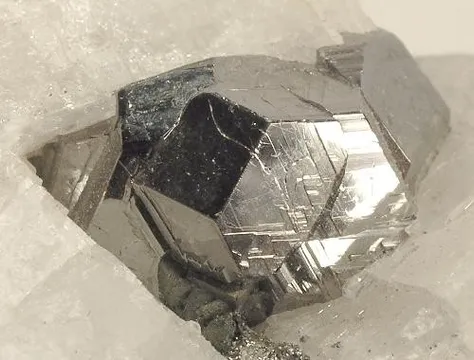
Kamoya South II is the modern benchmark locality for carrollite. Its best specimens have the look that made the species famous among contemporary sulfide collectors: brilliant silver to steel-gray crystals, often mirror-faced, with crisp spinel-family geometry set into pale calcite or dolomitic carbonate. The visual effect is unusually clean for a sulfide—hard, metallic geometry against light matrix—and the finest examples have enough reflectivity that the faces flash like cut metal when turned under a lamp.
Key facts
Kamoya South II is the modern benchmark locality for carrollite. Its best specimens have the look that made the species famous among contemporary sulfide collectors: brilliant silver to steel-gray crystals, often mirror-faced, with crisp spinel-family geometry set into pale calcite or dolomitic carbonate. The visual effect is unusually clean for a sulfide—hard, metallic geometry against light matrix—and the finest examples have enough reflectivity that the faces flash like cut metal when turned under a lamp.

Photo: Wikimedia Commons / Leon Hupperichs
The locality sits in the Kambove area of Haut-Katanga, within the Congolese part of the Central African Copperbelt. That setting matters. Kamoya South II is not an isolated “pretty pocket” locality; it is part of one of the world’s great sediment-hosted copper-cobalt provinces, where sulfides formed in and around dolomitic shales, dolostones, breccias, carbonate cavities, and reduced horizons. Carrollite, CuCo2S4, is the cobalt-bearing sulfide that here found an unusually favorable combination of chemistry, open space, and late-stage preparation by dissolution and etching.
The locality’s reputation rests on the size and sharpness of its crystals. Earlier Congolese carrollites from Kambove and Kamoto-type finds had already transformed expectations for the species, but Kamoya South II pushed the standard higher. Mineralogical Record commentary on the early 2000s find described Kamoya II crystals as sharp, mirror-faced, equant singles approaching baseball size, lying on cleavage surfaces in coarse white calcite. Even allowing for the fact that most available collector specimens are far smaller, that phrase captures why the locality became legendary: carrollite, once mainly a microscopic or small-crystal species, suddenly appeared as cabinet-quality metallic sculpture.

Photo: Wikimedia Commons / Rob Lavinsky, iRocks.com
Collectors look for symmetry, reflectivity, and naturalness. The classic Kamoya South II crystal is not merely an octahedron; it may show complex combinations of octahedron, cube, dodecahedron, and modified spinel forms, sometimes so geometrically busy that the crystal seems faceted by design. The best pieces show sharp edges, deep metallic luster, minimal bruising, and a bright carbonate matrix that gives scale and contrast. Detached singles can be superb, but a well-positioned crystal in calcite is usually more desirable, because it preserves the visual story of the pocket.
Search for specimens: View all carrollite specimens from Kamoya South II Mine, DR Congo
Kamoya South II Mine is at Kamoya, near Kambove, in Kambove Territory, Haut-Katanga Province, DR Congo. Mindat places it about 2 km west of Kambove, gives coordinates near 10°52'13" S, 26°34'10" E, and records the site as an open-cast mine, with “Kamoya Sud Mine” and “Kamoya South Mine” among its historical or alternate names. It is part of the Katanga Copper Crescent, within the broader Central African Copperbelt.
The deposit belongs to the sediment-hosted copper-cobalt system of the Kambove district. Regional studies of the Kambove West deposit—geologically close enough to be the most useful published analogue—describe Neoproterozoic Mines Subgroup host rocks dominated by dolomitic shales and dolostones. In these deposits, mineralized zones are strongly controlled by stratigraphy, brecciation, carbonate facies, reducing organic-rich horizons, and fluid pathways. The hypogene sulfide assemblage includes pyrite, chalcopyrite, bornite, chalcocite, and carrollite, followed by supergene remobilization and oxidation products such as malachite, heterogenite, chrysocolla, and related cobalt-copper minerals.
Kamoya South II was first opened in 1998 as a benched open cut. The site’s collecting history is unusually tangled because the mine was effectively treated as a secret specimen source. During operation, the mine owners enforced a strict no-specimen policy on miners; according to locality records, specimens that reached collectors were obtained at the mill rather than directly through normal field collecting. That secrecy caused a long trail of incorrect labels. Important Kamoya South II carrollites were attributed to Kamfundwa, Mashamba West, Kambove, and other nearby or better-known Congo localities before the source was clarified.
This is not a casual collecting locality. It is an industrial copper-cobalt operation in a major mining district, and access must be treated as private, controlled, and potentially hazardous. The locality’s specimen production is a by-product of ore mining and processing, not a public collecting opportunity. For collectors, provenance depends on old dealer records, collection labels, and comparison with documented Kamoya South II material rather than on new field access.
Production for fine collector carrollite appears to have been concentrated around the late 1990s and early 2000s. Specimens were already being discussed internationally by 2001, and the locality was the subject of Rochester Mineralogical Symposium presentations in 2005 and 2008. Market appearances continue today, but many are resales from older stock or established collections. That is typical of a classic locality whose brief peak output set the standard and then largely moved into collections.
Kamoya South II carrollite is visually defined by metallic luster and sculptural form. The color is bright silver to steel-gray, sometimes appearing almost black in low light but flashing white-silver on illuminated faces. Fresh faces can be extraordinarily reflective. Fine specimens show the isometric symmetry of the thiospinel structure in octahedral, cubo-octahedral, dodecahedral, and highly modified compound forms. Some crystals are simple and architectural; others are deeply complex, hoppered, etched, stepped, or composed of many small modifying faces.
The classic matrix is pale calcite—white, cream, grayish, or translucent—and crystals may sit in pockets, vugs, cleavage cavities, or etched carbonate. Dolomite is also recorded from the locality, along with chalcopyrite, bornite, chalcocite, quartz, siderite, malachite, native copper, spherocobaltite, heterogenite, chrysocolla, shattuckite, plancheite, baryte, goethite, asbolane, and other copper-cobalt minerals. In collector specimens, calcite is by far the association most frequently encountered, often providing the light background that makes the carrollite look especially dramatic. Chalcopyrite can add brassy highlights; bornite and chalcocite point back toward the copper-rich sulfide assemblage.
Typical collector crystals range from a few millimeters to several centimeters. Thumbnail pieces with 5–15 mm sharp crystals can be excellent when the luster is strong and the edges are undamaged. Small-cabinet matrix specimens with 1–3 cm crystals are highly desirable. Larger single crystals and major matrix pieces exist, and they are the reason the locality has its world-class reputation, but they are far less common and usually trade through advanced collector networks, auctions, or long-held private collections.
Natural etching is part of the Kamoya South II story. King and Morgan’s work on etching emphasizes that carrollite from the mine is frequently etched, and that oxidation can transform cobalt into asbolane, heterogenite, or spherocobaltite while copper enters malachite, chrysocolla, and related minerals. For collectors, that means “etched” is not automatically a defect. Mild, natural etching can create fascinating surface architecture and complex modified crystals. Heavy etching, however, can dull luster, round edges, and reduce the commanding geometry that makes the locality desirable.
Quality is judged by five main factors: luster, crystal definition, symmetry, matrix contrast, and condition. A smaller, mirror-bright crystal with crisp faces can outrank a larger but pitted or rounded one. A crystal naturally nested in calcite usually has more collector appeal than a loose crystal of comparable quality, especially if the matrix is not overly etched or broken. The most desirable pieces show a clear display face, strong contrast, minimal contact damage, and enough open space around the crystal for its form to read cleanly.
The greatest authenticity issue for Kamoya South II carrollite is not a widespread fake-crystal problem; it is locality confusion. Because the source was concealed during the early period of production, specimens were sold or labeled as Kamfundwa, Mashamba West, Kambove, or other Congo localities. Modern collectors should treat early Congo carrollite labels with caution and preserve every old label rather than discarding “wrong” ones. A specimen carrying an old Kamfundwa or Mashamba West label may still be a genuine Kamoya South II carrollite; the question is provenance, not necessarily mineral identity.
Condition is the other major concern. Carrollite has good hardness for a sulfide, but sharp metallic edges and corners chip readily. On matrix pieces, look carefully at the contact between crystal and calcite. Detached crystals can be reattached, and vug specimens can hide repairs along the base of a crystal. Check for glossy glue lines, unusual halos in the carbonate, mismatched dirt in the matrix, or slight misalignment where a crystal meets its socket. A disclosed, old repair may be acceptable on an important specimen, but it should be priced accordingly.
Etching must be evaluated with nuance. Many Kamoya South II crystals are naturally etched, and some etched crystals are superb. What matters is whether the etching enhances form or destroys it. Avoid pieces where the faces are uniformly sugary, dull, or rounded, unless the specimen is being bought as an inexpensive representative rather than a fine example. Strong acid cleaning can also damage calcite matrix and may leave the piece looking hollowed-out or over-prepared.
Matrix specimens are scarcer and generally more desirable than loose singles, especially when the crystal is well displayed in calcite. Loose crystals are still collectible, particularly if they show complex morphology or exceptional luster, but they need strong geometry to compete. For acquisition, expect occasional market availability rather than steady supply. Recent examples in dealer and auction records include small-cabinet matrix specimens with 7 mm crystals, 2 cm complex loose crystals, and larger cabinet pieces priced into the thousands of dollars. Fine, undamaged, matrix-mounted Kamoya South II carrollites remain competitive because they are both locality classics and species standards.
The Kamoya South II story begins like a mineral-market mystery. The mine opened in 1998 as a benched open cut, but the source of the remarkable carrollites was not made public. The owners reportedly ran a strict security force and enforced a no-specimen policy on the miners. For a mineral collector, that single fact explains the strange path these specimens took into the world: they were not gathered in the pit by collectors, wrapped in newspaper, and sold with proud locality notes. They slipped into the specimen trade from the mill, after the ore had already moved through the industrial system.
The result was a trail of false names. While the locality remained hidden, dealers and suppliers attached more familiar labels to the crystals: Kamfundwa, Mashamba West, and other Congo copperbelt mines. The problem was compounded by the fact that there are multiple Kamoya prospects and occurrences in the district, but only one large Kamoya South II open pit that locality specialists consider the source of virtually all important “Kamoya” carrollites. A fine specimen with a wrong old label is therefore not just a mislabeled rock; it is a relic of the secrecy surrounding the find.
Then came the shock of the crystals themselves. Mineralogical Record commentary from 2011, looking back over the late 20th- and early 21st-century carrollite chronology, described carrollite as hardly known in earlier times as euhedral macrocrystals. Kambove produced sharp silvery crystals to 1.5 cm in the late 1970s. Around 1990, Kamoto Fond produced larger brilliant crystals that briefly stood as the world’s ultimate carrollites. Then, in early 2001, Kamoya II changed the standard again with “practically unbelievable” size and quality: sharp, mirror-faced singles approaching baseball size, set on cleavage planes in coarse white calcite.
That is the image collectors remember: a dark, heavy copper-cobalt sulfide, usually thought of as a species for systematic collections, suddenly appearing as gleaming geometric crystals large enough to dominate a cabinet shelf. The best Kamoya South II specimens did not merely improve the species; they rewrote expectations for what carrollite could be.