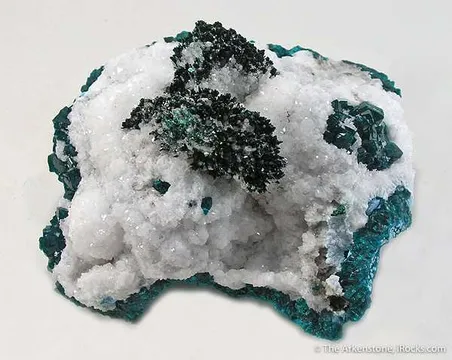
Kamoya South II Mine, DR Congo - a premier locality for carrollite, producing mirror-bright thiospinels on white carbonate; prized by collectors for contrast,…
Key facts
Kamoya South II is one of the decisive modern localities for carrollite. In the collector’s world it occupies a position very much like Tsumeb for dioptase or Bisbee for azurite: not the type locality, not the only occurrence, but the place that redefined what the species could look like as a cabinet mineral. The mine lies in the Kambove area of Haut-Katanga, within the Central African Copperbelt, a Neoproterozoic sediment-hosted copper-cobalt province where mineralization is carried by folded and faulted carbonate, shale, and siliceous rocks of the Katanga Supergroup. In specimen terms, that geology matters because Kamoya South II did not merely produce sulfide ore; it opened cavities, seams, and carbonate cleavage spaces where Cu-Co sulfides could crystallize as brilliant, freestanding objects.
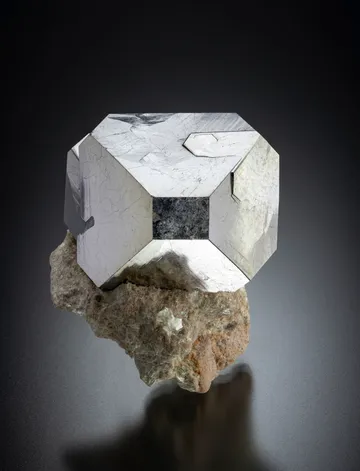
The signature specimen is unmistakable: silver to steel-gray carrollite, mirror-bright and sharply isometric, perched on white to creamy calcite or dolomite, commonly with chalcopyrite and sometimes with bornite, quartz, siderite, malachite, or pink cobalt-bearing carbonate. The best crystals are not the dull massive carrollite of ore petrology; they are sculptural thiospinels—octahedra, cubo-octahedra, dodecahedral modifications, and complex etched or growth-textured forms—that flash like polished metal under a light. Kamoya South II also has a complicated collecting history. During the first years of its specimen production the source was intentionally obscured, and important pieces entered collections as “Kamfundwa,” “Mashamba West,” “Kambove,” or simply “Katanga.” Later clarification made Kamoya South II the accepted source for virtually all of the great “Kamoya” carrollites.
Regional View
Country View
Collectors prize the locality because the visual contrast is so clean: hard, geometrical, metallic crystals rising from pale carbonate. The mine also produced enough variation to keep advanced collections interesting. Some specimens show a single proud carrollite octahedron in white calcite; others carry several modified crystals across a carbonate plate; still others show chalcopyrite sprinkled over or replacing parts of the carrollite, adding brassy highlights and clues to the paragenesis. Loose single crystals exist in significant numbers, but matrix examples—especially undamaged, aesthetic ones with a well-centered crystal—are much more desirable.

Photo: Wikimedia Commons

Photo: Wikimedia Commons
Search for specimens: View all specimens from Kamoya South II Mine, DR Congo
Kamoya South II, also recorded as Kamoya Sud II, Kamoya South, or Kamoya Sud Mine, is a benched open-cut copper-cobalt mine near Kamoya, about 2 km west of Kambove in Haut-Katanga. It belongs to the Kambove cluster of sediment-hosted copper-cobalt deposits, which also includes Kambove Principal, Kambove West, Kamfundwa, Shangolowé, M’sesa, Kabolela, Kamoya East, and Kamoya West. Regionally these deposits sit in the central part of the Congolese Copperbelt, itself the northern portion of the Central African Copperbelt, one of the world’s great Cu-Co metallogenic belts.
The ore setting is the classic Katangan copper-cobalt environment: folded and tectonically disrupted carbonate-shale-siliceous successions in which reducing beds, carbonate permeability, evaporitic textures, and later structural preparation combined to focus metal-bearing fluids. Published summaries of the Kamoya-Kambove district describe two principal orebodies, with the cobalt-rich zone in the lower orebody, hosted by faulted dolomite, shale, and chert within the Kambove structural setting. The specimen suite reflects that environment. Carrollite and chalcopyrite are the collector-facing sulfides; bornite and chalcocite occur as associated copper sulfides; calcite and dolomite provide the pale carbonate stage on which the best crystals are displayed; and the oxidized assemblage includes malachite, chrysocolla, plancheite, shattuckite, heterogenite, asbolane, and goethite.
The mine was opened in 1998 as a benched open cut. The early years were unusually secretive by specimen-market standards: security reportedly enforced a strict no-specimen policy in the pit, and many pieces that did reach the market were recovered downstream at the mill rather than collected openly from pockets. That history explains one of the locality’s persistent problems. When the great carrollites first appeared, dealers and suppliers often used names such as Kamfundwa, Mashamba West, Kambove, or vague “Katanga” attributions. Later locality work made clear that there are many Kamoya-named prospects and occurrences, but only Kamoya South II was the large open pit responsible for virtually all of the important “Kamoya” carrollite specimens.
Industrial production in the Kambove area has long been associated with Gécamines and with later joint-venture and processing arrangements around Kambove assets. Kamoya South II material belongs to that broader copper-cobalt production landscape rather than to a collector-access mine. The classic specimen pulse belongs above all to the late 1990s and early 2000s, with particularly famous material documented around 2001 and 2002. Later market records and gallery entries show additional pieces and smaller later finds, including material described from a new 2018 occurrence, but the locality’s reputation rests on the early discovery period when large, sharp, metallic carrollite crystals first emerged in numbers.
Collecting access today should be regarded as closed in practical terms. This is an industrial copper-cobalt mining district, not a public collecting locality, and the mine’s own specimen history involved security restrictions from the beginning. Contemporary collectors obtain Kamoya South II specimens through older stocks, collection dispersals, auctions, dealers, and specimens rescued long ago from the ore stream. For provenance-conscious collectors, older labels are important but must be read critically: a “Kamfundwa” or “Mashamba West” carrollite with the visual style of Kamoya South II may well be part of the early misattributed production.
Carrollite is the mineral that made Kamoya South II famous. The mine’s crystals are brilliant silver to steel-gray, typically octahedral to cubo-octahedral, but many are far more complex, combining octahedron, cube, rhombododecahedron, and smaller modifying faces, with etched faces, triangular growth markings, or subtly stepped surface textures. Documented specimens range from millimeter crystals scattered with chalcopyrite to cabinet-quality singles several centimeters across, and exceptional early crystals were reported approaching baseball size; one published collector example measured 2.75 inches across and weighed about one pound. The normal matrix is white to translucent calcite or dolomite, sometimes with chalcopyrite, bornite, quartz, siderite, malachite, or cobalt-bearing carbonate. The best Kamoya South II pieces have undamaged, mirror-lustrous crystals that stand proud of clean carbonate; ordinary pieces tend to be contacted, partly embedded, tarnished, bruised, or crowded into less legible ore matrix.
Calcite from Kamoya South II is chiefly important as the display matrix and pocket carbonate for carrollite, but good examples are not merely passive white rock. Specimens show white, gray-white, cream, translucent, and locally gemmy rhombic calcite, in coarse cleavage masses, rhombohedral crystal groups, and drusy to blocky carbonate plates that frame metallic carrollite. The most desirable calcite associations are those in which the carbonate is clean, bright, and three-dimensional enough to lift a carrollite crystal visually away from the matrix; translucent rhombs with scattered chalcopyrite can add sparkle, while snow-white calcite gives the strongest contrast to silvery carrollite. Calcite is also a clue to the better specimen zones: many of the classic early 2000s carrollites rested on or in coarse white calcite, and matrix examples are notably scarcer than loose carrollite crystals.
Beyond carrollite and calcite, Kamoya South II has a compact but interesting Cu-Co assemblage. Mindat’s documented list includes asbolane, baryte, bornite, chalcocite, chalcopyrite, chrysocolla, dolomite, goethite, heterogenite, malachite, native copper, plancheite, pyrite, quartz, shattuckite, siderite, and spherocobaltite. No valid type-locality mineral is the reason collectors seek Kamoya South II; its status comes from world-class crystallization of a known species. For the advanced systematic collector, the most significant side minerals are the cobalt and copper indicators—heterogenite, asbolane, spherocobaltite, malachite, chrysocolla, plancheite, and shattuckite—because they place the showy carrollite specimens within the mine’s sulfide-to-oxide evolution.
The main authenticity issue is locality, not treatment. Kamoya South II carrollites were famously mislabelled during the period when the mine’s identity was concealed. Early labels may read Kamfundwa, Mashamba West, Kambove, Kamoya South, Kamoya Sud, or simply Katanga. The highest-risk labels are those assigning large, brilliant, matrix carrollite crystals to Mashamba West or Kamfundwa without supporting provenance; published locality notes specifically warn that such attributions were commonly used before Kamoya South II was revealed. When buying an older piece, keep every label, but judge the locality history rather than accepting a single label at face value.
Condition matters enormously. Carrollite is metallic and sharply geometric, so small dings, bruised points, contacted faces, and abrasions interrupt the reflectivity immediately. Many crystals were liberated from coarse calcite or recovered through ore handling, and some show contacts where they grew against the pocket wall or were broken free from carbonate. Matrix specimens should be checked for repaired or reattached crystals, especially if a large carrollite appears perched unnaturally on a small pad of calcite. A black-light test is not a useful locality feature for carrollite itself, which is documented as non-luminescent here, though associated carbonate may vary and should not be used as a primary authentication criterion.
Etching is part of the locality’s identity rather than automatically a defect. Kamoya South II carrollite has been specifically studied for etched surfaces, and complex etched faces can be attractive when they preserve sharp outline, symmetry, and luster. For value, however, collectors still favor clean geometry, strong metallic flash, minimal bruising, and an aesthetic relationship to the calcite or dolomite. A single crystal on contrasting white carbonate generally outranks a heavier, more massive ore piece with several hidden or damaged crystals.
Market availability is steady but uneven. Small loose crystals and modest matrix specimens appear regularly, while truly fine matrix examples with centimeter-scale, undamaged, mirror-bright crystals are much harder. Auction and dealer records from recent years show a broad spread: affordable small specimens at the low end, mid-range cabinet pieces with contacted crystals, and premium pieces with large, bright crystals and strong provenance. The best examples are now treated as modern classics rather than just “new-find” curiosities, and top-quality Kamoya South II carrollite is no longer something to assume can be replaced easily.
Kamoya South II entered the collecting world almost like a rumor. The mine was a real industrial open cut, but the specimen locality was not openly advertised. Security was strict, and the rule for miners was blunt: no specimens. That one policy shaped the whole collecting history of the place. Instead of a normal flow of pocket pieces gathered at the face, the early specimens moved through the mill and the ore stream, detached from their geological context and then detached again from their true locality name.
The result was a brief but memorable era of false addresses. Collectors saw extraordinary carrollites—big, bright, mathematically sharp—and labels pointed them somewhere else. Kamfundwa was used. Mashamba West was used. Broader “Kambove” and “Katanga” labels were used. The misdirection was not a minor footnote; it became part of the specimen’s biography. Only later did locality specialists sort out that the great “Kamoya” carrollites were not from a scatter of similarly named prospects. There were eleven Kamoya-named prospects, occurrences, and related localities in the area, but only one large open pit was producing the important specimens: Kamoya South II.
Then came the crystals themselves. In early 2001, reports described carrollite from the Kamoya II surface prospect near Kambove in language rarely used for a cobalt sulfide. The crystals were sharp, mirror-faced, equant, and so large that comparisons to baseballs were not exaggeration for the finest singles. In coarse white calcite, those dark metallic forms looked almost artificial, as if a precision-machined object had been set into carbonate. Before these finds, carrollite had been known to collectors mostly as small crystals or ore-mineral curiosities. After Kamoya South II, the scale of expectation changed.
Russ Behnke’s Treasured Minerals preserves the emotional shock of that change. On a two-page spread titled “Carrollite Crystals from the Congo,” he singled out a Kamoya South II crystal measuring 2.75 inches across, with a little attached calcite, weighing one pound. Another crystal was a perfect one-inch floater with an “incredible number of crystal faces,” and a third measured 2.12 inches across with mirror-like luster. Behnke’s closing judgment now reads like a forecast fulfilled: he thought carrollite would become “a great and perhaps almost unobtainable classic in the future.”
The locality also produced quieter stories for the connoisseur: pieces where chalcopyrite appears to have grown epigenetically on carrollite; crystals with triangular growth figures so crisp that the faces look engraved; matrix specimens where translucent calcite rhombs carry small octahedra like bright metal studs; and rare combinations with dolomite, siderite, and malachite that show the mine’s color range beyond the famous black-silver-on-white contrast. These are not merely attractive details. They are how a collector reads Kamoya South II—through luster, matrix, modification, and the complicated scars of a secret locality finally named.