Sverdlovsk Oblast, Russia — Urals locality yielding emeralds in schist, banded malachite, and crocoite; prized by collectors for historic mining sites and clas…
Key facts
Sverdlovsk Oblast sits on the mineralogical backbone of the Middle Urals, where collector history is written in green: emeralds in black mica schist from the Izumrudnye Kopi, malachite from the great copper mines of Nizhny Tagil, and crocoite from the Berezovsk gold field. Few administrative regions can claim so many first-rank classics in such different genetic settings. Around Malyshevo, beryllium-bearing fluids met chromium-bearing ultramafic rocks along a tectonized granite–ultramafic contact, producing emerald, beryl, alexandrite, chrysoberyl, phenakite, phlogopite, and rare Be-Cr oxides. At Mednorudyanskoye, supergene copper minerals formed spectacular zoned masses of malachite, with cuprite, azurite, pseudomalachite, libethenite, brochantite, and native copper in the oxidized zone. At Berezovsk, gold-quartz veins and their oxidation products yielded crocoite, vauquelinite, pyromorphite, phoenicochroite, and embreyite—an assemblage that changed chemistry as well as collecting, because the lead chromate ore of Berezovsk was central to the recognition of chromium.
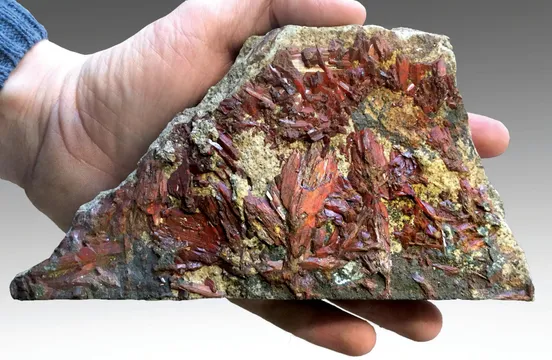
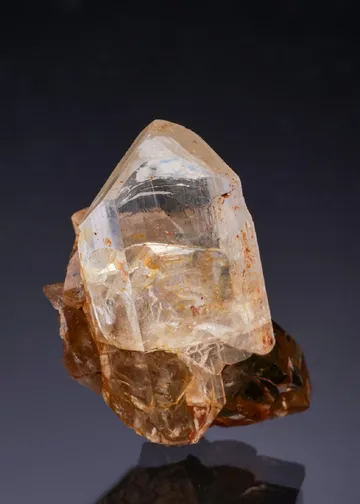
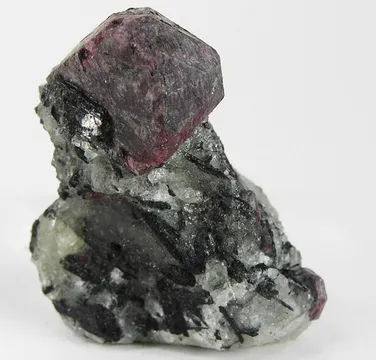
The best specimens from Sverdlovsk Oblast have a distinctly Ural look. Malyshevo emeralds are usually sharp to partly etched hexagonal prisms, often broken or healed by the region’s long tectonic history, set in black phlogopite-rich schist or pale plagioclase. Phenakite from the same fields may be colorless, tea-colored, or faintly greenish, with lustrous rhombohedral to prismatic crystals perched in mica-rich matrix. Nizhny Tagil malachite is not merely “green copper carbonate”; at its best it is banded, velvety, stalactitic, botryoidal, and architectural, the raw material behind the Russian malachite style of the nineteenth century. Berezovsk crocoite is generally smaller and more compact than the famous Tasmanian material, but it has a historical gravity no other crocoite can match: short red-orange prisms and jackstraw clusters on quartz, pyromorphite, and dark green to olive vauquelinite from the type-locality district.
Regional View
Country View

Photo: Wikimedia Commons
As a collecting region, Sverdlovsk Oblast is best understood as a suite of historic districts rather than a single mine. “Sverdlovsk,” “Ekaterinburg,” “Tokovaya,” “Takowaja,” “Malyshevo,” “Mariinsk,” “Izumrudnye Kopi,” “Berezovsk,” and “Nizhny Tagil” all appear on old labels, and those names matter. A precise label can separate an ordinary “Russian emerald” from a Mariinsky specimen, a generic polished malachite from Mednorudyanskoye imperial material, or a crocoite from “the Urals” from a Berezovsk type-locality specimen.
Search for specimens: View all specimens from Sverdlovsk Oblast, Russia
For collectors, the most important gem-mineral center in Sverdlovsk Oblast is the Izumrudnye Kopi area near Malyshevo, northeast of Yekaterinburg. The field lies on the eastern slope of the Middle Urals in a structurally intense zone where the Murzinsk-Aduisk block meets the Rezhevsk volcanogenic depression. Its mineralization is tied to the eastern exocontact of the Aduisk granite pluton and to the deep Susan fault system. The essential geological recipe is the interaction of Be-bearing granitic and pegmatitic fluids with chromium-bearing ultramafic rocks. In collector terms, that means emerald and green beryl where beryllium, aluminum, silica, and chromium were brought together in mica-rich metasomatic zones; phenakite, chrysoberyl, alexandrite, bromellite, phlogopite, and plagioclase in associated beryllium-bearing assemblages; and rare chromium-bearing oxides in chromite-rich ultramafic relics.
The ore bodies at Malyshevo are not simple open cavities like alpine clefts. Published geological descriptions distinguish two main morphological types: beryl-plagioclase veins and emerald-bearing veinlet-metasomatic micaceous zones. The plagioclase-beryl veins tend to occupy more competent blocks, while emerald-bearing micaceous zones occur in more ductile, sheared talc-schist and phlogopite-rich rocks. This is why many classic Ural emerald specimens are embedded in black mica schist and why many crystals show breakage, strain, internal fissuring, and later healing. The deposit’s strongest specimens are therefore not judged only by gemstone clarity; a sharp emerald prism in a convincing original schist matrix, especially with phlogopite or phenakite association, has a collector value quite apart from facet-grade transparency.
The Izumrudnye Kopi were discovered in the early 1830s. The first finds were made around the Tokovaya River, where green stones initially thought to be poor aquamarines proved to be emeralds. The Sretensky mine was opened in 1831, the Troitsky mine followed in 1832, and the Mariinsky deposit—later known as Malyshevo—was found soon after. Historical mine names can be confusing because several were renamed in the Soviet period: Mariinsky became Malyshevsky, Sretensky became Sverdlovsky, Troitsky became Pervomaisky, and other older names such as Krupskoye, Cheremshanskoye, Krasnobolotsky, and Ostrovsky appear on labels and in literature. Good collection labels often preserve both the old and later names, and that can be crucial when trying to place an emerald, alexandrite, or phenakite specimen within the broader field.
Mining priorities changed repeatedly. The earliest period was specimen- and gem-driven. Later, particularly in the Soviet period, beryl and phenakite became strategically important beryllium ores, while emerald and alexandrite were recovered as valuable by-products. In recent years the Malyshev emerald-beryllium deposit has again been described as Russia’s only industrial emerald source, operated by JSC Mariinsky Priisk within the Rostec/Kaliningrad Amber Combine sphere. Official reporting from the 2015–2022 re-evaluation period records renewed underground development, updated reserves, and by-product recognition for alexandrite, phenakite, gem and ornamental beryl, chrysoberyl, and phlogopite. Modern production is industrial and regulated; casual collecting at active workings should be treated as off limits unless explicit permission is obtained.
Mednorudyanskoye, in the Nizhny Tagil area, is the great malachite locality of Sverdlovsk Oblast. It lies on the southern slope of Mount Vysokaya within the city environment of Nizhny Tagil and was mined for copper ore and malachite from the early nineteenth century into the early twentieth century. Underground workings reached hundreds of meters, and later open-pit activity targeted iron ore rather than specimen malachite. The ore zone included chalcopyrite-magnetite assemblages, copper-bearing iron ores, native copper, oxidized copper clays and schists, and a spectacular supergene suite. The most famous malachite came not as delicate crystal groups but as massive, banded, concretionary, stalactitic, stalagmitic, and botryoidal aggregates. Historic Russian decorative malachite—veneers, columns, tabletops, and architectural panels—owes much of its nineteenth-century abundance to this deposit.
Mednorudyanskoye also matters scientifically. Brochantite and delafossite were first recognized there, and modern revisions of the mineral list have pushed the locality well beyond the few dozen species known to earlier authors. Cuprite, malachite, azurite, pseudomalachite, libethenite, brochantite, goethite, manganese oxides, siderite, native copper, and numerous phosphates and sulfates are documented from its oxidation zone. The best specimen-grade material from the old mine is now largely historical: polished slabs, old cabinet pieces, museum blocks, and small secondary-copper specimens from dumps or old collections. Claims of fresh “Nizhny Tagil malachite” deserve scrutiny, because the locality is better represented today by historic material than by routine new production.
Berezovsk, near Yekaterinburg, is the other great historic pole of Sverdlovsk mineralogy. The Berezovsk gold deposit was opened in the eighteenth century and is celebrated as Russia’s first primary gold deposit. To mineral collectors, however, it is equally famous for chromate minerals in the oxidized parts of the gold-quartz system. Crocoite, first reported from the district in the eighteenth century, occurs with quartz and lead-chromate/phosphate associates including vauquelinite, pyromorphite, phoenicochroite, and embreyite. The Tsvetnoi mine and Uspenskaya Hill/Crocoite shaft names are especially important in type-locality discussions. Unlike the large, glassy, often elongated Tasmanian crocoites from Dundas, Berezovsk specimens are typically smaller, denser, and more historical: red to orange-red crystals on altered granite, quartz, green pyromorphite, and dark vauquelinite.
Collecting access across Sverdlovsk Oblast should be approached conservatively. Active mines such as Mariinsky Priisk are industrial operations. Old shafts at Berezovsk and Nizhny Tagil carry collapse, flooding, and legal hazards. The Berezovsk crocoite shaft has been treated as a protected geological-mineralogical object with controlled excursion value rather than a free-collecting site. Russian regional law also distinguishes casual collection of geological materials from extraction or disturbance requiring permission. For the serious collector, the safest and most ethical path is to acquire well-documented old material, specimens released through legitimate mine channels, or pieces with museum/dealer provenance.
Beryl from Sverdlovsk Oblast is best known from the Malyshevo–Izumrudnye Kopi emerald-beryllium system, where pale green, blue-green, colorless, and emerald-zoned crystals occur in plagioclase-beryl veins and phlogopite-rich metasomatic rocks. Unlike many pegmatitic beryls, Ural beryl is commonly tied to sheared ultramafic-hosted metasomatites, so crystals may be fractured, etched, or embedded in mica and plagioclase rather than cleanly isolated in open pockets. Fine collector pieces show recognizable hexagonal form, attractive green zoning or blue-green color, convincing original matrix, and an old or specific mine label such as Mariinsky/Malyshevo, Sretensky/Sverdlovsky, Krupskoye, or Cheremshanskoye. Ordinary pieces are broken ore fragments; better ones preserve crystal architecture and association, especially when the beryl grades toward emerald or appears with phlogopite, phenakite, or chrysoberyl.
Emerald from Sverdlovsk Oblast is the signature gemstone of the Malyshevo district and one of the classic matrix emeralds of the world. Crystals are typically hexagonal prisms in phlogopite-rich mica schist, talc schist, actinolite-chlorite rocks, or plagioclase-bearing veins, with colors ranging from yellowish green to rich bluish to grass green; many are included, fractured, or partly broken by post-ore deformation. The strongest mineral specimens are not necessarily the cleanest cutting stones: collectors prize well-formed crystals still seated in black mica matrix, deep color without looking too dark, visible terminations, and associations with phlogopite, phenakite, chrysoberyl, or alexandrite. Large named finds such as Kokovin, President, Yubileiny, and later kilogram-scale crystals define the gem history, but cabinet specimens are usually much smaller; good thumbnails and miniatures with undisturbed matrix can be more desirable than larger repaired or extracted crystals.
Malachite from Sverdlovsk Oblast means first of all Mednorudyanskoye at Nizhny Tagil, whose oxidized copper ores supplied much of the material behind the nineteenth-century Russian malachite tradition. The locality produced massive, banded, stalactitic, stalagmitic, botryoidal, and spherulitic aggregates, with color zoning from dark green through bright green to pale greenish white; polished slabs reveal tight concentric banding, while natural pieces may show velvety or radiating surfaces. Scientific descriptions note varied deposition sequences in cavities, including relationships with goethite, pseudomalachite, chrysocolla, opal, hematite, cuprite, azurite, turquoise, and manganese oxides. Ordinary pieces are small polished fragments with vague “Russia” labels; important specimens have old Nizhny Tagil or Mednorudyanskoye provenance, natural surfaces or historic lapidary context, and the saturated, layered structure that made Tagil material a benchmark for decorative malachite.
Crocoite from Sverdlovsk Oblast is historically anchored at the Berezovsk gold deposit, particularly the Tsvetnoi mine and Uspenskaya Hill/Crocoite shaft area, where the mineral occurs in oxidized gold-bearing quartz-vein material with vauquelinite, pyromorphite, quartz, embreyite, phoenicochroite, manganese oxides, siderite, and altered granite. Berezovsk crystals are typically orange-red to deep red prisms, often short, compact, acicular, or jackstraw-like, and generally smaller than the long Tasmanian crystals familiar to modern collectors. Their appeal is locality, association, and contrast: red crocoite on dark green vauquelinite or lime-green pyromorphite is the classic look. Good pieces show intact crystals, bright color, and a specific Berezovsk/Tsvetnoi label; ordinary pieces are tiny scattered grains or damaged red crusts whose only distinction is the historic district name.
Cuprite from Sverdlovsk Oblast is most specifically documented from the Mednorudyanskoye malachite deposit, where it occurs in sulfide-magnetite aggregates as dark red micro- and fine-grained veinlets and, in cavities, as octahedral or cuboctahedral crystals generally in the millimeter range. Modern work records crystals to about 1–7 mm, commonly with goethite or tenorite crusts on exposed surfaces, after which malachite was deposited in the same cavities. Later cuprite forms include skeletal crystals built from blocky subindividuals with cube faces and fine acicular aggregates known as chalcotrichite; native copper grains may occur among cuprite and goethite. The best collector pieces are small but sharp, with visible red luster, octahedral form, and association with malachite or old Mednorudyanskoye matrix; larger massive red-brown material is usually less compelling unless the label and paragenesis are excellent.
Phenakite from Sverdlovsk Oblast is a true classic because the Izumrudnye Kopi area is the type locality for the species. It occurs with the emerald and chrysoberyl mineralization around Malyshevo, Krupskoye, Cheremshanskoye, and related workings, generally in mica-rich schist, plagioclase-bearing material, and hydrothermal beryllium assemblages. Crystals may be colorless, translucent white, tea-colored, or faintly greenish, and historic descriptions and locality records note crystals reaching very large sizes for the species, though attractive matrix specimens are much scarcer than loose or damaged pieces. Fine examples have a lustrous, complete phenakite crystal or group visibly seated in phlogopite-rich matrix, sometimes with emerald or chrysoberyl association; lesser examples are rounded, etched, quartz-like fragments that explain the mineral’s old “deceiver” reputation but lack display strength.
Beyond these headline minerals, Sverdlovsk Oblast is exceptional for type-locality species and classic rarities. Phenakite was described from the Ural emerald mines, mariinskite BeCr2O4 was described from the Mariinsky/Malyshevo deposit as a chromium analogue of chrysoberyl, and Mednorudyanskoye is historically tied to brochantite and delafossite. Berezovsk is the type-locality district for crocoite and vauquelinite and the source of embreyite from old oxidized chromate specimens. The broader region also yields alexandrite, chrysoberyl, euclase, topaz, heliodor, amethyst, spessartine, vesuvianite, demantoid-group garnet from nearby Ural contexts, platinum-group minerals, magnetite, fluorite, tourmaline-group species, and a long list of secondary copper phosphates, arsenates, sulfates, and chromates. The collector challenge is precision: “Sverdlovsk Oblast” is too broad for rare species, and the best labels narrow the specimen to Malyshevo, Izumrudnye Kopi, Berezovsk, Mednorudyanskoye, or another named mine.
The first authenticity issue is locality precision. Old Russian and European labels may use Ekaterinburg, Sverdlovsk, Katharinenburg, Ural, Siberia, Takowaja/Tokovaya, Mariinsky, Malyshevo, Izumrudnye Kopi, Berezovsk, or Nizhny Tagil in ways that overlap but are not identical. A good label should be preserved even when its spelling is archaic. For emerald and phenakite, “Malyshevo” and “Izumrudnye Kopi” are acceptable broad labels, but a named deposit such as Mariinsky/Malyshevsky, Sretensky/Sverdlovsky, Krupskoye, Cheremshanskoye, or Krasnobolotsky adds real value. For crocoite, a Berezovsk label is meaningful; a Tsvetnoi mine or Crocoite shaft/Uspenskaya Hill label is better. For malachite, “Nizhny Tagil” is useful, but “Mednorudyanskoye” is the name collectors want.
Emerald buyers should assume that clarity enhancement is possible unless a reputable laboratory report says otherwise. Ural emeralds are commonly fissured and included, and fractured stones are routinely oiled or otherwise filled in the broader emerald trade. Matrix specimens should be examined for glued-back crystals, composite repairs, filled cracks, and artificial darkening of matrix. Hydrothermal synthetic emeralds associated with Russian production history are another trap: the term “Russian emerald” can mean natural Ural emerald, synthetic hydrothermal emerald made in Russia, or simply a marketing phrase. Natural Malyshevo matrix emerald should have the right mica-schist or plagioclase context, natural crystal wear, and believable contact relationships.
Crocoite from Berezovsk is fragile, lead-bearing, and light-sensitive enough to deserve careful handling. Avoid prolonged intense light or ultraviolet exposure, and store specimens where small crystals will not be brushed or jarred. The crystals are softer and more brittle than their glassy appearance suggests. Vauquelinite and other lead chromates/phosphates in the same assemblage should be handled with normal toxic-mineral hygiene: do not lick, grind, or generate dust; wash hands after handling; and keep fragments away from children and pets.
Malachite from Mednorudyanskoye is commonly encountered as polished slab, veneer stock, old decorative material, or small massive fragments rather than fresh crystal specimens. It is sensitive to acids and can be dulled by harsh cleaning. The market contains abundant malachite from Congo, Arizona, Namibia, and other sources, so vague “old Russian malachite” claims should be backed by provenance, old labels, collection history, or distinctive Nizhny Tagil context. A nineteenth-century label, imperial decorative provenance, or connection to a known collection may matter more than size.
Phenakite from the Ural emerald mines is often less flashy than modern Brazilian or Burmese phenakite, but the type-locality status gives it enduring demand. Completeness is the key. Because phenakite resembles quartz and may be colorless to pale, old pieces should be checked for hardness, refractive behavior, crystal habit, and, for valuable specimens, analytical confirmation. Matrix examples with phlogopite and old labels are more desirable than loose rounded crystals unless the crystal is especially large, sharp, or historic.
Current market availability is uneven. Malyshevo emerald matrix specimens appear regularly but fine undamaged, well-labeled old pieces are not common. Phenakite from Izumrudnye Kopi is scarcer in attractive matrix form than the name recognition would suggest. Mednorudyanskoye malachite is available mostly as historic slabs and old collection pieces, with top-grade natural specimens now strongly contested. Berezovsk crocoite is obtainable, but fine, bright, damage-free specimens with strong vauquelinite or pyromorphite association are far less common than the modest crystal size might imply.
The Ural emerald story begins not in a royal treasury but in forest roots. In 1830, on the bank of the Tokovaya River, the pitch-worker Maxim Kozhevnikov found strange green stones tangled among the roots of a fallen tree. He reportedly thought they were rather poor aquamarines. By January 1831, the stones had reached Yakov Vasilyevich Kokovin, commander of the Yekaterinburg Lapidary Factory. Kokovin tested them and understood what had been found: Russia had emeralds. His own description stressed their hardness, noting that in comparative tests the Ural stones proved “stronger than foreign emerald.” On January 27, 1831, exploratory work began, and the first emerald-bearing vein led to the Sretensky mine. Within the year, small workings multiplied, and stones were being sent to St. Petersburg—from cutting fragments to a remarkable crystal of 2226 grams.
The discovery continued northward. In the summer of 1833, peasants named Korelin and Golendukhin found emeralds in the hay meadows of Glinskaya volost. In April 1834, Kokovin opened a new mine there and named it Mariinsky. That mine would become Malyshevo, the locality name now known to collectors around the world. The names changed with politics and time—Sretensky to Sverdlovsky, Troitsky to Pervomaisky, Mariinsky to Malyshevsky—but the specimens still carry the older geography: Tokovaya River, black mica schist, emerald prisms with the look of hard-won stones from sheared Ural rock.
Kokovin’s name is also tied to one of the darker episodes in Russian gem history. A superb Ural emerald, later linked with the name “Kokovin,” became the subject of accusation, confiscation, and disgrace. Accounts describe a major emerald seized with other stones during an inspection, sent toward St. Petersburg, and then disappearing. Suspicion fell back on Kokovin. He was arrested, tried, imprisoned, released in poor health, and died in 1840 after failing to clear his name. Later retellings place blame on Lev Perovsky and trace the stone through aristocratic hands, revolutionary upheaval, and eventual return to Russia. Whether every detail of the drama can be proved to modern archival standards, its persistence shows how deeply the emerald mines entered Russian cultural memory: in the Urals, a mineral specimen could become a state matter.
Mednorudyanskoye had its own green fever. In 1835, in the southern part of the mine near the Nadezhnaya shaft, miners encountered an enormous malachite mass at a depth of about 76 meters. Contemporary and later accounts give the block’s weight at about 3000 poods, roughly 48 metric tons. Museum records and historical summaries describe fragments of a larger malachite monolith found in 1836 that yielded about 480 metric tons of ornamental stone. In Nizhny Tagil, pieces of that history are not abstract: the local museum collection preserves large malachite blocks of hundreds of kilograms, relics of a deposit that fed Russian lapidary workshops for decades.
The malachite did not stay in the Urals. It moved into palaces, churches, exhibition halls, and world’s-fair spectacle. Tagil material was used in the Winter Palace and St. Isaac’s Cathedral, and Demidov malachite objects astonished visitors at the 1851 London Great Exhibition. One contemporary reaction captured the disbelief: people could not accept that a brooch stone and monumental doors could be made of the same material. That is the essence of Mednorudyanskoye’s collector importance. It produced not merely cabinet specimens, but enough fine malachite to change the scale on which a decorative mineral could be imagined.
Berezovsk belongs to an older chapter still. In 1745, Yerofey Markov of Shartash brought gold-bearing stones to the mining authorities, beginning the history of Russia’s primary gold industry. The reward story is famously ungenerous: Markov first received 42 kopecks, and only later was promised a payment tied to gold production. The deposit itself went on to become a major gold district, but its mineralogical afterlife was just as important. In 1766, Johann Gottlob Lehmann reported the red lead mineral from Berezovsk that would become crocoite. Chromium had not yet been isolated as an element; that recognition came later. A small red chromate from a Ural gold mine had opened a door into new chemistry.
The Crocoite shaft at Berezovsk has had a modern afterlife, too. Local accounts describe a plan to preserve crocoite in place as a kind of natural mineralogical museum, with work carried out by the veteran brigadier Evald Martin. A concrete cover was installed over the working to protect it from unauthorized entry, but the museum concept stalled. In the 1990s the locality was neglected and plundered. In the twenty-first century it was given renewed protected status and assigned for preservation and controlled access, a fitting treatment for a place where red crystals connect gold mining, mineral collecting, and the discovery of chromium.