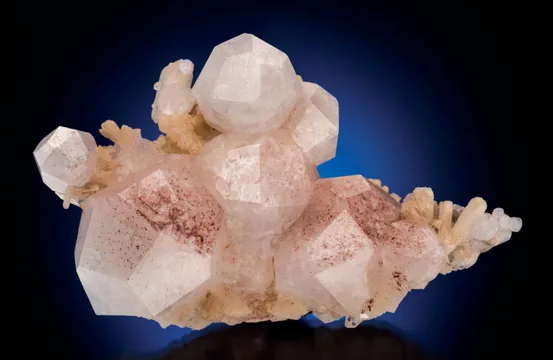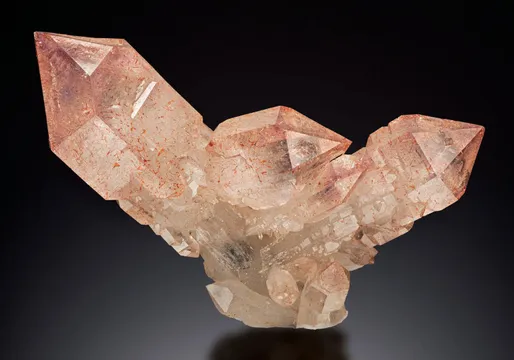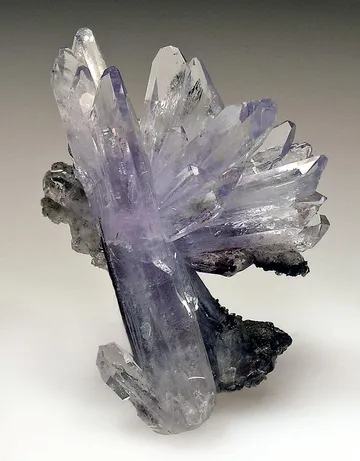
Spruce Ridge, USA - signature Snoqualmie locality yielding quartz with brassy to silvery pyrite, display-quality crystals in rugged pockets.
Key facts
Spruce Ridge is one of the signature American localities for quartz and pyrite combinations: a steep, active group of claims above the Middle Fork of the Snoqualmie River in King County, Washington, where hydrothermal cavities in granodiorite-hosted intrusive breccia have yielded brassy to silvery pyrite perched among clear, milky, and locally amethystine quartz. The best pieces have a distinctly “Spruce” look: sharp pyrite cubes or pyritohedrons standing in spiky nests of slender quartz points, sometimes with tan ankerite roses, clear calcite, or tabular barite adding a late-stage accent. It is not an ore mine in the usual commercial sense; its enduring importance is as a specimen locality, worked specifically for display-quality crystals from pockets in a rugged Cascade setting.
Regional View
Country View
Geologically, Spruce Ridge belongs to the Snoqualmie Batholith, a late Oligocene to early Miocene intrusive complex exposed by uplift and erosion of the old Cascade volcanic arc. The host rocks around the collecting area are dominantly granodioritic, with intrusive breccias created as volatile-rich fluids fractured the upper parts of a cooling shallow intrusion. Those fractures and open spaces became the architecture of the pocket system: quartz and sulfides lined the breccia blocks, while later carbonate and sulfate pulses added ankerite, calcite, and barite. The result is a locality where the mineral story is written directly into the specimens—early quartz, brilliant pyrite, etched contacts, iron-oxide films, late carbonates, and the occasional odd rarity.

Photo: Wikimedia Commons
For collectors, Spruce Ridge is important because the deposit combines beauty, locality character, and difficulty of recovery. Good pieces were never effortless stream-bed finds; the classic material came from hard-rock pockets on steep, roped ground, often after drilling, blasting, and careful pocket work. That hardship is part of the specimens’ reputation. A fine Spruce quartz-pyrite combination reads immediately across a case: glassy white or water-clear points, a strong central metallic form, and the hard Cascade geometry of a specimen broken from breccia rather than grown in a roomy sedimentary geode.
Search for specimens: View all specimens from Spruce Ridge, USA
Spruce Ridge lies near North Bend in the Middle Fork Snoqualmie country of King County, Washington, within the Snoqualmie Mining District. Mindat treats the locality as an active group of mines and records the historical names Spruce 15 claim, Spruce 16 claim, Spruce Claim, and Spruce Peak. The locality is placed in the SE¼ of section 2, T23N, R11E, Willamette Meridian, along the Middle Fork of the Snoqualmie River.
The deposit is best understood as a quartz-pyrite specimen deposit in intrusive breccia zones within granodiorite of the Snoqualmie Batholith. In the regional model used for the Snoqualmie area, volatile escape near the top of a shallow cooling intrusion fractured the rock, producing breccia bodies with open spaces. Later hydrothermal fluids moved through those openings, altered plagioclase in the granodiorite breccia blocks to muscovite and clay, and deposited quartz and metallic sulfides on pocket walls. The collecting significance of Spruce Ridge comes from those open cavities: vugs and larger pockets capable of growing free-standing quartz, pyrite, and later minerals rather than only massive sulfide ore.
The broader Snoqualmie intrusive-breccia system has copper, gold, and silver interest, but the Spruce Ridge claims are celebrated for specimens rather than ore production. Historical work began in the 1950s exploration period, when Bear Creek Mining filed claims as part of a large group held for evaluation of a deeper porphyry-copper target. Specimen work followed: What on Earth, Inc. of Ohio, associated with Sandy Ludlum, worked Spruce in 1977 and 1978; Bob Jackson, Stan Esbenshade, and Neil Pfaff worked it from 1979 through 1982; Geology Adventures operated from 1983 to 2008; and the mineral rights later passed to Spruce Collectors, LLC, a membership organization. Mindat records the property as patented in 2001.
Access today should be regarded as private and controlled. Spruce is not a casual public rockhounding site, and the combination of mineral rights, active claim status, steep slopes, roped travel, blasting, and unstable rock makes unauthorized collecting both unsafe and inappropriate. Modern accounts describe locked-gate approaches, warning signs, active summer work, and claim caretakers; current specimens on the market generally come from claim members, invited participants, older collections, or dealer dispersals.
The pockets are the heart of the locality. Collectors have described named working areas and individual vugs, including the 05 bench, the Canada Wolf vug, and the Golden Oatmeal vug. The 05 bench was the main pyrite bench by 2011 and had been worked since 2001; one field description noted abundant vugs in the breccia, averaging roughly two vugs per cubic yard in that area. The Canada Wolf vug, opened in August 2010, measured about 9 by 4 by 2 feet when emptied and produced more than 300 pounds of quartz and pyrite plates. The Golden Oatmeal vug was large enough to have a two-foot field of view in photographs, with plates fallen from roof and walls onto a clay layer that fortunately cushioned much of the material.
Spruce Ridge specimens also have a strong historical presence in American collecting literature. The locality was written up in The Mineralogical Record in 1978 as “Quartz & Pyrite from King County, Washington,” revisited by Raymond Lasmanis in Rocks & Minerals in 1991, and treated again by Bob Jackson in Rocks & Minerals in 2015 as an evolving great American collecting locality. Individual specimens have entered major private and institutional collections, and the best combinations are now recognized as classics of Washington mineralogy.
Quartz from Spruce Ridge occurs as slender prismatic crystals, doubly terminated crystals, scepters, and occasional Japan-law twins; clear, milky, and amethystine examples are all documented, with amethyst here characteristically appearing as sceptered growth. In some vugs more than half the quartz crystals can be sceptered, and the best specimens show undamaged, water-clear to lightly smoky-looking points in radiating sprays or plates with pyrite sharply perched among them rather than merely scattered as broken metallic grains. Ordinary Spruce quartz may be iron-stained, contacted, or part of a rough breccia plate; collector-grade pieces show crisp terminations, open aesthetics, strong luster, and ideally the classic contrast with brassy pyrite, tan ankerite, clear calcite, or tabular barite.
Pyrite is the visual anchor of Spruce Ridge: brilliant striated cubes and pyritohedrons, commonly modified by octahedron, trisoctahedron, and diploid faces, with documented crystals reaching several centimeters and exceptional records citing crystals to about 5 inches. Fine Spruce pyrite ranges from bright brass-yellow to more silvery after cleaning, and perched crystals commonly sit atop quartz where later pyrite crystallization and etching left iron-oxide seams, hollow or distorted contacts, and the unmistakable texture that experienced dealers and collectors associate with the claim. The best pieces retain sharp metallic faces and strong geometric dominance without excessive blast damage, bruised edges, or unstable contacts; single large pyrites are desirable, but the classic Spruce prize remains a pyrite crystal dramatically balanced in a nest of quartz.
Calcite at Spruce Ridge is a minor but locally attractive late mineral, recorded as clear to translucent crystals to about 1 inch in length and most often valued as an association on quartz and pyrite rather than as a standalone species. It appears in small clusters and “cat tooth” accents on quartz-pyrite plates, and some modern collectors report pink-orange response under ultraviolet light from small calcites associated with Spruce quartz and pyrite. Good calcite-bearing Spruce pieces are those where the calcite adds sparkle and paragenetic interest without obscuring the pyrite or quartz; loose, etched, iron-coated, or bruised calcite is common enough that clean, well-placed crystals are disproportionately appealing.
Ankerite is one of Spruce Ridge’s most distinctive accessories, occurring as white to tan aggregates of small curved rhombohedral crystals, saddle-shaped rhombs, stacked crystals, and rosette-like clusters perched on quartz or pyrite. The best examples are not merely ankerite present on a Spruce plate, but balanced compositions in which lustrous tan “roses” or bridges sit cleanly on gemmy quartz points, sometimes with pyrite nearby; such pieces are scarcer than the ordinary quartz-pyrite combinations and have strong locality appeal. Condition matters greatly because the curved rhombs are exposed and easily bruised, so complete rosettes, sharp lustrous faces, and minimal iron staining separate memorable ankerite specimens from routine late-carbonate coatings.
Other documented Spruce Ridge minerals include barite, bravoite, chalcopyrite, chlorite, cosalite, epidote, galena, native gold, limonite, malachite, siderite, sphalerite, tenorite, goethite, and dolomite. No verified type-locality mineral is associated with Spruce Ridge, but several species are important as locality rarities: cosalite and native gold are chiefly of interest to systematic collectors; malachite is reported as coatings from decomposing chalcopyrite; epidote occurs as a rock-forming mineral in thermally altered breccia and as inclusions in quartz; sphalerite is recorded as rare small submetallic crystals; and chalcopyrite is known in small tetrahedral crystals, including attractive epitactic material on pyrite. Barite is the most display-worthy of the secondary suite beyond the four featured species, forming tabular prismatic crystals to several centimeters and occasionally sitting handsomely on quartz or quartz-pyrite plates.
Spruce Ridge material is generally easy to recognize at high quality but easy to misvalue at lower quality. The classic specimen should combine sharp pyrite with quartz in an open, readable arrangement; a mere pyrite lump with a few quartz points, or a quartz plate with scattered broken pyrite, does not carry the same locality premium. Look for undamaged pyrite edges, complete quartz terminations, and stable contacts. Many specimens have natural etching, hollow contact zones, iron-oxide seams between pyrite and quartz, or rough areas from interference growth; these features can be original to the pocket and should not automatically be treated as damage. By contrast, bruised terminations, blast-shattered pyrite, reattached crystals, and trimmed bases that undercut the composition are significant condition issues.
Cleaning is a serious part of Spruce Ridge collecting history. Iron oxides commonly coat pocket material, and experienced collectors have reported cleaning Spruce pyrite with hydrochloric acid, Iron Out, and sometimes warm oxalic acid. Oxalic treatment can shift the pyrite toward a more silvery luster, while hydrochloric cleaning tends to preserve a brassier look. This is not necessarily “treatment” in the deceptive sense—many Spruce specimens require cleaning to reveal their quality—but collectors should ask whether a piece has been heavily acid cleaned, especially if the pyrite is unusually pale, silvery, or etched.
Documented mislabeling is a real issue. One large pyrite formerly in the Chet Lemanski collection carried a label reading Snohomish Pass in Snohomish County, but was identified by the selling dealer as undoubtedly from Spruce Ridge in King County. Similar mistakes are understandable because Spruce material has circulated for decades under names such as Spruce Claim, Spruce 16, Spruce Peak, Goldmyer Hot Springs, Snoqualmie Pass, and Middle Fork of the Snoqualmie River. For a serious specimen, the best label should include Spruce Ridge or Spruce Claim, King County, Washington, and ideally Snoqualmie Mining District or Middle Fork Snoqualmie context.
I found no well-documented production of outright fake Spruce Ridge quartz-pyrite specimens, and the locality’s habit is difficult to convincingly imitate because the pyrite-quartz contacts, iron-oxide seams, etched textures, and breccia-derived matrices have a coherent paragenetic look. The greater risks are wrong locality, over-cleaning, contact damage, repaired crystals, and inflated pricing of mediocre examples under the halo of the name.
Calcite may fluoresce pink-orange on some specimens, but Spruce Ridge is not primarily collected as a fluorescent locality. Pyrite should be kept dry and away from prolonged humidity; while large Spruce pyrite crystals are usually far more stable than framboidal pyrite in shale, all sulfides deserve sensible storage. Avoid soaking finished specimens unless you know the cleaning history and matrix stability, and be cautious with ultrasonic cleaning around ankerite and calcite.
Market availability is steady but limited. Spruce specimens appear through specialist dealers, online auctions, older collections, and current claim-related production, but the best combinations are scarce because collecting is seasonal, physically difficult, and controlled by private access. Thumbnail and small-cabinet examples with modest pyrite are still obtainable; sharp, dramatic combinations with large pyrite cubes or pyritohedrons, clean quartz, and accessory ankerite or calcite move into a much more competitive collector tier.
The modern story of Spruce Ridge begins with a provocation familiar to every field collector: somebody said the good days were over. At the 1976 Detroit show, John Medici heard the argument that all the worthwhile field-collecting opportunities had already been exhausted. Medici disagreed. The easy collecting might be gone, but the mountains still had pockets for people willing to work for them. With Neil Pfaff, Bill Hawes, and Sandy Ludlum, he began planning a hard collecting expedition after seeing a fine Spruce-area specimen in an old museum collection. Medici and Pfaff prospected on foot in 1976, found promising ground, and by later that summer had secured a bank loan for the project. That improbable leap—from show-floor debate to banker’s desk to Cascade breccia—helped launch the specimen era that made Spruce Ridge famous.
The locality’s later reputation was shaped by Bob Jackson, whose name is inseparable from Spruce. One vivid trip account recalls Jackson as “Bob the geologist,” living seasonally on the mountain with his wife Carol and working a mine that could not be mistaken for a roadside rock pile. The approach began with Interstate 90, then gravel, then a narrow logging road rough enough that even at five miles an hour a rented Toyota Highlander was tossed side to side as rocks struck underneath. One visitor reached a steep incline, decided he must have missed the place, and began backing down because there was nowhere to turn around. A white truck appeared behind him; its occupants were also heading to the mine and told him the trailhead was only an eighth of a mile ahead.
Even the trailhead was deliberately discreet. Jackson did not mark it, because he and Carol often lived near the mine in summer and did not want uninvited visitors. On that 2006 trip he arrived in a small red truck, loaded a backrack with dynamite—described by the visitor as yard-long yellow sticks wrapped together in blue tape—and started the group up the mountain. The trail was not a hike in the ordinary sense. It climbed steeply through roots, fallen timber, small cliffs, knotted ropes, and ledges only a few inches wide, with hundred-foot drop-offs below. After 600 feet of climb the party reached a small 14-by-14-foot mountain cabin, three black labs, and a caretaker. Another 200 feet above was the working face.
At the mine, Jackson told the collectors they were lucky: three people had canceled, leaving “8 vugs for the 5 of you.” The visitor’s description captures the shock of seeing a real Spruce pocket face for the first time—cracks and holes with crystals, large shining gold pyrite forms, and visible veins of quartz across the rock. He worked a vug near the edge behind an orange plastic catch fence; Jackson told the group, “If you slip, catch the fence, it will hold your weight.” The collector’s pack eventually reached about 40 pounds, heavier than the others’ 25 or 30, and the descent became its own ordeal: cramped fingers, exhausted legs, a sore foot, and the uneasy knowledge that the rocks on his back were the treasure he had come for. Back at the hotel he laid the sparkling pieces across the bed, drank Gatorade, and thought, “Wow. I made it.”
A more recent account from early September 2025 shows the mine still demanding the same seriousness. Don Wilcox joined Chris H., a Spruce Claim stakeholder, for a day that began at 6 a.m., ran through rough forest roads and a locked access gate, then climbed sharply almost immediately from the trailhead. The trail was described as a quarter-mile ascent, mostly at a 70 percent incline, with ropes along the way. Near the claim were warning signs, lodging and storage structures, an outhouse, and cold water that felt welcome after the climb. The actual workings sat in a steep narrow ravine, with ropes and ledges needed to move safely around benches and drop-offs.
That day included blasting. The miners drilled holes, packed explosives, sounded an airhorn, tested the circuit, and allowed the visitor the honor of firing the shot. He held one button until a blinking green light turned solid, called “Fire in the hole,” and pushed the second button. His written version preserves the moment simply: “KA BOOOM.” The group was protected behind a massive rock wall while small rocks flew out in front. Afterward the miners inspected the blast zone and found one unexploded charge that had to be remediated before collecting could resume. A loosened boulder later bounced down the gully for nearly 20 seconds.
The pocket work after the blast shows why Spruce specimens vary so widely in condition. Some vugs held pristine quartz; many were coated in iron oxides. Pyrite was abundant, but much of it was broken or fractured, and large pieces often did not survive the shock of blasting. Collectors probed muddy pockets with chopsticks, then used thin wedge chisels to release clusters with enough base to keep them stable. Good finds were wrapped in bubble wrap and clamshell takeout containers for the rough quarter-mile descent. Just before sunset the party packed up; near the bottom, warning signs marked hornets, and Wilcox was stung twice on the left hip and once on the right shoulder. He reached the road after dark, changed out of dust- and sweat-soaked clothes, and began the bumpy drive back toward North Bend with the specimens cushioned against the jolts.
Some of Spruce’s most memorable stories belong to individual vugs. The Canada Wolf vug of August 2010 measured 9 by 4 by 2 feet when empty and yielded more than 300 pounds of quartz and pyrite plates. The Golden Oatmeal vug earned its name from the decomposed granite scooped from inside; photographs and captions describe a large quartz-pyrite cavity whose floor had been covered with plates fallen from the roof and walls. A six-inch clay layer cushioned the fall, so many of the plates survived rather than shattering. The name may sound playful, but it captures an important truth about Spruce Ridge: the best specimens often survived because the geology provided its own packing material.
Two celebrated pieces, “Two Cubes, One Scepter” and “Excalibur,” came from a single small clay-filled vug in 1984. The pair—about 7 and 8 cm respectively—became among the most iconic Spruce Ridge quartz-pyrite specimens, yet the vug produced almost nothing else beyond a handful of doubly terminated quartz crystals. That is the pocket collector’s bargain in its purest form: days of difficult approach and dangerous work can end in a barren cavity, or in two specimens that define a locality for decades.