






A collector's guide to Southwest Mine, USA: its geology, mining history and notable minerals, illustrated with the 61 specimens documented from this locality on EarthWonders.
Key facts
The Southwest Mine at Bisbee is one of the great American collector localities because it joins three things rarely preserved together: a major copper orebody, an extraordinary oxidation-cave system, and a specimen suite that still looks unmistakably Bisbee at arm’s length. The mine lies in Hendricks Gulch on Queen Hill, in the Warren Mining District of Cochise County, Arizona, where copper, lead, and zinc sulfide replacement deposits were emplaced in Paleozoic limestone adjacent to the Sacramento Stock complex and later remade by deep supergene oxidation. The Southwest Mine’s best specimens are products of that remaking: calcite cave spar and speleothems tinted green by malachite or aurichalcite, velvety and acicular secondary copper carbonates, azurite-malachite plates from oxidized goethite-rich pockets, and uncommon cuprite combinations from the copper-rich parts of the ore.
Collectors prize Southwest Mine material for a very particular aesthetic. The classic pieces are not simply “Bisbee copper minerals”; they are cave pieces. Many grew in open voids or oxidation caves formed above and within exhausted sulfide replacement bodies. Calcite occurs as sharp rhombohedral and scalenohedral crystals, botryoidal and stalactitic forms, shelfstone, raft-related forms, and strange compound growths that record changing water levels inside the mine caves. The copper minerals can appear as inclusions, coatings, or matrix color: pale sea-green malachite in transparent calcite, turquoise-blue aurichalcite dusting iron oxide and limestone, or dark red cuprite beneath glassy colorless calcite.
Regional View
Country View
The locality’s historical importance is inseparable from the New Southwest Orebody. Discovered from development beneath Queen Hill in the early twentieth century and mined heavily after 1919, it became one of Bisbee’s large oxide-ore sources and exposed a remarkable suite of caves on the 4th, 5th, 6th, and 7th levels. These caves were not passive curiosities: they guided miners to oxidized ore, produced specimens now scattered through old Bisbee collections and museums, and helped shape the district’s scientific literature on oxidation subsidence, cave formation, and supergene mineralogy.

Photo: Wikimedia Commons

Photo: Wikimedia Commons
Search for specimens: View all specimens from Southwest Mine, USA
The Southwest Mine is in Hendricks Gulch at Bisbee, within the Warren Mining District of the Mule Mountains, Cochise County, Arizona. Its mineralization belongs to Bisbee’s classic limestone-replacement and porphyry-related system. The relevant ores were irregular replacement bodies, dominantly in Devonian Martin Limestone and locally associated with porphyry dikes, sills, silica breccias, and major northeast-trending fault structures, especially the Czar fault area. The broader Bisbee district was mineralized in several stages related to Jurassic intrusive activity around the Sacramento Stock complex: first large volumes of pyrite and silica, then copper-bearing replacement mineralization, then lead-zinc mineralization, and finally a small but mineralogically important multi-element phase carrying elements such as arsenic, vanadium, tungsten, antimony, bismuth, tellurium, and precious metals.
The Southwest Mine’s collectible minerals mostly came from the oxidized and enriched parts of the ore system. Primary sulfides such as pyrite, chalcopyrite, bornite, sphalerite, and related minerals supplied the metals; near-surface oxidation, circulating waters, and limestone-buffered chemistry then generated the familiar carbonate, oxide, sulfate, arsenate, halide, and silicate minerals. In the Southwest Mine this process was especially dramatic because the oxidation of sulfide replacement bodies produced open spaces, subsidence cracks, and cave systems. The caves were lined or partly filled with calcite, aragonite, gypsum, goethite, hematite, malachite, aurichalcite, azurite, and other secondary minerals, while their lower portions and associated broken ground contained oxide ore.
Historically, the ground that became the Southwest Mine grew out of workings around Queen Hill, Hendricks Gulch, the Czar Mine, and older lead-silver-copper activity in the area. Early Hendricks Gulch workings were pursued in the late 1870s for silver-rich cerussite and associated copper. In the early twentieth century, exploration from the Czar Mine drove upward beneath Queen Hill; by 1911 raises from the Czar 200 level had found ore and were developed into interior shafts. Those shafts, several adits, and the Sunrise Shaft eventually formed the Southwest Mine. Before surface access was improved, men and supplies had to be lowered through the Czar system and then transferred through internal Southwest workings.
Development changed rapidly in the 1910s. The Southwest Tunnel was driven at about the 5,500-foot elevation, and the Queen Tunnel was extended to support the growing mine. In 1919, the 7th level was extended to an adit portal in Hendricks Gulch, and the Sunrise Shaft was raised from the 3rd level or Queen Tunnel level to serve the expanding stopes. The New Southwest Orebody, discovered in 1919, yielded well over one million tons of ore during roughly the next nine years. Much of it was oxide ore, and much of the most interesting specimen material came from the caves and collapsed cave remnants above and around that ore.
One of the mine’s most famous underground features was the “Ballpark,” a huge stope complex developed on the New Southwest Orebody. Limited backfilling and the great size of the open areas left unstable ground; in early 1933 a catastrophic late-night collapse brought down multiple contiguous stopes. No one was in the mine at the time, but the collapse destroyed or damaged many cave systems and produced a vast void filled with house-sized boulders, deep canyon-like spaces, and collapsed speleothem-bearing blocks. Later explorers found calcite-coated boulders, broken cave formations, remnant pockets, and unusual cave mineralization in the chaotic collapse zone.
Specimen pockets and finds at the Southwest Mine are best understood by level and cave environment rather than by a single “pocket” name. The 5th level is documented for calcite with malachite and aurichalcite in limestone collapse breccia and oxide-ore voids, including colorless to white spar over green-tinted earlier calcite. The 6th level produced unusual calcite and gypsum cave material, including gypsum speleothems with minor malachite and rosasite, selenite growths, and iron-oxide raft material cemented by calcite. The 7th level is famous for large decorated oxidation caves, aragonite on calcite, conichalcite-tinted calcite, dolomite overgrowths, and dramatic in-place cave spar. The 4th level yielded a goethite-hosted cave with large rhombohedral calcite crystals, shelfstone, and intense copper-tinted stalactitic calcite.
Collecting access today should be considered closed. The Southwest Mine is on private mine ground, and the underground workings are hazardous, sealed, gated, collapsed, or otherwise inaccessible. The 5th level Southwest portal has been reported intact but sealed, and one of the 6th level portals has a bat gate while another is buried. Serious collectors should obtain Southwest Mine specimens through old collections, museum deaccessions where appropriate, reputable dealers, and documented estate material rather than attempting field access.
Calcite is the signature Southwest Mine species and occurs in a wider range of collectible forms than at almost any other Bisbee sublocality: colorless to white spar, pale honey to pinkish botryoidal groups, complex tabular crystals, scalenohedrons, rhombohedrons, stalactites, stalagmites, flowstone, shelfstone, cave rafts, helictitic forms, and crystal-coated speleothems. The most desirable pieces are those that preserve the cave origin visibly—sharp, glassy calcite on oxide matrix, translucent crystals included with malachite, pale green to blue-green copper-tinted stalactitic or botryoidal calcite, and older labels tying specimens to specific Southwest Mine levels. Documented in-place examples include 5th-level colorless to white tabular spar over malachite-tinted calcite with views around 30 cm, 5th-level spar crystals to 5 cm, 6th-level tiered shelfstone, and 7th-level calcite flowstone, helictites, rafts, and large cave forms. Good specimens have luster, intact terminations, undulled surfaces, visible copper coloration or association, and a sculptural speleothem habit; ordinary material is chalkier, broken, iron-stained without form, or simply “Bisbee calcite” with no Southwest attribution.
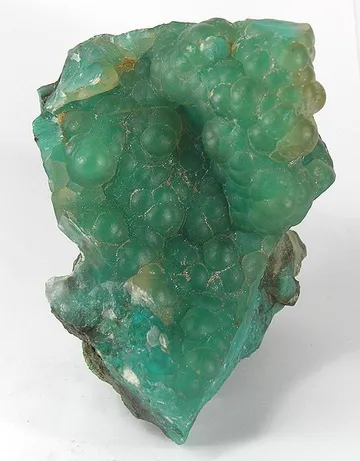
Malachite from the Southwest Mine ranges from small acicular crystals scattered in and on gypsum or calcite to coatings, included sprays, botryoidal crusts, and leaf-like pseudomorphs after azurite on gossanous matrix. Its best role here is often as a colorant and association rather than as a freestanding green mass: bright needles frozen inside transparent calcite, thin coatings on glassy scalenohedrons, green sprays on cuprite-rich or goethitic matrix, and pseudomorphs that preserve the sharper bladed habit of earlier azurite. Cabinet specimens documented from old collections include calcite clusters with malachite inclusions and Southwest Mine malachite-azurite plates around 11 cm across, while field descriptions also note acicular malachite in 5th-level pillars and minor malachite in the 6th-level gypsum cave. The finest pieces are vivid, undusted, and clearly crystallized or pseudomorphous, with strong contrast against white calcite, dark goethite, or red cuprite; massive green crusts without form are far less distinctive.
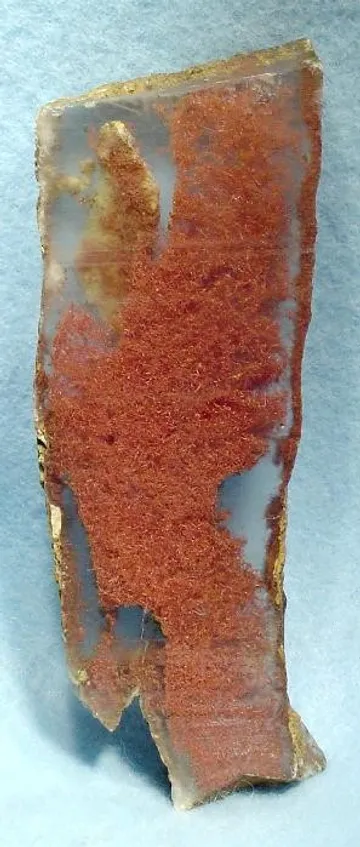
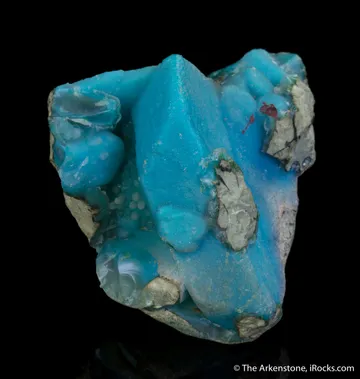
Aurichalcite is a classic Southwest Mine accent species, usually appearing as soft blue-green to turquoise fibrous or acicular coatings in oxidation-cave settings, especially on limestone, goethite-rich matrix, and around calcite. Bisbee-wide cave studies emphasize that aurichalcite was most commonly found in oxidation caves, lining walls or voids between boulders in cave bottoms, and Southwest Mine material is particularly associated with 5th-level limestone collapse breccia and calcite-bearing cave openings. Known specimen descriptions include small cabinet pieces, such as calcite with aurichalcite around 5.8 cm, and larger cabinet plates around 14 cm with aurichalcite and calcite. The best examples show a clean, saturated blue-green nap or spray contrasting with lustrous white calcite or dark matrix; weakly colored, dusty, or ambiguous fibrous coatings can be confused visually with rosasite or pale malachite and need good provenance or analytical confidence.
Cuprite from the Southwest Mine is less common on the market than calcite or malachite but is important because the locality produced transparent to translucent crystals and massive red cuprite in strong association with secondary copper minerals. Documented occurrence records describe modified cubic crystals to 5 cm, and collector specimens include glassy colorless calcite scalenohedrons, some doubly terminated and included or coated with malachite, resting on solid wine-red massive cuprite. Cuprite also occurs with malachite, atacamite, limonite, connellite, paratacamite, goethite, native copper, calcite, and other secondary halides and copper minerals in the broader Southwest suite. The best pieces retain red color, crystal form, and sharp contrast—especially cuprite supporting bright calcite or green malachite—while poorer material is massive, dull, altered to chrysocolla or malachite, or locality-vague “Bisbee cuprite” without documentation.
Beyond these four collector staples, the Southwest Mine is significant for an unusually rich secondary suite. The most important modern mineralogical distinction is eddavidite, Cu12Pb2O15Br2, for which the Southwest Mine is the type locality; it is the bromine analogue of murdochite and was described from 5th-level material. Other documented Southwest Mine or Southwest oxidation-cave minerals include aragonite, azurite, brochantite, cerussite, chrysocolla, conichalcite, connellite, descloizite, dolomite, goethite, gypsum, hematite, mimetite, murdochite, plattnerite, quartz, rosasite, and several uncommon halides and oxide species. Of particular collector interest are 7th-level conichalcite-tinted calcite and copper-tinted aragonite, tiny bright yellow mimetite, descloizite in cave-bottom voids with malachite and plattnerite, and post- or late-stage gypsum cave specimens with minor malachite and rosasite.
Southwest Mine specimens reward provenance discipline. The most valuable labels are specific: “Southwest Mine,” “Hendricks Gulch,” “Bisbee,” and ideally a level or feature such as 5th level, 6th level, 7th level, Queen Hill, New Southwest Orebody, or Ballpark. Many older pieces were labeled simply “Bisbee,” “Copper Queen,” or occasionally “Higgins Cave,” especially because access to the 7th-level Southwest cave could be reached through the Higgins Tunnel. A collector should not automatically reject such old labels, but should recognize that Southwest, Czar, Copper Queen, Higgins, and Holbrook material can be historically entangled underground and commercially simplified.
The most common condition issue is damage to calcite. Southwest Mine calcite formed in caves and collapse zones, so broken stalactite ends, contact bruises, chipped rhombohedral edges, dusty recesses, and iron-oxide staining are normal. Sharp 5th-level spar, scalenohedrons on cuprite, and delicate copper-tinted speleothem fragments are much scarcer in excellent condition. Botryoidal and stalactitic calcite may be naturally rounded, but broken bases should be evaluated separately from damage to display surfaces. Pieces recovered from collapse material may have excellent mineralogical interest even when incomplete, but cabinet-grade value still depends on luster, termination quality, and aesthetics.
Malachite and aurichalcite require careful handling. Acicular malachite can shed or bruise; aurichalcite is especially soft and can be flattened by careless cleaning. Avoid washing delicate fibrous material aggressively. Dust removal should be conservative, using a hand blower or very soft brush only where safe. Aurichalcite, rosasite, and pale malachite can look similar in small fibrous coatings, so labels should be treated as hypotheses unless supported by analytical work, a strong old collection trail, or an unmistakable association.
Fluorescence can add interest but should not be over-sold. Bisbee calcite is variable: some supergene calcite associated with oxide ores shows little response, while certain calcite generations fluoresce orange, red-orange, greenish, or near-white under shortwave UV. The Southwest Mine has documented examples of variable fluorescence in calcite from the 5th level and altered Martin Limestone with hydrothermal calcite on the 3rd level. A strong fluorescent response can help distinguish calcite generations, but it is not a blanket authenticity test for the locality.
No major published fakery tradition is attached specifically to the Southwest Mine in the way that some classic localities suffer from systematic assembled or dyed specimens. The real concern is mislabeling and overbroad labeling. Look for coherent mineral association, old collection history, matrix consistency, and appropriate cave-style habit. Suspicious examples include bright fibrous green or blue material labeled aurichalcite without supporting context, “Southwest Mine” specimens that look like generic Bisbee dump material, and calcite pieces with no old label being upgraded commercially to a more desirable sublocality.
Market availability is moderate for calcite and calcite-malachite combinations, limited for good aurichalcite, scarce for fine cuprite combinations, and very scarce for well-documented rarities such as eddavidite, murdochite, plattnerite, descloizite, or conichalcite-bearing cave pieces. Many good specimens entered collections through Bisbee miners, local collectors, the Graeme circle, Dave Stoudt material, older Arizona collections, and estate dispersals. The best buying opportunities are still old-label specimens where the piece visibly matches Southwest Mine cave mineralogy.
One of the most evocative early accounts of the Southwest Mine caves comes from the years when the New Southwest ground was still fresh and guarded. Edmond Otis Hovey of the American Museum of Natural History reached Bisbee in 1911 while gathering data for a model of the Copper Queen mine. Word of a newly discovered cave reached him almost immediately. Access had been controlled, so the rooms and formations were still close to pristine. After putting on regulation mine clothes, Hovey and his party descended the Czar shaft, walked southwest beneath Queen Hill, rode an electric hoist up a 400-foot raise, then climbed down 40 feet of vertical ladders through heated, oxidizing ground to a plank door. Beyond it was a crawl into a room too low to stand in, glittering under acetylene lamps with green-tinted calcite and shallow clear pools.
The cave opened upward through fallen blocks coated with their own dripstone into a chamber about 30 feet high and 40 feet across. Hovey saw white calcite, dark iron and manganese residues, salmon-tinted botryoidal clusters, stalactites following old cracks, and an immense greenish-white stalagmite rising at the upper end of the room. It was about 14 feet high and 14 or 15 feet across near its base, narrowing to roughly 10 feet across three feet above the shelf on which it stood. The party lit magnesium ribbon, and the room flashed into brilliance. Hovey thought the great stalagmite so beautiful that damaging it seemed “little short of vandalism,” even though scientific collecting and mine operation made removal almost inevitable. He estimated that such a mass would have required more than 67,000 years to form under favorable cave conditions, and likely longer in arid Arizona.
The same cave had smaller wonders that would make any modern collector ache. In one upper room, delicate green acicular calcite occurred in paintbrush-like groups on botryoidal masses. Elsewhere, calcite ribs projected from fallen blocks, crystal tufts lined dripstone passages, and a compound stalactite earned from the miners the nickname “elephant’s ear.” These were not specimens sitting in a dealer flat; they were cave architecture, grown in darkness above a copper orebody that miners were actively removing.
The 7th-level Southwest cave, later often called the Higgins Cave because it was more easily entered through the Higgins Mine, became a long-lived Bisbee legend. It lay within the Southwest Mine at about 5,780 feet above sea level near the Higgins property line. In 1954, Carl Trischka told Richard Graeme III how to reach it through the Higgins Tunnel. Graeme began visiting soon afterward and returned many times over the next half century. The cave had the rare advantage of being high enough in the mountain that ore did not have to be mined above it, meaning it could have survived better than most Bisbee caves. Instead, fascinated visitors removed stalactites and other formations over the years, causing the cumulative damage that old photographs make painfully clear.
That 7th-level cave still yielded remarkable observations. One room contained aragonite stalactite-like masses several feet long, made of intergrown jackstraw crystals several inches in length, with minor white dolomite overgrowths. Some specimens showed unusual copper-tinted aragonite on botryoidal calcite, and one area along a wall contained enough conichalcite to tint associated calcite a light greenish yellow. Nearby, tiny bright yellow mimetite and radiating blooms of splendent plattnerite occurred in a setting that was chemically far more exotic than an ordinary limestone cave.
The Ballpark collapse is one of the great subterranean episodes in Bisbee history. The New Southwest Orebody had been mined so extensively that the remaining open areas were huge and incompletely backfilled. In early 1933, late at night, several contiguous stopes collapsed catastrophically. The timing saved lives: no one was in the mine. What remained was a black immensity filled with boulders the size of small houses, with passages between them like canyons. Miners named it the Ballpark, a deceptively cheerful name for a place most would not enter.
In the early 1970s, one of the Graeme authors returned to the Ballpark during a district-wide alteration-sampling project. He started into the darkness, but the geologists and miners with him refused to follow. After only about 100 feet, the risk of becoming disoriented and lost was obvious, and exploration was postponed. Later, the Graemes returned together and spent several hundred hours exploring the collapsed void. They crawled hundreds of feet through spaces between boulders, found small caves wholly contained inside large fallen blocks, and documented cave remnants produced by doming cracks, marginal subsidence cracks, sag caves, and oxidation caves broken apart by collapse. Cracks extended more than a thousand feet horizontally and several hundred feet vertically, reaching the surface above Hendricks Gulch.
From that wreckage came specimens that read like a field guide to cave hydrology. Some calcite stalactite tips had grown horizontal crystal flanges at former water levels. Others had been submerged after forming, then overgrown by rhombohedral calcite perpendicular to the original stalactite surface. Botryoidal calcite was coated by later calcite crystals; single-crystal stalactites grew on rhombohedral bases; circular clusters of calcite formed at water lines. Recovery could be physically painful because the associated calcite crystals were sharp enough to cut hands simply while being picked up.
The 4th-level cave in goethite offered another kind of spectacle. In its lowest part, the ceiling consisted of enormous rhombohedral calcite crystals, many over a foot long, with some crystal faces more than 18 inches across. Several levels of shelfstone recorded changing pond levels through time. Later, white flowstone and stalactites formed in open air, locally carrying gnarled copper-tinted calcite helictites. Against the white cave deposits, occasional deeply green copper-tinted stalactites hung in striking contrast. The authors who saw it called it unlike any other cave they had encountered.
On the 6th level, a small goethite-hematite cave bisected by an exploration crosscut produced one of the oddest forms in the mine: helical aragonite growths. The remaining open space was only about five feet high and roughly 10 by 22 feet, and miners had used part of it for trash, including dynamite and blasting caps. Yet the ceiling and walls held aragonite spirals, some more than 10 inches long, with both right- and left-handed twists present. The sharpest resembled machine screws. One recovered cluster measured 18 inches, and smaller individual growths carried brown calcite overgrowths and specks of rosasite.
Another 6th-level cave was stranger still because it was dominated by gypsum rather than carbonate speleothems. The opening was no more than 40 feet long, 15 feet wide, and eight feet high, developed close to the surface over a modest copper-zinc orebody in manganese-rich Martin Limestone. Almost-white gypsum coated dark altered limestone, producing a high-contrast chamber. Ram’s-horn gypsum growths reached four inches, spongy blocks of intergrown selenite crystals exceeded 18 inches, black romanèchite speckled some surfaces, and tiny acicular malachite appeared randomly in and on the gypsum. On the lowest floor, a seven-foot-wide area of vertical half-inch selenite crystals marked an old pond surface inside the cave.
.jpg)
