Live Oak pit, Arizona - signature locality for blue-green chrysocolla with malachite and azurite, often with quartz; prized for vivid color and pocket textures.
Key facts
Live Oak pit is one of the signature specimen localities of the Miami-Inspiration copper deposit near Miami, in Gila County, Arizona: a western segment of a major porphyry-copper system where copper-bearing supergene solutions moved through fractured Precambrian Pinal Schist and the porphyritic border phases of the Schultze Granite. To the mining engineer it was an orebody; to collectors it became a small universe of blue-green silica-rich copper minerals, especially chrysocolla, malachite, azurite, chalcedony, and quartz.
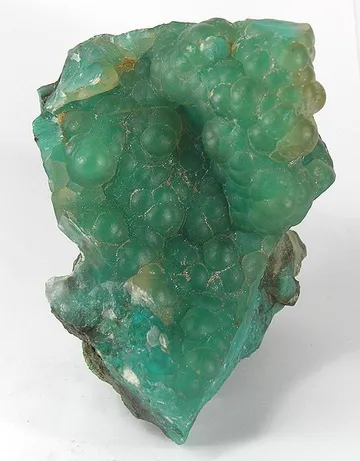
The locality’s fame rests on specimens that are unmistakably “Live Oak”: rounded or botryoidal masses and vug linings of saturated turquoise-blue to blue-green chrysocolla, commonly over or intergrown with malachite, sealed under a glittering skin of tiny quartz crystals. The finest examples do not look like ordinary Arizona chrysocolla rough. They have depth, translucency, pocket structure, and sparkle. Some preserve a remarkable replacement sequence in which azurite crystal forms were replaced by malachite, then by chrysocolla, and finally dusted or coated by quartz. That sequence gives the best pieces their collector magic: copper-carbonate geometry ghosted inside copper-silicate color and glassy silica.
Historically, Live Oak matters because it was not a small isolated prospect but part of the great Miami-Inspiration deposit, a continuous copper system divided by property lines, faults, and mining history into named bodies such as Live Oak, Keystone, Inspiration, Pinto, Captain, and Miami. Early Live Oak workings exploited oxide and silicate copper ore before the property was drawn into the larger Inspiration story. After World War II, the Live Oak area became the site of Inspiration’s first open-pit mining project, exposing a large body of oxide ore that could be blended with sulfide ore for leaching.
Regional View
Country View
For mineral collectors, Live Oak pit is best understood as both a specimen locality and a paragenetic lesson. The ore system brought copper and molybdenum into fractured schist and granite porphyry; later enrichment and oxidation produced chalcocite, chrysocolla, malachite, azurite, cuprite, and related secondary minerals. Silica was not merely background gangue here. It was part of the aesthetic: chalcedony, quartz druse, and silica-rich copper material turned soft copper alteration products into durable, gleaming cabinet specimens and lapidary material.

Photo: Wikimedia Commons

Photo: Wikimedia Commons
Search for specimens: View all specimens from Live Oak pit, USA
Live Oak pit is a swallowed-up pit within the Inspiration Mine, Miami-Inspiration deposit, Miami-Inspiration Mining District, Gila County, Arizona. The locality lies near Miami at the western part of the Inspiration mineralized area. Its old labels may read Live Oak pit, Live Oak Mine, Inspiration Mine, Miami, Globe-Miami District, or simply “Inspiration,” and older specimen labels sometimes include associated names such as Keystone, Joe Bush, Ox Hide, Thornton, Red Hill, or Cyprus Miami as the broader mine complex changed through time.
Geologically, the deposit is a porphyry copper system with important supergene enrichment and oxidation. The Miami-Inspiration orebody is associated with the contact between Precambrian Pinal Schist and the Schultze Granite, particularly granite-porphyry phases. The western part of the orebody strikes roughly northeast, and the system was broken into important structural blocks by faults including the Bulldog and Miami faults. Mineralization at Live Oak involved both disseminated copper in the larger porphyry environment and the copper-silicate Live Oak vein, a fissure-hosted body in granite porphyry overlying schist. The chrysocolla that made the locality famous was deposited by supergene solutions carrying copper leached from surrounding mineralized rock.
The ore assemblage recorded for Live Oak reflects that layered history. Primary and hypogene minerals included pyrite, chalcopyrite, bornite, molybdenite, quartz, and alteration minerals such as sericite and orthoclase. Supergene enrichment produced chalcocite and covellite, while oxidation yielded chrysocolla, malachite, azurite, cuprite, blue or bluish-green chalcedony, quartz coatings, and rarer molybdate and phosphate species. The supergene enriched zone at Miami-Inspiration averaged about 200 feet thick, but Live Oak’s western segment also had ore values persisting downward in a way that made it important to mine development.
The first four Live Oak claims were staked by J. J. Marshall in 1890, and a 160-foot shaft was sunk on oxide and silicate copper ore. Forest Kaldenberg acquired the property and organized the Live Oak Copper Mining and Smelting Company in 1898. Early development followed the Big Silicate vein with thousands of feet of tunnels and drifts; by 1899, ore was being shipped weekly to smelters at El Paso and Silver City. The early camp was small and practical: miners, a boarding house, a mine office, and the beginnings of what would later become part of one of Arizona’s great copper operations.
Development accelerated after 1905 and again after 1909, when Hoval A. Smith and Henry B. Hovland organized the Live Oak Development Company. The deepened Live Oak No. 1 shaft passed through a thick interval of chalcocite ore beneath the copper-silicate body, and by 1910 the underground work had outlined a major low-grade copper resource. In 1911 the Live Oak No. 2 shaft cut high-grade ore at depth. In December 1911, Live Oak Development merged with the Inspiration Copper Company to form Inspiration Consolidated Copper Company, bringing Live Oak into the larger Inspiration operation.
Mining began as underground work, but after World War II the economics of underground block-caving shifted. Labor shortages, deteriorating ground conditions, and lower grades made open-pit methods increasingly attractive. Inspiration’s first open-pit project was placed in the Live Oak area because relatively little stripping was needed to expose a large body of oxide ore. Preparations began in March 1947; stripping with electric shovels and haul trucks began in January 1948; and ore shipments from the Live Oak pit to the leach plant began in April 1948.
Today, collecting access should be considered closed unless a collector has explicit permission from the landowner and operator. This is not a casual field-collecting locality. The present Miami operation is part of Freeport-McMoRan’s Arizona holdings; Freeport describes Miami as including an open-pit copper mine, smelter, and rod mill, but states that it is no longer mining ore and produces copper by leaching material already placed on stockpiles. For the specimen market, that means Live Oak material is overwhelmingly old-stock: collection pieces, estate material, dealer inventories, museum deaccessions, and occasional auction appearances rather than newly collected pocket material.
The notable pockets and finds are best recognized through surviving specimens rather than a single modern collecting account. Classic pieces include open vugs lined with blue-green chrysocolla and sparkling quartz microcrystals; malachite balls or rosettes perched in chrysocolla-lined cavities; azurite crystal forms replaced by malachite and chrysocolla; quartz-coated chrysocolla on chalcocite-rich matrix; and large cabinet pieces that were once tempting lapidary rough but survived intact because collectors recognized their display value.

Photo: Wikimedia Commons
Chrysocolla is the defining mineral of Live Oak pit, occurring as blue to blue-green massive, botryoidal, vug-lining, vein-filling, and silica-rich material in the oxidized copper zone. The best specimens show saturated turquoise or aquamarine chrysocolla in rounded pockets, often with malachite bands, azurite replacement shapes, chalcocite-rich matrix, or a sparkling coat of quartz microcrystals. Cabinet pieces over 10 cm exist, and classic small-cabinet specimens around 6–8 cm are well represented in older dealer and museum photography, but truly fine examples depend less on size than on vivid color, open relief, intact quartz druse, and an unquestionable Live Oak or Inspiration provenance. Ordinary pieces can be dull green copper-silicate masses; top pieces have the wet blue color, pocketed texture, and glittering silica skin that make the locality instantly recognizable.
Azurite from Live Oak pit is most important as a former mineral preserved by pseudomorphs rather than as abundant freestanding blue crystals. Specimens and photo records document azurite crystal forms to roughly 2 cm or more that were replaced first by malachite and then, in celebrated examples, by chrysocolla and quartz; in some pieces the dark-blue azurite is only a remnant or a structural memory inside a later blue-green copper-silicate specimen. This matters for collecting because a Live Oak “azurite” specimen may be prized not for pristine azurite luster, as at Bisbee or Tsumeb, but for sharp inherited crystal form under later chrysocolla and quartz. The best examples retain obvious bladed or prismatic azurite morphology, strong blue-green chrysocolla color, minimal abrasion to projecting forms, and enough malachite or quartz contrast to make the replacement sequence legible.
Malachite at Live Oak pit appears as green botryoidal masses, bands in chrysocolla-rich matrix, compact needle-like balls in cavities, and especially as pseudomorphs after azurite blades or rosettes. It is rarely the sole reason a Live Oak specimen is important; its value lies in the way it marks the middle stage between earlier azurite and later chrysocolla-quartz mineralization. Fine malachite pieces may show small, crisp pseudomorphed rosettes or balls perched in blue chrysocolla-lined cavities, while larger pieces use malachite as a deep green foil against pale quartz and sky-blue chrysocolla. Superior specimens show clean, velvety to compact green surfaces without crushed edges, and the most instructive pieces make the azurite-to-malachite-to-chrysocolla story visible at a glance.
Quartz is the visual finishing mineral of many classic Live Oak specimens, forming sugary to sparkling microcrystalline druse, chalcedonic layers, and silica-rich coatings over chrysocolla and malachite. Its crystals are usually tiny rather than large display crystals, but the surface effect is decisive: a thin, bright quartz skin can turn a blue-green chrysocolla cavity into a scintillating cabinet specimen. Quartz also occurs as chalcedony and as blue or bluish-green copper-stained silica sold historically under names such as chrysocolla chalcedony, gem silica, or even older “blue chrysoprase.” The best quartz-bearing pieces have undamaged druse, open vugs, strong color seen through or beneath the silica, and enough three-dimensional relief that the specimen reads as a natural pocket rather than sawn lapidary rough.
Other documented Live Oak minerals broaden the locality beyond its blue-green showpieces. Mindat records bornite, brochantite, chalcocite, chalcopyrite, covellite, cuprite, galena, molybdenite, pyrite, biotite, muscovite, sericite, orthoclase, native gold, powellite, libethenite, lindgrenite, chrysoprase, and chalcedony from the pit-level locality. Lindgrenite is the outstanding rarity: light apple-green to dark green platy aggregates on fracture walls in shattered, hydrothermally altered schist, associated with molybdenite and rarely powellite. Libethenite is represented by dark green translucent crystals, while powellite and molybdenite tie the oxidized collector suite back to the molybdenum-bearing hypogene system. No valid type-locality mineral is established specifically from Live Oak pit, but the locality is an important Arizona occurrence for lindgrenite and a classic source for chrysocolla-quartz pseudomorph and gem-silica material.
The main authenticity issue with Live Oak specimens is not outright fakery so much as naming precision. “Gem silica,” “chrysocolla in quartz,” “quartz-coated chrysocolla,” and “chalcedony over chrysocolla” are not identical descriptions. Some Live Oak pieces are true silica-rich chrysocolla chalcedony suitable for lapidary use; others are collector specimens where quartz or chalcedony coats chrysocolla rather than containing it as a gem material. A good label should distinguish these when possible.
Azurite should also be treated carefully. Some Live Oak labels list azurite because the specimen preserves azurite crystal forms through replacement, even when visible blue azurite is absent. That is not necessarily dishonest, but for cataloging it is better to describe the paragenesis explicitly: quartz on chrysocolla after malachite after azurite, malachite after azurite, or chrysocolla after azurite, depending on what is actually visible and defensible.
Condition is critical. The sparkling quartz druse is easily dulled by abrasion, broken on high points, or filled with dust. Chrysocolla-rich areas may be softer, porous, or undercut beneath quartz and chalcedony; malachite rosettes and azurite-form pseudomorphs can chip at blade tips. Large old pieces should be checked for repairs, glued breaks, sawn backs, oiling or polishing, and lapidary trimming. Polished Live Oak gem-silica material is legitimate in its own category, but it should not be confused with natural-surface cabinet specimens.
Rarity is highly quality-dependent. Modest blue-green chrysocolla from the Inspiration area appears regularly, but fine Live Oak pit pieces with old provenance, saturated blue color, sharp pseudomorph form, intact quartz druse, and open pocket structure are not easily replaced. Large cabinet specimens that escaped being cut for lapidary material are particularly desirable. Current market availability is mostly through old collections, specialist dealers, and auction records; new field supply should not be assumed.
Fluorescence is not a major collecting attribute for the classic chrysocolla-malachite-quartz pieces, though powellite-bearing material may merit ultraviolet examination if it is part of a molybdate association. As with most copper secondary minerals, keep specimens dry, avoid acids and ultrasonic cleaning, and do not scrub quartz druse aggressively. A dust blower, soft brush, and stable display environment are safer than chemical cleaning.
Live Oak began with the sort of small, practical discovery that later mining districts tend to swallow. In 1890, J. J. Marshall staked four claims on oxide and silicate copper ore and sank a 160-foot shaft. The early attraction was not a grand porphyry model but visible copper color: silicate ore, oxidized material, and a vein that miners could follow. By 1899 the Live Oak property had enough work to support weekly shipments of two carloads of development ore to El Paso and Silver City smelters, while 17 miners lived at the little Live Oak community with its boarding house, mine office, and scattered dwellings.
The 1905 revival had the flavor of a mining-camp bargain. Joseph Erman arranged to ship enough ore from the property to finance a leach plant without cost to the company. By March 1906, the ore shipments had paid operating expenses, bought $20,000 of mining equipment, and funded substantial development. The arrangement did not last; disagreement turned into litigation, and the business relationship ended in 1907. But the episode captures Live Oak at the hinge between prospect and industrial mine: ore was valuable enough to fund its own machinery, yet the enterprise still depended on personalities, contracts, and trust.
The great shift came when the copper-silicate body proved to be only the upper sign of something deeper. After Hoval A. Smith and Henry B. Hovland took an option on the property in 1909, the Live Oak No. 1 shaft was deepened to test below the oxide and silicate ore. It hit sulfide mineralization at 300 feet and then passed through 150 feet of chalcocite ore. By October 1910, underground work had outlined about 10 million tons of ore averaging roughly 2 percent copper. In April 1911 the Live Oak No. 2 shaft was started in the western part of the property and encountered high-grade ore between 709 and 890 feet. Within months, Live Oak was no longer a stand-alone copper-silicate prospect; it was one of the anchors of the future Inspiration Consolidated Copper Company.
The later open-pit era left a very different image: not miners in drifts on the Big Silicate vein, but giant machinery chewing the red Arizona pit. In June 1972, a National Archives photograph captured a ten-cubic-yard shovel and front-end loader at work in the Live Oak pit of Inspiration Consolidated Copper Company. The picture is close, dusty, and physical: steel teeth, men beside machinery, and the scale shift that had transformed an old shaft-and-vein locality into a modern bulk-mining operation.
Collectors have their own preservation stories. One Live Oak chrysocolla specimen photographed for Mindat and Wikimedia was noted as having been purchased at Knott’s Berry Farm in California in 1948 for $3.00, a detail that now feels almost impossible when compared with the present value of fine old Arizona copper specimens. Another large Live Oak chrysocolla-quartz piece was associated with the Rice collection, whose Arizona classics helped form the Rice Northwest Museum of Rocks and Minerals; the significance is not merely institutional. Large chrysocolla-quartz pieces from Live Oak were attractive to lapidary cutters in the 1950s and 1960s, and specimens that remained intact are survivors of a market that often rewarded saws over shelves.
A modern auction description nicknamed one large Live Oak specimen “The Alligator,” a fitting image for the locality’s rugged, pocketed copper-silica surfaces. Other auctioned pieces show the quieter drama: a blue-green chrysocolla vug under glittering quartz, a malachite ball perched in a cavity, or a former azurite blade still recognizable after multiple mineral replacements. Live Oak’s best stories are embedded in those objects. They are not just blue specimens from Arizona; they are sequences of chemical events, mining decisions, and collector choices that happened to survive in cabinet size.