Sierra Mojada, Mexico - Coahuila ore district, famed for silver-lead-zinc ores and Sierra de Cruces grossular-vesuvianite, prized for color, form, and provenan…
Key facts
Sierra Mojada is one of the mineral localities where a collector must read the label carefully. In the mining sense, Sierra Mojada is the historic silver-lead-zinc-copper district on the high desert of western Coahuila, a carbonate-replacement system developed along the San Marcos fault system and its subsidiary structures. In the specimen sense, the name also commonly gathers in the nearby Sierra de Cruces material: raspberry-red grossular and honey- to mustard-brown vesuvianite from calcareous skarn in Sierra Mojada Municipality, long mislabeled in collections and dealer stock as “Lake Jaco,” “Lago de Jaco,” or “Sierra de la Cruz.”
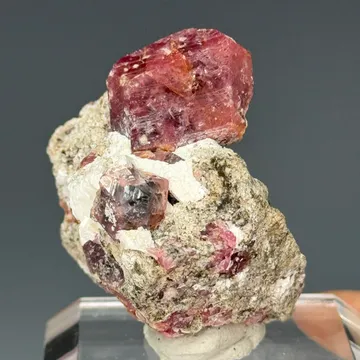
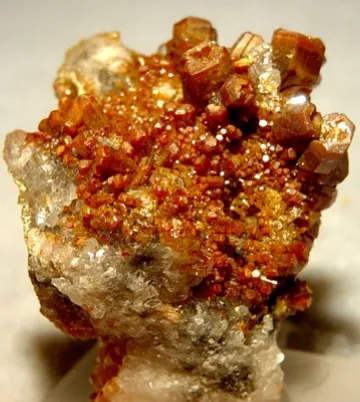
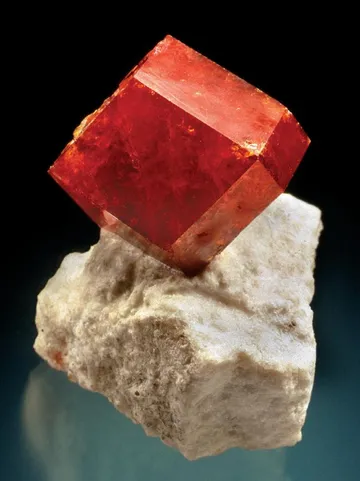
That double identity is exactly what makes the locality so interesting. The district itself is a serious ore field: oxidized silver-lead ores, hemimorphite-rich “red zinc,” smithsonite-rich “white zinc,” and a long list of secondary silver, lead, zinc, copper, arsenate, sulfate, carbonate, and oxide species. But the pieces most familiar in fine mineral cabinets are the Sierra de Cruces skarn specimens—sharp dodecahedral grossular, often raspberry, rose, mauve, peach, greenish cream, or olive-brown, with blocky lustrous vesuvianite on white calcite-quartz skarn matrix. The best examples have the immediate visual logic of a classic Mexican specimen: strong color contrast, clean crystal form, and a matrix that sets the crystals off rather than swallowing them.
Regional View
Country View
The historic ore district and the skarn occurrence are not interchangeable geologically, yet they are inseparable in the collector market. Old labels compress the geography, and modern cataloging has tried to untangle it: the “Lake Jaco” name is best treated as a historic trade locality for most grossular-vesuvianite specimens, with Sierra de Cruces, Sierra Mojada Municipality, Coahuila, Mexico being the more accurate modern assignment for the classic garnet-and-vesuvianite material.

Photo: Géry Parent / Wikimedia Commons

Photo:
Search for specimens: View all specimens from Sierra Mojada, Mexico
Sierra Mojada lies in western Coahuila near the Chihuahua border, in arid high-desert country at roughly 1,500 meters elevation. The historic mining camp is adjacent to the towns of Sierra Mojada and Esmeralda; modern technical reports place the Sierra Mojada project center near 27°24' N, 103°43' W, with road access from Torreón and rail infrastructure tied historically to ore movement and, today, to industrial dolomite transport. The collector-relevant Sierra de Cruces grossular-vesuvianite occurrence lies in the same municipality, east of the Laguna de Jaco area and near the broader Hércules–Sierra Mojada desert mining country.
The ore district is best understood as a polymetallic carbonate-replacement district later overprinted by oxidation and supergene enrichment. The host sequence is Lower Cretaceous carbonate and associated siliciclastic strata of the Coahuila block and Sabinas Basin margin. The San Marcos fault system, reactivated through several structural episodes, prepared the ground; northeast-trending structures such as the Veta Rica, Parreña, and Calabassos faults acted as important conduits for mineralizing fluids. Technical work on the district treats Sierra Mojada as the distal expression of northern Mexican CRD mineralization, with original sulfide mineralization of pyrite, galena, sphalerite, chalcopyrite, arsenopyrite, and tennantite in quartz-carbonate-barite gangue, followed by intense oxidation to the familiar silver, lead, and zinc oxide/carbonate/silicate assemblages.
The principal modern ore model separates a Shallow Silver Zone from a Base Metal Manto system. The Shallow Silver Zone is dominated by acanthite, bromargyrite-chlorargyrite solid solution, and tennantite, occurring in structures, karst breccias, low-angle fault breccias, mantos, and disseminated replacements in altered dolomite. The Base Metal Manto system is stacked stratigraphically: a historically important lead zone above the Red Zinc Zone and White Zinc Zone. The old lead manto, mined early and essentially exhausted by 1905, yielded cerussite-anglesite, chlorargyrite, and native silver ore along several kilometers of strike. The Red Zinc Zone is chiefly hemimorphite with subordinate smithsonite and hydrozincite in iron-oxide-rich porous and brecciated material; the White Zinc Zone is chiefly smithsonite, locally with minor hemimorphite, in mantos, chimneys, and karst-fill structures.
Mining began after silver and lead were discovered in 1879. The earliest work, to 1886, centered on native silver, silver chloride, and lead carbonate ores; afterward, silver-lead-zinc-copper ores in limestone and sandstone sustained the camp. Zinc silicate and carbonate ores were recognized beneath the silver-lead horizon around the turn of the twentieth century, and zinc, silver, and lead ores were mined from various operations along the district into the late twentieth century. Historic mine names associated with the district include Veta Rica, Deonea, Juárez, Volcán I and II, Once, San Antonio, San José, San Buena, Monterrey, Vasquez III, Tiro K, El Indio, Poder de Dios, Parreña, San Salvador, Fronteriza, Esmeralda, and Encantada.
Modern corporate history is equally important for understanding access. Metalline Mining became involved in 1996 through agreements around the Sierra Mojada concessions, with subsequent work by North Limited, Rio Tinto’s predecessor entity, and later Silver Bull Resources through Minera Metalin S.A. de C.V. Silver Bull’s current project position has been defined around a large open-pittable oxide silver-zinc resource, but ordinary collectors should not confuse an exploration project with a collecting site. The company has reported that access to its Sierra Mojada property has been blocked since September 2019, and recent filings state that it remains unable to access the property. Within the district, the only active mining noted in recent technical reporting is a Peñoles dolomite quarry near Esmeralda. For collectors, that means no assumption of legal public access should be made: old mines, modern concessions, ranch land, quarries, and blocked or hazardous workings all require permission, local guidance, and caution.
The grossular-vesuvianite specimens that made the locality famous in the specimen trade come from the Sierra de Cruces skarn, not from the oxidized silver-zinc mantos themselves. Published summaries describe Sierra de Cruces as a calcareous skarn formed where intrusive rocks affected Cretaceous limestone and minor dolomite. The assemblage includes grossular, vesuvianite, calcite, quartz, wollastonite, scapolite, epidote, diopside, dolomite, sphalerite, strontianite, and related skarn minerals. Specimen-quality material was known by the late 1940s, but significant commercial movement came later, especially after the 1970s rancher discovery story that brought red grossular and mustard-yellow vesuvianite into the hands of North American mineral dealers. Older pieces in collections may carry dates or collection histories from the 1950s through 1970s, while later lots, especially the vivid raspberry grossular on white matrix, continued to appear in quantity after the locality became well known.
Grossular from Sierra Mojada, in the collector sense, is the Sierra de Cruces material: rhombic dodecahedra and modified dodecahedra scattered on pale calcite-quartz-wollastonite-scapolite skarn, ranging from cream, olive, gray-green, and silvery mauve to the celebrated raspberry-red “rosolite” color. The red grossular commonly shows strong zoning, with pink to red rims over dark gray to black mantles or cores; published analytical work attributes the red coloration principally to manganese, especially Mn3+ in the garnet structure, while the dark zones are more iron- and titanium-rich. Typical attractive crystals are millimeter to centimeter scale, with fine specimens showing numerous 5–15 mm lustrous dodecahedra, while exceptional old pieces and auction specimens document crystals around 2 cm and, rarely, substantially larger. The best examples have glassy faces, sharp edges, undamaged exposed crystals, and strong contrast against white matrix; ordinary examples tend to be duller, more embedded, heavily contacted, or crowded with bruised garnets.
Vesuvianite from the Sierra de Cruces occurrence is the classic companion to the grossular: blocky to stout prismatic crystals in mustard yellow, golden brown, honey brown, olive brown, and gray-brown tones, commonly associated with small pink, greenish, gray, or mauve grossular dodecahedra on pale calc-silicate matrix. Dealer and museum-style descriptions repeatedly emphasize the locality’s large, robust, lustrous vesuvianites—individual crystals around 3 cm are well documented, and better cabinet specimens may carry vesuvianite crystals in the 4–5.5 cm range. Fine pieces show complete or nearly complete crystal architecture, bright vitreous to resinous luster, translucent edges, and attractive placement with contrasting garnet; lesser pieces are massive-looking, contacted, dull, or aesthetically dominated by broken brown crystal surfaces. Older labels may call the mineral idocrase and give “Lake Jaco” or “Laguna de Jaco,” but the modern collecting convention places the classic material at Sierra de Cruces in Sierra Mojada Municipality.
Beyond grossular and vesuvianite, Sierra Mojada is a deep locality for documented species. The ore district has acanthite, bromargyrite, chlorargyrite, cerussite, anglesite, galena, sphalerite, chalcopyrite, tennantite, pyrite, arsenopyrite, native silver, native copper, malachite, azurite, hemimorphite, smithsonite, hydrozincite, plattnerite, wulfenite, descloizite, erythrite, adamite, baryte, celestine, fluorite, strontianite, willemite, minrecordite, and several skarn or intrusive-associated silicates including aegirine, albite, cancrinite, gehlenite, spurrite, tremolite, wollastonite, and garnet-group minerals. Rosolite is best treated as a historic variety name for the raspberry-pink to red grossular rather than a separate species. Of the rarities, strontianite from Sierra Mojada earned a 1933 American Mineralogist note; minrecordite is recorded from Sierra Mojada; and the Sierra de Cruces grossular has been the subject of repeated modern gemological and mineralogical study because of its unusual red zoning.
The first rule with Sierra Mojada specimens is locality hygiene. Old labels reading “Lake Jaco,” “Lago de Jaco,” “Laguna de Jaco,” “Sierra de la Cruz,” “Sierra de las Cruces,” or even simply “Coahuila” may refer to the same grossular-vesuvianite skarn material now more accurately assigned to Sierra de Cruces, Sierra Mojada Municipality. Conversely, ore minerals labeled Sierra Mojada usually refer to the historic mining district near Sierra Mojada and Esmeralda, not necessarily to the garnet locality. Good collection records should preserve the old label wording while adding the modern locality correction.
I found no reliable documentation of systematic artificial coloring, irradiation, resin treatment, or manufactured fakes specifically tied to Sierra Mojada grossular or vesuvianite. The more common problem is mislabeling, followed by optimistic species names. Many old vesuvianite labels say idocrase, which is acceptable as an older synonym in the trade but should be cataloged as vesuvianite. Pink garnet may be called rosolite, but it remains grossular. Some brown vesuvianite specimens with attached grossular can be misread by non-specialists as beryl, epidote, or garnet intergrowths, so crystal habit and hardness alone are not always enough; matrix, association, and provenance matter.
Condition is the main value divider. Sierra de Cruces specimens often grew in tight skarn pockets or on exposed outcrop surfaces, and many show contacted backs, chipped dodecahedral corners, bruised vesuvianite terminations, or broken brown crystal faces. On grossular specimens, a few undamaged, well-spaced, lustrous raspberry crystals on clean pale matrix can outrank a larger but battered plate. On vesuvianite, watch for repairs to large blocky crystals, trimmed bases disguised as natural contact, and cleaved or abraded prism edges. Because old specimens often circulated for decades under multiple labels, provenance from respected collections can be meaningful.
Fluorescence is a useful but not definitive feature. Some Sierra de Cruces grossular and associated matrix pieces have been noted with ultraviolet reactions, including yellow-white response from matrix on at least one documented specimen and red fluorescence in related manganese-bearing grossular discussions. Do not authenticate the locality by fluorescence alone. For handling, the minerals themselves are robust by mineral-collection standards, but the best specimens are vulnerable at exposed crystal edges; avoid ultrasonic cleaning, strong acids on calcite-rich matrix, and aggressive brushing around small garnets.
Market availability is moderate but uneven. Small and mid-sized grossular pieces from the Sierra de Cruces production remain obtainable, especially rose to raspberry crystals on matrix. Truly fine, damage-free examples with vivid color and strong aesthetics are much scarcer. Large old vesuvianite-grossular combinations, especially those with complete 4–5 cm vesuvianite crystals and pleasing garnet accents, are far less common and command collector attention when they appear. Current field supply appears limited, and legal access issues in the broader Sierra Mojada district make fresh collecting uncertain.
The best-known Sierra de Cruces story begins not with a mining engineer, but with a rancher and a small red crystal. In 1974, according to the collector literature summarized from the Mineralogical Record account, a Mexican rancher noticed a red crystal in the Lake Jaco–Sierra de Cruces area. A friend recognized it as grossular. The discovery might have remained a desert curiosity, but mineral dealer Benny Fenn became involved and encouraged the rancher to stake a claim. What followed was a flow of specimens unlike almost anything else from Mexico: pink to red dodecahedral garnets and mustard-yellow vesuvianites sitting in snow-white calcite and quartz matrix. That color combination—raspberry, mustard, and white—became the locality’s calling card.
The remoteness of the place shaped its collecting history. Specimen-quality vesuvianite and grossular were reportedly discovered at Sierra de Cruces in 1947, but the locality was too remote and the specimen market too undeveloped for practical commercial collecting. By the 1970s, access had improved in part because a graded gravel road had been built toward the Hércules Mine. Even then, collectors described the work as desert collecting in the hard sense: rugged ground, aridity, and the living hazards of rattlesnakes, scorpions, and tarantulas. The result is that many pieces feel like old field finds rather than mine-run production—isolated pockets, outcrops, and claims feeding the market in waves.
The name “Lake Jaco” is its own chapter. Laguna de Jaco is a real geographic reference in the broader desert region, but most classic garnet-vesuvianite specimens carrying that label are now understood to come from Sierra de Cruces, east of the lake area, in Sierra Mojada Municipality. The old label persists because it traveled with specimens for decades: “Lake Jaco,” “Lago de Jaco,” “Sierra de la Cruz,” and “Sierra de las Cruces” all appear in collections. For a modern curator or serious collector, the old label is not something to discard; it is part of the object’s history. The proper catalog entry can read like a small detective story: historic label “Lake Jaco,” modern locality Sierra de Cruces, Sierra Mojada Municipality, Coahuila, Mexico.
Sierra Mojada’s mining district has a rougher, industrial story. S. F. Shaw’s early twentieth-century description placed the camp at the terminus of the Mexican Northern Railroad, with the Sierra Mojada valley running about 10 km east-west and bounded on the south by a mountain front that included an almost vertical wall of about 300 meters. Water was a constant problem. There were no running streams; rains might begin in mid-June and last through July, or fail entirely. Heavy storms sent sudden torrents down the arroyos, sometimes carrying large boulders, but the water ran off quickly. One deep well on the Volcán ranch produced about 20 gallons per minute, and reservoirs near Esmeralda could carry the town only partway through ordinary years. That is the landscape behind the ore labels: a mining camp where geology was rich, but water and access were always strategic minerals of their own.
S. F. Shaw, “The Ore Deposits of Sierra Mojada, Coahuila, Mexico,” AIME, 1922/1923 — Classic early technical description of the district, its geography, water conditions, and ore deposits.
James W. Malcolmson, “The Sierra Mojada, Coahuila, Mexico, and its ore deposits,” Engineering and Mining Journal, Vol. 72, 1901 — Early mining-era article on the Sierra Mojada camp and ore bodies.
Philip Krieger, “The occurrence of strontianite at Sierra Mojada, Mexico,” American Mineralogist, Vol. 18, 1933, pp. 345–350 — Specific mineralogical note on strontianite from Sierra Mojada.
Charles A. Geiger, Andreas Stahl, and George R. Rossman, “Raspberry-red grossular from Sierra de Cruces Range, Coahuila, Mexico,” European Journal of Mineralogy, Vol. 11, No. 6, 1999, pp. 1109–1113 — Foundational chemical and spectroscopic study of the red grossular color.
Robert W. Jones and Virgil W. Lueth, “Red Grossular from the Sierra de Cruces, Coahuila, Mexico,” Mineralogical Record, Vol. 34, No. 6, 2003, pp. 73–79, 95 — The classic collector-locality article on the red grossular and vesuvianite occurrence.
Gems & Gemology, Fall 2000, review of Geiger, Stahl, and Rossman’s raspberry-red grossular paper — Accessible gemological summary of the 1999 European Journal of Mineralogy study.
Gems & Gemology, Summer 2017, “Raspberry-red garnet with black core” — Gemological note discussing the red rim and black core zoning in Sierra de Cruces grossular.
Siyuan Wu, Siyi Zhao, Yi Zhao, and Chenxi Zhang, “Chromogenic Mechanism and Formation of Zonal Genesis of Raspberry-Red Grossular from the Sierra de Cruces Range, Mexico,” Minerals, Vol. 15, No. 2, 2025, article 138 — Modern open-access study of zoning, color centers, and mineral assemblage in Sierra de Cruces grossular.
J. R. Kyle, H. Ahn, and H. A. Gilg, “Nature and origin of the nonsulfide zinc deposits in the Sierra Mojada District, Coahuila, Mexico,” Mineralium Deposita, Vol. 53, 2018, pp. 1095–1116 — Key modern paper on the nonsulfide zinc system, including smithsonite, hemimorphite, isotope data, and supergene history.
Silver Bull Resources, S-K 1300 Summary Technical Report on the Resources of the Silver-Zinc Sierra Mojada Project, Coahuila, Mexico, 2023 — Detailed modern technical report on geology, structure, ore zones, resource history, and access status.
Tim Stockhausen, “The Upper Conglomerate and Its Importance to the Sierra Mojada Ag-Zn Deposit System, Coahuila, Mexico,” Ph.D. thesis, Colorado School of Mines, 2012 — Detailed academic work on the Upper Conglomerate and its role in the Sierra Mojada deposit system.
Weinrich Minerals, “Vesuvianite with Grossular,” specimen page with video — Dealer media for an old 1970s Sierra de Cruces vesuvianite-grossular specimen.
Weinrich Minerals, “Grossular with Vesuvianite,” specimen page with video — Short specimen media showing lustrous grossular with vesuvianite from Sierra de Cruces.
Rocky Mountain Minerals and Fossils, “Vesuvianite - Sierra de Cruces, Coahuila, Mexico,” product page with video — Modern dealer media useful for seeing typical golden-brown vesuvianite and the historic Laguna de Jaco label issue.
Mindat: Sierra Mojada, Sierra Mojada Municipality, Coahuila, Mexico — Broad mineral list for the historic Sierra Mojada district and sublocalities.
Mindat: Sierra de Cruces, Sierra Mojada Municipality, Coahuila, Mexico — Best locality database page for the grossular-vesuvianite skarn material and the “Lake Jaco” label correction.
Wikimedia Commons: Minerals of Lake Jaco — Open-image category containing numerous grossular and vesuvianite photographs historically labeled Lake Jaco.
Wikimedia Commons: Grossular from Sierra de Cruces by Géry Parent — High-resolution public-domain photograph of pink grossular from the locality.
Wikimedia Commons: Vesuvianite-Grossular specimen by Rob Lavinsky — Open-licensed photograph of a classic vesuvianite-grossular combination under the historic Lake Jaco label.
Silver Bull Resources: Sierra Mojada project home — Current corporate context for the modern Sierra Mojada silver-zinc project.
Silver Bull Resources: 2024 memorial filing announcement — Important access and legal-history context for the reported blockade of the Sierra Mojada project.
OneMine: S. F. Shaw, “The Ore Deposits of Sierra Mojada, Coahuila, Mexico” — Early technical source with valuable historical geography and mining detail.
MDPI Minerals: 2025 raspberry-red grossular study — Open-access modern study of color zoning and formation in Sierra de Cruces grossular.
GIA: Summer 2017 Gems & Gemology Gem News International — Gemological discussion of raspberry-red grossular with black core zoning.
The Mineralogical Record, Vol. 34, No. 6, 2003 back issue — Source issue containing Jones and Lueth’s “Red Grossular from the Sierra de Cruces, Coahuila, Mexico.”